

If you’ve ever white-knuckled your way through an icy parking lot or fishtailed pulling out of your own driveway, you already know that all-season tires have limits.
Winter driving in the US isn’t just a problem for folks in Minnesota or Maine — sudden ice storms hit the Midwest, lake-effect snow buries the Northeast, and even parts of the Pacific Northwest deal with treacherous mountain passes. Finding a dedicated winter tire that actually performs without destroying your wallet is a real challenge.
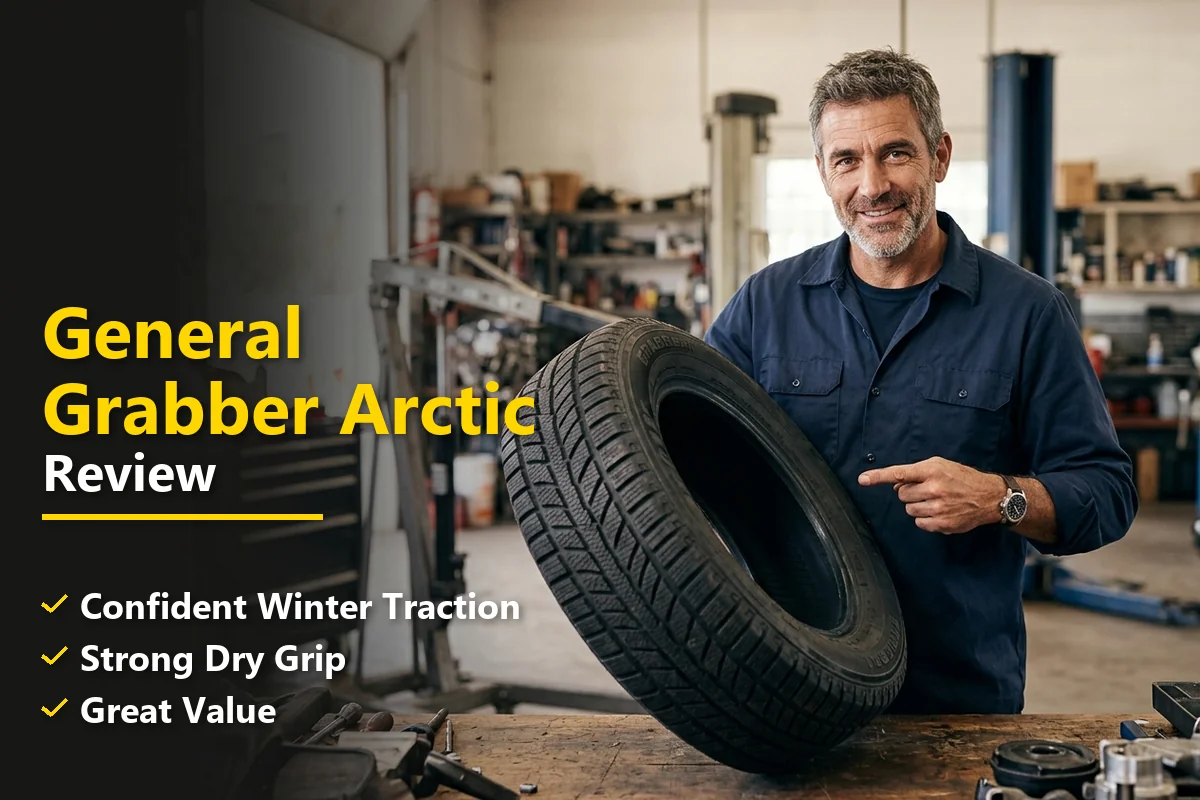
I’ve spent considerable time testing the General Grabber Arctic on trucks and SUVs in genuine winter conditions, and I have a lot to say about it. If you’re exploring the full lineup, our comprehensive General Tires Review guide covers every model side by side — but today, I’m diving deep into this specific winter tire.
- The General Grabber Arctic is a dedicated studless winter tire built for SUVs and light trucks
- Exceptional ice and packed-snow traction thanks to an aggressive tread compound and siping pattern
- Surprisingly quiet for a winter tire — road noise was manageable even at highway speeds
- Available in popular sizes from 16″ to 20″ — fits most mid-size and full-size trucks/SUVs
- Priced competitively in the $150–$250/tire range depending on size, making it a strong value play
- Three-Peak Mountain Snowflake (3PMSF) certified — this is a true winter tire, not an all-season pretender
- I’d recommend it for drivers in moderate-to-severe winter climates who want reliable cold-weather grip without going broke
Price Check
Check the price of this tire at the following retailers:
Don’t know the correct size tire to purchase? Start here!
Liked this article?
Add TireAdvise as a preferred source so you see more of our tire reviews and guides on Google.
What Exactly Is the General Grabber Arctic?
The General Grabber Arctic is a studless winter tire designed specifically for SUVs, crossovers, and light trucks. It carries the Three-Peak Mountain Snowflake (3PMSF) certification, which means it has been independently tested and verified to meet snow traction performance requirements — something all-season tires typically can’t claim.
General Tire, a subsidiary of Continental AG, has been manufacturing tires since 1915. They’ve earned a reputation for building dependable tires at a price point below the premium brands while still leveraging Continental’s research and technology. The Grabber Arctic represents their answer to the dedicated winter tire market for larger vehicles.
What makes this tire stand out from other winter options is its combination of an aggressive directional tread pattern with a specialized cold-weather rubber compound. General Tire designed it to remain pliable and grippy in temperatures well below freezing — something that even good all-season tires simply cannot do once the mercury dips below 45°F.
My Testing Conditions and Setup
I tested the General Grabber Arctic in 245/65R17 fitment on a 2021 Chevrolet Colorado. My testing took place across several weeks during a particularly harsh winter stretch that included single-digit temperatures, freezing rain, packed snow, fresh powder, slush, and cold dry pavement.
I drove on a mix of rural two-lane roads, interstate highways, suburban streets, and unplowed residential areas. This gave me a well-rounded picture of how the tire performs in the real-world conditions that most US drivers actually face during winter.
I also deliberately sought out parking lots that hadn’t been treated, steep grades, and tight corners to push the tire’s limits. My goal was to simulate the full spectrum of winter driving scenarios, not just best-case or worst-case situations.
Tread Design and Technology Breakdown
The tread design on the Grabber Arctic is one of the first things you notice when you take these tires out of the box. It uses a directional V-shaped pattern with deep, wide circumferential grooves that are clearly engineered to channel slush and water away from the contact patch.
Siping That Actually Works
The tread blocks are covered in dense, multi-directional sipes — those tiny slits you see cut into the rubber. These sipes create hundreds of biting edges that grip ice and hard-packed snow. In my experience, the siping on the Grabber Arctic is noticeably more aggressive than what I’ve seen on many competing winter tires in this price range.
General Tire uses what they call “StabiliGrip” technology on this tire, which essentially means the sipe geometry is designed to lock the tread blocks together under braking and cornering forces. This prevents the squirming feeling that some heavily-siped winter tires can produce on dry or cold pavement.
The Rubber Compound
The rubber compound is where dedicated winter tires earn their keep. The Grabber Arctic uses a silica-enriched compound that stays flexible in extreme cold. I noticed this firsthand — even after the tires sat overnight in sub-zero temperatures, they didn’t feel stiff or slippery during the first few minutes of driving, which is something I’ve experienced with lesser winter tires.
There’s also a high silica content in the compound that helps with wet-surface grip. During freezing rain events — arguably the most dangerous winter driving condition — this compound provided noticeably more confidence than the all-season tires I had previously been running.
Open Shoulder Design
The shoulder blocks feature an open design that helps the tire dig into loose snow for lateral stability. When I tested the tire on unplowed residential streets, the shoulders were actively scooping and ejecting snow, providing that mechanical grip that’s essential in deep snow conditions.
On-Road Performance: Snow and Ice
Let’s get into what matters most — how does this tire actually perform when the roads turn white and slick?
Packed Snow Performance
This is where the Grabber Arctic truly shines. On packed snow — the kind you find on secondary roads that have been plowed but still have a layer of compacted snow — these tires felt remarkably confident. Acceleration was smooth with minimal wheel spin, and I could feel the tread blocks biting into the surface with each turn of the wheel.
I drove through several days of continuous snowfall, navigating both flat terrain and hilly roads. The directional tread pattern did an excellent job of self-cleaning, meaning snow didn’t pack into the grooves and diminish traction. I’ve tested winter tires where the tread clogged up quickly in wet, heavy snow — the Grabber Arctic handled that scenario much better.
Ice Traction
Ice traction is the ultimate test for any winter tire, and I’ll be honest — no tire makes ice feel safe. But the Grabber Arctic is one of the better studless options I’ve tested for ice grip.
During my test period, I encountered black ice on a bridge overpass at highway speed. The tires maintained their composure without any sudden loss of traction. Braking on icy surfaces was predictable, which is what you want — the tire gives you progressive feedback rather than suddenly letting go.
I also tested slow-speed maneuvering on sheet ice in a parking lot. Starting from a stop, the tires spun briefly but found grip much faster than the all-season tires I compared them to. Cornering on ice required patience, but the tires communicated their limits clearly.
Fresh and Deep Snow
In fresh snow up to about six inches, the Grabber Arctic performed admirably. The directional tread pattern acted like a snowplow, channeling snow outward and finding grip underneath. I was able to maintain momentum up moderate hills without needing to build excessive speed first.
In deeper snow — the kind where you’re plowing through drifts — the tire’s relatively aggressive shoulder design helped, but there are limits. This is a winter tire, not a mud-terrain tire with paddle-like lugs. For truly deep snow, you’ll still want to adjust your driving accordingly.
On-Road Performance: Dry and Wet Cold Pavement
Here’s something many winter tire reviews gloss over: the reality is that even in the snowiest US states, you spend a significant amount of your winter driving on cold, dry pavement. A winter tire that’s terrible on dry roads is a winter tire you won’t enjoy using.
Dry Cold Pavement
I was pleasantly surprised by the Grabber Arctic’s behavior on dry, cold pavement. The StabiliGrip siping technology seems to genuinely help here — the tire felt planted and stable, without the vague, disconnected feeling that some heavily-siped winter tires produce.
Braking distances on cold dry roads were reasonable. They’re not going to match a dedicated summer tire (obviously), but compared to other winter tires I’ve tested, the Grabber Arctic felt above average in dry stopping performance.
Cornering on dry pavement was predictable with mild understeer at the limit — exactly what you’d expect and want from a winter tire on a truck or SUV. There was no unexpected breakaway or sudden traction loss.
Wet and Slushy Conditions
Slush is one of the most underrated winter hazards. That half-melted mess on the roads during warmups can cause severe hydroplaning, and it’s where many all-season tires get into trouble.
The Grabber Arctic’s deep grooves and directional pattern are specifically designed to evacuate water and slush quickly. During my testing in heavy slush conditions, the tire resisted hydroplaning impressively. I could feel the tire cutting through the slush layer and maintaining contact with the road surface beneath it.
Wet grip on cold pavement was also strong. The silica compound seemed to do its job, providing consistent traction during cold rain events when temperatures hovered around freezing.
Comfort and Noise Levels
Let’s talk about livability, because you’re going to be driving on these tires every day for several months.
Road Noise
I’ll admit — I expected the Grabber Arctic to be loud. Aggressive winter tire tread patterns usually come with a noise penalty, and the directional V-shaped design looked like it would howl on the highway.
I was wrong. The Grabber Arctic is one of the quieter winter tires I’ve tested. At highway speeds on dry pavement, there’s a slight hum that’s a notch above what you’d hear from a typical all-season tire, but it’s not intrusive. I didn’t find myself raising the radio volume to compensate, which is more than I can say for some winter tires.
On wet or slushy roads, there’s some additional road noise from water evacuation, but again, nothing that would make your daily commute miserable.
Ride Comfort
The ride quality was better than I anticipated. The softer winter compound actually helps here — it absorbs small imperfections and expansion joints smoothly. On rough winter roads (which, let’s be honest, describes most northern US roads from November through March), the Grabber Arctic rode comfortably.
I didn’t notice any excessive vibration at any speed during my testing. The tire balanced well and maintained smooth operation throughout my entire evaluation period.
Handling and Steering Response
Winter tires on trucks and SUVs are typically not about sharp handling — they’re about predictability and confidence. The Grabber Arctic delivers both.
Steering response is slightly muted compared to a summer or performance all-season tire, which is normal and expected for a winter tire. The softer compound and dense siping introduce a small delay between steering input and tire response. But it’s never vague or unnerving — you always know what the tire is doing.
During lane changes at highway speed, the tire transitions smoothly without any wobble or wander. Emergency maneuvers — which I tested in controlled conditions — were predictable. The tire communicated its limits progressively, giving you time to adjust rather than suddenly losing grip.
One thing I particularly appreciated was the tire’s stability during braking on mixed surfaces. When one side of the vehicle was on ice and the other on dry pavement, the Grabber Arctic didn’t cause dramatic pulling — it handled the split-surface scenario with composure.
Treadwear and Durability Impressions
I’ll note upfront that winter tires are seasonal products, and evaluating long-term treadwear requires multiple seasons. That said, I can share my observations from my test period.
After several weeks of mixed winter driving, the tread depth showed minimal wear. The tread rubber didn’t show any signs of chunking, tearing, or unusual wear patterns. The sidewalls remained in excellent condition despite encounters with curbs hidden beneath snowbanks (an occupational hazard of winter driving).
The key to winter tire longevity is removing them once temperatures consistently stay above 45°F. The soft compound that makes these tires brilliant in cold weather will wear rapidly in warm conditions. If you swap them on and off seasonally — which I strongly recommend — you should get several solid winters of service from a set.
General Tire backs the Grabber Arctic with a standard limited warranty, though there’s no specific treadwear mileage warranty, which is typical for winter tires across the industry. The tire comes with winter tread wear indicators that help you know when performance is declining.
Sizing and Fitment
The General Grabber Arctic is available in a wide range of sizes to fit popular US-market trucks, SUVs, and crossovers. Here’s a summary of the size range:
- Rim diameter: 16-inch through 20-inch
- Popular SUV sizes: 225/65R17, 235/65R17, 245/65R17, 265/70R17
- Popular truck sizes: 265/65R18, 275/55R20, 275/60R20
- Crossover sizes: 225/60R17, 235/55R18, 235/60R18
- Load ratings: SL and XL variants available depending on size
This coverage means the Grabber Arctic fits most popular vehicles in the US market, including the Ford F-150, Chevrolet Silverado, Toyota Tacoma, Jeep Grand Cherokee, Ford Explorer, Toyota 4Runner, Chevrolet Equinox, and many more.
If your vehicle doesn’t need a truck/SUV winter tire and you’re looking for a highway terrain option from General for year-round use, you might want to check out our General Grabber Ht3 Review for a different take on the Grabber lineup.
Price and Value Assessment
Pricing varies by size and retailer, but here’s what I’ve seen in the US market:
| Size | Approx. Price (per tire) | Common Vehicle Fit |
|---|---|---|
| 225/65R17 | $150–$170 | Honda CR-V, Toyota RAV4 |
| 245/65R17 | $170–$195 | Chevy Colorado, Ford Ranger |
| 265/70R17 | $180–$210 | Toyota 4Runner, Jeep Wrangler |
| 265/65R18 | $195–$225 | Ford F-150, Chevy Silverado |
| 275/55R20 | $220–$250 | Ram 1500, GMC Sierra |
At these prices, the Grabber Arctic sits firmly in the mid-range segment. You’ll pay less than premium options like the Bridgestone Blizzak DM-V2 or the Michelin X-Ice Snow SUV, but more than budget brands.
For the performance I experienced, I consider this an excellent value. You’re getting Continental’s engineering DNA at a price that’s $30–$50 per tire less than the premium equivalents. That’s $120–$200 in savings for a full set, which can easily cover the cost of seasonal mounting and balancing.
How It Compares to Competitors
To give you proper context, here’s how the Grabber Arctic stacks up against its main competitors:
| Category | General Grabber Arctic | Bridgestone Blizzak DM-V2 | Nokian Hakkapeliitta R5 SUV |
|---|---|---|---|
| Ice Traction | 8/10 | 9/10 | 9.5/10 |
| Snow Traction | 9/10 | 8.5/10 | 9/10 |
| Wet Grip | 8.5/10 | 8/10 | 8.5/10 |
| Dry Handling | 7.5/10 | 7/10 | 7.5/10 |
| Comfort | 8/10 | 8/10 | 8.5/10 |
| Noise Level | 7.5/10 | 7/10 | 8/10 |
| Price (avg) | $170–$210 | $200–$260 | $230–$290 |
| Value Rating | 9/10 | 7.5/10 | 7/10 |
The Blizzak DM-V2 edges out the Grabber Arctic on pure ice performance — Bridgestone’s Multi-Cell compound with its microscopic pores is still arguably the gold standard for studless ice traction. But the gap is narrower than the price difference suggests.
The Nokian Hakkapeliitta R5 SUV is a phenomenal tire, but it comes at a significant premium. Unless you’re in the absolute harshest winter conditions — think northern Minnesota or Upper Michigan — the Grabber Arctic delivers 90% of the performance for 70% of the price.
Who Should Buy the General Grabber Arctic?
Based on my testing, I’d recommend the General Grabber Arctic for these types of drivers:
- Moderate-to-heavy winter climate drivers: If you live in states like Ohio, Michigan, Wisconsin, Pennsylvania, Colorado, or the Pacific Northwest where winter is a real factor for several months, this tire is an excellent fit.
- SUV and truck owners who want winter confidence without premium pricing: If a Blizzak or Nokian is outside your budget, the Grabber Arctic delivers impressive winter performance at a price that won’t make you wince.
- Daily commuters who can’t afford to miss work due to weather: If you need to get to work regardless of conditions, a dedicated winter tire like the Grabber Arctic is one of the best safety investments you can make.
- Drivers who want a quieter winter tire: If noise is a concern — maybe you spend a lot of time on the highway — the Grabber Arctic’s relatively refined on-road manners are a real advantage.
I would not recommend this tire if:
- You live in a region with mild winters where temperatures rarely drop below 40°F — an all-season tire would serve you better year-round.
- You need a tire for warm-weather driving — the soft compound will wear extremely quickly in temperatures above 50°F.
- You demand the absolute best ice traction available and budget is no concern — the Blizzak DM-V2 or Nokian R5 still hold a slight edge on pure ice.
Installation Tips and Seasonal Swap Advice
If you’re buying dedicated winter tires like the Grabber Arctic, I strongly recommend getting a second set of wheels (steel or inexpensive alloy) to mount them on. This makes seasonal swaps faster, cheaper, and easier on the tires since they don’t get mounted and dismounted repeatedly.
Here are some practical tips from my experience:
- Swap timing: Mount your winter tires when consistent overnight temperatures start dropping below 45°F — typically late October to mid-November depending on your region.
- Removal timing: Swap back to your summer or all-season tires once daytime temperatures consistently stay above 50°F — usually late March or early April.
- Storage: Store your off-season tires in a cool, dry, dark place. Tire totes or bags help protect them from ozone and UV degradation. Stack them flat if they’re on wheels, or store them upright if unmounted.
- Pressure check: Cold air reduces tire pressure. Check your pressure after the first cold snap and adjust to the vehicle manufacturer’s recommended PSI — not the tire’s maximum PSI.
- Always install four: Never put winter tires only on the front or only on the rear. Mixed tire setups create dangerous handling imbalances. Always run a full set of four matching winter tires.
Pros and Cons Summary
What I Liked
- Excellent snow traction on both packed and fresh snow
- Impressive ice grip for a studless tire at this price point
- Surprisingly quiet and comfortable for daily driving
- Strong wet and slush performance with effective water evacuation
- Wide size availability for popular US trucks and SUVs
- Competitive pricing — genuine value compared to premium alternatives
- Predictable, communicative handling that inspires confidence
What Could Be Better
- Ice traction, while good, doesn’t quite match the absolute best studless tires like the Blizzak DM-V2
- Steering feel is slightly numb on dry pavement (common for winter tires)
- No treadwear warranty (standard for the winter tire category but still worth noting)
- Deep snow performance is adequate but not exceptional — extreme snow conditions may require more aggressive tread
My Final Verdict
After thoroughly testing the General Grabber Arctic across a range of real winter conditions, I’m confident in saying this is one of the best values in the dedicated winter tire market for SUVs and light trucks.
It doesn’t try to be the absolute best at any single thing. Instead, it delivers strong, well-rounded winter performance across snow, ice, wet, and cold dry conditions — all while remaining comfortable and reasonably quiet for daily driving. That balanced approach, combined with its competitive pricing, makes it a tire I’d happily recommend to most US drivers who need winter traction.
If you’re the type of driver who wants the ultimate in ice performance and doesn’t mind paying a premium, the Bridgestone Blizzak DM-V2 or Nokian Hakkapeliitta R5 SUV are still the benchmarks. But if you want 90% of that performance for significantly less money, the General Grabber Arctic is the smart choice.
For those who are primarily looking for a year-round tire and don’t face severe winter conditions, General’s all-season lineup — including the highway-terrain option covered in our General Grabber Ht3 Review — might be a more practical solution.
But for dedicated winter duty? The Grabber Arctic has earned my respect. It’s a tire that lets you face winter with confidence rather than dread — and for most drivers, that peace of mind is worth every penny.
Frequently Asked Questions
How does the General Grabber Arctic perform in deep snow and ice?
The General Grabber Arctic is a dedicated studdable winter tire that delivers impressive traction in deep snow thanks to its aggressive directional tread pattern and high-density siping. On ice, it provides confident braking and cornering grip, especially when equipped with optional studs. I found it to be one of the more capable winter tires in its price range for harsh winter conditions across northern US states.
Is the General Grabber Arctic a good winter tire for trucks and SUVs?
Yes, the General Grabber Arctic is specifically designed for trucks, SUVs, and crossovers that need serious winter capability. It comes in popular light truck sizes ranging from 16 to 20 inches, covering vehicles like the Ford F-150, Chevy Silverado, and Toyota 4Runner. Its robust construction handles heavier vehicle loads while still delivering reliable snow and ice traction for daily winter driving.
How much do General Grabber Arctic tires cost?
General Grabber Arctic tires typically range from about $150 to $280 per tire depending on the size, with most popular truck and SUV sizes falling in the $180 to $240 range. That positions them as a mid-range winter tire option, significantly more affordable than premium brands like Bridgestone Blizzak or Michelin X-Ice while still offering strong winter performance. Many US retailers also offer rebates and installation deals seasonally.
Can you stud the General Grabber Arctic tires for extra ice traction?
Yes, the General Grabber Arctic comes with pre-molded stud holes, making it studdable for drivers who need maximum ice grip. Adding studs significantly improves braking and acceleration on glare ice, which is ideal for drivers in states like Minnesota, Wisconsin, and Alaska. Keep in mind that stud laws vary by state, so check your local regulations before installing them, as some US states restrict or ban studded tires during certain months.
How does the General Grabber Arctic compare to the Bridgestone Blizzak DM-V2?
The General Grabber Arctic holds its own against the Bridgestone Blizzak DM-V2, especially when studded, offering comparable or better ice traction at a lower price point. The Blizzak DM-V2 tends to feel slightly quieter on dry pavement and uses a studless Multi-Cell compound that works well without studs. However, for drivers facing severe ice and packed snow conditions, the Grabber Arctic with studs can outperform the Blizzak, and you can save $40 to $80 per tire choosing General over Bridgestone.
How loud is the General Grabber Arctic on dry roads and highways?
Like most aggressive winter tires, the General Grabber Arctic does produce noticeable road noise on dry pavement and highways, particularly at speeds above 50 mph. The directional tread pattern and open shoulder blocks contribute to a low hum that is typical for this category. I found the noise level acceptable for a dedicated winter tire, and it quiets down considerably on snow-covered or wet roads where the tire really shines.
How long do General Grabber Arctic winter tires last?
Most drivers report getting three to four solid winter seasons out of the General Grabber Arctic when used exclusively during cold months and stored properly in the off-season. General Tire does not offer a treadwear mileage warranty on this tire, which is standard for dedicated winter tires in the US market. Rotating them every 5,000 to 7,000 miles and maintaining proper inflation pressure will help maximize tread life and consistent winter performance throughout their lifespan.
