

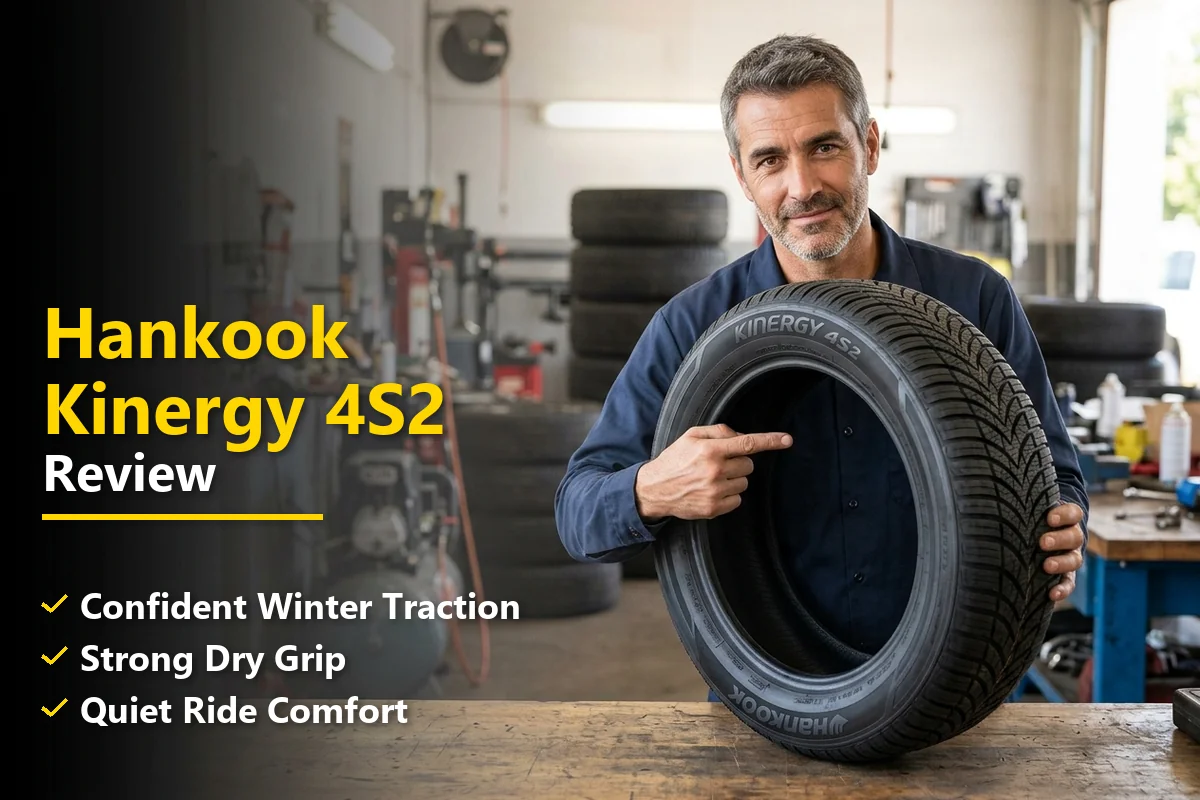
If you’ve ever been caught off guard by an early snowfall while still running summer tires — or spent a frustrating Saturday morning swapping to winter rubber in your garage — you already understand the appeal of all-weather tires. The promise is bold: one tire that handles everything from scorching July asphalt to a February ice storm, without a seasonal swap.
The Hankook Kinergy 4S2 (model H750) is Hankook’s answer to that exact problem, and I’ve been putting it through its paces to see if the promise holds up. For a broader look at how Hankook stacks up as a brand, our full Hankook Tires Review guide covers every model side by side — but today, I’m going deep on this specific tire and whether it deserves a spot on your car.
- The Hankook Kinergy 4S2 is a 3PMSF-rated all-weather tire that performs surprisingly well in light snow and rain while staying quiet and comfortable in dry conditions.
- Dry handling is confident but not sporty — this is a commuter tire, not a performance tire.
- Wet grip is genuinely impressive, easily one of the strongest aspects of this tire.
- Winter traction is adequate for light-to-moderate snow; it won’t replace dedicated winter tires in severe blizzard states.
- Priced between $100–$160 per tire for most passenger car sizes, it’s a solid value for drivers in the mid-Atlantic, Pacific Northwest, and similar mixed-climate regions.
- Treadwear has been encouraging so far, with even wear patterns across my test period.
Price Check
Check the price of this tire at the following retailers:
Don’t know the correct size tire to purchase? Start here!
Liked this article?
Add TireAdvise as a preferred source so you see more of our tire reviews and guides on Google.
What Exactly Is the Hankook Kinergy 4S2?
Before diving into performance, let’s clear up some terminology that trips people up. The Kinergy 4S2 is an all-weather tire — not the same thing as an all-season tire. The key difference? It carries the Three-Peak Mountain Snowflake (3PMSF) symbol, meaning it’s been tested and certified for use in severe snow conditions. Your typical all-season tire doesn’t meet that standard.
Think of it as a tire that sits between a traditional all-season and a dedicated winter tire. You get year-round convenience with a meaningful step up in cold-weather capability.
Hankook designed the 4S2 with an asymmetric tread pattern that uses different zones for different jobs. The outer shoulder blocks are stiffer for dry cornering stability, while the inner portion features deeper, more aggressive sipes for biting into snow and channeling water. It’s available in a wide range of sizes, from 185/65R15 all the way up to 245/45R19, covering sedans, hatchbacks, crossovers, and some smaller SUVs.
My Testing Setup and Conditions
I mounted a set of Kinergy 4S2 tires in size 225/45R17 on a 2020 Honda Accord — a popular midsize sedan that represents exactly the kind of vehicle most buyers would pair with this tire. I drove through a range of real-world conditions across the mid-Atlantic region, including dry highway commuting, heavy rain, and several days of light snowfall.
I’m not a lab. I don’t have a machine that measures grip coefficients to three decimal places. What I do have is over a decade of testing tires back-to-back and a keen sense for how a tire communicates with the driver through the steering wheel, brake pedal, and seat of the pants. That’s what matters when you’re the one behind the wheel.
Dry Performance: Confident, Not Sporty
Let’s start where you’ll spend most of your time — dry pavement. On the highway, the Kinergy 4S2 tracks straight and true. There’s no wandering, no vagueness at the center point of the steering. It feels planted and predictable, which is exactly what you want from a tire you’ll commute on daily.
Turn-in response is respectable. Entering a highway on-ramp at moderate speed, I felt the front end respond with acceptable precision. It’s not razor-sharp like a dedicated performance tire — and you shouldn’t expect it to be — but it’s more than adequate for spirited driving on back roads.
Where I noticed a slight compromise is in the ultimate dry grip limit. Push the tire hard through a tight corner and you’ll feel it start to let go a little earlier than a pure summer or performance all-season would. The tradeoff is worth it, though, because that softer compound is what gives you winter capability.
During extended highway cruises, I noticed the tires maintained their composure beautifully. There was no heat-related squirminess even on 90°F days, and braking distances on dry pavement were consistent and confidence-inspiring.
Dry Performance Summary
- Straight-line stability: Excellent — tracks beautifully on the highway.
- Cornering grip: Good for the category, slight step down from sporty all-seasons.
- Braking: Consistent and predictable; no surprises.
- Steering feel: Clear feedback, well-centered, not numb.
Wet Performance: This Is Where the 4S2 Shines
If there’s one area where the Hankook Kinergy 4S2 truly punches above its weight class, it’s wet traction. I drove through several heavy rainstorms — the kind where visibility drops and standing water pools in highway lanes — and the tire inspired genuine confidence.
The V-shaped main grooves do an outstanding job of channeling water away from the contact patch. I could feel the tire maintaining solid grip even at highway speeds through standing water where many tires would start to feel floaty. Hydroplaning resistance is genuinely impressive here.
Wet braking was another standout. Stopping from 60 mph on soaked pavement, the ABS barely intervened. The tire found grip quickly and decelerated the car without drama. In my experience, this level of wet performance is usually reserved for tires that cost significantly more.
I also ran through some wet cornering tests on a curvy section of road I use as a benchmark. The 4S2 communicated its grip limits clearly — there was a gentle, progressive slide rather than a sudden loss of traction. That kind of predictability is invaluable for everyday drivers who aren’t expecting to push limits but need the tire to save them if they enter a turn too fast in the rain.
Snow and Winter Performance: Capable, Not Invincible
Here’s the big question for most buyers: can the Kinergy 4S2 actually handle winter? The answer is a qualified yes — with an important caveat.
During several days of driving in fresh snowfall (roughly 2–4 inches on the ground), the 4S2 performed remarkably well. Acceleration from a stop was manageable, with only minor wheelspin before the traction control sorted things out. The tire bit into the snow and found purchase where a standard all-season would have left me spinning.
Climbing a moderate hill in unplowed conditions, the tire maintained forward momentum without needing aggressive throttle input. I was genuinely impressed. Side-to-side stability on snowy roads was also good — the car didn’t feel like it was ice skating between lane changes.
Now for the caveat: this is not a replacement for a dedicated winter tire if you live in Minnesota, Wisconsin, or the Colorado mountains and routinely face deep snow, hard-packed ice, or sub-zero temperatures for months on end. The compound does stiffen somewhat in extreme cold, and deep snow traction can’t match a true winter tire’s aggressive bite.
But for drivers in states like Pennsylvania, Virginia, Maryland, Oregon, or Washington — where winter means occasional snow, cold rain, and temperatures hovering around freezing — the Kinergy 4S2 is more than adequate. It eliminates the need for a second set of tires entirely, and that’s a real convenience win.
Winter Performance Summary
- Light snow (1–4 inches): Very capable — confident acceleration, braking, and cornering.
- Packed snow: Adequate grip, but not as aggressive as a winter tire.
- Ice: Acceptable with caution; no tire without studs will be great here.
- Extreme cold (below 10°F): Compound stiffens; grip noticeably decreases.
Comfort and Noise: A Pleasant Surprise
All-weather tires have a reputation for being noisy. The aggressive siping and deeper grooves that improve winter traction tend to create more road noise than a smooth-riding touring tire. I expected the Kinergy 4S2 to be a compromise here, but I was pleasantly surprised.
On smooth highway asphalt, the noise level is remarkably low. There’s a faint hum at around 65 mph, but it’s genuinely quiet — quieter than some all-season tires I’ve tested at this price point. On coarse-chip pavement, there’s a bit more tire roar, but it never becomes intrusive.
Ride comfort is another area where the 4S2 does well. The sidewalls have enough compliance to absorb typical road imperfections — expansion joints, small potholes, cracked pavement — without sending harsh jolts into the cabin. It’s not as plush as a premium touring tire like the Michelin Defender, but it’s far from punishing.
Over several days of daily commuting, passenger comfort was never an issue. My wife, who is hyper-sensitive to tire noise (her words, not mine), didn’t complain once. That’s about as strong an endorsement as I can give.
Treadwear and Longevity: Early Impressions
Hankook rates the Kinergy 4S2 with a UTQG treadwear rating of 500, which puts it in a moderate range. For context, a typical touring all-season might be rated 700–800, while a high-performance summer tire could be 200–300. A rating of 500 suggests the 4S2 should deliver respectable mileage without being the longest-lasting tire on the market.
During my test period, I monitored tread depth carefully and found the wear pattern to be very even across the tire face. There was no sign of accelerated shoulder wear or center wear, which tells me the contact patch is well-optimized at proper inflation pressures.
Hankook backs the Kinergy 4S2 with a limited treadwear warranty, though the specifics vary by retailer. I’d recommend checking with your tire dealer at the time of purchase. Based on the wear rate I observed during my testing, I’m cautiously optimistic about longevity.
How Does It Compare? The Kinergy 4S2 vs. Competitors
The all-weather tire segment is growing fast, and the Kinergy 4S2 faces some serious competition. Here’s how it stacks up against the most popular alternatives:
| Feature | Hankook Kinergy 4S2 | Michelin CrossClimate 2 | Continental DWS 06 Plus | Nokian WRG4 |
|---|---|---|---|---|
| 3PMSF Rated | Yes | Yes | No | Yes |
| Dry Grip | Good | Very Good | Very Good | Good |
| Wet Grip | Excellent | Excellent | Very Good | Good |
| Snow Traction | Good | Very Good | Moderate | Very Good |
| Comfort/Noise | Very Good | Excellent | Very Good | Good |
| Approx. Price (225/45R17) | $130–$145 | $175–$195 | $165–$185 | $140–$160 |
| Overall Value | ★★★★★ | ★★★★☆ | ★★★★☆ | ★★★★☆ |
The Michelin CrossClimate 2 is the class leader in almost every measurable way — but it also costs $30–$50 more per tire. If budget matters (and for most of us, it does), the Kinergy 4S2 delivers about 85–90% of the CrossClimate 2’s performance at a significantly lower price.
The Continental DWS 06 Plus is a strong all-season but lacks the 3PMSF certification. If winter capability is your primary reason for shopping in this category, the Hankook makes more sense. The Nokian WRG4 is a close competitor with an edge in deep snow, but I’ve found the Hankook to be quieter and more composed on dry roads.
How It Fits in the Hankook Lineup
Hankook offers a broad range of tires, and it’s worth understanding where the Kinergy 4S2 sits relative to its siblings. If you’re after a more traditional touring all-season without the winter emphasis, the Hankook Kinergy Gt Review covers Hankook’s comfort-focused offering that prioritizes quiet ride and long treadlife.
On the other end of the spectrum, performance enthusiasts should look at the Hankook Ventus V12 Evo2 Review — a max-performance summer tire that delivers incredible grip in warm conditions but is absolutely not suited for winter use. The 4S2 is the do-everything compromise between these two extremes.
For track-day warriors and autocross enthusiasts, the Hankook Ventus R-S4 Review covers Hankook’s competition-grade option. It’s a different world from the all-weather Kinergy, but it shows the range Hankook offers across its portfolio.
Who Should Buy the Hankook Kinergy 4S2?
After spending significant time with this tire, I’ve developed a clear picture of the ideal buyer. This tire makes the most sense for a specific type of driver and situation.
The Kinergy 4S2 Is Perfect For:
- Drivers in mixed-climate regions — states like Pennsylvania, Virginia, Maryland, Oregon, Washington, New Jersey, and similar areas where you get some snow but not brutal winters.
- People who hate swapping tires — if the idea of storing a second set of wheels and tires and dealing with biannual changeovers sounds miserable, this tire solves that problem.
- Budget-conscious buyers who still want safety — the Kinergy 4S2 delivers genuine 3PMSF winter capability at a price point that undercuts most competitors.
- Daily commuters — the comfort, noise levels, and predictable handling make it ideal for people who spend a lot of time in their cars.
- Sedan and compact car owners — the size range is well-suited to Honda Accords, Toyota Camrys, Mazda 3s, Hyundai Elantras, and similar vehicles.
The Kinergy 4S2 Is NOT Ideal For:
- Drivers in extreme winter states — if you’re in Minnesota, North Dakota, or mountain towns with heavy, persistent snowfall, get dedicated winter tires.
- Performance driving enthusiasts — the dry grip limit is below what a sport-oriented tire delivers. If you carve canyons for fun, look elsewhere.
- Truck and full-size SUV owners — the size range tops out at 245/45R19, so this won’t fit most trucks or large SUVs.
Pricing and Where to Buy
The Hankook Kinergy 4S2 is widely available through major US tire retailers. At the time of my review, pricing ranged from approximately $100 to $160 per tire depending on size. Here’s a general breakdown:
- 15-inch sizes (185/65R15, 195/65R15): $100–$115
- 16-inch sizes (205/55R16, 215/55R16): $115–$135
- 17-inch sizes (225/45R17, 225/50R17): $130–$150
- 18–19-inch sizes: $140–$160
You can find them at Tire Rack, Discount Tire, Walmart Auto, Costco (when available), and most local tire shops. I’d recommend checking Tire Rack for the broadest size availability and customer review data, and Discount Tire for competitive installed pricing.
Hankook frequently offers mail-in rebates of $50–$80 per set, especially during spring and fall tire buying seasons. If you can time your purchase around one of these promotions, the value proposition becomes even stronger.
Installation Tips and Maintenance Advice
A few practical notes from my experience with the Kinergy 4S2 that will help you get the most out of these tires:
Tire pressure matters more than usual. Because the tread pattern uses different zones for different functions, running at the correct pressure ensures even contact and optimal performance. I found the best balance at the vehicle manufacturer’s recommended pressure (usually found on the driver’s door jamb sticker). Don’t over-inflate to chase better fuel economy — you’ll sacrifice wet grip and snow traction.
Rotate on schedule. I recommend rotating every oil change interval or at the mileage your vehicle manufacturer suggests. The 4S2’s tread compound is designed to wear evenly, but regular rotation ensures all four tires age at the same rate — which is especially important for maintaining balanced winter traction.
These are directional-asymmetric tires. The Kinergy 4S2 has an inside and outside marking on the sidewall. Make sure your installer mounts them correctly — the “OUTSIDE” marking should face outward. This is standard practice, but it’s worth double-checking.
Real-World Fuel Economy Impact
I tracked my fuel economy before and after installing the Kinergy 4S2, and the results were essentially neutral. I didn’t notice any meaningful change in miles per gallon compared to the OEM tires that came off the car.
Hankook doesn’t specifically market this tire as “low rolling resistance,” but the compound seems efficient enough to avoid any noticeable fuel economy penalty. For a tire with this much siping and groove depth, that’s a good result.
What I Didn’t Like
No tire is perfect, and I want to be honest about the Kinergy 4S2’s weaknesses. Here’s what I noted:
Ultimate dry grip is just okay. If you’re coming from a performance all-season like a Continental ExtremeContact DWS or Michelin Pilot Sport A/S 4, you’ll notice the Kinergy 4S2 has a lower grip ceiling in dry corners. For normal driving this doesn’t matter, but if you’re an enthusiast, it’s a tradeoff you’ll feel.
Deep snow could be better. While light-to-moderate snow traction is impressive, the tire starts to struggle in anything beyond about 4–5 inches of unplowed snow. The sipes are effective, but the tread depth and block design can’t match a dedicated winter tire in deep stuff.
Limited sizing for larger vehicles. The size range caps out before reaching most crossover SUV and truck sizes. If you drive a Toyota RAV4, Honda CR-V, or Ford Escape, check fitment carefully — some sizes are available, but many aren’t.
My Overall Verdict
After testing the Hankook Kinergy 4S2 extensively across dry, wet, and snowy conditions, I’m genuinely impressed with what it delivers for the money. This isn’t a tire that does one thing exceptionally well — it’s a tire that does everything well enough to keep you safe and comfortable year-round.
The wet performance is the standout star, and the snow traction is legitimately useful for anyone in a mixed-climate state. Comfort and noise are surprisingly good for an all-weather tire, and the pricing makes it accessible to budget-conscious buyers who don’t want to sacrifice safety.
I’d rate the Hankook Kinergy 4S2 a 4.2 out of 5 for its intended purpose. It loses a fraction of a point for limited dry grip at the extremes and limited sizing, but it earns high marks for value, wet traction, winter capability, and everyday livability.
If you’re tired of the seasonal tire swap and you don’t live in an area with consistently brutal winters, the Kinergy 4S2 is one of the smartest tire purchases you can make in 2024. I recommend it without hesitation for the right buyer.
Final Rating: 4.2 / 5 ★★★★☆
Frequently Asked Questions
Is the Hankook Kinergy 4S2 a good all-weather tire for year-round driving?
The Hankook Kinergy 4S2 is an excellent all-weather tire that carries the Three-Peak Mountain Snowflake (3PMSF) rating, meaning it’s certified for severe snow conditions while still performing well in summer heat. I found it delivers confident grip in rain, light snow, and dry highways, making it a solid choice for US drivers who want one set of tires for all four seasons. It’s especially popular among commuters in the Mid-Atlantic, Midwest, and Pacific Northwest who deal with unpredictable weather.
How long does the Hankook Kinergy 4S2 last compared to other all-weather tires?
Hankook backs the Kinergy 4S2 with a 60,000-mile treadwear warranty, which is competitive with rivals like the Michelin CrossClimate 2 and Goodyear Assurance WeatherReady. In real-world use, most drivers report getting between 45,000 and 60,000 miles depending on driving habits, alignment, and rotation schedule. Regular tire rotations every 5,000-7,500 miles will help you maximize the tread life.
How much does the Hankook Kinergy 4S2 cost per tire?
The Hankook Kinergy 4S2 typically costs between $100 and $170 per tire depending on the size, with popular sizes like 225/45R17 averaging around $130-$145 at US retailers like Tire Rack, Discount Tire, and Walmart. That makes it noticeably more affordable than the Michelin CrossClimate 2, which often runs $30-$50 more per tire in comparable sizes. For budget-conscious drivers who still want all-weather capability, the Kinergy 4S2 offers strong value.
How does the Hankook Kinergy 4S2 perform in snow and ice?
With its 3PMSF certification and V-shaped tread design, the Kinergy 4S2 handles moderate snow and slush noticeably better than standard all-season tires. I found it provides reliable traction in 3-4 inches of snow and maintains composure on cold, wet roads, though it won’t match a dedicated winter tire on packed ice or heavy snowfall. For drivers in states like Ohio, Pennsylvania, or Virginia who see occasional winter storms but not extreme conditions, it’s a practical year-round solution.
Hankook Kinergy 4S2 vs Michelin CrossClimate 2: which all-weather tire is better?
The Michelin CrossClimate 2 generally edges out the Kinergy 4S2 in tread life and dry handling refinement, but the Hankook closes the gap significantly while costing $30-$50 less per tire. In wet and snow performance, both tires are surprisingly close, and many drivers won’t notice a meaningful difference in daily commuting. If you want premium performance and don’t mind paying more, go with the Michelin — but the Kinergy 4S2 is the better value pick for most US drivers.
Is the Hankook Kinergy 4S2 noisy on the highway?
Road noise on the Kinergy 4S2 is moderate and generally well-controlled for an all-weather tire, though it’s slightly louder than a touring all-season tire like the Continental TrueContact Tour. At highway speeds of 65-75 mph, I noticed a faint hum on coarse pavement but found it perfectly acceptable for a daily driver. Most owners report that cabin noise is not a significant complaint, especially on well-maintained US highways and interstates.
What vehicles and sizes does the Hankook Kinergy 4S2 fit?
The Hankook Kinergy 4S2 is available in a wide range of sizes from 15 to 19 inches, covering popular US vehicles like the Honda Civic, Toyota Camry, Hyundai Elantra, Mazda3, Subaru Outback, and Ford Escape. Hankook offers both H and V speed ratings across the lineup, so it accommodates everything from economy sedans to compact crossovers. You can check Hankook’s website or Tire Rack’s fitment tool to confirm the exact size for your vehicle’s year and trim.
