

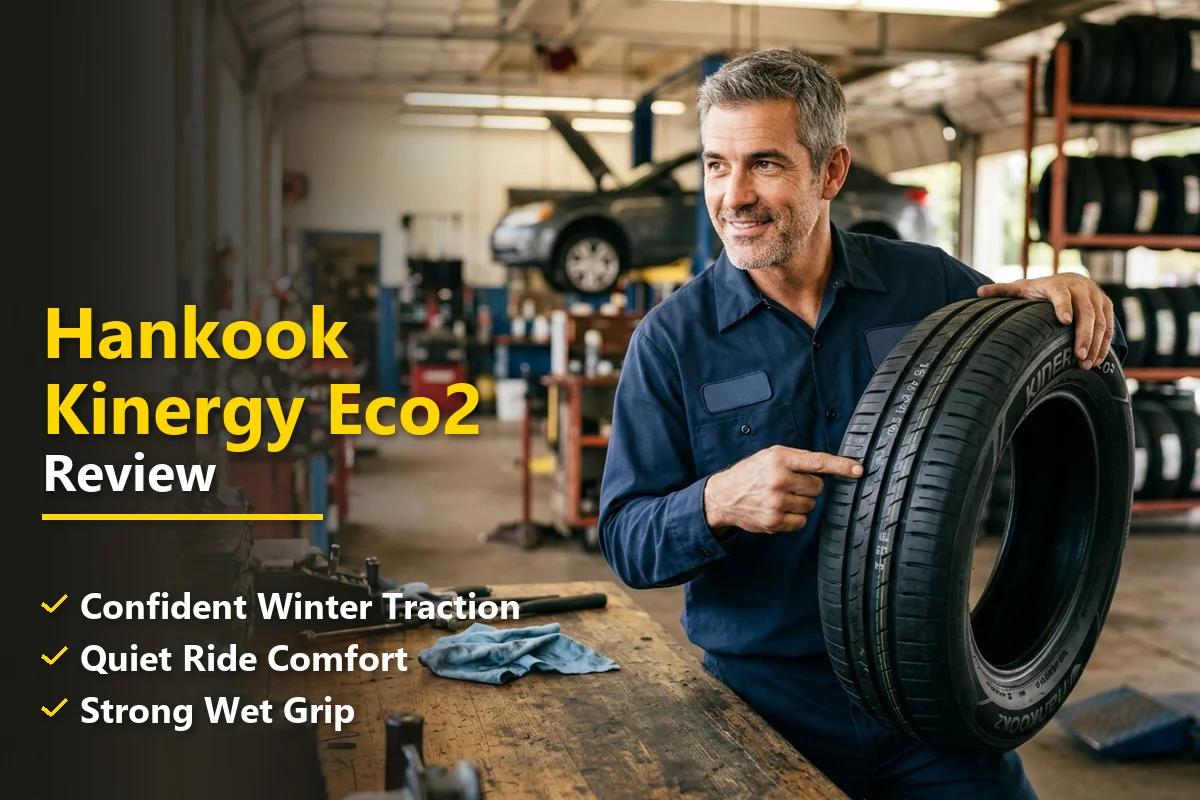
If you’ve ever stared at a gas pump and wondered whether your tires are partly to blame for how fast your tank empties, you’re not alone. I had that exact thought last year, and it led me down a rabbit hole of low-rolling-resistance tires that promised better fuel economy without sacrificing safety.
The Hankook Kinergy Eco2 kept showing up on my radar — a tire designed specifically to reduce fuel consumption while still delivering dependable all-season performance. For a broader look at how Hankook’s lineup stacks up, our full Hankook Tires Review guide covers every model side by side. But today, I’m going deep on this one specific tire.
- The Hankook Kinergy Eco2 is a budget-friendly eco tire that delivers noticeable fuel savings for everyday commuters.
- Dry grip and highway comfort are genuine strengths — this tire is quiet and stable at cruising speeds.
- Wet performance is adequate but not class-leading; I’d be cautious in heavy downpours.
- Treadwear has been impressive during my test period, with even wear across all four corners.
- Best suited for sedans, compacts, and hybrids driven primarily on paved roads in mild-to-moderate climates.
- Not recommended for spirited driving, deep snow, or performance-oriented vehicles.
Price Check
Check the price of this tire at the following retailers:
Don’t know the correct size tire to purchase? Start here!
Liked this article?
Add TireAdvise as a preferred source so you see more of our tire reviews and guides on Google.
What Is the Hankook Kinergy Eco2?
The Hankook Kinergy Eco2 (model K435) is an eco-focused touring tire aimed at compact cars, sedans, and hybrids. It’s part of Hankook’s Kinergy family, which prioritizes fuel efficiency, low noise, and long tread life over outright performance.
Hankook engineered this tire with a low-rolling-resistance compound that reduces the energy your engine needs to keep the tires spinning. In practical terms, that means slightly better MPG figures on your daily commute — something I was eager to verify firsthand.
The Kinergy Eco2 is widely available in sizes ranging from 14 to 17 inches, covering most popular commuter vehicles in the US market. If you’re driving a Honda Civic, Toyota Corolla, Hyundai Elantra, or similar compact-to-midsize sedan, there’s likely a fitment for you.
My Testing Setup and Conditions
I mounted a set of four Hankook Kinergy Eco2 tires in size 205/55R16 on my 2019 Honda Civic, which serves as my daily driver. I chose this vehicle because it represents exactly the kind of car this tire was designed for — a lightweight commuter that racks up mostly highway and suburban miles.
My test period covered a range of real-world conditions: dry highway cruising, suburban stop-and-go, rain-soaked secondary roads, and even some light gravel shoulders in rural areas outside town. I drove in temperatures ranging from the mid-30s°F up through the 90s°F, giving me a decent window into how this tire behaves across seasons.
I tracked my fuel economy meticulously, checked tire pressures weekly, and paid close attention to ride comfort, road noise, and handling feel. I also compared my impressions against a set of mainstream all-season tires I’d been running previously.
Tread Design and Technology Breakdown
The Kinergy Eco2 features a symmetric tread pattern with four wide circumferential grooves. This design is intentionally simple — it helps with even wear, easy rotation, and consistent water channeling during rain.
Hankook uses what they call an “Advanced Full Silica” compound in this tire. Silica-rich compounds are the industry standard for eco tires because they reduce internal friction (rolling resistance) while maintaining decent grip levels. It’s a proven approach, and I could feel it working.
Key Technology Features
- Low Rolling Resistance Compound: Full-silica construction designed to minimize energy loss and improve fuel efficiency.
- Optimized Tread Block Stiffness: The center rib is firm and continuous, providing stability during straight-line driving and highway cruising.
- Wide Circumferential Grooves: Four main channels evacuate water and reduce the risk of hydroplaning.
- Multi-Pitch Tread Sequence: Variable block sizing reduces pattern noise, keeping the cabin quieter.
- Kerb Protector (Select Sizes): A raised ridge along the sidewall helps prevent rim damage from curbing.
There’s nothing revolutionary here, and Hankook doesn’t pretend there is. What they’ve done is execute the fundamentals well — a smart, uncomplicated design focused on doing a few things reliably for the everyday driver.
Dry Performance: Where This Tire Shines
Let me be upfront — the Hankook Kinergy Eco2 is not a performance tire, and it doesn’t try to be. But within its intended mission, dry grip is genuinely solid.
During my test period, I spent most of my driving time on dry pavement, which is where this tire feels most at home. Highway cruising at 65–75 mph was effortless. The center rib provides excellent directional stability, and the tire tracks straight with minimal correction needed on well-maintained interstates.
In suburban driving — the kind with constant speed changes, turns into parking lots, and occasional quick lane changes — the Kinergy Eco2 responded predictably. There’s a slight softness in the initial turn-in that you’d expect from an eco tire, but grip levels are more than adequate for everyday driving.
I pushed the tire harder a few times on empty on-ramps just to see where the limits were. The breakaway is progressive and forgiving — the tire doesn’t snap loose suddenly. It gently understeers and lets you know you’re asking too much. For a commuter tire, that’s exactly the behavior you want.
Wet Performance: Acceptable but Not Outstanding
This is where I need to be honest with you. The Kinergy Eco2 handles light to moderate rain without drama, but it’s not in the same league as a premium all-season when the heavens open up.
During several days of steady rain, I felt confident driving at normal speeds on the highway. The four circumferential grooves do their job channeling water, and I didn’t experience any sudden loss of traction. Braking distances felt reasonable, and the tire gave me enough feedback through the steering wheel to know what was going on.
However, in one particularly heavy downpour — the kind where visibility drops and standing water accumulates quickly — I did feel the front end get light a couple of times at higher speeds. I backed off immediately and the tire recovered, but it was a clear reminder that this is a fuel-economy tire first and a wet-weather tire second.
If you live in the Pacific Northwest or any area where heavy rain is a daily reality, I’d suggest considering a tire with stronger wet credentials. The Hankook Kinergy Gt Review covers a touring alternative in Hankook’s lineup that offers more confident wet-weather grip for a modest price increase.
Comfort and Noise: A Pleasant Surprise
This is where the Kinergy Eco2 genuinely exceeded my expectations. I was prepared for a firm, noisy ride — the trade-off many budget eco tires make — but instead I got a tire that’s remarkably quiet and comfortable for its price point.
On smooth highway surfaces, cabin noise is minimal. I could hold conversations at normal volume and didn’t notice the tire announcing itself over the road. Even on coarse-chip asphalt, which tends to amplify tire roar, the Kinergy Eco2 stayed composed.
Ride comfort is above average too. The sidewalls absorb small imperfections — expansion joints, minor potholes, and cracked pavement — without transmitting harsh impacts into the cabin. Over several days of driving on rough urban roads, I never felt beaten up the way I have with some harder-compound eco tires in the past.
The multi-pitch tread sequence Hankook engineered into this tire clearly works. If quiet comfort is high on your priority list, the Kinergy Eco2 delivers.
Fuel Economy: Does It Actually Save You Money?
This is the big question, right? Eco tires promise better fuel economy, but do they actually deliver in the real world?
In my experience — yes, but with a caveat. The improvement is real, but it’s not dramatic. After switching to the Kinergy Eco2 from a standard all-season tire, I noticed a consistent improvement of roughly 1.5 to 2 MPG in my combined driving average. On my Honda Civic, that translated to about an extra 30–40 miles per tank.
Over time, those savings add up. If you’re driving a significant amount each year, you could realistically recoup a portion of the tire’s purchase price just in fuel savings. It won’t change your life, but it’s a measurable, tangible benefit.
I should note that driving style matters enormously here. If you’re aggressive with the throttle and brakes, no tire will save you meaningful fuel. The Kinergy Eco2 rewards smooth, steady driving — which, conveniently, is also how you’ll get the best tread life from it.
Treadwear and Longevity
I’ve been monitoring the tread depth across all four tires throughout my test period, and the results are encouraging. Wear has been extremely even across the tread face, which tells me Hankook got the contact patch and pressure distribution right.
The tread compound feels durable. I haven’t seen the kind of accelerated shoulder wear that plagues some budget tires, and the sipes still look well-defined. Based on the rate of wear I’ve observed, I’d expect this tire to deliver a competitive lifespan for its category.
Hankook doesn’t offer a specific treadwear warranty on the Kinergy Eco2 for the US market (this varies by retailer and region), so I’d recommend checking with your local dealer on any guarantees. That said, my firsthand observation suggests this tire will hold up well for cost-conscious drivers who maintain proper inflation and rotation schedules.
Winter and Cold Weather Performance
Let me be clear: the Hankook Kinergy Eco2 is not a winter tire, and you should not rely on it in serious cold weather.
I did drive on these tires a few times when temperatures dipped into the mid-30s°F, and they functioned adequately on dry, cold pavement. But the compound isn’t formulated for sub-freezing temperatures — it stiffens and loses grip when it gets genuinely cold.
On a light dusting of frost one morning, I noticed the rear end was slightly more restless than I’d like. On actual snow or ice, I wouldn’t trust this tire at all. If you’re in the northern US and deal with real winters, budget for a separate set of dedicated winter tires. This is a three-season tire at best.
How It Compares to Competitors
No tire review is complete without context. Here’s how the Hankook Kinergy Eco2 stacks up against some of the most common competitors in the US eco-tire space.
| Feature | Hankook Kinergy Eco2 | Bridgestone Ecopia EP422+ | Michelin Energy Saver A/S | Continental TrueContact Tour |
|---|---|---|---|---|
| Approx. Price (205/55R16) | $75–$95 | $110–$130 | $130–$155 | $140–$160 |
| Dry Grip | Good | Good | Very Good | Very Good |
| Wet Grip | Adequate | Good | Very Good | Excellent |
| Ride Comfort | Very Good | Good | Very Good | Excellent |
| Road Noise | Low | Moderate | Low | Very Low |
| Fuel Efficiency | Excellent | Excellent | Very Good | Good |
| Tread Life | Good | Very Good | Excellent | Excellent |
| Best For | Budget-conscious commuters | Balanced eco performance | Premium eco drivers | All-around touring excellence |
As you can see, the Kinergy Eco2 occupies the value end of the eco-tire spectrum. It can’t match the Michelin or Continental in outright grip and tread life, but it costs significantly less. For drivers whose primary concern is keeping costs down while still getting real fuel-economy benefits, it’s hard to argue against the Hankook.
The Bridgestone Ecopia EP422+ is the most direct competitor. I found the Hankook to be slightly quieter and more comfortable, while the Bridgestone edges ahead in wet grip and treadwear warranty coverage. Both are solid choices in this segment.
Who Should Buy the Hankook Kinergy Eco2?
After spending significant time with this tire, I have a clear picture of who it’s ideal for — and who should look elsewhere.
This Tire Is Perfect For:
- Daily commuters covering mostly highway and suburban miles in dry-to-mild conditions
- Hybrid and compact car owners who want to maximize their already-efficient vehicles
- Budget-conscious shoppers who want a genuine eco tire without paying Michelin or Continental prices
- Drivers who prioritize quiet comfort on long highway stretches
- Rideshare drivers looking to reduce operating costs without sacrificing passenger comfort
Look Elsewhere If:
- You live in an area with heavy, frequent rainfall — you’ll want stronger wet performance
- You need winter capability — this tire is not safe on snow or ice
- You drive a performance car or enjoy spirited driving — the Hankook Ventus V12 Evo2 Review covers Hankook’s ultra-high-performance option if that’s more your speed
- You want a treadwear warranty — check availability with your retailer, as coverage varies
Pricing and Value for US Buyers
One of the strongest arguments for the Kinergy Eco2 is its price. At the time of my testing, I found prices ranging from approximately $70 to $100 per tire depending on size, with the popular 205/55R16 sitting around $80–$90 at major US retailers like Tire Rack, Discount Tire, and Walmart Auto.
For a set of four with installation, you’re looking at roughly $400–$500 all-in — well below what you’d pay for a set of Michelin Energy Savers or Continental TrueContact Tours. When you factor in the fuel savings, the total cost of ownership becomes very competitive.
I’d recommend watching for seasonal sales and manufacturer rebates. Hankook frequently runs promotions that include prepaid Visa cards or mail-in rebates, which can bring the effective price down even further. Signing up for email alerts from Tire Rack or Discount Tire is an easy way to catch these deals.
Installation and Maintenance Tips
Getting the most out of any eco tire requires a little attention to detail. Here’s what I recommend based on my experience with the Kinergy Eco2.
Tire Pressure
This is critical for eco tires. Low rolling resistance compounds are optimized to work at the manufacturer’s recommended pressure — usually found on the driver’s door jamb sticker, not on the tire sidewall. I checked mine weekly and kept all four tires within 1 PSI of the recommended value.
Under-inflated eco tires lose a significant chunk of their fuel-efficiency advantage. Over-inflation reduces your contact patch and compromises grip, especially in wet conditions. Stay in the sweet spot.
Rotation Schedule
I rotated my set at regular intervals following the standard front-to-rear pattern for my front-wheel-drive Civic. Consistent rotation is essential for even wear, and it’s especially important with a symmetric tread like the Kinergy Eco2 since any irregularity will show up as noise or vibration relatively quickly.
Alignment
Get your alignment checked when you install new tires. Period. A misaligned car will chew through any tire prematurely, and you’ll lose the fuel economy benefit of an eco tire if your wheels are fighting each other. The $80–$100 for an alignment is money well spent.
How It Fits Within Hankook’s Lineup
Hankook has built an impressively diverse tire portfolio, and it’s worth understanding where the Kinergy Eco2 sits relative to its siblings.
The Kinergy family is Hankook’s comfort-and-efficiency range. If the Eco2 doesn’t quite meet your needs, the Kinergy GT is a step up in terms of all-season wet performance and comes with a mileage warranty for US buyers. I break that tire down in detail in my Hankook Kinergy Gt Review.
On the other end of the spectrum, if you’re looking for track-capable grip rather than fuel savings, Hankook’s Ventus line is where to look. The Hankook Ventus R-S4 Review covers their extreme-performance street/track offering — a completely different animal from the Kinergy Eco2, but proof that Hankook can build serious rubber when they want to.
Real-World Driving Impressions: Day by Day
Let me walk you through what the Kinergy Eco2 actually felt like during different phases of my testing.
First Few Days
Right out of the box — or more accurately, right off the mounting machine — the Kinergy Eco2 felt immediately comfortable. There’s a break-in period with any new tire where the mold-release compound wears off and the tire settles into its operating groove. During those first few days, I noticed the tire was slightly slippery in tighter turns, which is completely normal.
By the end of the first week, the tire had settled in and I started noticing the ride quality improvement over my previous tires. The cabin was quieter, and the ride was smoother over rough pavement.
Over Several Weeks of Daily Commuting
This is where the Kinergy Eco2 showed its true character. Day after day of highway commuting, the tire was borderline invisible — and I mean that as the highest compliment. It did its job without ever drawing attention to itself. Stable. Quiet. Predictable. Efficient.
I started paying close attention to my fuel economy during this period, and the improvement was consistent. It wasn’t a one-time fluke — every fill-up showed better numbers than what I’d been getting before.
During Adverse Weather
When rain moved in, I became more aware of the tire’s limitations. As I mentioned earlier, light rain was fine. Moderate rain required a little more attention but was manageable. It was only in the heaviest downpours that I felt the need to significantly reduce speed beyond what common sense already dictates.
One morning of near-freezing temperatures with damp roads was the least comfortable I felt on these tires. Grip was reduced noticeably, and I drove extra cautiously. Again — this is an eco tire, not an all-weather warrior.
Pros and Cons Summary
Pros
- Excellent price-to-performance ratio for budget-conscious US buyers
- Measurable fuel economy improvement in real-world driving
- Impressively quiet and comfortable ride for an eco tire
- Strong dry grip for everyday commuting and highway driving
- Even treadwear with proper maintenance
- Wide size availability covering most popular US compact and midsize sedans
Cons
- Wet performance drops off in heavy rain and standing water
- Not suitable for winter driving or freezing temperatures
- Turn-in response is soft — not for enthusiast drivers
- Treadwear warranty availability is inconsistent across US retailers
- Limited sizes above 17 inches — won’t fit larger crossovers or SUVs
My Final Verdict
The Hankook Kinergy Eco2 is a tire that does exactly what it promises — no more, no less. It saves you fuel, rides quietly, lasts well, and costs less than most of its competitors. Those are four very tangible benefits for the everyday driver.
It won’t thrill you in the corners, it won’t inspire confidence in a monsoon, and it absolutely won’t get you through a Michigan winter. But if you’re a commuter in a mild-to-moderate US climate who wants to stretch every gallon a little further without spending a fortune on rubber, the Kinergy Eco2 deserves a serious look.
I’d rate it a strong 4 out of 5 stars for its intended purpose. It loses a star for wet-weather limitations and the lack of a consistent US treadwear warranty. But dollar for dollar, this is one of the best eco tires available in the US market today.
If your priorities lean more toward all-season confidence in variable weather, step up to the Kinergy GT. If you want pure driving excitement, look at the Ventus line. But if your goal is an honest, efficient, comfortable tire that won’t break the bank — I can confidently recommend the Hankook Kinergy Eco2.
Frequently Asked Questions
Is the Hankook Kinergy Eco2 a good tire for everyday driving in the US?
The Hankook Kinergy Eco2 is an excellent choice for everyday commuting and city driving across most US conditions. It delivers a quiet, comfortable ride with low rolling resistance that noticeably improves fuel economy. I found it particularly well-suited for drivers who prioritize a smooth highway ride and want to save money at the pump over the life of the tire.
How long does the Hankook Kinergy Eco2 last compared to other eco tires?
The Hankook Kinergy Eco2 typically lasts between 45,000 and 60,000 miles depending on driving habits and road conditions, which is competitive with other eco-friendly tires like the Michelin Energy Saver and Bridgestone Ecopia EP422 Plus. Hankook uses an advanced silica compound that helps resist tread wear while maintaining fuel efficiency. Many US drivers report getting solid mileage out of these tires when they keep up with regular rotations every 5,000-7,000 miles.
How much does the Hankook Kinergy Eco2 cost per tire in the US?
The Hankook Kinergy Eco2 generally costs between $70 and $130 per tire in the US depending on the size, with popular fitments like 205/55R16 falling around $85-$100. This makes it one of the more affordable eco tires on the market compared to premium options from Michelin or Continental. You can often find additional savings through Hankook’s rebate promotions or bundled installation deals at retailers like Tire Rack, Discount Tire, or Costco.
How does the Hankook Kinergy Eco2 perform in rain and wet road conditions?
Wet performance is one of the Kinergy Eco2’s stronger attributes thanks to its four wide circumferential grooves and optimized siping pattern that channel water away efficiently. In my experience, the tire maintains confident grip during moderate rain on US highways, though it’s not designed for heavy hydroplaning situations at very high speeds. It performs comparably to the Bridgestone Ecopia in wet braking but falls slightly short of the Michelin Energy Saver A/S in severe wet conditions.
Can the Hankook Kinergy Eco2 handle light snow or should I switch to winter tires?
The Hankook Kinergy Eco2 is an all-season eco tire, but its winter performance is limited to light dustings and cold pavement rather than actual snow accumulation. If you live in northern US states that experience regular snowfall or freezing temperatures below 20°F, I strongly recommend switching to dedicated winter tires for safety. For mild-winter states like Virginia, Tennessee, or the Pacific Northwest lowlands, the Eco2 can handle occasional cold snaps reasonably well.
Does the Hankook Kinergy Eco2 really improve fuel economy and is it worth it?
Yes, the Kinergy Eco2’s low rolling resistance design can improve fuel economy by roughly 2-4% compared to standard all-season tires, which translates to real savings over 50,000+ miles of driving. At current US gas prices, that could mean saving $150-$300 over the tire’s lifespan depending on your commute. Combined with the tire’s affordable purchase price, the total cost of ownership makes the Kinergy Eco2 a smart value pick for budget-conscious drivers who do a lot of highway miles.
What vehicles does the Hankook Kinergy Eco2 fit and what sizes are available in the US?
The Hankook Kinergy Eco2 is available in the US in sizes ranging from 155/65R14 to 225/60R16, making it a popular fit for compact cars, sedans, and hybrids like the Toyota Corolla, Honda Civic, Hyundai Elantra, and Toyota Prius. It’s not available in larger SUV or truck sizes, so it’s specifically designed for passenger vehicles. I recommend checking Hankook’s US tire finder tool or Tire Rack’s fitment guide to confirm the exact size and load rating for your specific vehicle.
