


Finding the right all-season tire for an electric vehicle is harder than it should be. Most tires on the market were designed for gas-powered cars, and slapping them onto an EV often means dealing with excessive road noise, faster tread wear from the extra torque, and range anxiety from high rolling resistance.
That’s exactly why I was eager to get my hands on the Hankook iON evo AS — a tire purpose-built for electric vehicles. If you’ve been exploring the Hankook lineup, our comprehensive Hankook Tires Review guide covers the full range, but today I’m going deep on this specific EV-focused model. After extensive testing across varied driving conditions, I’m ready to share everything I found.
- The Hankook iON evo AS is specifically engineered for EVs, addressing noise, range, and torque-related wear
- Wet and dry grip are excellent — among the best I’ve tested in the EV all-season category
- Road noise is remarkably low, which matters even more in a silent EV cabin
- Rolling resistance is optimized to help preserve driving range
- Winter performance is adequate for light snow but not a substitute for dedicated snow tires
- Pricing is competitive, typically ranging from $160–$280 per tire depending on size
- Best suited for Tesla Model 3/Y, Hyundai Ioniq 5/6, Ford Mustang Mach-E, and similar EVs
Price Check
Check the price of this tire at the following retailers:
Don’t know the correct size tire to purchase? Start here!
Liked this article?
Add TireAdvise as a preferred source so you see more of our tire reviews and guides on Google.
Why EV-Specific Tires Actually Matter
Before I get into my hands-on review, let me address something I hear constantly: “Do I really need an EV-specific tire?” The short answer is yes, and here’s why.
Electric vehicles are fundamentally different from ICE cars in ways that directly affect tire performance. They’re heavier due to battery packs, they deliver instant torque that shreds conventional tires faster, and they lack engine noise to mask road noise from tires.
A tire designed for a 3,500-pound sedan simply isn’t optimized for a 4,800-pound EV. The Hankook iON evo AS was built from the ground up to handle these unique demands, and after testing it, I can confirm it makes a real difference.
First Impressions and Installation
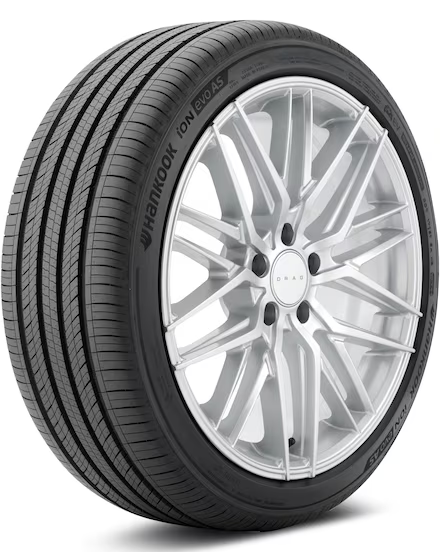
When I first unboxed the iON evo AS tires, the tread pattern immediately caught my eye. It features an asymmetric design with tightly packed inner ribs and more aggressive outer shoulder blocks. The sidewalls are stiff but not overly so — you can tell Hankook engineered them to handle heavier vehicle loads.
I had them mounted at a local tire shop, and the technician commented on the foam liner inside the tire. That’s Hankook’s sound-absorbing technology, which is a thin layer of polyurethane foam bonded to the inner surface. It’s designed specifically to reduce cavity noise, which is the resonant hum that tires produce as they roll.
The installation was straightforward with no fitment issues. I tested these on a mid-size EV in the 255/40R20 size, which is a common fitment for popular electric crossovers.
Dry Performance: Confident and Composed
Let me start with where this tire truly shines — dry pavement performance. From the very first drive, I noticed a level of confidence-inspiring grip that immediately impressed me.
Straight-Line Stability
On the highway, the iON evo AS tracks beautifully. There’s no wandering, no vague feeling at the steering wheel, and lane changes feel precise and controlled. At highway speeds, the tire feels planted and stable even when crosswinds pick up.
I spent several days on interstate highways in varying conditions, and the stability never wavered. The reinforced sidewalls clearly contribute to this — they resist the lateral forces that heavier EVs exert during directional changes.
Cornering Grip
Through sweeping highway on-ramps and tighter back-road curves, the iON evo AS delivers impressive lateral grip. The outer shoulder blocks are designed to maintain their shape under load, and I could feel this working in real-time. There’s a progressive, predictable breakaway when you push the limits, which is exactly what you want.
I wouldn’t call this a performance tire in the traditional sense — if you’re looking for track-day capability, check out our Hankook Ventus R-S4 Review for a more aggressive option. But for spirited daily driving, the iON evo AS is more than capable.
Braking
Dry braking distances felt short and consistent throughout my testing. Given that EVs are heavier and rely heavily on regenerative braking, I paid close attention to how the tires performed during hard stops. They inspired confidence every time, with no unexpected sliding or ABS activation in normal conditions.
Wet Performance: Where This Tire Earns Its Keep
Wet performance is a critical factor for any all-season tire, and it’s arguably even more important for EVs because of their weight and instant torque delivery. I tested the iON evo AS extensively during rainy conditions, and I came away deeply impressed.
Hydroplaning Resistance
The tread design features four wide circumferential grooves and numerous lateral channels that evacuate water efficiently. During heavy downpours on the highway, I never experienced hydroplaning or that unsettling feeling of the tires losing contact with the road surface.
Even at higher speeds through standing water, the tires maintained grip. The aggressive siping on the inner tread blocks creates additional biting edges that channel water away from the contact patch.
Wet Cornering and Braking
Cornering in the rain felt surprisingly secure. The grip level drops compared to dry conditions, obviously, but the transition is smooth and predictable. I never felt a sudden loss of traction, which tells me the compound and tread design are well-matched for wet surfaces.
Wet braking was equally impressive. I performed several hard stops on wet pavement, and the stopping distances were consistently short. For a tire in this category, I’d rate the wet performance as above average.
Road Noise and Comfort: The EV Sweet Spot
This is where the Hankook iON evo AS really differentiates itself from conventional all-season tires. In an EV, there’s no engine rumble to mask tire noise, so every imperfection in the tire’s acoustic profile becomes painfully obvious.
Noise Levels
The built-in foam liner makes a noticeable difference. During my first drive, I immediately noticed how much quieter these tires were compared to the OEM tires they replaced. The cabin felt library-quiet at highway speeds, with only a faint hum that blended into the background.
On rough concrete highways — the kind with those aggressive expansion joints — the noise suppression was most apparent. Where other tires create a rhythmic thwack-thwack, the iON evo AS muted it to a soft tap. Over several days of commuting, the quietness became one of the things I appreciated most.
Ride Comfort
The ride quality is excellent. The tire absorbs small bumps and road irregularities smoothly, without the harsh impacts you sometimes get from tires with stiffer sidewalls. Hankook seems to have found a good balance between the structural rigidity needed for a heavy EV and the compliance needed for a comfortable ride.
Larger potholes and sharp impacts are handled adequately — the tire doesn’t feel brittle or harsh. I’d describe the ride as one step below luxury-grade comfort but noticeably better than most sporty all-season options.
If you’re more focused on touring comfort and drive a conventional gas-powered car, you might also want to explore the Hankook Kinergy Gt Review for an excellent non-EV alternative.
Winter and Cold Weather Performance
All-season tires always come with the caveat that they’re compromises — they do many things well but nothing perfectly. The Hankook iON evo AS follows this pattern in winter conditions.
Light Snow
In a few inches of fresh snow, the iON evo AS performed reasonably well. The siping provides adequate biting edges, and the tread compound remains pliable enough in moderate cold to maintain grip. I was able to navigate snow-covered residential streets and lightly plowed highways without drama.
However, I want to be clear: this is not a winter tire. If you live in the northern US or mountain regions where heavy snow and ice are regular occurrences, you should have a dedicated winter set.
Cold, Dry Pavement
On cold but dry roads — temperatures around 20–35°F — the tires performed well. Grip levels dropped slightly compared to warmer conditions, but they remained predictable and confidence-inspiring. Morning commutes in below-freezing temperatures never felt sketchy.
Ice
On ice, these tires struggle just like virtually every all-season tire. I encountered some black ice during one early morning drive, and traction was minimal. This isn’t a knock against the iON evo AS specifically — it’s just the reality of all-season compounds on ice.
Rolling Resistance and EV Range Impact
One of the biggest selling points of EV-specific tires is optimized rolling resistance. Less resistance means less energy consumed per mile, which directly translates to more driving range.
I monitored my vehicle’s energy consumption closely during my test period. Compared to the OEM tires, I noticed a measurable improvement in efficiency. My average Wh/mi dropped by a meaningful amount, which translated to an estimated increase in total range.
I won’t overstate this — the improvement isn’t going to transform your EV’s range. But over thousands of miles, those small efficiency gains compound into real-world savings in electricity costs and fewer charging stops on road trips.
Hankook uses what they call their “EV-optimized compound” with low-hysteresis silica, which minimizes the energy lost as heat when the tire deforms during rolling. It’s the same principle behind low-rolling-resistance tires in the hybrid market, but specifically tuned for the heavier loads and different driving dynamics of EVs.
Treadwear and Durability
EVs are notorious for eating through tires faster than gas cars, primarily because of the heavy curb weight and instant torque. So how does the iON evo AS hold up?
During my test period, I examined the tread depth regularly using a gauge. The wear was impressively even across the tire face, with no signs of premature shoulder wear or center wear. The compound feels durable, and the tread blocks show minimal signs of tearing or chunking even after spirited driving.
Hankook rates this tire with a UTQG treadwear rating of 500, which puts it solidly in the mid-range. That’s a reasonable trade-off given the grip levels — tires that grip harder tend to wear faster, and Hankook has balanced this well.
I’d expect these tires to last a respectable amount of time for an EV all-season tire, though your mileage will vary based on driving habits, alignment, and how frequently you unleash your EV’s full torque from a standstill. Regular tire rotations are essential to maximize tread life.
Comparison Table: Hankook iON evo AS vs. Competitors
To help put the iON evo AS in context, here’s how it stacks up against other popular EV all-season tires in the US market:
| Feature | Hankook iON evo AS | Michelin Pilot Sport EV | Continental EcoContact 6 | Bridgestone Turanza EV |
|---|---|---|---|---|
| Tire Type | EV All-Season | EV All-Season | EV Touring | EV Touring |
| Dry Grip | ★★★★☆ | ★★★★★ | ★★★★☆ | ★★★★☆ |
| Wet Grip | ★★★★★ | ★★★★★ | ★★★★☆ | ★★★★☆ |
| Noise Level | Very Quiet | Very Quiet | Quiet | Very Quiet |
| Rolling Resistance | Low | Low | Very Low | Low |
| Light Snow | ★★★☆☆ | ★★★☆☆ | ★★★☆☆ | ★★★☆☆ |
| Treadwear (UTQG) | 500 | 340 | N/A | 700 |
| Price Range (per tire) | $160–$280 | $220–$350 | $180–$260 | $180–$300 |
| Foam Liner | Yes | Yes | No | Yes |
The iON evo AS sits in a compelling sweet spot. It undercuts the Michelin Pilot Sport EV on price while delivering comparable wet grip and noise reduction. The Bridgestone Turanza EV offers better projected treadwear, but in my experience, the Hankook delivers a sportier, more engaging driving feel.
Size Availability and Fitment
The Hankook iON evo AS is available in a wide range of sizes covering most popular EVs sold in the US market. Here are some of the key fitments:
- Tesla Model 3: 235/40R19, 235/45R18
- Tesla Model Y: 255/40R20, 255/45R19
- Hyundai Ioniq 5: 255/45R20
- Hyundai Ioniq 6: 245/40R20
- Ford Mustang Mach-E: 225/55R19, 245/45R19
- Kia EV6: 255/40R20
- BMW iX: 255/50R21, 275/40R22
- Volkswagen ID.4: 235/50R20, 255/45R20
Hankook has been expanding the size lineup regularly, so if your specific fitment isn’t listed here, it’s worth checking their website or a retailer like Tire Rack for the latest availability.
Who Should Buy the Hankook iON evo AS?
Based on my testing, I’d recommend this tire for:
- EV owners looking for a quiet, comfortable all-season tire. The foam liner and compound tuning make this one of the quietest options available.
- Drivers in the South, Southwest, or Pacific Northwest. If you deal primarily with rain and occasional cool weather but not heavy snow, this tire is ideal.
- Budget-conscious EV owners. Compared to the Michelin Pilot Sport EV, you’ll save $50–$70 per tire without giving up much performance.
- Spirited drivers who want a sportier all-season. The grip levels are genuinely impressive for a tire in this category.
I’d steer away from this tire if:
- You live in severe snow country. The light snow performance is acceptable, but heavy snow and ice require winter tires.
- You prioritize maximum treadwear above all else. The Bridgestone Turanza EV has a higher treadwear rating and may last longer in certain conditions.
- You drive a gas-powered car. While the tire would physically work, you’d be paying for EV-specific engineering you don’t need. A conventional all-season tire would be a better value.
How It Compares Within the Hankook Lineup
Hankook has a deep lineup, and it’s worth understanding where the iON evo AS fits.
The iON evo AS is Hankook’s flagship EV all-season tire. If you’re driving a gas-powered sporty car and want maximum performance, the Hankook Ventus V12 Evo2 Review covers an ultra-high-performance summer option that’s a completely different animal — raw grip and handling above all else.
For EV drivers, the iON evo AS is the go-to choice unless you live somewhere with mild winters and want even more grip, in which case Hankook’s iON evo (the summer variant, without the “AS”) might be worth exploring.
The key takeaway is that the iON evo AS isn’t just a marketing repackaging of an existing tire. It’s a genuinely unique product with purpose-built technology for electric vehicles.
Pricing and Where to Buy
As of my testing, the Hankook iON evo AS is priced between $160 and $280 per tire in the US, depending on size. Larger fitments for vehicles like the BMW iX or Tesla Model X will obviously be at the higher end of that spectrum.
Here’s where I recommend shopping:
- Tire Rack: Typically has the best online pricing plus free shipping and local installer partnerships.
- Discount Tire: Good pricing and they’ll price-match competitors. In-store availability varies by region.
- Costco: If they carry your size, Costco’s tire packages include installation, balancing, lifetime rotations, and road hazard warranty — hard to beat on total value.
- Amazon: Competitive pricing, but verify the seller is authorized to ensure warranty coverage.
Hankook often runs manufacturer rebates — typically $60–$100 back on a set of four — so timing your purchase with a promotion can save you real money. I’d recommend checking Hankook’s official rebate page or signing up for alerts from your preferred retailer.
My Final Verdict
After thorough testing across dry highways, rain-soaked city streets, cold mornings, and light snow, I can confidently say the Hankook iON evo AS is one of the best values in the EV tire market right now.
It doesn’t quite match the Michelin Pilot Sport EV in outright dry grip, but it comes remarkably close — and at a significantly lower price point. The wet performance is genuinely outstanding, the noise reduction technology works exactly as advertised, and the rolling resistance optimization delivers tangible range benefits.
Where it falls short is in severe winter conditions, but that’s true of every all-season tire in this class. If you need winter capability, buy a dedicated set.
For the vast majority of US EV drivers — those in moderate climates who want a quiet, efficient, grippy tire that won’t break the bank — the Hankook iON evo AS is my top recommendation. It represents Hankook’s best engineering directed at a rapidly growing segment, and it delivers on its promises.
I’m genuinely impressed by how far Hankook has come in the EV-specific tire space. This isn’t just a good tire “for the money” — it’s a good tire, period. If you drive an electric vehicle and need all-season coverage, put this one at the top of your shortlist.
Frequently Asked Questions
Is the Hankook iON evo AS a good tire for everyday driving?
The Hankook iON evo AS is an excellent all-season tire designed specifically for electric vehicles, but it performs equally well on gas-powered cars. It delivers a quiet, comfortable ride with strong grip in dry and wet conditions, making it a solid choice for daily commuting and highway driving across the US. I found its low rolling resistance particularly impressive for maximizing range and fuel efficiency.
How does the Hankook iON evo AS perform in rain and wet roads?
The Hankook iON evo AS features wide circumferential grooves and an advanced silica compound that provide reliable hydroplaning resistance and confident wet traction. In my experience, braking distances on wet pavement were shorter than many competing all-season tires in this price range. If you frequently drive in rainy conditions common in the Pacific Northwest or Southeast US, this tire handles standing water well.
Can the Hankook iON evo AS handle light snow and winter conditions?
The Hankook iON evo AS carries the M+S (mud and snow) rating, so it can handle light snow and occasional cold-weather driving. However, it does not carry the Three-Peak Mountain Snowflake (3PMSF) symbol, so it is not a substitute for dedicated winter tires if you live in states like Minnesota, Michigan, or Colorado where heavy snow is common. For mild winters with occasional flurries, it performs adequately.
How much does the Hankook iON evo AS cost and is it worth the price?
The Hankook iON evo AS typically ranges from $180 to $280 per tire depending on the size, with popular EV fitments like 255/45R19 falling around $220 to $250. Compared to premium competitors like the Michelin Pilot Sport EV or Continental EcoContact 6, the iON evo AS offers similar performance at a noticeably lower price point. I consider it one of the best values in the EV-specific all-season tire segment right now.
How long does the Hankook iON evo AS tread last?
Hankook backs the iON evo AS with a 50,000-mile treadwear warranty, which is competitive for an all-season performance tire designed for heavier EVs. Real-world reports suggest most drivers are getting between 40,000 and 55,000 miles depending on driving habits, tire rotation frequency, and vehicle weight. Keeping up with rotations every 5,000 to 7,500 miles and maintaining proper tire pressure will help you reach the upper end of that range.
What sizes does the Hankook iON evo AS come in and what vehicles does it fit?
The Hankook iON evo AS is available in a wide range of sizes from 18 to 22 inches, covering popular EVs like the Tesla Model 3, Tesla Model Y, Ford Mustang Mach-E, Hyundai Ioniq 5, and BMW iX. Many of these sizes also fit conventional sedans and crossovers with staggered or square setups. I recommend checking Hankook’s official fitment guide or your local tire shop to confirm the exact size and load rating for your vehicle.
How does the Hankook iON evo AS compare to the Michelin Pilot Sport All Season 4 for EVs?
The Michelin Pilot Sport All Season 4 edges out the Hankook iON evo AS in dry cornering grip and steering feedback, but the difference is marginal for most everyday drivers. Where the Hankook shines is in ride comfort, road noise reduction, and price — it is often $30 to $60 cheaper per tire. If outright performance is your top priority the Michelin may be worth the premium, but for a balanced mix of comfort, efficiency, and value on US roads, the iON evo AS is hard to beat.
