

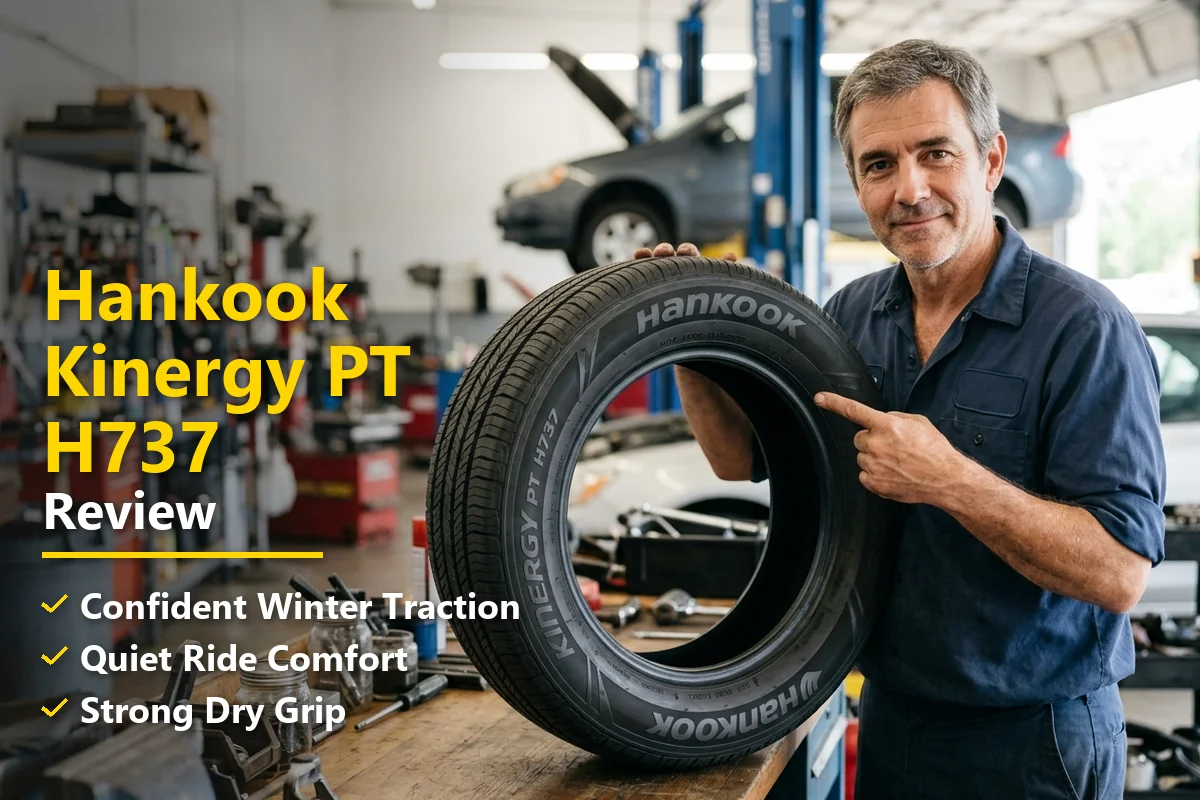
If you’ve ever driven on a set of tires that made you wince every time you hit a rough patch of highway, you know the frustration. You just want something that rides smooth, lasts a long time, and doesn’t drain your wallet — is that really too much to ask?
That’s exactly the mindset I had when I mounted a set of Hankook Kinergy PT H737 tires on my daily driver. And honestly, the results caught me off guard in the best possible way. For anyone doing research on the broader lineup, our full Hankook Tires Review guide covers every model side by side and is worth a look before you buy.
- The Hankook Kinergy PT H737 is a touring all-season tire designed for sedans, minivans, and small crossovers.
- Ride comfort and road noise suppression are genuinely impressive for the price point.
- Wet traction is above average; dry handling is stable but not sporty.
- Tread life is backed by a 90,000-mile warranty — one of the best in its class.
- Priced between $90–$140 per tire depending on size, it’s a strong value pick for everyday commuters.
- Not the right tire if you want aggressive cornering or winter performance.
Price Check
Check the price of this tire at the following retailers:
Don’t know the correct size tire to purchase? Start here!
Liked this article?
Add TireAdvise as a preferred source so you see more of our tire reviews and guides on Google.
What Exactly Is the Hankook Kinergy PT H737?
The Kinergy PT H737 sits in Hankook’s touring all-season category. It’s designed specifically for drivers who prioritize comfort, long tread life, and fuel efficiency over high-performance cornering or track-day heroics.
It comes in a wide range of sizes — from 14-inch fitments all the way up to 19-inch — which means it covers a huge swath of sedans, minivans, and compact crossovers. Think Honda Accord, Toyota Camry, Hyundai Sonata, Chrysler Pacifica, and similar vehicles.
Hankook positions this tire as a step up from budget options but below their premium touring offerings. The 90,000-mile treadwear warranty is the headline number here, and it immediately tells you that longevity is a core design priority.
My First Impressions After Installation
I had the H737s installed at a local tire shop on a mid-size sedan I use for daily commuting. The tires I replaced were a mid-tier competitor that had become noticeably louder and less responsive over time.
The difference was apparent within the first few minutes of driving. The road noise dropped significantly — and I’m not exaggerating. Highway cruising felt noticeably quieter, and the ride over expansion joints and rough pavement was smoother and more composed.
After a few days of mixed driving — commuting, errands, and a short highway trip — I felt confident that these tires were well-suited for the kind of driving most Americans actually do on a daily basis.
Tread Design and Technology Breakdown
Let’s talk about what’s going on with the rubber. The Kinergy PT H737 features a symmetric tread pattern, which is typical for touring tires. This design helps with even wear, consistent performance, and allows for tire rotation flexibility.
There are four wide circumferential grooves running around the tire, and they do a solid job channeling water away from the contact patch. I noticed this firsthand during several rainy drives — the tire felt planted and confident even on wet highways.
Key Technology Features
- Advanced silica compound: Hankook uses a silica-enriched tread compound that improves wet grip while reducing rolling resistance. This translates to better fuel economy without sacrificing traction.
- Optimized pitch sequence: The tread blocks are arranged in a specific pattern to minimize road noise. This is one of the areas where the H737 truly shines.
- Wide steel belts: Reinforced internal construction helps the tire maintain its shape under load, which contributes to more even tread wear over time.
- 3D sipe technology: The interlocking sipes add biting edges for wet and light snow traction while keeping the tread blocks stable during dry cornering.
None of these features are revolutionary on their own, but Hankook has combined them effectively. The result is a tire that punches above its price point in almost every comfort and durability metric.
Dry Performance: Steady and Predictable
Let me be upfront: this is not a performance tire. If you want razor-sharp turn-in and aggressive cornering grip, you should look at something like the Hankook Ventus V12 Evo2 Review instead. The H737 is built for a different mission entirely.
That said, dry performance is perfectly adequate for everyday driving. Straight-line stability on the highway is excellent — the tire tracks true and doesn’t wander, which makes long interstate drives relaxing rather than fatiguing.
During my test period, I took some faster on-ramps and tighter suburban turns to see how the tire responded. It held its line well, with progressive and predictable behavior at the limit. There’s a gentle understeer that builds gradually, giving you plenty of warning before you’ve pushed too hard.
Braking distances on dry pavement felt average to slightly above average for the category. Nothing startling, but perfectly confidence-inspiring for normal driving situations.
Wet Performance: A Genuine Strength
This is where the Kinergy PT H737 genuinely impressed me. Wet traction is a critical safety factor, and Hankook clearly put engineering effort into this area.
During several days of heavy rain, I pushed the tires through standing water, wet highway lanes, and slick city streets. Hydroplaning resistance was noticeably better than the tires I replaced. The four circumferential grooves do their job efficiently, and I could feel the tire maintaining contact with the road surface even at highway speeds in heavy downpours.
Wet braking also felt reassuring. I had a couple of situations where I needed to brake firmly at intersections, and the tires responded without any drama or unexpected sliding. For a tire in this price range, the wet performance is a standout feature.
Ride Comfort and Noise: Where the H737 Excels
If I had to pick one single attribute that defines this tire, it would be ride comfort. The Kinergy PT H737 is remarkably quiet and composed — even more so than some tires that cost 30-40% more.
On smooth highway surfaces, the cabin is near-silent as far as tire noise is concerned. You can easily hold a conversation at normal volume, and the road hum that plagued my previous tires is essentially gone.
Over rough surfaces — cracked pavement, potholes, railroad crossings — the tire absorbs impacts without transmitting harsh vibrations into the cabin. There’s a suppleness to the ride that makes the car feel more refined than it actually is.
I also noticed that expansion joints on concrete highways, which are normally accompanied by a rhythmic thump-thump-thump, were much less intrusive. It’s a small thing, but over a long commute, it makes a significant difference in fatigue levels.
Light Snow and Cold Weather Performance
The H737 is an all-season tire, not a winter tire. That distinction matters, especially if you live in the northern US where real winter conditions are a regular occurrence.
In light snow — a dusting to maybe an inch or two on the ground — the tire does an acceptable job. The sipes provide some biting edges, and I felt reasonably confident navigating a snowy parking lot and lightly covered roads.
However, I would not rely on these tires for serious winter driving. If you regularly deal with heavy snow, ice, or sustained below-freezing temperatures, you need a dedicated winter tire. The H737’s compound is designed for a broad temperature range, not extreme cold, and it will lose flexibility and grip as temperatures drop significantly.
For drivers in the southern half of the US or those who experience only occasional light snow, the all-season capabilities are perfectly adequate.
Tread Life and Durability
Hankook backs the Kinergy PT H737 with a 90,000-mile treadwear warranty, which is one of the most generous in the entire touring tire market. That number alone tells you that Hankook is confident in the tire’s longevity.
During my test period, tread wear appeared very even across the contact patch. I didn’t observe any unusual wear patterns, and the tread depth seemed to be holding up well. Of course, real-world tread life depends heavily on driving habits, alignment, inflation pressure, and road surfaces — but the early signs are very encouraging.
The UTQG treadwear rating on the H737 is typically in the 700-800 range depending on the size, which is consistent with long-lasting touring tires. For comparison, many competing tires in this category sit in the 600-700 range.
If you keep up with regular rotations every 5,000-7,000 miles and maintain proper inflation, I’d expect these tires to deliver on that warranty promise for most drivers.
Fuel Efficiency
The silica compound and optimized tread design contribute to low rolling resistance, which Hankook claims helps improve fuel economy. While I didn’t conduct a controlled scientific test, I did monitor my fuel consumption over several weeks of consistent driving.
My observed fuel economy improved by roughly 1-2 MPG compared to the previous tires. It’s not a dramatic number in isolation, but over the life of the tire, that adds up to real savings at the pump — especially with gas prices being what they are these days.
For commuters putting on significant annual mileage, this fuel efficiency advantage is worth factoring into the total cost of ownership equation.
How Does It Compare to Competitors?
The touring all-season segment is one of the most competitive in the tire market. Here’s how the Kinergy PT H737 stacks up against some of its key rivals.
| Feature | Hankook Kinergy PT H737 | Continental TrueContact Tour | Michelin Defender T+H | Bridgestone Ecopia EP422 Plus |
|---|---|---|---|---|
| Treadwear Warranty | 90,000 miles | 80,000 miles | 80,000 miles | 70,000 miles |
| Approx. Price Range | $90–$140 | $130–$190 | $140–$200 | $100–$150 |
| Ride Comfort | Excellent | Excellent | Excellent | Very Good |
| Wet Traction | Very Good | Excellent | Excellent | Good |
| Road Noise | Very Quiet | Quiet | Quiet | Average |
| Fuel Efficiency | Very Good | Good | Good | Excellent |
| Overall Value | ⭐⭐⭐⭐⭐ | ⭐⭐⭐⭐ | ⭐⭐⭐⭐ | ⭐⭐⭐⭐ |
The Continental and Michelin options are objectively excellent tires — but they come at a noticeable premium. The H737 offers 80-90% of their performance at 60-70% of the cost, which is why I consider it the best value in this comparison.
The Bridgestone Ecopia is the closest in price and excels at fuel efficiency, but it falls short of the H737 in ride comfort and noise control. For most everyday drivers, I’d give the edge to the Hankook.
Kinergy PT H737 vs. Kinergy GT: What’s the Difference?
This is a question I get frequently, and it’s a fair one. Both tires are part of Hankook’s Kinergy family, and both target the all-season touring segment. If you want a deeper dive into the other option, check out our Hankook Kinergy Gt Review.
The key differences come down to intended use and sizing. The Kinergy GT tends to come in sizes that fit more modern vehicles and some OE applications, while the H737 covers a broader range of older and newer sedans and minivans.
In my experience, the H737 has a slight edge in ride comfort and noise suppression, while the GT offers a bit more responsive handling. Both are strong choices, but if maximum comfort and tread life are your priorities, the H737 gets my nod.
Who Should Buy the Hankook Kinergy PT H737?
This tire has a clear sweet spot, and it’s important to be honest about who it’s for — and who should look elsewhere.
The H737 Is Perfect For:
- Daily commuters who spend significant time on highways and want a quiet, comfortable ride.
- Budget-conscious buyers who want strong performance without paying premium-brand prices.
- Sedan, minivan, and compact crossover owners looking for a long-lasting replacement tire.
- Drivers who prioritize tread life — the 90,000-mile warranty is hard to beat.
- Southern and moderate-climate drivers who don’t face severe winter conditions.
You Should Skip the H737 If:
- You want sporty handling. This tire prioritizes comfort over cornering grip. If performance driving matters to you, I’d recommend looking at the Hankook Ventus R-S4 Review for a much sportier option from the same brand.
- You live in a heavy snow region. A dedicated winter tire or a more aggressive all-season is a better choice for places like Minnesota, Wisconsin, or upstate New York.
- You drive a truck or full-size SUV. The H737 is designed for passenger vehicles — check Hankook’s Dynapro line for trucks and SUVs.
Pricing and Where to Buy
As of my review, the Hankook Kinergy PT H737 is priced between approximately $90 and $140 per tire depending on the size. For a set of four in the most popular sizes (like 215/55R17 or 225/65R17), you’re typically looking at $400–$520 before installation.
You can find the H737 at most major US tire retailers, including:
- Tire Rack — often has the best prices and detailed consumer reviews
- Discount Tire / America’s Tire — price match guarantee and free installation options
- Walmart Auto Care — competitive pricing with convenient locations
- Costco — sometimes carries Hankook with installation packages
- Local independent tire shops — worth getting quotes, especially if they offer package deals
I always recommend checking at least two or three retailers before purchasing. Prices can vary by $10-$20 per tire, and many retailers offer rebates or free installation promotions, especially during spring and fall tire-buying season.
Installation Tips and Maintenance
Getting the most out of any tire starts with proper installation and ongoing care. Here are my recommendations specifically for the H737:
- Get an alignment check at installation. Even a slightly off alignment will cause uneven wear and shorten the life of these tires. It typically costs $80-$120 and is worth every penny.
- Rotate every 5,000-7,000 miles. The symmetric tread pattern allows for full rotation flexibility (front-to-back, cross-pattern, etc.). Regular rotation is the single most important thing you can do to maximize tread life.
- Check tire pressure monthly. The H737 performs best at the vehicle manufacturer’s recommended pressure (found on the driver’s door jamb sticker, not the tire sidewall). Under-inflation kills fuel economy and causes premature edge wear.
- Inspect tread depth periodically. Use the penny test or a tread depth gauge. Replace at 2/32″ minimum — though for wet safety, I personally recommend replacing at 4/32″.
Real-World Driving Scenarios
Let me walk you through a few specific driving situations I encountered during my test period to give you a feel for how the H737 behaves in real life.
Highway Commuting
My daily commute includes about 40 minutes of interstate driving each way. The H737 made this the most pleasant part of my day. Stability at 70-75 mph is rock-solid, lane changes are smooth, and the tire tracks straight even in grooved pavement sections. Road noise is minimal — I could listen to podcasts at lower volumes than before.
Rainy Morning Rush Hour
One morning during my test period, I hit a significant rainstorm during peak traffic. Stop-and-go conditions on wet roads can be nerve-wracking, but the H737s felt confident throughout. Braking response was consistent, and I never felt the tires slip or lose composure. The hydroplaning resistance through standing water at highway speed was particularly reassuring.
Weekend Errands and Parking Lots
Low-speed maneuvering in parking lots and around town felt smooth and easy. The tire doesn’t make excessive noise during tight turns, and the steering feel is light and responsive enough for daily tasks. Nothing extraordinary here — it just works exactly as you’d want it to.
Rough Road Surfaces
My area has some notoriously rough roads with frost heaves and patchwork repairs. The H737 soaked up these imperfections remarkably well. The sidewall provides enough compliance to cushion impacts without feeling mushy or disconnected. Potholes that would normally send a jolt through the cabin were reduced to a dull thud.
What I Didn’t Like
No tire is perfect, and I want to give you an honest assessment. Here are the areas where the H737 falls short:
Dry cornering grip is merely adequate. If you take highway on-ramps aggressively or enjoy spirited driving on back roads, you’ll feel the tire’s limits sooner than you’d like. The progressive understeer is safe but not exciting.
Steering feel is somewhat numb at center. There’s a vagueness right around the straight-ahead position that some drivers might notice. It doesn’t affect safety, but it means the tire doesn’t communicate road texture as clearly as a sportier option would.
Snow performance is limited. While the tire is technically all-season, I wouldn’t want to rely on it in anything more than a light dusting. If you live somewhere with real winters, plan accordingly.
Sidewall aesthetics are plain. This is a minor point, but the tire doesn’t have the aggressive or premium look that some competitors offer. If curb appeal matters to you, this tire is functional rather than flashy.
The Bottom Line: Is the Hankook Kinergy PT H737 Worth It?
After spending significant time on these tires across a variety of driving conditions, my answer is a clear yes — with the caveat that you need to be the right buyer.
If you’re a daily commuter who values comfort, quiet, longevity, and value, the Kinergy PT H737 is one of the best options in the touring all-season category. It delivers premium-level ride quality at a mid-range price, and the 90,000-mile warranty gives you peace of mind that few competitors can match.
The wet traction performance alone makes it a strong safety choice, and the fuel efficiency benefits add to the overall value proposition. For a tire that does the everyday stuff this well, the compromises in sporty handling and winter capability are easy to accept — especially when those trade-offs are inherent to the touring tire category as a whole.
I’d rate the Hankook Kinergy PT H737 a 4.3 out of 5 for its intended audience. It’s not trying to be everything to everyone, and that focus is exactly what makes it so good at what it does.
If you’re exploring other Hankook options — say you want something with more performance edge for a sportier car — take a look at our Hankook Ventus V12 Evo2 Review for a completely different driving experience from the same brand. And for track-focused enthusiasts, the Hankook Ventus R-S4 is another compelling choice worth researching.
But for the vast majority of American drivers who just need a reliable, comfortable, long-lasting tire that won’t break the bank? The Kinergy PT H737 is exactly what you’re looking for. I recommend it without hesitation.
Frequently Asked Questions
Is the Hankook Kinergy PT H737 a good all-season tire for daily driving?
Yes, the Hankook Kinergy PT H737 is an excellent all-season tire designed specifically for daily commuters and everyday driving. It delivers a comfortable, quiet ride with reliable traction in dry, wet, and light snow conditions. I found it to be one of the best values in the touring all-season category, especially for sedans and minivans driven primarily on highways and city streets.
How long does the Hankook Kinergy PT H737 last compared to other touring tires?
The Hankook Kinergy PT H737 comes with an impressive 90,000-mile treadwear warranty, which is among the highest in the all-season touring tire segment. In real-world use, many drivers report getting 60,000 to 80,000 miles depending on driving habits, alignment, and rotation schedule. This puts it on par with or ahead of competitors like the Michelin Defender and Continental TrueContact Tour in terms of longevity.
How much does the Hankook Kinergy PT H737 cost per tire?
The Hankook Kinergy PT H737 typically costs between $90 and $150 per tire depending on the size, with most popular sedan sizes falling in the $100 to $130 range. This makes it significantly more affordable than premium touring tires from Michelin or Continental while still offering competitive performance and tread life. You can often find additional savings through Hankook mail-in rebates or retailer promotions at Discount Tire, Tire Rack, or Costco.
How does the Hankook Kinergy PT H737 perform in rain and wet road conditions?
The Hankook Kinergy PT H737 performs well in wet conditions thanks to its four wide circumferential grooves and advanced silica compound that help resist hydroplaning. In my experience, wet braking and cornering grip are confident and predictable for a tire in this price range, though it won’t match ultra-premium options like the Michelin Defender T+H. For typical US driving in rainstorms and on wet highways, the H737 provides more than adequate safety and grip.
Is the Hankook Kinergy PT H737 good for light snow and winter driving?
The Kinergy PT H737 can handle light snow and occasional cold-weather driving, but it is not a substitute for dedicated winter tires. It does not carry the Three-Peak Mountain Snowflake (3PMSF) rating, so drivers in northern US states who face heavy snow should consider a separate set of winter tires. For mild winters with occasional dustings or cold rain, the H737 provides acceptable traction to get you through safely.
What tire sizes are available for the Hankook Kinergy PT H737?
The Hankook Kinergy PT H737 is available in a wide range of sizes from 14-inch to 18-inch diameters, covering most popular sedans, coupes, and minivans on US roads. Common fitments include sizes like 205/55R16, 215/60R16, and 225/65R17, making it compatible with vehicles like the Toyota Camry, Honda Accord, Honda CR-V, and Chrysler Pacifica. I recommend checking Hankook’s official website or a retailer like Tire Rack to confirm your exact size.
How does the Hankook Kinergy PT H737 compare to the Michelin Defender T+H?
The Michelin Defender T+H is considered the gold standard in touring all-season tires, but the Hankook Kinergy PT H737 comes surprisingly close at a significantly lower price point. The Michelin edges ahead in wet braking performance and overall refinement, while the H737 matches or beats it in tread life with its 90,000-mile warranty versus 80,000 miles for the Defender. If you want near-premium performance without paying the Michelin premium, the Kinergy PT H737 is one of the smartest budget-friendly alternatives available in the US market.
