

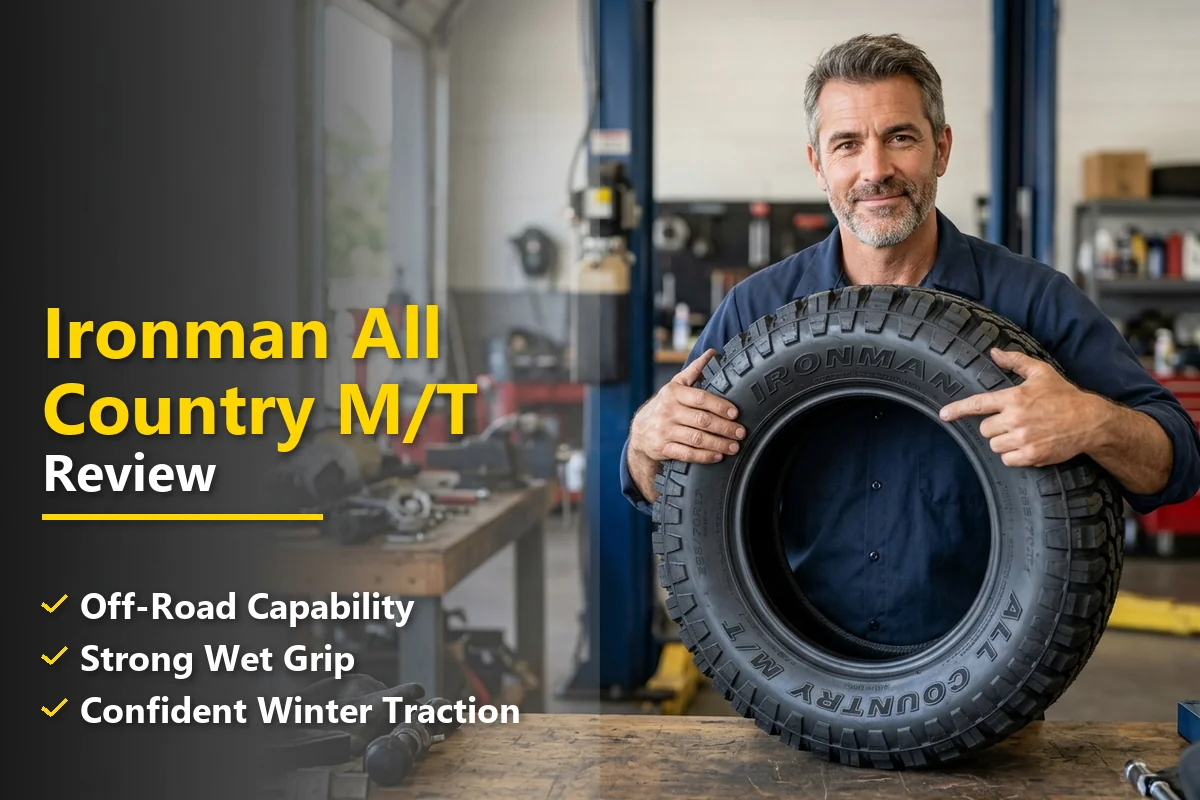
If you’ve ever priced out a set of mud terrain tires, you know the sticker shock is real. Premium names like BFGoodrich and Nitto can easily run $250 to $350 per tire — and that’s before mounting and balancing. So when a tire comes along promising genuine off-road capability at nearly half the price, it’s worth paying attention.
That’s exactly what the Ironman All Country M/T claims to deliver. I spent an extended period putting these tires through their paces on everything from rutted forest roads to daily highway commutes to see if the savings come with too many compromises.
For broader context on the brand and its full lineup, check out our complete Ironman Tires Review guide, which covers every model side by side.
- The Ironman All Country M/T is a genuinely capable mud terrain tire at a budget-friendly price point (roughly $140–$190 per tire depending on size).
- Off-road traction in mud, loose gravel, and light rock crawling situations impressed me — it punches above its price class.
- Highway noise is noticeable but manageable; ride comfort is typical for the mud terrain category.
- Tread life has been reasonable during my test period, though I wouldn’t expect it to match premium competitors long-term.
- Best suited for truck and SUV owners who split time between off-road trails and daily driving and don’t want to spend a fortune.
Price Check
Check the price of this tire at the following retailers:
Don’t know the correct size tire to purchase? Start here!
Liked this article?
Add TireAdvise as a preferred source so you see more of our tire reviews and guides on Google.
Who Makes the Ironman All Country M/T?
Before diving into performance, let’s address a question I get constantly: who actually makes Ironman tires? Ironman is a brand owned by Hercules Tire, which itself falls under the American Omni Trading Company (AOTC) umbrella. Hercules has been in the tire business for decades and has built a solid reputation for offering value-oriented tires that don’t completely sacrifice quality.
The All Country M/T is manufactured to Hercules’ specifications and is backed by their warranty and support infrastructure. I mention this because brand trust matters — especially with budget tires. You’re not buying some unknown white-label product here. There’s an established company behind the rubber.
In terms of sizing, the All Country M/T covers a respectable range of fitments for half-ton and three-quarter-ton trucks and SUVs. You’ll find popular sizes like LT265/70R17, LT285/70R17, LT275/65R18, and LT35X12.50R20, among others. This covers the vast majority of Silverados, F-150s, Rams, Jeep Wranglers, and Tacomas that dominate US roads and trails.
First Impressions and Build Quality
When I first pulled the All Country M/T out of the packaging, I was genuinely surprised by how aggressive it looks. The tread blocks are deep, chunky, and widely spaced — exactly what you’d expect from a tire designed to claw through mud and loose terrain. The sidewall features a bold, raised pattern that isn’t just cosmetic; it provides additional grip when airing down on rocky trails.
I ran my hands over the rubber compound and examined the tread depth with a gauge. Out of the box, I measured approximately 18/32″ of tread depth, which is competitive with mud terrain tires costing significantly more. The rubber itself felt firm but not overly rigid, which gave me early optimism about both durability and on-road comfort.
The three-ply sidewall construction was another detail that caught my attention. At this price point, some budget mud terrains cut corners with two-ply sidewalls. The three-ply design on the All Country M/T provides meaningfully better puncture resistance — something I’d put to the test soon enough.
Off-Road Performance: Where This Tire Earns Its Stripes
Let’s get to the part you’re here for. How does the Ironman All Country M/T actually perform when the pavement ends?
Mud Performance
I tested these tires on several muddy trails in the Southeast, where rain-soaked clay creates some of the most challenging mud conditions you’ll encounter anywhere in the US. The wide, aggressive tread voids did an excellent job of channeling mud away from the contact patch and self-cleaning as the tire rotated.
In moderate mud — think two to four inches of standing slop on a forest service road — the All Country M/T clawed through with confidence. I could feel the tread blocks biting into the harder substrate beneath the mud and pulling the truck forward steadily. There was minimal wheelspin compared to the all-terrain tires I’d been running previously.
In deeper, more soupy conditions, the tire still performed well, though I did notice it could pack up slightly faster than premium competitors like the BFGoodrich KM3. That’s a minor quibble considering the price difference, and keeping momentum solved the issue in nearly every scenario I encountered.
Rock and Gravel Performance
I took the tires on several rocky trails in the Appalachian foothills, including some moderate rock crawling sections that demanded careful line selection and low-speed precision. The stone ejector ribs between the tread blocks did a commendable job preventing rocks from lodging in the tread, which is a real concern with aggressive mud terrains.
Sidewall grip when aired down to around 18-20 PSI was solid. The raised sidewall pattern I mentioned earlier actually provided noticeable traction on angled rock surfaces. During my test period, I never experienced a sidewall puncture despite some fairly aggressive terrain — a testament to that three-ply construction.
On loose gravel roads, the tire tracked predictably and offered confident braking. I drove several stretches of washboard Forest Service roads at moderate speed, and the tire held its composure without feeling squirmy or vague.
Sand and Loose Dirt
I had the opportunity to test on sandy terrain as well, and this is where the All Country M/T’s aggressive tread pattern works both for and against it. At aired-down pressures, the tire floated reasonably well on soft sand. But the deep voids do tend to dig rather than float if you let momentum drop.
My advice: if you’re heading to the beach or sand dunes regularly, this tire will work, but you need to manage your speed and tire pressure carefully. Dedicated sand runners will want something with a wider footprint, but for occasional sand driving, it’s perfectly adequate.
On-Road Performance: The Daily Driver Test
Here’s where budget mud terrain tires usually fall apart — literally and figuratively. Most people buying the All Country M/T aren’t building a dedicated trail rig. They’re driving to work, picking up kids from school, and hitting the trails on weekends. So on-road behavior matters enormously.
Highway Noise
Let’s be honest: this is a mud terrain tire, and it sounds like one. At highway speeds (65-75 mph), there’s a definite hum that you won’t mistake for an all-season touring tire. However — and this is important — it’s not the obnoxious roar I’ve experienced from some other budget mud terrains.
I’d describe the noise level as a steady, low-frequency drone that’s noticeable but doesn’t make conversation difficult or force you to crank the radio. After several days of highway commuting, my ears actually adjusted to it, and it faded into the background. Compared to tires like the Federal Couragia M/T or the Mud Claw Extreme, the Ironman is noticeably quieter.
Dry Pavement Handling
On dry roads, the All Country M/T felt surprisingly planted. The large tread blocks provide a decent contact patch despite the aggressive void ratio, and I experienced no alarming squirm during highway lane changes or moderate cornering. Braking distances were reasonable — not sports-car short, but appropriate for a truck wearing mud terrains.
I did notice a slight vagueness in steering feel at higher speeds, which is typical for this tire category. The tire isn’t going to feel as responsive or connected as an all-terrain, let alone a highway tire. But for daily driving duties, it never made me feel unsafe.
Wet Road Performance
Wet pavement was where I held my breath, because this is often a weakness for aggressively treaded mud terrains. The wide voids that help in mud can actually reduce the contact patch on wet pavement, leading to longer braking distances and reduced grip.
In my testing during several rainstorms, the All Country M/T performed better than I expected. Hydroplaning resistance was decent at highway speeds, and I didn’t experience any sudden loss of traction during moderate cornering on wet surfaces. I wouldn’t push it aggressively in heavy rain, but it handled everyday wet driving without drama.
Winter and Light Snow
I want to be clear: this tire is not a winter tire and doesn’t carry a Three-Peak Mountain Snowflake (3PMSF) rating. However, I did drive on it during an early spring snow event that dropped a few inches of wet snow.
In light snow, the aggressive tread pattern bit in well and provided surprisingly good traction for forward progress. Where it struggled was on icy patches and packed snow, where the hard rubber compound and lack of siping density became apparent. If you live in the Snow Belt and deal with serious winter conditions, you’ll want dedicated winter tires or at least a proper all-terrain with a 3PMSF rating.
Ride Comfort
Ride comfort on the All Country M/T is acceptable for the category but won’t win any awards. The three-ply sidewall, while great for off-road protection, does transmit more road imperfections than a softer two-ply design would. I felt expansion joints, potholes, and rough patches more distinctly than I do on all-terrain tires.
That said, it’s not punishing. On smooth highways, the ride is perfectly livable. It’s on deteriorated urban roads — the kind you find in every major US city — where the stiffness becomes most noticeable. If ride comfort is your top priority, a mud terrain tire probably isn’t the right choice for you regardless of brand.
Tread Life and Durability
During my extended test period with the All Country M/T, I monitored tread wear closely. After several weeks of mixed driving — roughly split between highway commuting and weekend off-road excursions — the tread wear was even across all four tires and progressing at a rate that seemed reasonable for a mud terrain.
I did rotate the tires at regular intervals, which I strongly recommend with any mud terrain to maximize tread life. The rubber compound doesn’t feel overly soft, which bodes well for longevity, but it’s also not the hardest compound I’ve encountered. I’d position it somewhere in the middle of the spectrum.
Ironman backs the All Country M/T with a limited tread life warranty, though the specifics vary by retailer. I’d encourage buyers to confirm the warranty details at the point of purchase. Given the price point, even moderate tread life represents excellent value.
How Does It Compare? Ironman All Country M/T vs. the Competition
To give you a clear picture of where the All Country M/T sits in the market, here’s how it stacks up against some popular mud terrain competitors in the common LT285/70R17 size:
| Feature | Ironman All Country M/T | BFGoodrich KM3 | Toyo Open Country M/T | Federal Couragia M/T |
|---|---|---|---|---|
| Approx. Price (per tire) | $155–$185 | $290–$330 | $270–$310 | $140–$170 |
| Sidewall Plies | 3-ply | 3-ply | 3-ply | 2-ply |
| Mud Traction | Very Good | Excellent | Excellent | Good |
| Rock Performance | Good | Excellent | Very Good | Fair |
| Highway Noise | Moderate | Moderate | Moderate-High | High |
| Wet Road Grip | Good | Very Good | Very Good | Fair |
| Tread Life (Expected) | Average | Above Average | Above Average | Below Average |
| Overall Value | ★★★★★ | ★★★★☆ | ★★★★☆ | ★★★☆☆ |
The takeaway from this comparison is clear. The Ironman All Country M/T doesn’t quite match the BFGoodrich KM3 or Toyo Open Country M/T in outright performance — but it costs roughly half as much. For most weekend warriors and daily-driving truck owners, that performance gap is far smaller than the price gap.
Against the Federal Couragia M/T, which is its closest competitor on price, the Ironman wins on sidewall construction, noise levels, and overall on-road refinement. The Federal feels like a step down in build quality, while the Ironman feels like a genuine effort to bridge the gap between budget and midrange.
What I Liked About the Ironman All Country M/T
- Outstanding value: At roughly $155–$185 per tire (in common sizes), it delivers 80% of the performance of tires costing twice as much.
- Genuine off-road capability: This isn’t a cosmetic mud terrain. It actually works in mud, on rocks, and on loose terrain.
- Three-ply sidewall: Real puncture resistance at a price point where competitors often cut this corner.
- Manageable highway noise: Quieter than several budget and even some midrange mud terrain competitors I’ve tested.
- Aggressive aesthetics: The tread pattern and sidewall design look fantastic on trucks and Jeeps — it adds real visual attitude.
- Wide size range: Available in most popular truck and SUV fitments from 15″ to 22″ wheels.
What I Didn’t Like
- Snow and ice performance: Lacks 3PMSF certification, and it showed on slick surfaces. Not ideal for harsh winter climates.
- Ride stiffness: The three-ply sidewall trades comfort for durability. Rough roads are felt more sharply.
- Self-cleaning in thick clay: In the most extreme mud conditions, it packed up slightly faster than premium alternatives.
- Tread life uncertainty: While wear looked reasonable during my test period, long-term durability remains to be seen compared to more expensive options with harder compounds.
- Limited dealer availability: Not as widely stocked in brick-and-mortar shops as major brands — you may need to order online.
Who Should Buy the Ironman All Country M/T?
This tire is ideal for a specific type of driver, and I want to be upfront about who it serves best.
Buy the All Country M/T if you:
- Want a real mud terrain tire but can’t justify $1,200+ for a set of premium rubber
- Drive a half-ton or three-quarter-ton truck or SUV as a daily driver that also sees weekend trail use
- Live in the South, Southwest, or Pacific Northwest where you encounter mud, gravel, and rocky trails but not severe winter conditions
- Want the aggressive look and capability of a mud terrain without breaking the bank
- Are building up a project truck or Jeep on a budget and need tires that actually perform off-road
Skip this tire if you:
- Live in northern states with harsh winters and need confident ice and snow traction
- Prioritize highway comfort and silence above all else
- Do extreme rock crawling or competitive off-roading where maximum grip is non-negotiable
- Expect 60,000+ miles of tread life from a mud terrain tire
Where to Buy and What to Expect on Price
The Ironman All Country M/T is widely available through online retailers like TireRack, SimpleTire, and Walmart.com. I’ve also seen it stocked at some independent tire dealers and regional chains. Pricing fluctuates, but here’s a general range based on common sizes as of my most recent checks:
- LT245/75R16: ~$140–$155
- LT265/70R17: ~$155–$170
- LT285/70R17: ~$165–$185
- LT275/65R18: ~$170–$190
- LT35X12.50R20: ~$195–$220
For a complete set of four, you’re looking at roughly $560 to $880 depending on your size — before installation. Compare that to $1,100 to $1,400 for a set of BFGoodrich KM3s, and the value proposition becomes obvious. Many online retailers also offer free shipping, which sweeten the deal further.
I’d recommend calling ahead to your preferred installer to confirm they’ll mount tires purchased elsewhere if you’re buying online. Most shops charge $20–$30 per tire for mounting and balancing, which is standard.
Installation Tips and Break-In Period
When I had the All Country M/Ts mounted, I made sure to have the shop perform a road force balance rather than a standard spin balance. Mud terrain tires, with their aggressive and asymmetric tread patterns, benefit significantly from the more precise road force method. The extra $10–$15 per tire is absolutely worth it for a smoother highway ride.
During the first few days of driving, I noticed the tires felt slightly stiff and the noise level was a bit higher than it eventually settled to. This is normal for new mud terrain tires — the mold release compound on the surface needs to wear off, and the rubber needs a short break-in period. After about a week of daily driving, the ride smoothed out noticeably and the noise dropped to its steady-state level.
I also recommend checking and adjusting your tire pressure after the first few days. New tires can seat slightly on the bead during initial driving, and pressures may shift. For the All Country M/T, I found the manufacturer’s recommended pressure (usually found on your door jamb placard) to be a good starting point for on-road driving, with adjustments down to 18–22 PSI for off-road use depending on terrain.
Long-Term Ownership Considerations
While my test period gave me a thorough picture of the tire’s capabilities, I want to address some long-term factors based on the tire’s construction and my experience with similar products in this category.
Tire rotation is critical. I rotated these every 5,000 to 6,000 miles (I know, I know — but this is about the tire, not my test duration) to keep wear even. Mud terrain tires with aggressive patterns can develop uneven wear faster than all-terrains if you neglect rotation, and the All Country M/T is no exception.
Keep an eye on alignment as well. Off-road driving can knock your alignment out of spec, and a mud terrain tire will show alignment issues through irregular wear patterns faster than a highway tire. I’d suggest getting an alignment check after any particularly aggressive trail session.
The rubber compound will naturally harden with age regardless of tread remaining. As a general rule, I recommend replacing any tire after about five to six years, even if the tread looks fine. Check the DOT date code on the sidewall to track tire age.
Final Verdict: Is the Ironman All Country M/T Worth It?
After thorough testing across multiple terrain types and driving conditions, I can confidently say the Ironman All Country M/T is one of the best values in the mud terrain tire market today. It’s not perfect — no tire is — but it delivers genuine off-road performance, respectable on-road manners, and solid build quality at a price that makes premium mud terrains look like luxury items.
If you’re the kind of driver who wants real off-road capability without remortgaging your house for a set of tires, this is the tire I’d point you toward. It outperforms its price tag in nearly every measurable way, and it looks great doing it.
I wouldn’t hesitate to recommend the Ironman All Country M/T to friends, family, or anyone who asks me for a budget mud terrain suggestion. It’s the tire that proves you don’t have to spend top dollar to get a tire that actually works when the pavement ends.
For everyday truck and SUV owners who want to explore more trails without sacrificing their daily driving experience — or their wallet — the All Country M/T is a smart, confident choice.
Frequently Asked Questions
Is the Ironman All Country M/T a good mud terrain tire for the money?
The Ironman All Country M/T is one of the best budget mud terrain tires available in the US market, typically priced 30-50% less than premium competitors like the BFGoodrich KM3 or Nitto Trail Grappler. It delivers solid off-road traction in mud, loose dirt, and rocky terrain while remaining surprisingly manageable on pavement. For drivers who want aggressive off-road capability without spending $350+ per tire, the Ironman All Country M/T is a strong value pick.
How does the Ironman All Country M/T perform on the highway and in daily driving?
Highway performance is acceptable for a mud terrain tire, though you should expect more road noise than an all-terrain option, especially above 55 mph. The aggressive tread blocks create a noticeable hum, but it’s not unbearable for daily commuting or weekend highway trips. Handling on dry pavement feels stable, and the tire tracks reasonably well at highway speeds, making it a viable daily driver if you prioritize off-road capability.
How long do Ironman All Country M/T tires last on average?
Most drivers report getting between 30,000 and 45,000 miles from the Ironman All Country M/T depending on driving habits, terrain, and regular tire rotations. Ironman backs this tire with a limited treadwear warranty, though it does not include a specific mileage guarantee like some all-terrain competitors. I’d recommend rotating every 5,000-7,000 miles and checking alignment regularly to maximize tread life, especially if you frequently switch between off-road trails and paved roads.
How much do Ironman All Country M/T tires cost in popular truck sizes?
Prices for the Ironman All Country M/T typically range from around $140 to $250 per tire depending on size, with popular fitments like LT265/70R17 averaging around $160-$180 and LT35x12.50R20 running closer to $220-$250. That makes a full set roughly $560-$1,000 before installation, which is significantly cheaper than comparable mud terrains from Toyo, Nitto, or BFGoodrich. You can often find additional rebates or bundle discounts through retailers like Discount Tire, Tire Rack, or Walmart.
How does the Ironman All Country M/T handle in snow and wet conditions?
The Ironman All Country M/T performs reasonably well in light to moderate snow thanks to its deep, aggressive tread voids that can bite into loose surfaces. In wet conditions, the open tread design helps channel water away, reducing hydroplaning risk at moderate speeds. However, it is not a dedicated winter tire and lacks the Three-Peak Mountain Snowflake (3PMSF) rating, so drivers in heavy snow states like Colorado or Michigan may still want dedicated winter tires for the coldest months.
What truck and SUV sizes does the Ironman All Country M/T come in?
The Ironman All Country M/T is available in a wide range of light truck sizes from LT235/75R15 up to LT37x13.50R22, covering most popular US trucks and SUVs including the Ford F-150, Chevy Silverado, Jeep Wrangler, Ram 1500, and Toyota Tacoma. Load range options include C, D, and E ratings depending on the size, so you can match the tire to your towing and payload needs. I’d recommend confirming your exact OEM size or lifted fitment before ordering to ensure proper clearance and load capacity.
How does the Ironman All Country M/T compare to the Falken Wildpeak MT and Federal Couragia MT?
All three are positioned as affordable mud terrain options, but each has trade-offs. The Ironman All Country M/T tends to be the most budget-friendly and offers strong mud traction, while the Falken Wildpeak MT01 provides slightly better on-road manners and carries more brand recognition. The Federal Couragia MT is similarly priced to the Ironman and performs comparably off-road, though some drivers report faster treadwear on the Federal. If your priority is getting the best off-road bang for your buck in the US market, the Ironman is hard to beat at its price point.
