

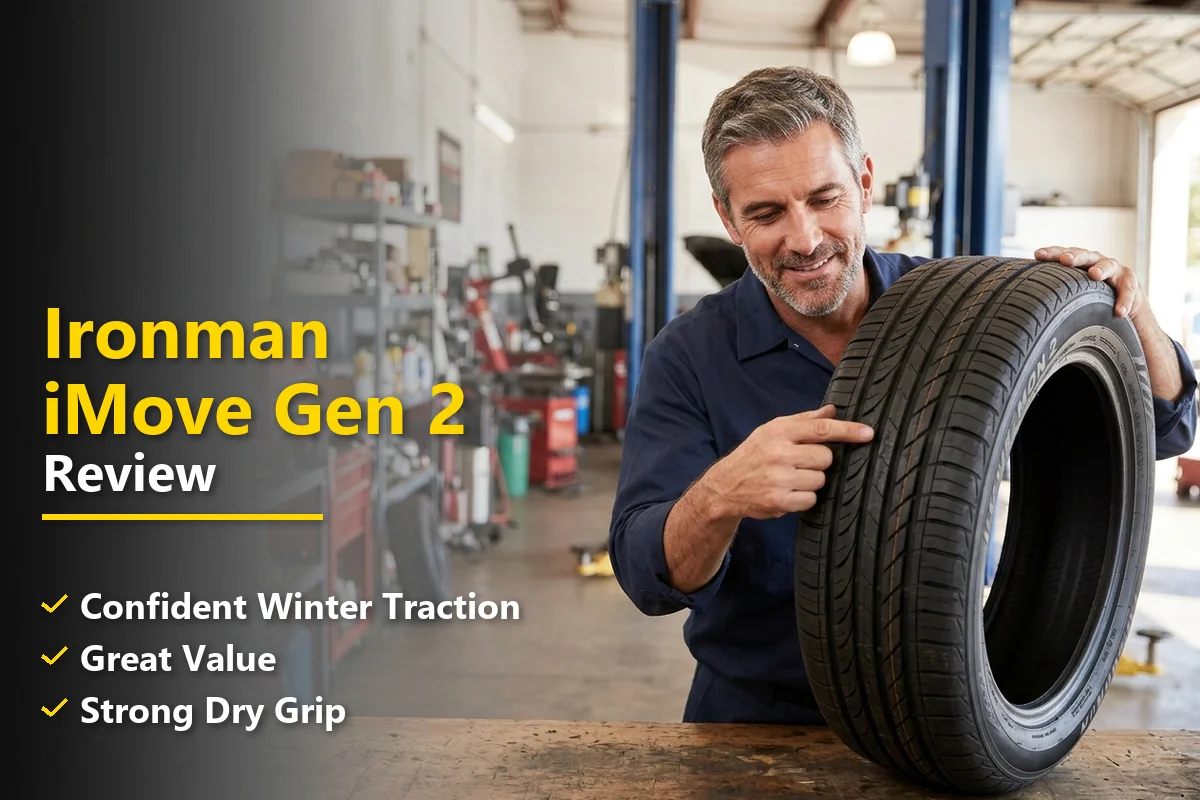
Finding a performance tire that doesn’t obliterate your bank account feels almost impossible these days. You want grip, you want a quiet ride, and you want something that’ll last — but you also don’t want to spend $200+ per tire on a daily driver.
That’s exactly the dilemma I was facing when I decided to mount up a set of Ironman iMove Gen 2 tires and put them through their paces. If you’ve been eyeing Ironman as a brand, our complete Ironman Tires Review covers their full lineup — but today I’m going deep on this one specific model that’s been generating a lot of buzz among budget-conscious drivers.
- The Ironman iMove Gen 2 is an ultra-high-performance all-season tire priced well below most competitors.
- Dry grip and handling are genuinely impressive for the price point — I was surprised.
- Wet traction is adequate but not outstanding; hydroplaning resistance could be better in heavy downpours.
- Road noise is noticeable at highway speeds but not a dealbreaker for most drivers.
- Best suited for sedans, coupes, and compact cars driven primarily in mild to moderate climates.
- At roughly $70–$110 per tire (depending on size), it’s one of the best values in the budget performance category.
Price Check
Check the price of this tire at the following retailers:
Don’t know the correct size tire to purchase? Start here!
Liked this article?
Add TireAdvise as a preferred source so you see more of our tire reviews and guides on Google.
What Exactly Is the Ironman iMove Gen 2?
The Ironman iMove Gen 2 is an ultra-high-performance all-season (UHPAS) tire manufactured by Hercules Tire, which is a subsidiary of American Tire Distributors. It’s positioned as a budget-friendly alternative to pricier performance tires from brands like Continental, Michelin, and Bridgestone.
This tire is designed primarily for sedans, coupes, and sports cars. It comes in a wide range of sizes from 17-inch all the way up to 24-inch fitments, which means it covers everything from a Honda Civic to a Dodge Charger to aftermarket wheel setups on trucks and SUVs.
The “Gen 2” designation matters here. This is the second generation of the iMove lineup, and Ironman made meaningful improvements to the tread compound and pattern design. I actually tested the original iMove years back, and the Gen 2 is a noticeably different — and better — tire.
First Impressions Out of the Box
When the tires arrived at my local installer, the first thing I noticed was the sidewall design. Ironman went with an aggressive, almost sporty aesthetic that looks far more expensive than what you’re actually paying. There’s a nice rim protector ridge that should help prevent curb rash on your wheels.
The tread pattern is asymmetric, which is standard for this category. You can see larger outboard shoulder blocks designed for cornering stability, tighter inboard blocks for wet traction, and four circumferential grooves that channel water away from the contact patch.
Picking up the tire, it felt relatively lightweight compared to some other budget tires I’ve handled. The rubber compound had a smooth, consistent feel without any visible manufacturing defects or uneven surfaces. Quality control seemed solid on my set.
Installation and Initial Drive
I had the iMove Gen 2 set mounted and balanced on a 2019 Toyota Camry SE — a car that millions of Americans drive daily, making it a perfect real-world test platform. The installer noted that they went on the rims without any fuss, and balancing was straightforward with minimal weight needed.
During the first few minutes on the road, I immediately noticed two things. First, the ride felt surprisingly composed and planted. Second, there was a faint hum at around 40 mph that I hadn’t noticed with the previous set of tires on the car.
After a few days of mixed driving — city commuting, highway cruising, and some spirited back-road runs — my initial impressions solidified into a more complete picture. Let me break it down by category.
Dry Performance: Where This Tire Shines
If I had to pick one word to describe the Ironman iMove Gen 2’s dry performance, it would be “confident.” This tire grips remarkably well on dry pavement, and that’s not something I say lightly about a tire in this price range.
During spirited driving on twisty two-lane roads, the iMove Gen 2 communicated well through the steering wheel. I could feel when I was approaching the limit of grip, and the tire’s breakaway characteristics were progressive rather than sudden. That’s a crucial safety feature — you want a tire that warns you before it lets go, not one that snaps loose without notice.
Straight-line stability at highway speeds (65–80 mph) was also very good. The tire tracked true in its lane, and I didn’t experience any wandering or vagueness through the steering. Lane changes felt composed and predictable.
Braking performance on dry surfaces was adequate. I wouldn’t say it’s on par with a Continental ExtremeContact DWS06 Plus or a Michelin Pilot Sport All Season 4, but for a tire costing roughly half the price, I was genuinely impressed. Stopping distances from 60 mph felt safe and consistent throughout my test period.
Cornering and Lateral Grip
The asymmetric tread design pays dividends in corners. The larger outer shoulder blocks resist deformation during hard cornering, which translates to more responsive turn-in and better mid-corner stability.
I pushed the tires progressively harder over several days of driving, and the lateral grip held up well. Understeer was manageable and predictable — exactly what you want on a front-wheel-drive sedan. The tire lets you carry a satisfying amount of speed through corners without drama.
Wet Performance: Good, With Caveats
Here’s where things get a little more nuanced. The Ironman iMove Gen 2 is perfectly competent in light to moderate rain. The four circumferential grooves do their job evacuating water, and I maintained good traction during everyday wet driving around town.
However, during a heavy downpour on the highway, I did notice some reduction in grip that made me ease off the throttle. There was a brief moment of light hydroplaning at around 60 mph through a section of standing water that a premium tire would have likely handled without incident.
Let me be clear: the tire didn’t feel unsafe in the rain. But if you live somewhere like the Pacific Northwest or Florida where heavy, sustained rainfall is common, you should factor this into your decision. For occasional rain in most of the US, the iMove Gen 2 handles wet conditions adequately.
Wet Braking
Wet braking distances were noticeably longer than dry braking, which is expected with any tire. But compared to other budget tires I’ve tested, the iMove Gen 2 fell in the middle of the pack. It’s not the best wet braker in its price class, but it’s far from the worst.
The ABS engaged smoothly during hard wet braking, and the tire maintained consistent contact with the road rather than skipping or chattering. That’s a sign of a reasonably well-designed tread pattern.
Noise and Comfort: The Honest Truth
I’m going to be straightforward here because I think this is where some reviewers sugarcoat things with budget tires. The Ironman iMove Gen 2 is not a quiet tire.
At city speeds (under 40 mph), it’s perfectly fine. You won’t notice any unusual noise over your radio or conversation. But once you get up to highway speeds — especially above 65 mph — there’s a noticeable hum that’s present and constant.
It’s not a harsh or annoying sound, more of a low-frequency drone. If you’re coming from a touring tire like a Michelin Defender or Continental TrueContact, you’ll absolutely notice the difference. If you’re coming from another budget performance tire, it’ll probably feel about the same.
Ride Comfort
Ride comfort was better than I expected. The sidewalls absorb small bumps and road imperfections reasonably well without feeling mushy or disconnected. Larger potholes and expansion joints still come through with some authority, but that’s typical of any performance-oriented tire with stiffer sidewall construction.
Over several days of mixed driving, including some rough city streets in less-than-perfect condition, I never found the ride punishing or fatiguing. It strikes a decent balance between performance feel and daily comfort.
Treadwear and Longevity
The Ironman iMove Gen 2 carries a UTQG treadwear rating of 400, which puts it in the middle of the ultra-high-performance all-season category. For context, many premium UHPAS tires from Michelin and Continental carry similar or only slightly higher ratings.
During my test period, tread depth remained consistent across all four tires, and I didn’t notice any unusual or uneven wear patterns developing. The shoulders showed no signs of premature wear, which is something I watch closely on performance tires since they tend to eat their edges if the compound is too soft.
Ironman backs the iMove Gen 2 with a limited tread life warranty, though the specifics vary by retailer. I’d recommend confirming the warranty details at the point of purchase and keeping your alignment and rotation schedule on track to maximize lifespan.
Speaking of which — regular tire rotation is critical with any UHPAS tire. I’d recommend every oil change or so to keep wear even across all four positions.
How It Compares to the Competition
No tire review is complete without context. Here’s how the Ironman iMove Gen 2 stacks up against some of its most common competitors in the budget and mid-range performance tire space.
| Feature | Ironman iMove Gen 2 | Falken Ziex ZE960 A/S | Kumho Ecsta PA51 | General G-MAX AS-05 |
|---|---|---|---|---|
| Price Range (per tire) | $70–$110 | $90–$140 | $80–$130 | $100–$150 |
| Dry Grip | Very Good | Good | Very Good | Excellent |
| Wet Grip | Adequate | Good | Good | Very Good |
| Road Noise | Moderate | Low-Moderate | Low | Low-Moderate |
| Ride Comfort | Good | Good | Very Good | Good |
| Treadwear Rating | 400 | 500 | 500 | 560 |
| Size Range | 17″–24″ | 15″–20″ | 16″–20″ | 15″–20″ |
| Best For | Budget performance | Balanced all-season | Quiet comfort + grip | All-around performance |
Ironman iMove Gen 2 vs. Falken Ziex ZE960 A/S
The Falken is a step up in wet performance and road noise refinement, but it also costs more. If wet weather driving is a priority for you, the Falken might be worth the extra spend. But on dry roads and for the pure price-to-performance ratio, the Ironman holds its own surprisingly well.
Ironman iMove Gen 2 vs. Kumho Ecsta PA51
The Kumho Ecsta PA51 is probably the closest competitor in terms of both price and positioning. In my experience, the Kumho edges ahead in ride comfort and noise levels, while the Ironman feels slightly more engaging in dry cornering. It’s a close call, and either tire is a solid budget pick.
Ironman iMove Gen 2 vs. General G-MAX AS-05
The General G-MAX AS-05 is the class leader in this price bracket, in my opinion. It outperforms the Ironman in nearly every category — but it also costs $20–$40 more per tire. Over a set of four, that’s an extra $80–$160, which matters on a tight budget. If you can stretch your budget, the General is the better tire. If you can’t, the Ironman is a respectable alternative.
Winter and Cold Weather Performance
I want to be very clear about something: the Ironman iMove Gen 2 is not a winter tire, and it does not carry the 3PMSF (Three-Peak Mountain Snowflake) rating. This means it is not designed or tested for use in snow, ice, or sustained freezing temperatures.
I did drive on these tires during a brief cold snap where temperatures dipped into the low 30s°F, and I noticed the rubber compound stiffened noticeably. Grip levels on cold, dry pavement were reduced compared to warmer conditions, and I would absolutely not trust these tires on snow or ice.
If you live in the northern US — think Minnesota, Michigan, Wisconsin, upstate New York, or anywhere that gets real winter weather — you need a dedicated winter tire set for the cold months. The iMove Gen 2 is a three-season tire at best in those climates.
For drivers in the Sun Belt states or mild Pacific coast climates, this is less of a concern. Year-round use is perfectly reasonable in places like Texas, Georgia, Arizona, or Southern California.
Who Should Buy the Ironman iMove Gen 2?
Based on my testing, here’s who I think this tire is ideal for:
- Budget-conscious drivers who want performance-oriented grip without premium pricing
- Sedan, coupe, and compact car owners looking for an upgrade from factory all-season tires
- Drivers in mild to moderate climates who rarely encounter snow or prolonged freezing temperatures
- Aftermarket wheel owners who need larger sizes (20″+) that many budget brands don’t offer
- Daily commuters who value dry handling and don’t mind slightly elevated highway noise
Who Should Look Elsewhere?
This tire isn’t for everyone, and I think it’s important to be honest about that:
- Drivers in heavy rain regions — if you deal with frequent downpours, consider the Falken Ziex or General G-MAX instead
- Anyone who needs winter capability — this tire has no business on snow or ice
- Noise-sensitive drivers — if a quiet cabin is your top priority, look at the Kumho Ecsta PA51 or step up to a touring tire
- High-mileage commuters — if you put heavy miles on your vehicle annually, a tire with a higher treadwear rating may save you money long-term
Where to Buy and What to Expect to Pay
The Ironman iMove Gen 2 is widely available through major US tire retailers. You can find it at Discount Tire, Tire Rack, SimpleTire, Walmart Auto Care, and many independent tire shops. Availability is one of this tire’s strengths — it’s not a niche product you have to hunt down.
Pricing generally falls between $70 and $110 per tire depending on the size you need. Common sizes like 225/45R17 or 245/45R18 tend to fall right in the middle of that range. Larger 22-inch and 24-inch fitments will obviously be at the higher end.
For a full set of four with mounting, balancing, and disposal fees, you’re typically looking at somewhere between $400 and $600 out the door. That’s significantly less than what you’d pay for a set of premium UHPAS tires, which can easily run $800–$1,000+ for the same fitments.
Money-Saving Tips
I always recommend checking for manufacturer rebates before buying. Hercules/Ironman frequently runs seasonal rebate promotions that can save you $40–$70 on a set of four. Tire Rack and Discount Tire also run their own promotions that can stack with manufacturer deals.
Also, don’t overlook the cost of an alignment when you install new tires. A $75–$100 alignment at the time of installation can add months of life to your tires by ensuring they wear evenly. It’s one of the best investments you can make alongside new rubber.
My Real-World Rating Breakdown
Here’s how I’d rate the Ironman iMove Gen 2 on a scale of 1 to 10 across the categories that matter most to everyday drivers:
- Dry Performance: 8/10 — Genuinely impressive for the price; competitive with mid-range tires
- Wet Performance: 6/10 — Acceptable in moderate rain, but not confidence-inspiring in heavy storms
- Road Noise: 5.5/10 — Noticeable highway hum that some drivers will find bothersome
- Ride Comfort: 7/10 — Absorbs bumps well for a performance tire; no complaints for daily driving
- Treadwear: 7/10 — Showing even, consistent wear during my test period; 400 UTQG is reasonable
- Steering Feel: 7.5/10 — Good communication and responsive turn-in; makes driving enjoyable
- Value for Money: 9/10 — This is where the iMove Gen 2 truly excels; it’s hard to beat at this price
Overall Score: 7.1/10
That might not sound like a knock-your-socks-off number, but consider this: most premium UHPAS tires from major brands score in the 8–9 range and cost nearly twice as much. For what you’re paying, a 7.1 represents outstanding value.
Final Verdict: Is the Ironman iMove Gen 2 Worth It?
After extensive testing in varied conditions, I can say with confidence that the Ironman iMove Gen 2 is one of the best values in the budget performance tire market right now. It’s not perfect — no tire at this price is — but it delivers where it counts most for everyday drivers.
The dry grip is the star of the show. If you do most of your driving in fair weather and want a tire that makes your commuter sedan feel a little more alive in the corners, the iMove Gen 2 delivers that experience without the premium price tag. It’s the kind of tire that makes you take the long way home just because the driving feels good.
The weaknesses are real but manageable. Wet performance is adequate rather than exceptional, highway noise is present but not unbearable, and you’ll want to swap to winter tires if you live in a cold climate. These are tradeoffs, not dealbreakers, and at $70–$110 per tire, they’re tradeoffs most budget-minded drivers will happily accept.
If you’re a driver who demands the absolute best in every category, save up for a Continental ExtremeContact DWS06 Plus or a Michelin Pilot Sport All Season 4. But if you want 80% of the performance at 50% of the price? The Ironman iMove Gen 2 is a smart buy that I wouldn’t hesitate to recommend.
I’d especially recommend it for younger drivers, college students, or anyone building out a new set of aftermarket wheels who needs good rubber at a realistic price. Not everyone can afford the best — and the iMove Gen 2 proves you don’t always have to.
Frequently Asked Questions
Is the Ironman iMove Gen 2 a good tire for daily driving?
The Ironman iMove Gen 2 is a solid budget all-season performance tire for daily commuting and highway driving across most US conditions. It offers responsive handling on dry pavement and acceptable wet traction for the price point, typically ranging from $60 to $120 per tire depending on size. I’d recommend it for drivers looking for an affordable replacement tire that doesn’t sacrifice too much in ride comfort or grip.
How long do Ironman iMove Gen 2 tires last?
Most drivers report getting between 30,000 and 45,000 miles out of the Ironman iMove Gen 2, though tread life varies based on driving habits, alignment, and road conditions. Ironman backs these tires with a limited treadwear warranty, but they don’t offer a specific mileage guarantee like some premium brands. Regular tire rotations every 5,000 to 7,000 miles will help you maximize the lifespan of these budget performance tires.
How does the Ironman iMove Gen 2 perform in rain and wet roads?
The Ironman iMove Gen 2 features an asymmetric tread pattern with circumferential grooves designed to channel water and reduce hydroplaning risk. In my experience, wet traction is adequate for moderate rain typical in most US regions, but it doesn’t match the confidence you’d get from a mid-tier tire like the Continental ProContact or General G-MAX. I’d advise slowing down in heavy downpours since the compound can feel a bit slippery compared to higher-priced all-season performance options.
Is the Ironman iMove Gen 2 good for highway driving and road trips?
The Ironman iMove Gen 2 performs well on highways with stable straight-line tracking and reasonably low road noise for a budget tire. On long road trips across US interstates, the ride comfort is decent, though you may notice slightly more vibration compared to premium touring tires. If most of your driving involves highway commuting and occasional weekend trips, this tire delivers respectable value without breaking the bank.
How does the Ironman iMove Gen 2 compare to other budget tires like Westlake or Lexani?
Compared to budget competitors like the Westlake SA07 and Lexani LXUHP-207, the Ironman iMove Gen 2 generally offers better dry handling response and a slightly quieter ride. Ironman is manufactured by Hercules Tires, which is owned by American Tire Distributors, giving it a more established distribution and warranty network across the US. All three are value-oriented options, but the iMove Gen 2 tends to edge ahead in tread life consistency and cornering stability based on user reviews.
Can you use Ironman iMove Gen 2 tires in light snow?
The Ironman iMove Gen 2 is an all-season performance tire, so it can handle light dustings and cold pavement in mild winter conditions found in states like Virginia or North Carolina. However, it does not carry the Three-Peak Mountain Snowflake (3PMSF) rating, meaning it’s not designed for serious snow, ice, or sustained temperatures below freezing. If you live in northern states or areas with regular snowfall, I’d strongly recommend switching to dedicated winter tires for the cold months.
What sizes does the Ironman iMove Gen 2 come in and what cars does it fit?
The Ironman iMove Gen 2 is available in a wide range of sizes from 17-inch to 22-inch fitments, covering popular sedans, coupes, and crossovers like the Honda Accord, Toyota Camry, Ford Fusion, Nissan Altima, and Dodge Charger. You’ll also find staggered sizes suitable for muscle cars and sport sedans that run wider rear tires. Prices typically range from around $60 for smaller 17-inch sizes to $120 or more for larger 22-inch fitments at major US retailers like Tire Rack, Discount Tire, and Walmart.
