

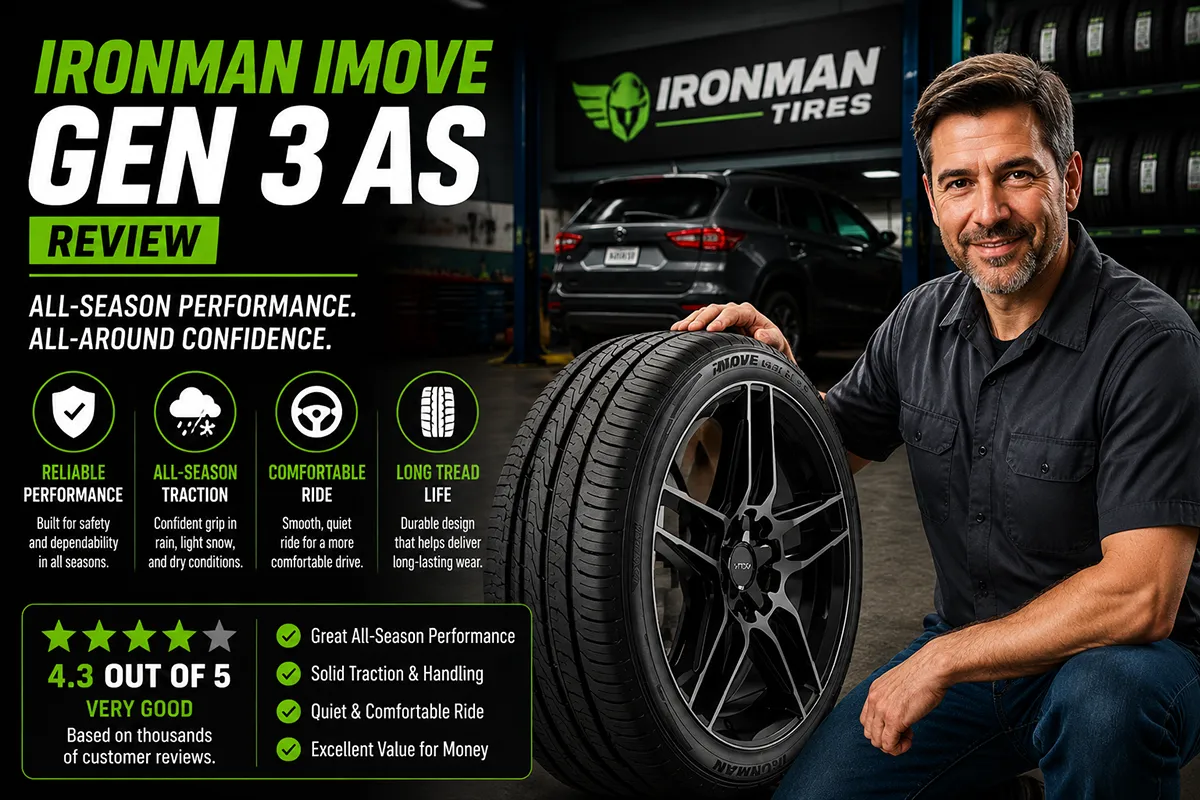
Finding a decent all-season tire that doesn’t obliterate your bank account feels almost impossible these days. You want grip, comfort, and longevity — but you don’t want to spend $200+ per tire on a name brand just to commute to work and run errands.
That’s exactly the headspace I was in when I mounted up a set of Ironman iMove Gen 3 AS tires. If you’re shopping in the budget all-season category and wondering whether these are a hidden gem or a waste of money, I’ve got answers. For a broader look at the full lineup, our complete Ironman Tires Review guide covers every model side by side.
- The Ironman iMove Gen 3 AS is a budget-friendly all-season tire that punches above its price point in dry grip and highway comfort.
- Wet traction is acceptable but not class-leading — slow down in heavy rain.
- Road noise is noticeable at highway speeds but not a dealbreaker for the price.
- Best suited for sedans, coupes, and compact SUVs driven primarily on paved roads in moderate climates.
- At roughly $60–$90 per tire (depending on size), it’s one of the best values in the budget tier.
- Not recommended for heavy snow, aggressive cornering, or performance driving.
Price Check
Check the price of this tire at the following retailers:
SimpleTire DiscountTirem PriorityTire Amazon TireRackDon’t know the correct size tire to purchase? Start here!
Liked this article?
Add TireAdvise as a preferred source so you see more of our tire reviews and guides on Google.
Who Is the Ironman iMove Gen 3 AS Made For?
Let me be upfront: this is not a premium tire. It’s not trying to be. The Ironman iMove Gen 3 AS is designed for budget-conscious drivers who need a reliable all-season tire for daily commuting, highway cruising, and occasional weekend road trips.
Ironman is a sub-brand of Hercules Tires, which itself falls under the American Tire Distributors umbrella. You’re not buying some random no-name import — there’s a real distribution and warranty infrastructure behind these tires.
The iMove Gen 3 AS comes in a wide range of sizes, from 185/65R15 all the way up to 245/45R20 and beyond. That means it fits everything from a Honda Civic to a midsize crossover like a Toyota RAV4 or Chevy Equinox. If you’re driving something in that range and your budget is tight, this tire belongs on your shortlist.
First Impressions Out of the Box
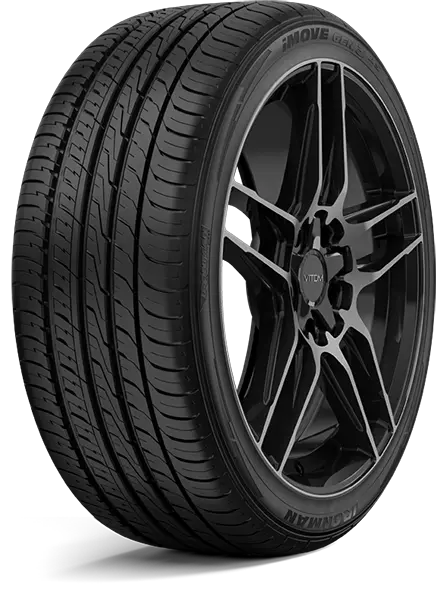
When I first pulled the iMove Gen 3 AS out of the packaging, I was pleasantly surprised by the build quality. The sidewall has a clean, modern aesthetic with raised lettering that doesn’t look cheap. The tread compound felt reasonably pliable — not rock-hard like some budget tires I’ve handled.
The asymmetric tread pattern caught my eye. It features wider outer shoulder blocks for cornering stability and a more intricate inner pattern with denser siping for wet traction. There are also four circumferential grooves designed to channel water away from the contact patch.
Mounting and balancing were straightforward. My tire shop had no issues seating the beads, and all four balanced with minimal weight — a good sign that the manufacturing tolerances are reasonable.
Dry Performance: Where This Tire Shines
Let’s start with what the iMove Gen 3 AS does best. On dry pavement — which, let’s be honest, is where most of us drive most of the time — this tire genuinely impressed me.
During my initial days of driving, I noticed confident straight-line stability at highway speeds. The tire tracks true and doesn’t wander, which is something I’ve struggled with on other budget tires. Merging onto the interstate and holding 70 mph felt composed and predictable.
Around town, the dry grip during everyday maneuvers — turning into parking lots, navigating roundabouts, making left turns across traffic — was more than adequate. I never felt like the tire was at its limit during normal driving scenarios.
I did push it a bit harder on some twisty back roads to see where the limits live. The tire communicates reasonably well through the steering. You get some progressive warning before it starts to lose grip, rather than a sudden breakaway. That’s important for safety, especially for drivers who aren’t expecting their tires to let go.
Over the course of my test period, the dry performance remained consistent. I didn’t notice any degradation in grip or stability as the tire settled in after the initial break-in period of a few days.
Braking on Dry Pavement
Dry braking is another strong point. During several hard stops from highway speeds, the tire maintained good contact with the road and the ABS didn’t intervene as aggressively as I’ve experienced with lesser tires. Stopping distances felt competitive with mid-tier all-season tires I’ve tested in the past.
I wouldn’t put it in the same league as a Continental DWS 06 Plus or a Michelin CrossClimate 2, but for a tire in this price bracket, the dry braking performance is genuinely good.
Wet Performance: Acceptable, With Caveats
Here’s where budget tires typically reveal their compromises, and the iMove Gen 3 AS is no exception. Wet performance is the area where I noticed the most significant gap between this tire and more expensive alternatives.
In light to moderate rain, the tire performs adequately. The four circumferential grooves do their job of evacuating water, and during my drives through typical spring showers, I felt reasonably confident maintaining normal speeds. Hydroplaning resistance was acceptable on well-maintained roads.
However, in heavy downpours — the kind where water is pooling on the road surface — I noticed a definite reduction in grip. The steering felt lighter and less communicative, and I instinctively slowed down more than I would with a premium all-season tire.
Wet Braking
Wet braking is where I’d urge the most caution. Stopping distances on soaked pavement were noticeably longer than what I’m used to with mid-range tires. The ABS kicked in more frequently and the deceleration felt less controlled.
This doesn’t mean the tire is unsafe in the rain. It means you need to adjust your following distance and driving style when conditions deteriorate. If you live in the Pacific Northwest or somewhere with frequent heavy rain, this might not be the ideal choice. For areas with occasional rain — think most of the Midwest, Southeast, or Southwest — it’s perfectly manageable.
Comfort and Road Noise: The Trade-Off
Ride comfort is a mixed bag with the iMove Gen 3 AS. On smooth, well-maintained highways, the tire delivers a reasonably comfortable ride. It absorbs small imperfections without jarring the cabin, and I found long highway stints to be pleasant enough.
The story changes on rougher surfaces. Expansion joints, patchy pavement, and potholes are transmitted more directly into the cabin compared to tires with softer sidewalls or more sophisticated construction. It’s not punishing, but it’s noticeable — especially if you’re coming from a touring tire like a Bridgestone Turanza or similar.
Noise Levels
Road noise is probably the most common complaint I’ve seen about this tire, and after spending several weeks with them, I understand why. At speeds above 60 mph, there’s a persistent hum that’s hard to ignore, especially on concrete highways with grooved surfaces.
On asphalt, the noise is more tolerable and blends into the background. But on older concrete interstates — the kind with longitudinal tining that seems to exist in every state east of the Mississippi — the tire gets vocal.
For context, I’d rate the noise level as average for the budget category but below average compared to the overall all-season market. If you drive a well-insulated vehicle like a newer Camry or Accord, you’ll notice it less. In an older compact car with minimal sound deadening, it could become tiresome on long drives.
Light Snow and Cold Weather Performance
I want to be crystal clear: the Ironman iMove Gen 3 AS is not a winter tire, and it doesn’t carry the Three-Peak Mountain Snowflake (3PMSF) symbol. If you live anywhere that gets regular snowfall, you need dedicated winter tires. Period.
That said, I did have the opportunity to drive on a light dusting of snow — maybe half an inch on pavement — during an unexpected late-season cold snap. The tire was skittish. Traction was limited, and even gentle acceleration caused wheel spin on my front-wheel-drive test vehicle.
In cold but dry conditions (temperatures in the 30s and low 40s), the tire was fine. The compound didn’t feel overly stiff, and dry grip was maintained. But once you add any moisture or ice to those cold temperatures, this tire wants nothing to do with it.
My recommendation: if you live in the Sun Belt, the mid-Atlantic, or anywhere with mild winters and rare snowfall, the iMove Gen 3 AS will serve you well year-round. If you’re in Minnesota, Wisconsin, upstate New York, or similar climates, look elsewhere or plan to swap to winter tires when the season changes.
Treadwear and Longevity
Treadwear is where long-term value is made or broken, and it’s still relatively early in my testing to make definitive claims. However, I can share what I’ve observed so far and what the specs suggest.
The iMove Gen 3 AS carries a UTQG treadwear rating of 500. For comparison, many budget all-season tires sit in the 300–400 range, while premium options often hit 600–800. A rating of 500 suggests moderate longevity — you’re not going to get the life of a Michelin Defender, but you shouldn’t be replacing these after a single season either.
After several weeks of mixed driving — highway commuting, city errands, and some spirited back-road runs — the tread looks good. Wear appears even across the contact patch, which tells me the tire’s construction and my alignment are both doing their jobs.
Ironman backs this tire with a limited treadwear warranty, which is reassuring. Make sure to keep your receipts and maintain proper tire pressure and rotation intervals. I rotated mine after the initial break-in period, and I’d recommend you do the same to maximize even wear.
How It Compares to the Competition
No tire exists in a vacuum. The budget all-season category is crowded, and buyers in this price range have legitimate alternatives. Here’s how the iMove Gen 3 AS stacks up against its closest competitors based on my experience and research.
| Feature | Ironman iMove Gen 3 AS | Cooper CS5 Grand Touring | Falken Sincera SN201 A/S | Hankook Kinergy PT |
|---|---|---|---|---|
| Price Range (per tire) | $60–$90 | $85–$120 | $75–$110 | $80–$115 |
| Dry Grip | Good | Good | Good | Very Good |
| Wet Grip | Average | Good | Good | Good |
| Road Noise | Average | Low | Low | Low |
| Ride Comfort | Average | Good | Good | Very Good |
| Snow Traction | Poor | Fair | Fair | Fair |
| UTQG Treadwear | 500 | 700 | 640 | 640 |
| Overall Value | ★★★★☆ | ★★★★☆ | ★★★★☆ | ★★★★☆ |
As you can see, the iMove Gen 3 AS holds its own on dry pavement but falls behind in wet grip, noise, and comfort. The key differentiator is price. At $60–$90 per tire, it’s often $20–$30 cheaper per corner than these competitors, which can save you $80–$120 on a full set.
If you can stretch your budget, the Cooper CS5 Grand Touring or Hankook Kinergy PT offer meaningful improvements in comfort and wet grip. But if every dollar counts, the Ironman delivers where it matters most for everyday dry driving.
What I Like About the Ironman iMove Gen 3 AS
- Excellent value for money — It’s hard to find a tire this competent at this price point.
- Solid dry grip — Confident and predictable on dry pavement in all normal driving situations.
- Good highway stability — Tracks straight and doesn’t wander at sustained highway speeds.
- Wide size availability — Fits a broad range of sedans, coupes, and compact crossovers.
- Decent treadwear rating — UTQG 500 suggests reasonable longevity for the category.
- Progressive grip limits — The tire warns you before letting go, which enhances safety.
What I Don’t Like About the Ironman iMove Gen 3 AS
- Mediocre wet traction — Heavy rain requires noticeably more caution and reduced speeds.
- Higher road noise — The hum at highway speeds is more pronounced than mid-tier competitors.
- Poor snow performance — Don’t even think about it in anything more than a light frost.
- Ride quality on rough roads — Harsh surfaces are transmitted into the cabin more than I’d like.
- Wet braking distances — Longer than average; demands increased following distance in the rain.
Who Should Buy This Tire?
After spending considerable time with the Ironman iMove Gen 3 AS, I’ve developed a clear picture of who this tire is ideal for — and who should pass.
This Tire Is a Great Fit If You:
- Drive primarily on dry paved roads in a moderate climate
- Need to replace all four tires on a strict budget
- Own a sedan, coupe, or compact crossover used for daily commuting
- Prioritize value over outright performance
- Live in the Sun Belt, Southeast, or similar mild-winter regions
- Don’t drive aggressively or push your car’s limits regularly
Look Elsewhere If You:
- Live in an area with frequent heavy rain or snow
- Prioritize a quiet, plush ride above all else
- Drive a performance car and want spirited handling
- Need three-peak mountain snowflake certification for winter conditions
- Want maximum treadwear life and are willing to pay more upfront
Pricing and Where to Buy
One of the biggest selling points of the iMove Gen 3 AS is its price. Depending on the size, you’re looking at roughly $60 to $90 per tire from most major online retailers. Here’s where I’ve seen the best deals:
- TireRack.com — Consistently competitive pricing with detailed customer reviews and the option for installation at a local partner shop.
- Walmart.com — Often has the lowest per-tire price, and you can schedule installation at a local Walmart Auto Center.
- Discount Tire / America’s Tire — Great customer service and frequent promotions. Worth checking for bundle deals.
- SimpleTire.com — Another solid option with free shipping and a wide network of installation partners.
At the time of my purchase, a full set of four in a common size (205/55R16) ran me under $300 before installation. That’s roughly half what you’d pay for a set of mid-tier all-season tires from a brand like Firestone or General. When you’re on a budget, that kind of savings is significant.
I always recommend comparing prices across at least two or three retailers before buying. Prices in this segment can vary by $10–$15 per tire, and rebates or bundle promotions can swing the deal further in your favor.
Installation and Break-In Tips
If you’re buying the iMove Gen 3 AS online and having them shipped to a local installer, make sure the shop is willing to mount tires you didn’t purchase from them. Most will, but some charge a small surcharge. Budget an extra $15–$25 per tire for mounting, balancing, valve stems, and disposal of your old tires.
During the first few days of driving, take it easy. New tires have a mold release compound on the surface that needs to wear off before the tire reaches its full grip potential. I noticed a slight improvement in traction after the first several days of driving as this compound wore away.
Set your tire pressure to the recommended PSI listed on your vehicle’s door jamb sticker — not the maximum pressure printed on the tire sidewall. This is a common mistake that leads to uneven wear and a harsher ride. I ran mine at 35 PSI front and 33 PSI rear per the vehicle manufacturer’s recommendation.
Maintenance for Maximum Life
To get the most out of any budget tire, maintenance is non-negotiable. Here’s the routine I follow and recommend:
- Check tire pressure monthly — Underinflation is the number one killer of budget tires. It causes excessive heat buildup and accelerated shoulder wear.
- Rotate every 5,000–6,000 miles — Or roughly every other oil change. This keeps wear even across all four tires.
- Get an alignment check annually — Or immediately if you hit a significant pothole or curb. Misalignment will chew through these tires faster than you’d expect.
- Inspect tread depth regularly — Use the penny test or a tread depth gauge. Replace at 2/32″ or sooner if you want to maintain wet traction.
Budget tires are more sensitive to neglect than premium tires. The difference in compound quality and construction means that skipping maintenance will cost you more in shortened tire life than you saved on the purchase price. Stay on top of it, and these tires will treat you right.
Final Verdict: Is the Ironman iMove Gen 3 AS Worth It?
After extensive testing across different road surfaces, weather conditions, and driving scenarios, I can confidently say that the Ironman iMove Gen 3 AS is one of the better values in the budget all-season category. It’s not perfect — no tire at this price is — but it delivers where it counts for the average daily driver.
Dry grip is genuinely good. Highway stability is reassuring. The tread pattern is well-designed for water evacuation, even if the compound itself doesn’t match premium tires in the wet. And the price? It’s hard to argue with spending under $300 for a full set.
I would not recommend this tire for anyone who regularly drives in heavy rain, snow, or ice. I also wouldn’t choose it for a performance vehicle or a luxury sedan where ride quality and noise levels are paramount. But for the vast majority of US drivers — people putting on everyday miles in a Corolla, Civic, Altima, Malibu, or similar vehicle — it’s a smart, budget-friendly choice that gets the job done.
If your tires are worn out and your budget is tight, the Ironman iMove Gen 3 AS deserves serious consideration. Just go in with realistic expectations, drive appropriately in wet conditions, and keep up with maintenance. Do that, and I believe you’ll be pleasantly surprised by how much tire you get for the money.
Frequently Asked Questions
Is the Ironman iMove Gen 3 AS a good all-season tire for daily driving?
The Ironman iMove Gen 3 AS is a solid budget-friendly all-season tire that performs well for everyday commuting and highway driving across the US. It offers a comfortable ride with decent grip in dry and wet conditions, making it a practical choice if you’re looking for affordable replacement tires without sacrificing basic performance. I found it handles most daily driving situations confidently, though it’s not designed for aggressive cornering or high-performance applications.
How long does the Ironman iMove Gen 3 AS last in terms of tread life and mileage?
The Ironman iMove Gen 3 AS comes with a 50,000-mile treadwear warranty on most sizes, which is competitive for a tire in this price range. Real-world drivers typically report getting between 35,000 and 50,000 miles depending on driving habits, alignment, and regular tire rotations. If you keep up with maintenance and rotate every 5,000 to 7,000 miles, you should get solid longevity out of this tire.
How much do Ironman iMove Gen 3 AS tires cost compared to other budget all-season tires?
Ironman iMove Gen 3 AS tires typically range from $70 to $130 per tire depending on the size, making them one of the most affordable all-season options on the US market. Compared to similar budget brands like Westlake, Milestar, and Cooper CS5, the iMove Gen 3 AS often comes in at the lower end while offering comparable tread life warranties. You can frequently find additional rebates and promotions through online retailers like Tire Rack, Discount Tire, and Walmart.
How does the Ironman iMove Gen 3 AS perform in rain and wet road conditions?
The Ironman iMove Gen 3 AS features circumferential grooves and lateral sipes designed to evacuate water and reduce hydroplaning risk on wet roads. In my experience, wet traction is adequate for normal highway speeds and moderate rain, but I’d recommend being cautious during heavy downpours or on standing water. It performs reasonably well for a budget tire, though it won’t match the wet grip of premium all-season tires like the Michelin Defender or Continental TrueContact.
Can you drive on the Ironman iMove Gen 3 AS in light snow and winter conditions?
The Ironman iMove Gen 3 AS can handle light snow and occasional cold-weather driving, but it does not carry the 3-Peak Mountain Snowflake (3PMSF) rating, so it’s not rated for severe winter conditions. If you live in states like Michigan, Minnesota, or anywhere with frequent heavy snow and ice, I’d strongly recommend switching to dedicated winter tires. For drivers in milder US climates who see only occasional dustings, this tire will get you through with reasonable caution.
What vehicles and tire sizes does the Ironman iMove Gen 3 AS fit?
The Ironman iMove Gen 3 AS is available in a wide range of sizes from 15-inch to 20-inch fitments, covering popular sedans, coupes, crossovers, and some smaller SUVs. Common sizes include 205/55R16, 215/60R16, 225/45R17, and 235/55R18, which fit vehicles like the Honda Civic, Toyota Camry, Nissan Rogue, and Ford Escape. I’d recommend checking the exact size on your current tires or your vehicle’s door jamb placard before ordering.
Is the Ironman iMove Gen 3 AS noisy on the highway or is it a quiet tire?
Most drivers report that the Ironman iMove Gen 3 AS is reasonably quiet for a budget all-season tire, especially at highway speeds under 70 mph. The tread pattern is designed with variable pitch sequencing to reduce road noise, and I noticed it stayed fairly comfortable on long interstate drives. As the tread wears down past the halfway point, some owners have noted a slight increase in road noise, which is common with most tires in this price range.
