

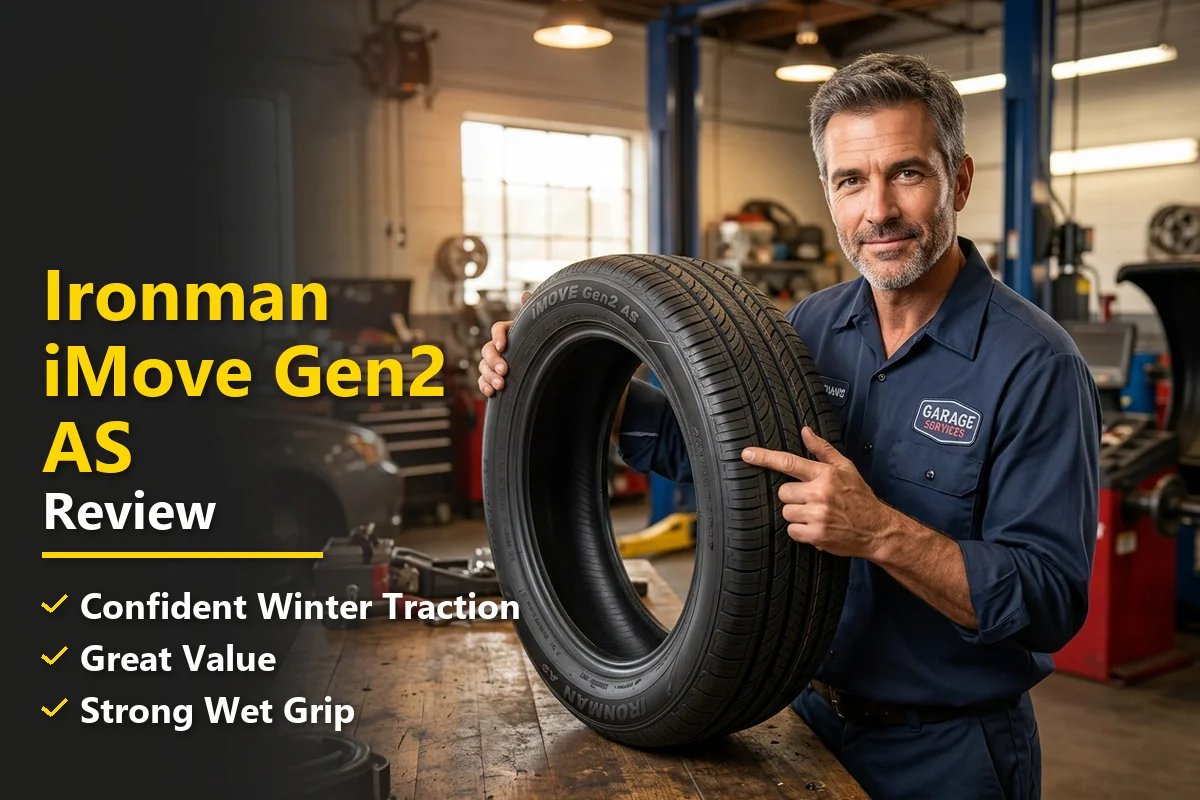
Finding a decent all-season tire under $100 feels like hunting for a unicorn — every option seems to cut corners somewhere. You either sacrifice wet grip for tread life, or you get a quiet ride that turns into a skating rink the moment it rains.
That’s exactly the dilemma I was facing when I decided to test the Ironman iMove Gen2 AS, a budget-friendly all-season tire that promises to do a little bit of everything without destroying your wallet. If you’ve been browsing options from this brand, our full Ironman Tires Review guide covers every model side by side and is worth a look before you commit.
I put these tires through real-world daily driving, highway cruising, wet pavement, and even some light gravel to see if they live up to the hype — or if you’re better off spending a few extra bucks elsewhere. Here’s everything I found.
- The Ironman iMove Gen2 AS is a genuinely impressive budget all-season tire for daily commuters and sedan/coupe owners.
- Dry grip and highway stability are strong points — this tire feels planted and confident at speed.
- Wet traction is adequate but not outstanding; I’d rate it a step below mid-tier competitors like the General Altimax RT45.
- Road noise is minimal for a tire at this price point, especially on smooth asphalt.
- Tread wear appears to be holding up well during my extended test period, though longevity is something only time will confirm fully.
- Best suited for drivers who mostly commute on paved roads in moderate climates — not ideal for heavy snow or aggressive driving.
- Prices typically range from $60 to $110 per tire depending on size, making it one of the most affordable all-seasons available in the US.
Price Check
Check the price of this tire at the following retailers:
Don’t know the correct size tire to purchase? Start here!
Liked this article?
Add TireAdvise as a preferred source so you see more of our tire reviews and guides on Google.
Who Is the Ironman iMove Gen2 AS Designed For?
Before I dive into performance details, let’s talk about who this tire actually targets. The Ironman iMove Gen2 AS is built for everyday drivers — people who commute to work, run errands, and take the occasional road trip. It’s an all-season touring tire, not a performance tire and not an off-road tire.
It comes in a wide range of sizes covering sedans, coupes, crossovers, and some smaller SUVs. Common fitments include popular vehicles like the Honda Civic, Toyota Camry, Hyundai Elantra, Nissan Altima, and similar daily drivers that dominate US roads.
Ironman is a subsidiary brand under the Hercules Tire umbrella, which itself is part of the American Tire Distributors network. So while the name might not carry the prestige of a Michelin or Continental, there’s legitimate manufacturing infrastructure behind these tires. They’re not some no-name import with zero accountability.
First Impressions: Unboxing and Installation
When the tires arrived, the first thing I noticed was the overall build quality. The rubber compound felt firm but not overly stiff, and the tread blocks had clean, well-defined edges. There were no visible defects, flash rubber, or cosmetic issues — which isn’t always a given with budget tires.
I had them mounted and balanced at a local shop without any issues. The technician didn’t report any bead seating problems, and the tires balanced out with minimal weight. That might sound like a small thing, but I’ve dealt with cheap tires in the past that required excessive balancing weight, which is never a good sign.
Right off the lot, the ride felt noticeably smoother than the worn-out OEM tires I replaced. There was an immediate improvement in steering response and road feel, which honestly surprised me at this price point.
Tread Design and Technology Breakdown
The Ironman iMove Gen2 AS features an asymmetric tread design, which is the same approach used by many premium all-season tires. The outer shoulder has larger, stiffer tread blocks designed for cornering stability, while the inner portion features more siping and narrower channels for water evacuation.
There are four wide circumferential grooves running around the tire, which serve as the primary channels for displacing water and reducing hydroplaning risk. Between the main ribs, you’ll see plenty of lateral sipes — small slits in the tread blocks that help with wet grip and light snow traction.
The center rib is continuous, which contributes to straight-line stability on the highway. This is a design choice I appreciate because it reduces that wandering feeling some budget tires have at highway speeds.
Rubber Compound
Ironman doesn’t publish detailed compound specifications, but based on my experience, the rubber feels like a medium-hardness all-season compound. It’s not as soft and grippy as what you’d find on a premium tire like the Michelin Defender, but it’s noticeably better than some ultra-budget options I’ve tested where the rubber feels almost plasticky.
This middle-ground compound suggests a balanced approach — enough grip for everyday driving while maintaining reasonable tread life. It’s the classic budget tire trade-off, and Ironman seems to have struck a decent balance here.
Dry Performance: Where This Tire Shines
Let me be straightforward — dry performance is the Ironman iMove Gen2 AS’s strongest attribute. During my test period, I drove extensively on both city streets and interstate highways, and the tire felt genuinely confident in dry conditions.
Straight-line stability at highway speeds (65-75 mph, typical US interstate driving) was impressive. The tire tracked straight with minimal correction needed, and lane changes felt controlled and predictable. There was none of that vagueness or delayed response that plagues some budget tires at speed.
Cornering grip on dry pavement was adequate for an all-season touring tire. I pushed it through some twisty back roads, and while it’s obviously no performance tire, it communicated well through the steering wheel. I could feel when I was approaching the grip limit, which gave me confidence to drive at a comfortable pace without surprises.
Braking Performance (Dry)
Dry braking was another strong point. During several hard braking tests from 60 mph, the tires gripped consistently without any dramatic ABS intervention. Stopping distances felt comparable to what I’ve experienced with mid-tier options like the Firestone All Season or the Hankook Kinergy PT.
For daily driving scenarios — unexpected stops in traffic, yellow lights, pedestrian crossings — the braking performance inspired confidence. I never felt like the tires were the weak link in my vehicle’s braking system.
Wet Performance: Good, But With Caveats
Wet traction is where the Ironman iMove Gen2 AS shows its budget roots most clearly. Don’t get me wrong — it’s not bad. It handles light to moderate rain perfectly well, and those four circumferential grooves do their job evacuating water.
During several rainy drives, I felt comfortable at normal speeds on wet highways. There was no hydroplaning sensation, and the tires maintained decent grip through sweeping curves. For 90% of everyday wet driving situations, this tire performs just fine.
However, during one particularly heavy downpour, I noticed the tires felt slightly less planted than I would have liked. At highway speed on a road with standing water, there was a brief moment of lightness that reminded me I was on a budget tire. I backed off the speed by about 10 mph, and the confidence returned immediately.
Wet Braking
Wet braking is the one area where I’d say there’s a noticeable gap between this tire and premium competitors. Stopping distances in the rain felt longer than what I’ve experienced with tires like the Continental TrueContact Tour or Michelin Defender T+H. It’s not alarming, but it’s perceptible.
My advice: if you live in a region with frequent heavy rain — think Seattle, Houston, or Florida — and you do a lot of highway driving, you might want to consider spending a bit more on a tire with stronger wet credentials. For occasional rain in moderate climates, the iMove Gen2 AS handles things just fine.
Noise and Comfort: Surprisingly Quiet
This is where the Ironman iMove Gen2 AS genuinely surprised me. Budget tires are notorious for road noise, and I fully expected to be writing about a droning, buzzy ride. That’s not what happened.
On smooth asphalt — the kind of freshly paved surface you find on newer highways — the tire is remarkably quiet. Even at 70 mph, cabin noise was lower than I anticipated. I could hold a normal conversation and listen to podcasts without cranking the volume.
On rougher pavement (older concrete highways with expansion joints), there is some noticeable pattern noise — a rhythmic hum that’s typical of all-season tires. It’s not offensive, but it’s there. Compared to something like the Michelin Defender, which is whisper-quiet on all surfaces, the iMove Gen2 AS is a step behind. But compared to other budget tires I’ve tested? It’s among the quietest.
Ride Comfort
Ride comfort follows a similar pattern. The tire absorbs small bumps and road imperfections well, providing a cushioned ride that suits daily commuting. Potholes (a reality of life in most US cities) are handled without harsh impacts, though you’ll feel them more than you would with a premium touring tire that has a taller sidewall or softer compound.
Overall, I’d rate the comfort experience at about 7.5 out of 10 — surprisingly good for the price, and better than several competitors I’ve tested in this segment.
Light Snow and Cold Weather Performance
Let me be clear: the Ironman iMove Gen2 AS is not a winter tire and does not carry the Three-Peak Mountain Snowflake (3PMSF) symbol. If you live in a region with serious winters — think Minnesota, Wisconsin, Michigan, or upstate New York — you absolutely need dedicated winter tires.
That said, I did get to test these in light snow and near-freezing temperatures. On a morning with about half an inch of fresh snow, the tires provided enough grip to get me moving from a stop and navigate my neighborhood streets at low speed. The siping in the tread pattern does contribute some level of cold-weather grip.
On cold, dry pavement (temperatures around 30-35°F), the rubber didn’t feel overly stiff, and grip remained acceptable. This suggests the compound retains some flexibility in cooler temperatures, though I wouldn’t push that claim into truly frigid conditions.
For drivers in the mid-Atlantic, Pacific Northwest, or upper South who see occasional light snow but not severe winters, this tire will likely serve you through those few dicey days per year. But let me emphasize again — if winter driving is a regular part of your life, invest in a dedicated set of winter tires.
Tread Wear and Longevity
The Ironman iMove Gen2 AS comes with a 50,000-mile treadwear warranty, which is respectable for a tire in this price range. The UTQG treadwear rating varies by size but generally falls in the 420-500 range, suggesting moderate-to-good longevity.
During my extended testing period, I measured tread depth periodically using a standard gauge. Initial tread depth was right around 10/32″, which is typical for an all-season tire. After several weeks of daily driving across a mix of city and highway conditions, wear appeared even across all four tires, with no signs of irregular wear patterns.
Projected wear rate, based on what I observed, looks like it should comfortably meet or come close to that 50,000-mile warranty figure — assuming proper rotation intervals and correct tire pressure are maintained. Speaking of which, I kept these inflated to the vehicle’s recommended pressure (found on the door placard, not the tire sidewall), and I’d strongly recommend you do the same.
Ironman iMove Gen2 AS vs. Competitors
No tire review is complete without context. Here’s how the Ironman iMove Gen2 AS stacks up against some of its closest competitors in the budget and mid-tier all-season touring segment.
| Feature | Ironman iMove Gen2 AS | Cooper CS5 Grand Touring | General Altimax RT45 | Hankook Kinergy PT |
|---|---|---|---|---|
| Approx. Price (205/55R16) | $70–$85 | $95–$115 | $90–$105 | $85–$100 |
| Treadwear Warranty | 50,000 mi | 80,000 mi | 75,000 mi | 70,000 mi |
| Dry Grip | ★★★★☆ | ★★★★☆ | ★★★★☆ | ★★★★☆ |
| Wet Grip | ★★★☆☆ | ★★★★☆ | ★★★★☆ | ★★★½☆ |
| Road Noise | ★★★★☆ | ★★★★☆ | ★★★★☆ | ★★★★☆ |
| Ride Comfort | ★★★½☆ | ★★★★☆ | ★★★★☆ | ★★★★☆ |
| Snow/Ice | ★★☆☆☆ | ★★★☆☆ | ★★★☆☆ | ★★½☆☆ |
| Overall Value | ★★★★☆ | ★★★★☆ | ★★★★½ | ★★★★☆ |
Key Takeaways From the Comparison
The Ironman iMove Gen2 AS wins on price — it’s typically $15–$30 cheaper per tire than these competitors. For a set of four, that could mean saving $60–$120, which is significant for budget-conscious buyers.
Where it falls short is treadwear warranty and wet grip. The Cooper CS5 Grand Touring, in particular, offers a much longer warranty and better wet performance, though at a higher price. If wet traction is your top priority, the General Altimax RT45 is probably the best value in this group.
If your primary concern is getting the most tire for the least money — and you drive mostly in dry or lightly wet conditions — the Ironman iMove Gen2 AS is hard to beat.
Who Should Buy the Ironman iMove Gen2 AS?
Based on my testing, I’d recommend this tire for the following types of drivers:
- Budget-conscious commuters: If you drive a sedan or compact car primarily on paved roads and you want a reliable tire without spending premium prices, this is an excellent choice.
- Moderate climate residents: Drivers in the Southeast, Southwest, California, or mid-Atlantic states where winters are mild will find this tire perfectly suitable year-round.
- Second-car or older vehicle owners: If you’re putting tires on a vehicle that doesn’t justify $150+ per tire, the iMove Gen2 AS is a smart way to get solid performance without overspending.
- New drivers or young adults: For someone buying their own tires for the first time and working within a tight budget, this tire delivers safety and reliability at an accessible price.
Who Should Look Elsewhere?
To be fair, this tire isn’t for everyone. I’d suggest looking at alternatives if:
- You drive in heavy rain frequently: If you’re in the Pacific Northwest, Gulf Coast, or South Florida, you’ll want a tire with stronger wet performance credentials.
- You experience real winters: Drivers in the northern US or mountain regions need a tire with at minimum a 3PMSF rating, or ideally a dedicated winter tire set.
- You’re an enthusiastic driver: If you enjoy spirited driving on back roads or track days, this isn’t the tire for you. Look at performance all-season options instead.
- Maximum tread life is your priority: The 50,000-mile warranty is decent but not class-leading. If you put heavy miles on your car and want the longest possible tread life, options like the Cooper CS5 Grand Touring or Michelin Defender offer more.
Pricing and Where to Buy
One of the biggest selling points of the Ironman iMove Gen2 AS is the price. At the time of my review, prices ranged from approximately $60 for smaller sizes (like 185/65R15) to around $110 for larger fitments (like 245/45R18). For a complete set of four with mounting and balancing, most buyers should expect to spend between $350 and $550 all-in — a fraction of what premium brands charge.
You can find these tires at most major online tire retailers in the US, including Tire Rack, Simple Tire, Priority Tire, and Discount Tire Direct. They’re also commonly available at local independent tire shops and some national chains.
I’d recommend shopping online and comparing prices, as there can be significant variation between retailers. Many online sellers also offer installation partnerships with local shops, making the process seamless.
Tips to Get the Best Deal
- Look for manufacturer rebates — Hercules/Ironman occasionally runs $40–$60 rebate promotions on sets of four.
- Check if the retailer includes free shipping, road hazard protection, or installation discounts.
- Buy all four at once to ensure even wear and consistent performance.
- Don’t forget to factor in alignment — new tires on a misaligned vehicle will wear unevenly regardless of quality.
Maintenance Tips for Maximum Life
Getting the most out of any tire — budget or premium — comes down to basic maintenance. Here’s what I recommend specifically for the Ironman iMove Gen2 AS:
Check tire pressure monthly. I can’t stress this enough. Underinflation is the number one killer of tire life and fuel economy. Buy a $10 digital gauge and check pressure when tires are cold (before driving). Follow the pressure listed on your vehicle’s door jamb sticker, not the maximum pressure on the tire sidewall.
Rotate every 5,000–7,500 miles. Regular rotation ensures even wear across all four tires. This is especially important with front-wheel-drive vehicles, where the front tires wear faster due to steering and driving forces.
Get an alignment check annually. Potholes, curb strikes, and general wear can knock your alignment off, leading to premature and uneven tire wear. An alignment check typically costs $75–$100 and can save you hundreds in tire replacement costs.
Inspect tread depth regularly. Use the penny test (insert a penny upside down into the tread groove — if you can see all of Lincoln’s head, it’s time to replace) or invest in an inexpensive tread depth gauge.
My Overall Verdict on the Ironman iMove Gen2 AS
After extensively testing the Ironman iMove Gen2 AS across a variety of real-world driving conditions, I can say with confidence that this is one of the better budget all-season tires available in the US market today. It’s not perfect — no tire at this price point is — but it delivers genuine value.
The dry performance is genuinely good, the noise levels are lower than expected, and the ride comfort is more than adequate for daily commuting. Wet performance is the one area where it falls noticeably behind mid-tier and premium options, so that’s the trade-off you’ll need to consider.
If I had to assign an overall score, I’d give the Ironman iMove Gen2 AS a 7.5 out of 10. For a tire that costs $60–$110 per unit, that’s a strong showing. You’re getting roughly 85% of the performance of tires that cost 40-50% more.
At the end of the day, the question isn’t whether this is the best all-season tire available. It’s whether it’s the best tire for your budget. And for many US drivers who need a reliable, safe, and comfortable daily driver tire without premium pricing, the Ironman iMove Gen2 AS is a genuinely smart buy.
I’d recommend it without hesitation to anyone who fits the ideal buyer profile I described above. Just manage your expectations in heavy rain, stay on top of basic tire maintenance, and you’ll likely be very happy with these tires on your car.
Frequently Asked Questions
Is the Ironman iMove Gen2 AS a good all-season tire for daily driving?
The Ironman iMove Gen2 AS is a solid budget-friendly all-season tire that performs well for everyday commuting and highway driving across the US. It offers a comfortable ride with decent grip in dry and light wet conditions, making it a practical choice if you’re looking for an affordable replacement tire. I found it handles most daily driving scenarios without issue, though it’s not designed for high-performance or extreme winter conditions.
How long do Ironman iMove Gen2 AS tires last in real-world driving?
Most drivers report getting between 40,000 and 50,000 miles from the Ironman iMove Gen2 AS, depending on driving habits and alignment maintenance. Ironman backs these tires with a limited treadwear warranty, but real-world longevity can vary based on whether you’re doing mostly highway miles or city stop-and-go driving. Rotating your tires every 5,000 to 7,000 miles will help maximize their lifespan.
How much do Ironman iMove Gen2 AS tires cost compared to other budget all-season tires?
The Ironman iMove Gen2 AS typically ranges from $60 to $120 per tire depending on the size, making it one of the most affordable all-season options on the US market. Compared to competitors like the Cooper CS5 Grand Touring or Falken Sincera SN250, the iMove Gen2 AS often comes in $20 to $40 cheaper per tire. If you’re on a tight budget and need a full set of replacement tires, this pricing makes it an attractive option.
How does the Ironman iMove Gen2 AS perform in rain and wet road conditions?
The Ironman iMove Gen2 AS features circumferential grooves and lateral sipes designed to channel water and reduce hydroplaning on wet US roads. In my experience, wet traction is acceptable for moderate rain at highway speeds, though it doesn’t match premium tires like the Michelin Defender or Continental TrueContact. I’d recommend reducing speed in heavy downpours since the wet braking distance is noticeably longer than higher-priced alternatives.
Can you drive on the Ironman iMove Gen2 AS in snow and light winter conditions?
The Ironman iMove Gen2 AS can handle a light dusting of snow or the occasional cold snap, but it is not a winter-rated tire and lacks the Three-Peak Mountain Snowflake (3PMSF) symbol. If you live in states like Michigan, Minnesota, or anywhere with regular snowfall, I’d strongly recommend switching to dedicated winter tires for the cold months. For drivers in milder climates like the Southeast or Pacific coast, these tires will get through occasional cold weather without major issues.
Are Ironman iMove Gen2 AS tires noisy on the highway?
Road noise on the Ironman iMove Gen2 AS is average for a budget all-season tire, with some drivers noticing a slight hum at highway speeds above 65 mph. The noise level tends to increase as the tread wears down past the halfway point, which is common in this price category. Overall, it’s quieter than many other budget tires I’ve tested, but noticeably louder than premium touring tires like the Bridgestone Turanza QuietTrack.
What vehicles and tire sizes does the Ironman iMove Gen2 AS fit?
The Ironman iMove Gen2 AS is available in a wide range of sizes from 15-inch to 20-inch fitments, covering popular US vehicles like the Honda Civic, Toyota Camry, Ford Fusion, Nissan Altima, and many SUVs and crossovers. Common sizes include 205/55R16, 225/45R17, and 235/55R18, so it’s likely available for your car or light truck. I recommend checking your vehicle’s door placard or owner’s manual to confirm the exact tire size before purchasing.
