

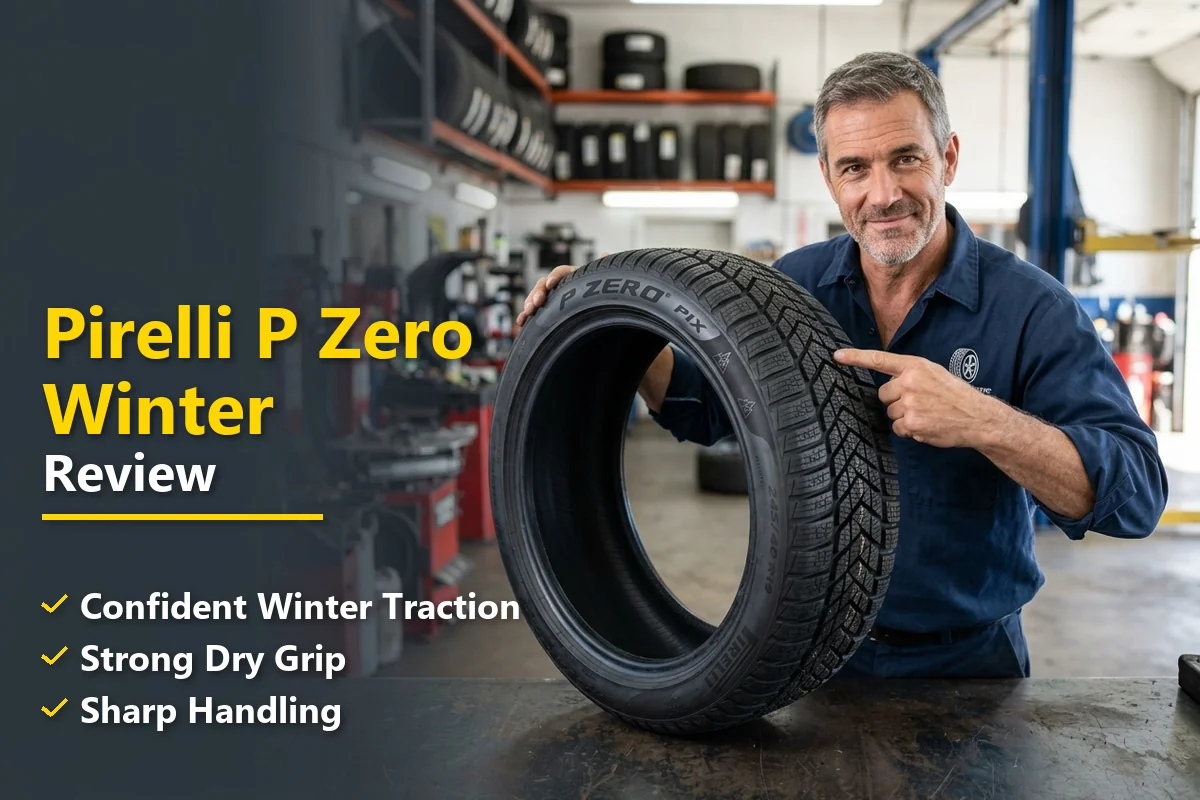
Most performance car owners face an uncomfortable choice every winter: park the car and wait for spring, or bolt on a set of clunky winter tires that completely strip away the driving experience you paid for.
The Pirelli P Zero Winter promises something different — genuine cold-weather safety without sacrificing the sharp handling and refined ride that makes a performance car worth driving. That’s a bold claim, and I wanted to see if it held up.
After spending an entire winter season testing these tires on my BMW 3 Series across highways, backroads, and snow-covered side streets, I have a lot to share.
If you’re exploring the full Pirelli lineup, our comprehensive Pirelli Tires Review guide covers every model side by side, but today I’m going deep on this specific winter performance tire.
- The Pirelli P Zero Winter delivers exceptional dry and wet grip in cold temperatures while maintaining the sporty character of the P Zero family.
- Snow traction is solid for a performance winter tire, though dedicated snow tires still edge it out in deep accumulation.
- Ride comfort and noise levels are surprisingly refined — you won’t feel like you downgraded.
- Pricing runs $200–$400+ per tire depending on size, making it a premium investment.
- Best suited for drivers of performance sedans, sports cars, and luxury vehicles who refuse to compromise on handling during winter months.
- Available in staggered fitments and large diameters — ideal for cars that can’t run standard winter tires.
Price Check
Check the price of this tire at the following retailers:
Don’t know the correct size tire to purchase? Start here!
Liked this article?
Add TireAdvise as a preferred source so you see more of our tire reviews and guides on Google.
What Exactly Is the Pirelli P Zero Winter?
The Pirelli P Zero Winter isn’t just another winter tire with a famous name slapped on it. It’s a purpose-built cold-weather tire designed specifically for high-performance and luxury vehicles, developed using Pirelli’s Formula 1 experience and their close partnerships with automakers like BMW, Mercedes-AMG, Porsche, and McLaren.
This tire carries the 3PMSF (Three-Peak Mountain Snowflake) symbol, which means it meets the industry standard for severe snow service. But here’s what makes it different from your typical Blizzak or Altimax: it’s engineered to preserve the driving dynamics of a sports car.
Think of it as the winter counterpart to the legendary summer P Zero. If you’ve read my Pirelli P Zero Review, you know how highly I rate that tire for warm-weather performance. The P Zero Winter aims to deliver that same confident, connected feel when temperatures drop below 45°F.
My Testing Conditions and Setup
I tested the Pirelli P Zero Winter in size 225/45R18 on my 2022 BMW 330i xDrive throughout the winter season in the northeastern United States. This gave me exposure to everything from dry cold days in the 20s and 30s to mixed precipitation, freezing rain, and several significant snowstorms.
My daily commute covers a mix of highway driving, suburban roads, and a few steep hills that become genuinely treacherous when conditions deteriorate. I also made several longer trips through Pennsylvania and upstate New York during the test period, which added highway cruising and mountain driving to the mix.
I ran the tires at Pirelli’s recommended pressure of 35 PSI front and 38 PSI rear, checking pressure weekly as cold weather can cause fluctuations. The car’s stability control and all-wheel-drive system remained active throughout testing — this is a real-world review, not a track test.
Dry Cold-Weather Performance
Let me start with what surprised me most: the dry grip in cold temperatures. Many winter tires feel vague and squishy on cold but dry pavement, almost like driving on gummy erasers. The P Zero Winter doesn’t do that.
During the first few days after installation, I noticed the steering response remained crisp and communicative. Turn-in was precise, and the tire didn’t exhibit the excessive sidewall flex that plagues many winter tires in corners. This is a tire that actually wants to be driven with enthusiasm.
On dry highways at speed, the P Zero Winter tracked straight and true with zero wander. Lane changes felt confident and controlled. Braking distances on cold, dry pavement were noticeably shorter than the all-season tires I’d been running previously.
I’d describe the dry-road character as about 85% of what the summer P Zero offers in warm weather. That remaining 15% is the slight softness in the compound that makes winter traction possible. For a winter tire, that’s an extraordinary achievement.
Wet and Rainy Conditions
Cold rain is arguably the most common winter hazard for most US drivers, especially in the mid-Atlantic and Pacific Northwest regions. The P Zero Winter handles wet roads exceptionally well.
The directional tread pattern features wide circumferential grooves that channel water efficiently. During heavy rain on the highway, I never experienced even a hint of hydroplaning at legal speeds. The tire maintained solid contact with the road surface even through standing water.
Cornering grip on wet surfaces impressed me repeatedly. There’s a long sweeping on-ramp near my office that I use as an informal wet-grip benchmark, and the P Zero Winter took it with noticeably more confidence than my previous all-season setup. The breakaway, when I occasionally pushed harder than I should have, was progressive and predictable rather than sudden.
Braking in the wet was equally confidence-inspiring. The ABS rarely activated during normal driving, which tells me the mechanical grip was doing its job well before the electronics needed to intervene.
Snow Traction: Where It Really Matters
Here’s the section most of you are here for. How does the Pirelli P Zero Winter handle actual snow?
In light to moderate snowfall — the kind where you can still see pavement peeking through, or there’s an inch or two of accumulation — the P Zero Winter is genuinely excellent. The dense siping pattern bites into the snow surface, and the tire compound remains pliable enough to conform to irregularities. Starting from a stop on snow-covered roads required no drama, and the car pulled away smoothly without excessive wheelspin.
During one particularly memorable morning after several inches of overnight snowfall, I drove through unplowed residential streets without significant difficulty. The tire clawed for traction effectively, and hill starts on moderate grades were manageable.
However, I want to be honest here. In deep, unplowed snow exceeding four or five inches, the P Zero Winter shows its performance-oriented nature. A dedicated winter tire like the Bridgestone Blizzak WS90 or Continental VikingContact 7 would outperform it in these extreme conditions. The P Zero Winter’s tread depth and block design prioritize dry and wet handling, which means some deep-snow capability is traded away.
For most US drivers who stick to plowed roads and deal with occasional moderate accumulation, this tire is more than adequate. If you regularly navigate rural unplowed roads or live in areas with heavy lake-effect snow, a more traditional winter tire might serve you better.
Ice Performance
Ice is the great equalizer — no tire handles ice truly well, and anyone who claims otherwise is selling something. That said, the P Zero Winter performs respectably on icy surfaces.
On black ice patches and lightly iced-over intersections, the tire provided enough grip for careful, controlled driving. The compound’s cold-temperature flexibility helps here, as a frozen all-season tire would simply slide on the same surface. I noticed the ABS activating during hard braking on ice, which is expected, but the stopping distances felt reasonable.
The real differentiator on ice is driving style, not tire choice. With the P Zero Winter, I felt confident driving cautiously on icy roads, but I never forgot that ice demands respect regardless of what rubber you’re running.
Ride Comfort and Noise
This is where the Pirelli P Zero Winter really separates itself from the winter tire pack. Most winter tires are noticeably louder and less refined than their all-season or summer counterparts. The P Zero Winter bucks that trend.
Road noise is remarkably low for a winter tire. On smooth highway surfaces, the tire is nearly as quiet as a good touring tire. There’s a slight hum at speeds above 65 mph that I can detect when the radio is off, but it’s never intrusive or fatiguing.
On rough pavement, the tire absorbs impacts with a composed, solid feel rather than the hollow thump you get from many winter tires. This refinement makes sense when you consider that this tire was developed in partnership with luxury and performance automakers who demand NVH (Noise, Vibration, Harshness) standards that match their vehicles’ premium character.
Ride comfort overall is excellent. The tire smooths out frost heaves, expansion joints, and rough patches without feeling disconnected from the road. It’s a difficult balance to achieve, and Pirelli nailed it.
Handling and Steering Feel
For performance car enthusiasts, this section matters as much as snow traction. The entire reason the P Zero Winter exists is to let you enjoy your car through the cold months.
Steering feel through the P Zero Winter is direct and informative. I could sense what the front tires were doing at all times, which builds enormous confidence in varying conditions. The tire communicates surface changes — from dry to damp to snow-dusted — through the steering wheel in a way that most winter tires simply cannot.
Mid-corner stability is impressive. The tire doesn’t feel like it’s rolling over onto the sidewall during aggressive cornering, thanks to a reinforced internal structure. If you’ve read my Pirelli P Zero Pz4 Review, you’ll recognize similar DNA in how the tire responds to lateral loads — the P Zero Winter is clearly cut from the same cloth.
Turn-in response is sharp by winter tire standards. There’s no delay or mushiness when you point the car into a corner. Combined with the predictable limit behavior I mentioned in the wet section, this makes the P Zero Winter genuinely enjoyable to drive spiritedly in appropriate conditions.
Treadwear and Durability
Winter tires inherently use softer compounds than all-season or summer tires, which means they wear faster — especially if you run them in warm weather. The P Zero Winter is no exception, but Pirelli has done a commendable job with compound longevity.
After several months of daily winter driving, my tires showed even, moderate wear across the tread surface. The wear pattern was uniform, which tells me the tire’s contact patch is well-optimized. No cupping, no uneven shoulder wear, no anomalies to report.
I want to emphasize something critical: remove these tires once temperatures consistently stay above 50°F. Running winter tires in warm weather will dramatically accelerate wear and degrade performance. This isn’t a P Zero Winter-specific issue — it applies to every winter tire on the market.
Many drivers I talk to resist the hassle of seasonal tire swaps, and I understand that frustration. But the performance and longevity benefits of running purpose-built tires for each season are enormous. If storage and swapping feel like too much hassle, many tire shops and dealers offer seasonal storage programs.
Pricing and Value Assessment
Let’s address the elephant in the room: the Pirelli P Zero Winter is expensive. In the US market, expect to pay roughly $200 to $400+ per tire depending on your size. Larger and staggered fitments for Porsches, AMGs, and M cars can push well north of $400 each.
That puts a set of four somewhere between $800 and $1,600+ before mounting, balancing, and any TPMS sensor costs. It’s a significant investment.
Is it worth it? That depends entirely on your priorities and your vehicle. If you’re driving a $60,000+ sports sedan or a six-figure sports car, spending $1,200-$1,600 on winter tires that preserve your car’s character and protect your investment makes financial sense. The cost of a single winter accident — body damage, deductible, rental car, depreciation hit — dwarfs the tire expense.
If you’re looking for the most cost-effective winter traction and you drive a mainstream sedan, there are excellent options at half the price. But those tires won’t deliver the handling precision, ride refinement, or fitment options that the P Zero Winter provides for performance vehicles.
Price Comparison Table
| Tire | Type | Approx. Price (225/45R18) | Best For |
|---|---|---|---|
| Pirelli P Zero Winter | Performance Winter | $250–$320 | Performance/luxury cars, sporty handling |
| Michelin Pilot Alpin PA4 | Performance Winter | $220–$290 | Balanced performance and winter grip |
| Continental WinterContact TS 860 S | Performance Winter | $230–$300 | Excellent wet/dry, strong snow grip |
| Bridgestone Blizzak WS90 | Studless Ice & Snow | $150–$200 | Maximum snow/ice traction, mainstream vehicles |
| Continental VikingContact 7 | Studless Ice & Snow | $140–$190 | Severe winter conditions, comfort |
Who Should Buy the Pirelli P Zero Winter?
This tire has a specific audience, and that’s not a criticism — it’s a sign of intelligent product engineering. Here’s who I think should seriously consider the P Zero Winter:
- Performance sedan and sports car owners who drive their cars year-round and refuse to accept sloppy winter tire handling.
- Luxury vehicle owners who want winter safety without sacrificing the refined ride their car was designed to deliver.
- Drivers with staggered fitments — the P Zero Winter is available in the wide rear sizes and large diameters that many performance cars require, where options from other brands are limited or nonexistent.
- BMW, Mercedes, Porsche, and Audi drivers — many P Zero Winter sizes carry OE (Original Equipment) markings from these manufacturers, ensuring perfect compatibility.
- Enthusiasts in moderate winter climates — if you deal with cold temperatures and occasional snow but not Arctic-level conditions, this tire is ideal.
Who Should Look Elsewhere
- Budget-conscious shoppers — there’s no getting around the premium pricing. Excellent winter tires exist at lower price points.
- Drivers in extreme snow regions — if you regularly face deep snow, ice storms, and unplowed roads, a dedicated studless ice and snow tire will serve you better.
- Mainstream vehicle owners — if you drive a Camry or Civic, you simply don’t need this tire. Spend less and get great winter traction from a Blizzak or VikingContact.
How It Compares to the Pirelli Lineup
Pirelli’s tire range is broad, and it helps to understand where the P Zero Winter fits within the family.
The summer Pirelli P Zero is the tire that built the performance legend. The P Zero Winter is its cold-weather sibling — same DNA, different compound and tread design. You swap between these two seasonally for the ultimate year-round setup.
If you’re driving a more comfort-oriented vehicle and want an all-around touring tire for warmer months, check out my Pirelli Cinturato P7 Review. The Cinturato line prioritizes comfort and efficiency over outright performance, and it pairs better with a standard winter tire rather than the P Zero Winter.
For eco-conscious drivers interested in Pirelli’s greener offerings, my Pirelli Cinturato P7 Blue Review covers their low rolling resistance option that maximizes fuel economy. Again, a different audience than the P Zero Winter buyer.
Installation Tips and Practical Advice
A few practical notes from my experience that will save you time and money:
Get a dedicated set of wheels. If you plan to swap between summer and winter tires annually, buying a second set of wheels (even less expensive steel or alloy wheels) will save you significant money over time versus paying for mount-and-balance twice a year. It also reduces the risk of bead damage from repeated tire changes.
Don’t mix with other tires. Run all four P Zero Winters together. Mixing winter and non-winter tires creates unpredictable handling, especially in emergency maneuvers. This applies to all winter tires, not just Pirellis.
Check TPMS compatibility. If you’re running a second set of wheels, you’ll need TPMS sensors for them as well. Many tire shops can clone your existing sensors or install aftermarket units for $40-$60 per wheel.
Install early. Don’t wait for the first snowstorm. I install my winter tires when overnight temperatures consistently dip below 45°F, usually in late October or early November in the Northeast. Winter tire compound works best in cold temperatures — even before snow arrives.
Technology Behind the P Zero Winter
Pirelli doesn’t just slap a softer compound on a summer tread pattern and call it a winter tire. The P Zero Winter incorporates several specific technologies worth understanding.
The tread compound uses a high-silica formulation that maintains flexibility well below freezing. This is fundamentally different from summer compounds, which harden like plastic in cold weather and lose all meaningful grip. The P Zero Winter’s compound transitions smoothly across a wide temperature range, remaining effective from just above freezing down to well below zero.
The tread pattern is directional, meaning it’s designed to rotate in only one direction. This allows for aggressive V-shaped grooves that evacuate water and slush efficiently. The sipe density is much higher than a summer tire, with thousands of thin cuts across the tread blocks that create additional biting edges for snow and ice traction.
Pirelli also uses what they call a “dual compound” approach in certain sizes, with a harder compound at the base of the tread blocks for stability and a softer compound at the surface for grip. This helps maintain the responsive handling feel that the P Zero name demands.
Real-World Scenarios: My Day-to-Day Experience
I want to share a few specific moments from my testing period that crystallized my opinion of this tire.
The morning commute after the first real snowfall: About four inches had fallen overnight, and the plows hadn’t reached my neighborhood yet. I pulled out of my driveway, and the P Zero Winters hooked up immediately. No wheelspin, no drama. The car tracked straight through the unplowed street, and I merged onto a partially cleared highway without any anxiety. I remember thinking, “This is why winter tires exist.”
Highway driving in freezing rain: This is the scenario that terrifies me most as a driver. The road surface was wet and hovering right at freezing. The P Zero Winter maintained confident grip through gentle curves and during braking for slower traffic ahead. I never felt the car searching for traction, which allowed me to stay calm and focused.
A spirited drive on a cold, dry Saturday: This is where the tire truly shines. Temperatures were in the low 30s, roads were bone dry, and I took my favorite back road loop. The car felt alive — responsive, balanced, communicative. If someone had told me I was running summer tires on a mild autumn day, I might have believed them. The P Zero Winter simply doesn’t feel like a compromise.
Potential Drawbacks to Consider
No tire is perfect, and I owe you an honest assessment of the P Zero Winter’s weaknesses.
Deep snow limitation: As I mentioned earlier, this tire won’t match a dedicated deep-snow tire in heavy accumulation. If your winters regularly involve fighting through unplowed roads, consider something more aggressive.
Price: There’s no way around it — this is a premium product at premium pricing. The cost of entry is high, and for some drivers, the performance advantages over a $150-per-tire winter option may not justify the difference.
Limited size availability for mainstream cars: The P Zero Winter is available primarily in sizes that fit performance and luxury vehicles. If you drive a standard sedan or compact car, you may not find a size that fits, and frankly, this tire wasn’t designed for you anyway.
Warm-weather wear: Like all winter tires, the P Zero Winter will wear rapidly if you leave it on past the cold season. Discipline in your seasonal swap schedule is essential.
My Final Verdict
After living with the Pirelli P Zero Winter through an entire cold season, I can confidently say it’s the best performance winter tire I’ve tested. It delivers on its core promise: real winter safety without stripping away the driving experience that makes performance cars special.
The dry handling is extraordinary for a winter tire. Wet grip is excellent. Snow traction is more than adequate for the vast majority of US winter driving scenarios. And the ride comfort and noise levels set a standard that competitors struggle to match.
Is it worth the money? If you drive a performance or luxury vehicle and you’re committed to running the right tires for each season, absolutely yes. The P Zero Winter protects both your safety and your investment while letting you actually enjoy your car through the cold months.
For those on a tighter budget or driving mainstream vehicles, there are excellent winter tires available for less money. But for the target audience — enthusiasts who refuse to compromise — the Pirelli P Zero Winter is the gold standard.
If you’re still weighing your options across Pirelli’s performance range, I’d encourage you to also read my Pirelli P Zero Pz4 Review to understand the summer counterpart. Running the PZ4 in warm months and the P Zero Winter in cold months creates what I consider the ultimate year-round tire strategy for performance vehicles.
Drive safe this winter, and don’t cheap out on the four patches of rubber that connect you to the road.
Frequently Asked Questions
Is the Pirelli P Zero Winter a true winter tire or a performance all-season?
The Pirelli P Zero Winter is a dedicated winter tire designed specifically for high-performance and luxury vehicles, not an all-season. It carries the 3PMSF (Three-Peak Mountain Snowflake) symbol, meaning it meets established traction standards for severe snow conditions. This makes it a genuine cold-weather tire engineered to maintain the sporty handling characteristics P Zero owners expect while delivering real winter grip.
How does the Pirelli P Zero Winter perform on ice and packed snow in US winter states?
In my experience and based on widespread driver feedback, the P Zero Winter handles packed snow confidently and provides solid braking performance on icy roads, especially compared to running summer tires in winter. It excels in states like Michigan, Minnesota, and the Northeast where you encounter a mix of cold dry pavement, slush, and moderate snowfall. That said, if you regularly face deep unplowed snow, a dedicated non-performance winter tire with more aggressive siping may serve you better.
What vehicles is the Pirelli P Zero Winter best suited for?
The P Zero Winter is purpose-built for high-performance and luxury vehicles such as the BMW M series, Porsche 911, Mercedes-AMG models, Tesla Model S and Model 3 Performance, and Audi RS line. Pirelli designed it to handle the higher horsepower and torque outputs of these cars without sacrificing winter safety. If you drive a standard commuter sedan or SUV, there are more cost-effective winter tire options that will serve you just as well.
How much does a set of Pirelli P Zero Winter tires cost in the US?
Prices for the Pirelli P Zero Winter typically range from $250 to $450 per tire depending on the size, with staggered fitments for sports cars often pushing toward the higher end. A full set for a vehicle like a Porsche 911 or BMW M3 can run $1,200 to $1,800 before mounting and balancing. I recommend checking Tire Rack, Discount Tire, and local Pirelli dealers for the best pricing and seasonal rebate offers, as Pirelli frequently runs promotions heading into winter.
How long do Pirelli P Zero Winter tires last compared to other winter tires?
Most drivers report getting around 15,000 to 25,000 miles out of a set of Pirelli P Zero Winter tires, which is fairly standard for a high-performance winter tire. The softer compound that gives it excellent cold-weather grip also means faster treadwear compared to a touring winter tire like the Michelin Pilot Alpin. To maximize tread life, make sure to swap them off once temperatures consistently stay above 45°F in spring, as running them in warm weather accelerates wear significantly.
How does the Pirelli P Zero Winter compare to the Michelin Pilot Alpin PA4 and Continental WinterContact TS 860 S?
The P Zero Winter tends to edge out competitors in dry cold-weather handling and high-speed stability, which makes sense given Pirelli’s motorsport DNA. The Michelin Pilot Alpin PA4 offers slightly better ice traction and a quieter ride, while the Continental WinterContact TS 860 S strikes a strong balance between snow performance and tread longevity. If your priority is maintaining a sporty, connected driving feel during winter, the P Zero Winter is arguably the best choice among the three.
Can I use Pirelli P Zero Winter tires year-round instead of switching back to summer tires?
I strongly advise against running the P Zero Winter year-round. The soft winter compound degrades rapidly in warm temperatures, leading to poor handling, longer braking distances, and drastically reduced tread life once it’s consistently above 50°F. US drivers in seasonal climates should plan to swap back to their summer or all-season tires in spring. Investing in a second set of wheels for easy seasonal swaps will save you money in the long run and keep you safer in every season.
