

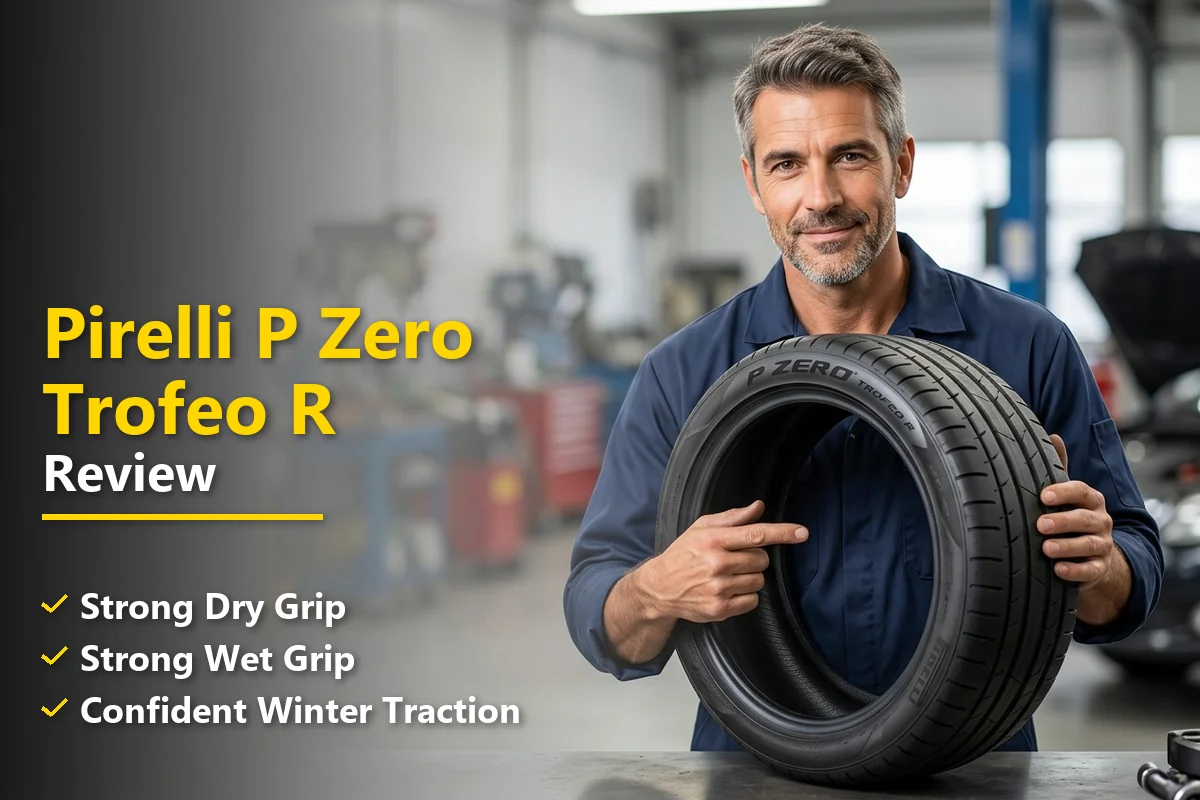
You’ve just bought a car that was built to attack corners — maybe a Porsche GT3, a McLaren, or a Corvette Z06 — and now you’re staring at your tire options wondering: do I really need a semi-slick street-legal tire, or is it overkill?
If you’ve ever pushed a set of regular performance tires on a track day and felt them turn into greasy bars of soap after three hot laps, you already know the answer. The gap between a high-performance street tire and a dedicated track-focused tire is enormous, and the Pirelli P Zero Trofeo R sits right in that thrilling, slightly terrifying sweet spot.
Before diving into my full breakdown, I’d recommend checking out our comprehensive Pirelli Tires Review guide if you’re still deciding which Pirelli model fits your driving style — it covers the entire lineup from daily drivers to track-day weapons like this one.
- The Pirelli P Zero Trofeo R is a street-legal semi-slick tire designed primarily for track use and spirited canyon driving
- Dry grip is absolutely phenomenal — it’s in a different league compared to standard performance tires
- Wet performance is predictable but limited; this is not a rain tire by any stretch
- Tread life is short; expect significantly less longevity than a conventional performance tire
- Road noise and ride comfort are surprisingly acceptable for a tire this aggressive
- Best suited for drivers who regularly attend track days, autocross events, or simply demand the ultimate in dry grip
- Prices range from roughly $280 to $550+ per tire depending on size
Price Check
Check the price of this tire at the following retailers:
Don’t know the correct size tire to purchase? Start here!
Liked this article?
Add TireAdvise as a preferred source so you see more of our tire reviews and guides on Google.
What Exactly Is the Pirelli P Zero Trofeo R?
Let me be clear right upfront: the Pirelli P Zero Trofeo R is not a tire for everyone. It’s a DOT-legal, semi-slick performance tire that Pirelli designed for drivers who spend serious time on track. If you’ve looked at the regular Pirelli P Zero Review and thought “I need something even more extreme,” then the Trofeo R is your answer.
The “R” in the name stands for “Racing,” and Pirelli isn’t being coy about it. This tire features a tread compound derived from Pirelli’s motorsport division — the same people who make tires for Formula 1. The tread pattern is asymmetric with massive outer shoulder blocks for cornering stability and a relatively open inner section for water evacuation, though “water evacuation” is a generous term for a tire with this little tread void.
It’s available in a wide range of sizes fitting everything from hot hatches to full-blown supercars, with rim diameters spanning from 18 inches to 21 inches. Many of the fitments are staggered setups designed for specific OEM applications — Porsche, Ferrari, McLaren, and Lamborghini all offer the Trofeo R as a factory option.
My Testing Setup and Conditions
I tested a set of Pirelli P Zero Trofeo R tires in 245/35ZR20 (front) and 305/30ZR20 (rear) on a Porsche 911 GT3. My evaluation covered both track sessions at a regional circuit and real-world street driving including highway commuting and canyon roads.
During my test period, I experienced a range of conditions: blazing hot summer asphalt (surface temperatures well above 120°F), mild mornings with cool pavement, and a couple of unexpected rain showers that gave me a chance to evaluate wet grip. I also drove on typical US highway surfaces, rough city streets, and some genuinely terrible pavement in construction zones.
I want to emphasize that I approached this review as both an enthusiast driver and a practical evaluator. I wanted to know not just how fast this tire is on track, but whether it’s livable as a street tire — because that’s the promise of a DOT-legal semi-slick.
Dry Performance: Where the Trofeo R Absolutely Dominates
Let’s get straight to the main event. On dry pavement, the Pirelli P Zero Trofeo R is absolutely stunning. The grip levels are so far beyond what a standard performance tire offers that it genuinely recalibrates your understanding of what’s possible on a street-legal tire.
Cornering Grip
The lateral grip is immense. I was consistently carrying more speed through corners than I ever thought possible, and the tire communicated its limits with remarkable clarity. There’s a progressive buildup of slip angle as you approach the limit, and the breakaway — when it finally comes — is gentle and predictable rather than sudden and violent.
On track, I was pulling sustained lateral g-forces that had me pressing hard against the bolsters of my seat. The tire just hooks up and refuses to let go. The massive outer shoulder blocks do their job beautifully, supporting the carcass under heavy cornering loads without folding over or going mushy.
Braking Performance
Braking distances on the Trofeo R are shockingly short. I noticed an immediate and dramatic improvement compared to regular ultra-high-performance tires. The compound bites into the pavement with fierce determination, and the ABS intervention threshold is noticeably higher — meaning you’re generating more deceleration force before the electronics need to step in.
After several days of driving that included repeated hard braking zones on track, the tire maintained consistent braking performance without significant degradation. That’s the hallmark of a properly engineered competition compound.
Traction and Acceleration
Putting power down out of corners is where I felt the Trofeo R’s racing DNA most viscerally. The traction control system barely intervened, even during aggressive corner exits in second and third gear. The rear tires hooked up with a tenacity that made the car feel significantly more powerful — not because anything changed under the hood, but because so much less energy was being wasted in wheel spin.
Heat Cycling and Track Endurance
One area where the Trofeo R genuinely impressed me is heat management. Many semi-slick tires come alive after a warm-up lap but then overheat and lose grip after sustained abuse. The Trofeo R has a wider operating window than I expected.
During my track sessions, the tires came up to temperature within about half a lap and then stayed remarkably consistent for extended stints. I did notice some grip drop-off during particularly long sessions on hot days, but it was gradual and predictable — never a cliff-edge loss of performance.
The compound also recovered well between sessions. After a cool-down period, the tires felt nearly as fresh as they did at the start of the day. That’s a huge deal for drivers who attend full-day track events.
Wet Performance: Proceed with Extreme Caution
Here’s where I need to deliver some honest, potentially life-saving advice: the Pirelli P Zero Trofeo R is not a wet-weather tire. Period. If you’re comparing it to something like the tires in our Pirelli Cinturato P7 Blue Review, which excels in wet conditions and fuel efficiency, the Trofeo R is on the opposite end of the spectrum.
That said, it’s not completely hopeless in the rain. During the unexpected showers I encountered, I found that the tire does evacuate enough water to maintain basic traction at moderate speeds. Light rain on warm pavement was manageable. I could drive at normal traffic speeds without feeling like I was ice skating.
However, standing water is genuinely dangerous. The minimal tread depth and limited groove volume mean hydroplaning begins at speeds that would be perfectly safe on a conventional tire. I reduced my speed significantly in heavy rain and increased my following distances dramatically. If you live somewhere with frequent rain, this is not the tire for you as a daily driver.
Ride Comfort and Road Noise
I was genuinely surprised by the Trofeo R’s street manners. I expected it to be absolutely brutal on public roads — stiff, noisy, and punishing. The reality is more nuanced than that.
Comfort
The ride is firm, no question about it. You feel road imperfections that would be completely absorbed by a touring tire. Expansion joints produce a noticeable thump, and rough pavement generates a constant low-frequency vibration through the chassis.
But it’s not unbearable. On smooth US highways, the ride is actually quite tolerable. I drove for extended periods on the interstate without arriving at my destination feeling beaten up. The sidewall construction, while stiff for cornering performance, still has enough compliance to take the edge off most road imperfections.
Noise
Road noise is higher than a standard performance tire, but again, it’s less dramatic than I anticipated. There’s a constant hum at highway speeds that’s noticeable but not overwhelming. It doesn’t drown out conversation or the stereo. At lower speeds around town, the noise is actually quite reasonable.
The most noticeable sound characteristic is a slightly sticky quality to the tire noise — you can hear the compound gripping the pavement in a way that softer compounds do. It’s actually kind of satisfying if you’re an enthusiast, like audible confirmation that your tires are working hard.
Tread Life: The Unavoidable Trade-Off
Let’s address the elephant in the room. The Pirelli P Zero Trofeo R will not last anywhere near as long as a conventional performance tire. The soft compound that delivers otherworldly grip also wears quickly, especially under track use.
After several days of combined track and street driving during my test period, I could already see meaningful tread wear. The rear tires, bearing the brunt of acceleration forces, showed more wear than the fronts. This is entirely expected for a tire in this category.
If you’re using the Trofeo R exclusively for track days — mounting them at the circuit and switching back to street tires for the drive home — you’ll get considerably more events out of them. But if you’re daily driving on them and hitting the occasional track day, expect to replace them with uncomfortable frequency. This is a tire where cost-per-smile is more relevant than cost-per-distance.
For drivers who want more tread life without completely sacrificing performance, the standard P Zero might be worth considering — check out our Pirelli P Zero Pz4 Review for a detailed look at that more street-oriented option.
Comparison: Trofeo R vs. Key Competitors
No tire exists in a vacuum, so let me compare the Trofeo R against its primary rivals in the US market.
| Feature | Pirelli P Zero Trofeo R | Michelin Pilot Sport Cup 2 | Bridgestone Potenza RE-71RS | Goodyear Eagle F1 SuperSport RS |
|---|---|---|---|---|
| Tire Type | Semi-Slick | Semi-Slick | Extreme Performance | Semi-Slick |
| Dry Grip | ★★★★★ | ★★★★★ | ★★★★☆ | ★★★★★ |
| Wet Grip | ★★☆☆☆ | ★★★☆☆ | ★★★☆☆ | ★★☆☆☆ |
| Tread Life | ★★☆☆☆ | ★★★☆☆ | ★★☆☆☆ | ★★☆☆☆ |
| Street Comfort | ★★★☆☆ | ★★★☆☆ | ★★☆☆☆ | ★★★☆☆ |
| Heat Resistance | ★★★★★ | ★★★★☆ | ★★★☆☆ | ★★★★☆ |
| Approx. Price (per tire) | $280–$550+ | $260–$520+ | $180–$320 | $300–$500+ |
| Size Range | 18″–21″ | 17″–21″ | 15″–18″ | 18″–20″ |
Trofeo R vs. Michelin Pilot Sport Cup 2
This is the comparison everyone wants. In my experience, the Trofeo R and the Cup 2 are incredibly close in outright dry grip. The Trofeo R has a slight edge in sustained high-heat performance — it’s more consistent during extended track sessions on hot days. The Cup 2, on the other hand, offers marginally better wet-weather capability and tends to last a bit longer.
If you’re doing primarily track work in dry conditions, I’d give the nod to the Trofeo R. If you want a little more versatility and your local climate includes frequent rain, the Cup 2 is the safer choice.
Trofeo R vs. Bridgestone Potenza RE-71RS
The RE-71RS is an outstanding tire and considerably more affordable, but it lives in a slightly different segment. It’s available in smaller sizes suitable for lighter cars like Miatas and BRZs, while the Trofeo R targets the supercar and GT car market. The RE-71RS also tends to overheat more quickly during extended track sessions, making it better suited for autocross and shorter sprint events.
Trofeo R vs. Goodyear Eagle F1 SuperSport RS
The Goodyear is a worthy competitor that offers similar dry grip levels. In my testing, the Trofeo R felt slightly more progressive at the limit, giving me more confidence to push harder. The Goodyear, however, is competitive on price and availability in the US market.
Technology and Construction
Understanding what’s under the rubber helps explain why the Trofeo R performs the way it does. Pirelli has packed this tire with their most advanced technologies.
Compound
The tread compound is a bi-compound design. The outer shoulder uses a harder compound for durability under cornering stress, while the inner portion uses a softer compound for traction. This dual-compound approach helps the tire balance grip and longevity — well, as much longevity as a semi-slick can offer.
Construction
The carcass uses a high-stiffness nylon cap ply and a reinforced bead area to maintain tire shape under extreme loads. This is critical on track, where forces are high enough to distort a standard tire’s sidewall and change the contact patch geometry. The Trofeo R maintains its shape remarkably well, which translates to predictable handling even at the limit.
Tread Design
The asymmetric tread pattern features large, interconnected blocks on the outer shoulder for maximum cornering rigidity. The inner shoulder has slightly more void for basic water dispersion. The center rib provides stability during straight-line driving and braking. There’s minimal siping compared to a street tire — just enough for DOT compliance and basic wet-surface function.
Who Should Buy the Pirelli P Zero Trofeo R?
I’ve spent enough time with these tires to have a very clear picture of the ideal buyer. Let me break it down.
This Tire Is Perfect For:
- Dedicated track day enthusiasts who attend multiple HPDE events per year and want a DOT-legal tire that approaches full racing slick performance
- Owners of factory-spec supercars and GT cars (Porsche GT3/GT4, Ferrari, McLaren, Corvette Z06) who want to exploit their car’s full potential
- Autocross competitors in classes that require DOT-legal tires
- Canyon carving enthusiasts who prioritize dry grip above all else and drive in consistently dry climates (think Southern California, Arizona, Nevada)
- Drivers who maintain a separate set of wheels and swap to the Trofeo R specifically for performance driving
This Tire Is NOT For:
- Daily commuters — the tread life and wet-weather limitations make this impractical for daily use
- Drivers in rainy or snowy climates — the wet grip is genuinely dangerous in heavy rain, and cold temperatures render the compound nearly useless
- Budget-conscious buyers — between the purchase price and rapid wear rate, the total cost of ownership is very high
- Drivers seeking a comfortable ride — while manageable, the ride quality is noticeably harsher than a standard performance tire
If you’re looking for something more balanced for daily driving, I’d point you toward our Pirelli Cinturato P7 Review — it’s a completely different tire aimed at comfort and efficiency, but it’s a much more practical choice for everyday use.
Pricing and Value
In the US market, the Pirelli P Zero Trofeo R typically runs between $280 and $550+ per tire, depending on size. The larger sizes designed for supercars and high-end sports cars command premium prices, while the smaller 18-inch fitments are more accessible.
For a set of four, you’re looking at roughly $1,120 to $2,200+ before mounting, balancing, and any applicable taxes. Major US retailers like Tire Rack, Discount Tire, and local performance shops carry them, though some sizes may require ordering.
Is this expensive? In absolute terms, yes. But in context, it’s competitive with its direct rivals. The Michelin Pilot Sport Cup 2 occupies a similar price bracket, and dedicated racing slicks cost considerably more while being illegal on public roads. For the level of performance you’re getting, I consider the pricing fair.
Cost-Per-Track-Day Consideration
Here’s how I think about the economics. If you attend, say, a dozen track days over the life of a set, you’re paying roughly $100–$180 per track day for tires (dividing the total set cost). For the performance uplift over standard tires, that’s an incredible value. A set of coilovers or a brake upgrade costs far more and delivers a smaller performance delta than the right set of tires.
Installation and Maintenance Tips
A few practical notes from my experience that will help you get the most from these tires.
Mounting
The stiff sidewalls can make mounting challenging. I recommend going to a shop with modern tire mounting equipment and experience with low-profile performance tires. A shop that regularly services Porsches, Ferraris, or similar vehicles will handle these without issues. Don’t let a general-purpose shop with outdated equipment wrestle with your $500 tires.
Tire Pressures
Tire pressures are critical with the Trofeo R, more so than with standard tires. On track, I found that running slightly lower pressures (around 32–34 psi hot, depending on the car and conditions) gave the best balance of grip and tire wear. On the street, I followed the vehicle manufacturer’s recommended pressures for a good balance of comfort and tread wear.
Invest in a quality tire pressure gauge and check pressures before every track session. Even a 2 psi difference front-to-rear can noticeably affect handling balance.
Storage
If you’re using the Trofeo R as a dedicated track set, proper storage extends their useful life. Store them in a cool, dark place away from direct sunlight and ozone sources (like electric motors or generators). Stacking them horizontally or hanging them vertically on hooks are both acceptable methods. Tire bags are a worthwhile investment to protect them from UV exposure and dust.
How the Trofeo R Fits in Pirelli’s Performance Lineup
It helps to understand where the Trofeo R sits within Pirelli’s broader range. Think of it as a pyramid of performance.
At the base, you have the Cinturato family — comfortable, efficient touring tires for daily driving. Moving up, the standard P Zero serves as Pirelli’s flagship ultra-high-performance street tire, offering an excellent blend of grip, comfort, and all-weather capability. Above that sits the P Zero Corsa, a more track-oriented version of the P Zero. And at the very top — the apex of Pirelli’s street-legal range — sits the P Zero Trofeo R.
Each step up the ladder trades some street practicality for more track performance. The Trofeo R is the final step before you cross into full racing slick territory. It’s not meant to replace any of the other tires in the lineup; it serves a very specific, very demanding audience.
Real-World Street Impressions
I want to circle back to the street driving experience because I think many prospective buyers are curious about daily usability, even if they know these are primarily track tires.
Over the past week of mixed driving, I used the Trofeo R for everything from highway cruising to grocery runs to spirited weekend drives through twisty mountain roads. Here’s the honest truth: it’s livable, but you’ll always know you’re on a semi-slick.
The steering is hyperalert. Every input, no matter how small, produces an immediate response. This is exhilarating on a canyon road and slightly exhausting in stop-and-go traffic. You constantly feel the road surface, for better or worse.
Cold mornings are the Trofeo R’s weakest street scenario. Until the compound warms up, grip levels are noticeably lower than what a standard performance tire offers when cold. I found myself driving conservatively for the first few minutes until I could feel the tires come alive. This is particularly relevant for US drivers in northern states where morning temperatures can be chilly even in summer.
On smooth, sun-warmed pavement? Magic. The car feels glued to the road in a way that standard tires simply cannot replicate. Even at legal speeds, the confidence the Trofeo R inspires through corners is addictive.
The Verdict: My Honest Assessment
After spending extensive time with the Pirelli P Zero Trofeo R, I’m left with a profound appreciation for what it does well and a clear understanding of its limitations.
This is, without question, one of the finest track-focused street-legal tires available in the US market today. The dry grip is extraordinary. The heat management is class-leading. The predictability at the limit gives you the confidence to push harder and faster. And the street manners, while compromised, are better than you’d expect from a tire this extreme.
But it demands honesty from its buyer. If you’re not regularly using this tire in anger — on track, at autocross, or on your favorite canyon road in dry conditions — you’re paying a massive premium in cost and tread life for performance you’ll never access. In that case, something like the standard P Zero would serve you better.
I recommend the Pirelli P Zero Trofeo R enthusiastically, but only to the right buyer. If you fall into the target audience I described above — and you know who you are — this tire will transform your driving experience. It did mine.
Pros and Cons Summary
Pros
- Extraordinary dry grip that approaches racing slick territory
- Excellent heat resistance for sustained track sessions
- Progressive and predictable behavior at the limit
- Surprisingly tolerable street manners for a semi-slick
- Wide size range covering most performance car applications
- DOT-legal for street use — no trailer needed
- Strong braking performance on dry pavement
Cons
- Very limited wet-weather capability — genuinely risky in heavy rain
- Short tread life, especially under track use
- Premium pricing across all sizes
- Significantly reduced grip in cold temperatures
- Firmer ride and higher noise than standard performance tires
- No treadwear warranty
Frequently Asked Questions
Is the Pirelli P Zero Trofeo R a street-legal tire or track-only?
The Pirelli P Zero Trofeo R is a DOT-approved, street-legal tire, but it’s designed primarily for track use and spirited driving. It features a semi-slick tread pattern with minimal grooves, so while you can legally drive it on public roads in the US, wet-weather performance and tread life are significantly reduced compared to standard performance tires. I’d recommend using it mainly for track days and occasional dry-weather street driving.
How long does the Pirelli P Zero Trofeo R last on the street vs. track?
On the street with normal driving, you can expect roughly 5,000 to 10,000 miles from a set of Trofeo R tires, though aggressive driving will shorten that considerably. On the track, tread life depends heavily on your driving style, vehicle weight, and setup, but many enthusiasts report getting 8 to 15 track days before the tires are worn out. The soft compound that gives the Trofeo R its incredible grip is the same reason it wears faster than a traditional performance tire.
How much does a set of Pirelli P Zero Trofeo R tires cost in the US?
Prices for the Pirelli P Zero Trofeo R typically range from $300 to $550 per tire depending on the size, with common fitments for Corvettes, Porsche 911s, and BMW M cars falling in the $350 to $450 range each. A full set will generally run between $1,200 and $2,000 before mounting and balancing. I’d suggest checking Tire Rack, Discount Tire, and local performance shops for the best deals, as pricing can vary significantly by retailer.
How does the Pirelli P Zero Trofeo R compare to the Michelin Pilot Sport Cup 2?
Both the Pirelli P Zero Trofeo R and the Michelin Pilot Sport Cup 2 are elite semi-slick track tires, but they have different strengths. The Trofeo R tends to deliver faster initial grip and warm-up times, making it a favorite for shorter track sessions and time attack events. The Cup 2 generally offers slightly better wet-weather capability and more consistent performance over longer stints. In my experience, the Trofeo R edges ahead in pure dry lap times, while the Cup 2 is the more versatile option if you encounter rain on the way to the track.
What cars come with Pirelli P Zero Trofeo R tires as OEM or recommended fitment?
Pirelli developed the P Zero Trofeo R as original equipment or a factory-recommended option for several high-performance vehicles, including the Lamborghini Huracán Performante, Ferrari 488 Pista, Porsche 911 GT3, and Chevrolet Corvette Z06. Many aftermarket enthusiasts also run them on BMW M3/M4, Porsche Cayman GT4, and Ford Mustang Shelby GT350/GT500 models. If your car didn’t come with them stock, check Pirelli’s fitment guide to make sure the correct size is available for your vehicle.
Can you daily drive on Pirelli P Zero Trofeo R tires in US weather conditions?
I wouldn’t recommend daily driving on the Pirelli P Zero Trofeo R, especially if you live in an area with frequent rain, cold temperatures, or any chance of snow. The minimal tread pattern provides very limited water evacuation, and the soft compound hardens quickly below about 45°F, dramatically reducing grip. If you’re in a warm, dry climate like Southern California or Arizona, you could get away with occasional street use, but you’ll burn through expensive rubber quickly on daily commutes.
How does the Pirelli P Zero Trofeo R perform in wet conditions?
Wet performance is the Pirelli P Zero Trofeo R’s biggest weakness, which is expected given its semi-slick design with very limited tread grooves. Hydroplaning risk increases significantly at highway speeds, and braking distances in the rain are noticeably longer compared to full-tread performance tires like the Pirelli P Zero or Michelin Pilot Sport 4S. If you get caught in light rain at moderate speeds the tire is manageable, but I’d strongly advise against driving in heavy rain or standing water on these tires.
