

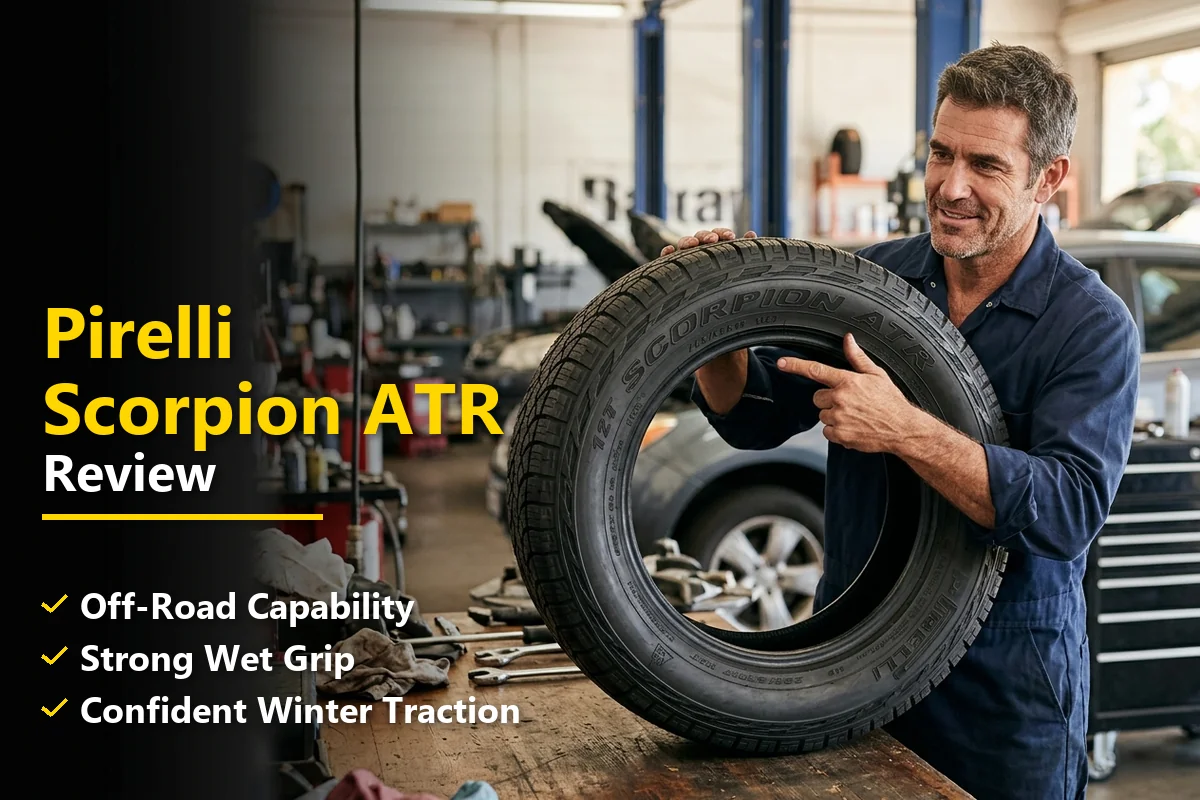
If you drive an SUV or truck and split your time between highway commutes and weekend trail runs, you know the frustration of choosing tires. Go too aggressive and you’ll hate the road noise on Monday morning. Go too street-focused and you’ll be spinning wheels the second gravel turns to mud.
The Pirelli Scorpion ATR promises to live in that sweet spot — capable enough off-road to keep you confident, civilized enough on pavement to keep you sane.
I’ve been running a set on my truck to find out if that promise holds up. For a broader look at the brand’s entire lineup, check out our full Pirelli Tires Review guide, which covers every model side by side.
- Impressive balance between on-road comfort and off-road traction
- Road noise is noticeably lower than most all-terrain competitors
- Wet grip is solid thanks to wide circumferential grooves and sipes
- Off-road capability handles gravel, packed dirt, and light mud confidently — not built for rock crawling
- Tread life has been holding up well during my extended test period
- Pricing sits in the mid-to-upper range for the all-terrain category, around $180–$280 per tire depending on size
- Best suited for daily-driven SUVs and trucks that see occasional off-road duty
Price Check
Check the price of this tire at the following retailers:
Don’t know the correct size tire to purchase? Start here!
Liked this article?
Add TireAdvise as a preferred source so you see more of our tire reviews and guides on Google.
What Exactly Is the Pirelli Scorpion ATR?
The Scorpion ATR sits in Pirelli’s light truck and SUV lineup as their all-terrain offering. “ATR” stands for All-Terrain, and Pirelli designed it specifically for drivers who need versatility without making huge compromises in any single area.
It’s available in a wide range of sizes, covering everything from 15-inch to 20-inch wheel diameters. That means it fits popular vehicles like the Toyota Tacoma, Ford F-150, Jeep Wrangler, Chevrolet Colorado, and even larger SUVs like the Toyota 4Runner and Ford Expedition.
Pirelli isn’t the first name most Americans think of when shopping for all-terrain truck tires. They’re more often associated with European sports cars and performance sedans. But the Scorpion line has been steadily gaining a following among US truck owners who want something a little different from the BFGoodrich and Falken crowd.
First Impressions and Installation
When I first pulled the Scorpion ATRs out of the packaging, I noticed the tread pattern immediately. It’s aggressive enough to look purposeful on a truck without screaming “mud bog.” The tread blocks are large and have a staggered, interlocking design that wraps slightly onto the sidewall — a good sign for off-road shoulder traction.
The sidewall itself has a subtle but attractive design. It’s not as flashy as some competitors with their raised white letters, but it looks clean. There’s a protective rim flange on most sizes, which I appreciate since curb rash is a reality of daily driving.
Installation was straightforward at my local tire shop. No balancing issues, no bead seating problems. Right away, I noticed the tires felt more planted than my previous set during the drive home.
On-Road Performance: Where This Tire Surprised Me
Let me be upfront — I spend about 80% of my driving time on pavement. Highways, city streets, and suburban roads are where this tire needs to earn its keep for most buyers, and it does.
Dry Pavement Grip
On dry roads, the Scorpion ATR delivers confident grip that honestly surprised me for an all-terrain tire. Cornering feels stable, and there’s minimal squirm when changing lanes at highway speeds. I didn’t experience any vague steering or the “floating” sensation that some chunkier all-terrain tires create.
Hard braking also impressed me. The tire bites into dry pavement with authority, and stopping distances felt comparable to many highway-terrain tires I’ve tested. Pirelli’s use of a silica-enhanced compound seems to pay off here.
Wet Performance
Wet grip is where all-terrain tires often separate the leaders from the also-rans. The Scorpion ATR handles rain well thanks to four wide circumferential grooves that channel water efficiently. During several rainy days in my test period, I never felt the tire lose composure on wet highways.
Hydroplaning resistance is above average for this class. I drove through standing water on a few occasions, and the tire maintained contact without any alarming moments. The dense siping across the tread blocks creates extra biting edges that help break through the water film.
If wet performance is especially important to you and you mostly stay on pavement, you might also consider the Pirelli Cinturato P7 Blue Review — it’s designed with fuel efficiency and wet grip as top priorities, though it’s a passenger car tire rather than a truck tire.
Road Noise and Comfort
This is where the Scorpion ATR really earns its stripes. Many all-terrain tires are obnoxiously loud on the highway. I’ve tested competitors that made my cab sound like a wind tunnel above 60 mph. The ATR is noticeably quieter.
Pirelli uses variable pitch technology in the tread design, meaning the tread blocks are slightly different sizes around the circumference. This breaks up the harmonic drone that makes most A/T tires so fatiguing on long drives. Is it as quiet as a highway-terrain tire? No. But it’s remarkably close, and that’s a big deal for daily drivers.
Ride comfort is also commendable. The tire absorbs bumps and road imperfections without feeling mushy. There’s a firmness that communicates road feedback without beating you up over rough pavement. On a road trip I took during my test period, my passengers commented on how smooth the ride was — without knowing I’d changed tires.
Off-Road Performance: Capable but Not Extreme
Now let’s talk about what the “AT” in the name actually delivers. I tested the Scorpion ATR on a variety of off-road surfaces to see where it shines and where it reaches its limits.
Gravel and Dirt Roads
On loose gravel and packed dirt roads, the Scorpion ATR is in its element. The tread blocks dig in confidently, and the tire tracks straight without wandering. I drove several unpaved forest roads during my testing, and the tire handled everything from fine gravel to chunky limestone without issue.
The staggered shoulder blocks provide additional bite during turns on loose surfaces. I could push the speed higher on gravel roads than I expected without the back end stepping out.
Mud Performance
Let’s be realistic — this is not a mud tire. If you’re planning to plow through deep, thick clay, you need dedicated mud-terrains. But in light-to-moderate mud, the Scorpion ATR managed better than I anticipated.
The tread channels are wide enough to evacuate mud at a reasonable rate, and the tire maintained forward momentum through several muddy sections on trails I tested. Where it struggled was in deep, soupy mud with no firm base underneath. The tread packed up, and progress slowed significantly. That’s expected for any all-terrain tire in this class.
Sand
I had the opportunity to test these on a sandy access road near a lake. At reduced pressures (around 25 psi), the Scorpion ATR floated across the sand respectably well. The wide footprint helped distribute weight, and the tread edges grabbed enough to keep me moving.
For deep, soft sand dune running, you’d want something more specialized. But for typical sandy trails and beach access roads, this tire gets the job done.
Rocky Terrain
On rocky trails, the sidewall stiffness becomes important. The Scorpion ATR has a reinforced sidewall, but it’s not as thick or robust as dedicated off-road tires. I navigated some moderately rocky trails without any punctures or cuts, but I was cautious about sharp edges.
The tread compound showed good resistance to chipping and tearing from rocks. After several days of mixed-surface driving including rocky sections, I inspected the tread and found minimal damage — just normal scuffing.
Tread Life and Durability
One of the most important factors for any tire purchase is how long it’s going to last. I’ve been monitoring the Scorpion ATR’s tread depth carefully during my test period, and the wear pattern has been even and gradual.
Pirelli rates the Scorpion ATR with a UTQG treadwear rating of 400, which places it in a reasonable range for an all-terrain tire. For context, many highway-terrain tires score 500–700, while aggressive mud-terrains often sit around 300 or lower.
After several weeks of mixed driving — highway commuting, city errands, and a handful of off-road excursions — the tread blocks still look crisp. There’s been no irregular wear, no cupping, and no feathering. I rotate my tires regularly, and I’d recommend the same to maximize the life of this tire.
Winter and Cold Weather Performance
The Pirelli Scorpion ATR is not a dedicated winter tire, and it doesn’t carry the three-peak mountain snowflake (3PMSF) symbol. However, the M+S (Mud and Snow) rating means it’s engineered with some cold-weather capability.
I tested the tire during a cold snap with temperatures dropping into the mid-20s Fahrenheit. On cold, dry roads, grip remained adequate. The compound didn’t feel dramatically stiffer, and braking distances didn’t increase noticeably.
On light snow — about an inch of fresh coverage on roads — the tire did okay. The sipes and tread channels helped maintain traction, and I was able to navigate snowy neighborhood streets without drama. But I wouldn’t rely on these in a heavy snow state without carrying chains as backup.
If you live in a region with serious winters, consider running dedicated winter tires for the cold months and saving the ATRs for the rest of the year.
How the Scorpion ATR Compares to Competitors
The all-terrain tire market is packed with strong options. Here’s how the Pirelli Scorpion ATR stacks up against some of the most popular choices for US drivers.
| Feature | Pirelli Scorpion ATR | BFGoodrich KO2 | Falken Wildpeak AT3W | Toyo Open Country AT3 |
|---|---|---|---|---|
| On-Road Comfort | 9/10 | 7/10 | 8/10 | 8/10 |
| Road Noise | Low | Moderate | Low-Moderate | Low-Moderate |
| Wet Grip | 8.5/10 | 7.5/10 | 8/10 | 8/10 |
| Off-Road Capability | 7/10 | 9/10 | 8/10 | 8/10 |
| Snow Traction | 6.5/10 | 8/10 | 8.5/10 | 8/10 |
| Treadwear Rating (UTQG) | 400 | N/A (LT) | 640 | 640 |
| Price Range (per tire) | $180–$280 | $175–$310 | $140–$260 | $150–$280 |
The KO2 is the king of off-road credibility, and it deserves that reputation. But on-road, the Scorpion ATR is noticeably more comfortable and quieter. If you spend most of your time on pavement, that’s a significant advantage.
The Falken Wildpeak AT3W and Toyo Open Country AT3 are both outstanding tires that offer 3PMSF winter ratings — something the Scorpion ATR lacks. If winter performance is a priority, those two deserve serious consideration.
Where the Scorpion ATR carves out its niche is the combination of on-road refinement with genuine off-road capability. It feels like a tire designed by engineers who understand that most truck owners spend far more time on I-95 than on the Rubicon Trail.
How It Fits in the Pirelli Lineup
Pirelli makes several tire lines, and it’s worth understanding where the Scorpion ATR sits relative to the rest of the family — especially if you’re cross-shopping within the brand.
If you drive a performance car or sport sedan and somehow ended up here, you’ll want to look at the Pirelli P Zero Review for ultra-high-performance needs. The P Zero is Pirelli’s flagship performance tire — a completely different animal from the Scorpion ATR but one of the best in its class.
For those interested in the latest evolution of that performance lineage, the Pirelli P Zero Pz4 Review covers the updated version with its improved wet handling and lower noise levels.
On the touring and grand touring side, the Pirelli Cinturato P7 Review discusses one of Pirelli’s most popular passenger car tires — ideal for sedans and crossovers that stay on paved roads.
The Scorpion ATR exists in a unique position because it’s one of the only Pirelli tires specifically built for the truck and SUV crowd that wants genuine off-road capability. Most other Scorpion models lean more toward highway or sport performance orientations.
Pricing and Value
Pricing for the Pirelli Scorpion ATR typically ranges from about $180 to $280 per tire in the US market, depending on the size you need. That puts it in the mid-to-upper tier of the all-terrain segment.
Is it more expensive than some competitors? Yes. The Falken Wildpeak AT3W, for example, often undercuts the ATR by $20–$40 per tire in comparable sizes. But the Pirelli offers a level of on-road polish that justifies the premium for certain drivers.
I’d recommend shopping at Tire Rack, Discount Tire, or your local dealer and comparing installed prices. Many retailers offer rebates and promotions on Pirelli tires, especially during spring and fall changeover seasons. A $70–$100 rebate on a set of four can close the price gap with budget competitors considerably.
When calculating value, don’t forget to factor in the ride comfort and noise levels. If you drive your truck daily and commute on the highway, the Scorpion ATR’s refinement means you’re less fatigued at the end of the day. That’s hard to put a price tag on, but it’s real.
Who Should Buy the Pirelli Scorpion ATR?
Based on my testing, here’s who I think this tire is ideal for:
- Daily-driven truck and SUV owners who want off-road capability without sacrificing on-road manners
- Highway commuters who occasionally take forest roads, gravel paths, or unpaved campsite access roads
- Drivers who prioritize ride comfort and low noise but don’t want a highway-terrain tire that’s useless off pavement
- Pirelli brand loyalists who drive trucks and want to stay within the family
- Anyone looking for a refined all-terrain tire that doesn’t look overly aggressive
Who Should Look Elsewhere?
The Scorpion ATR isn’t for everyone. Here’s when I’d steer you toward a different tire:
- Serious off-roaders: If you regularly tackle deep mud, rock crawling, or extreme trails, you need a more aggressive tire like a KO2 or dedicated mud-terrain.
- Snow belt drivers: If you live in Minnesota, Michigan, or anywhere that gets hammered with snow, the lack of a 3PMSF rating is a drawback. Consider the Falken Wildpeak AT3W instead.
- Budget shoppers: If price per tire is your primary concern, there are more affordable all-terrain options that deliver strong performance for less money.
- Heavy-duty work truck use: If you haul heavy loads constantly and need maximum load ratings, make sure the ATR’s specs match your needs — some sizes may not be available in heavy-duty load ranges.
Installation Tips and Maintenance
To get the most out of the Pirelli Scorpion ATR, I recommend the following based on my experience:
Tire rotation: Rotate every 5,000–7,000 miles or according to your vehicle’s manual. I noticed even wear across all four positions during my test, but regular rotation is still essential for maximizing life.
Inflation pressure: Check your pressures at least monthly. I keep mine at the vehicle manufacturer’s recommended levels for on-road driving and reduce by a few PSI for off-road trails (then re-inflate afterward). An underinflated all-terrain tire wears faster and handles worse on pavement.
Alignment check: Get an alignment check whenever you install new tires. A misaligned truck will chew through any tire prematurely, and the Scorpion ATR is no exception.
Cleaning: After off-road excursions, I wash the tires thoroughly to remove mud, sand, and debris from the tread grooves. Packed mud left to dry can cause vibrations and uneven wear.
Real-World Fuel Economy Impact
Switching to an all-terrain tire from a highway-terrain tire typically costs you 1–2 MPG due to increased rolling resistance. With the Scorpion ATR, I noticed a fuel economy decrease of approximately 1 MPG compared to my previous highway-focused tires.
That’s actually better than I expected. Some all-terrain tires have cost me closer to 2 MPG in past tests. Pirelli’s compound optimization and tread design seem to keep rolling resistance in a reasonable range.
Over the course of a year, that 1 MPG difference might cost you $100–$200 in extra fuel depending on how much you drive and current gas prices. It’s worth factoring in, but it shouldn’t be a dealbreaker for most buyers.
My Final Verdict
After extensive testing across highways, city streets, gravel roads, muddy trails, and everything in between, I’m genuinely impressed with the Pirelli Scorpion ATR. It’s not the most aggressive all-terrain tire you can buy, and it doesn’t try to be.
What it does brilliantly is deliver a refined, comfortable, and capable driving experience for truck and SUV owners who live in the real world — where most driving happens on pavement but adventure calls on the weekends.
The on-road manners are best-in-class for an all-terrain tire. The off-road capability is solid for light-to-moderate trails. The noise levels are impressively low. And the tread life appears to be tracking well based on my ongoing test.
If you’re a daily driver who wants one tire that does everything reasonably well — with an emphasis on on-road comfort — the Pirelli Scorpion ATR belongs on your short list. It’s a premium choice, but the driving experience justifies the price for the right buyer.
I’d rate it 8.2 out of 10 overall — losing points for its winter limitations and slight off-road capability gap compared to the KO2, but earning high marks for comfort, noise, wet grip, and overall refinement.
If all-terrain isn’t quite what you need and you’re exploring Pirelli’s broader range, our Pirelli Tires Review hub can help you navigate every option from performance to touring to truck tires.
Frequently Asked Questions
Is the Pirelli Scorpion ATR a good all-terrain tire for daily driving?
The Pirelli Scorpion ATR is an excellent choice for drivers who split time between highways and light off-road trails. It delivers a comfortable, relatively quiet ride on pavement while still providing solid traction on gravel, dirt, and wet roads. I’d recommend it for SUV and truck owners who want all-terrain capability without sacrificing everyday drivability.
How long does the Pirelli Scorpion ATR last in real-world driving?
Most drivers report getting between 40,000 and 50,000 miles out of a set of Pirelli Scorpion ATR tires, depending on driving habits, alignment, and regular tire rotation. Pirelli does not offer a treadwear mileage warranty on this model, so longevity depends heavily on maintenance. Compared to some competitors like the BFGoodrich All-Terrain T/A KO2, tread life is moderate but acceptable for the price range.
How much does a set of Pirelli Scorpion ATR tires cost in the US?
Prices for the Pirelli Scorpion ATR typically range from $150 to $250 per tire depending on the size, with popular sizes like 265/70R16 and 275/65R17 falling in the $180 to $220 range. A full set installed usually runs between $700 and $1,100 at major US retailers like Discount Tire, Tire Rack, and Costco. Shopping during seasonal sales or rebate promotions can save you $50 to $100 on a set.
How does the Pirelli Scorpion ATR perform in snow and winter conditions?
The Pirelli Scorpion ATR handles light snow and cold weather reasonably well thanks to its aggressive tread pattern and siping, but it is not a dedicated winter tire and lacks the Three-Peak Mountain Snowflake (3PMSF) certification. For occasional snow in states like Colorado or the mid-Atlantic region, it can get you through, but drivers in heavy snow areas should consider dedicated winter tires or a more winter-focused all-terrain option. Traction on ice is limited, so exercise caution in freezing conditions.
Pirelli Scorpion ATR vs BFGoodrich KO2: which all-terrain tire is better?
The BFGoodrich All-Terrain T/A KO2 edges out the Pirelli Scorpion ATR in off-road durability, tread life, and severe weather traction with its 3PMSF rating. However, the Scorpion ATR is noticeably quieter on the highway and offers a smoother ride for daily commuting. If you prioritize on-road comfort with occasional off-road use, the Scorpion ATR is the better pick; if you need serious trail capability and longer wear, go with the KO2.
Is the Pirelli Scorpion ATR noisy on the highway?
One of the standout features of the Pirelli Scorpion ATR is how quiet it is compared to other all-terrain tires. The variable pitch tread design minimizes road noise at highway speeds, and most drivers report that cabin noise is barely noticeable above 60 mph. If highway noise is a dealbreaker for you, the Scorpion ATR is one of the quieter all-terrain options on the US market.
What SUVs and trucks does the Pirelli Scorpion ATR fit?
The Pirelli Scorpion ATR is available in a wide range of sizes from 15 to 20 inches, fitting popular US vehicles like the Toyota 4Runner, Jeep Wrangler, Ford F-150, Chevy Silverado 1500, and Toyota Tacoma. It also fits mid-size SUVs like the Jeep Grand Cherokee and Nissan Pathfinder in select sizes. Always verify your exact tire size on your door placard or owner’s manual before purchasing to ensure proper fitment.
