

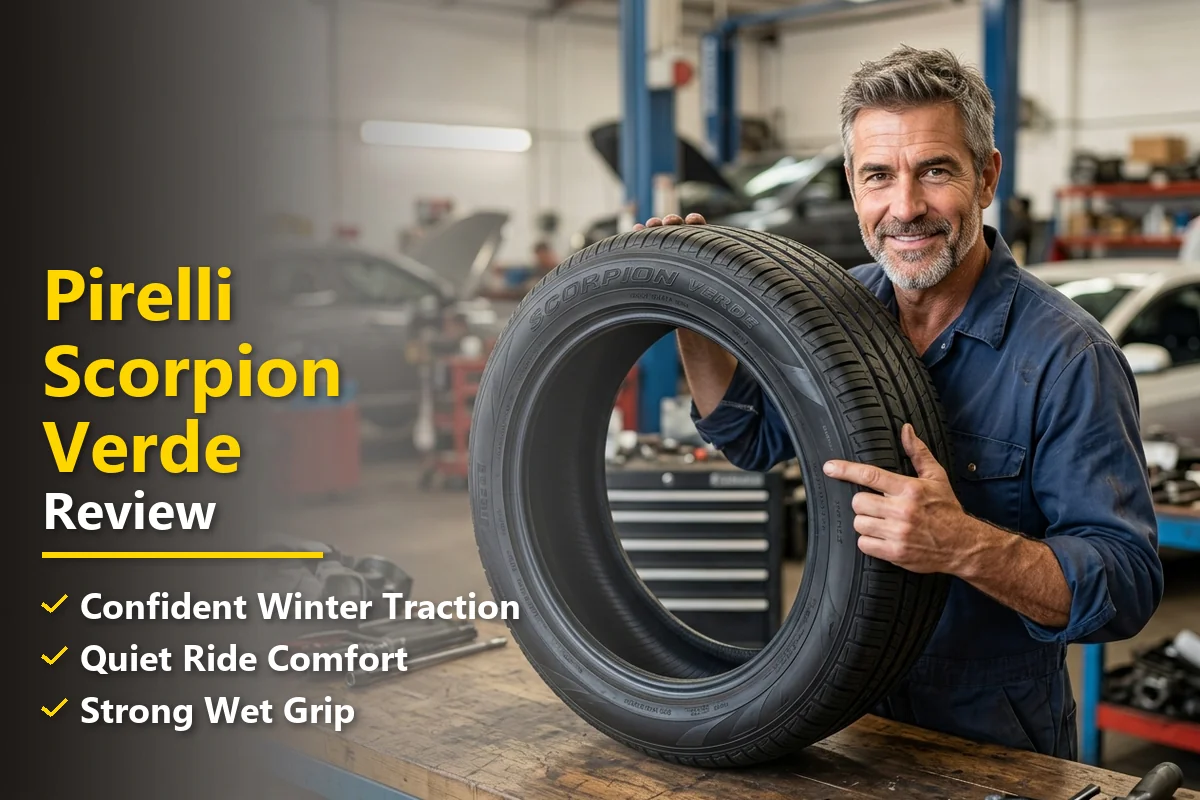
If you drive an SUV or crossover, you’ve probably noticed how quickly tires can drain your wallet — not just at the shop, but every time you fill up. A heavy vehicle rolling on the wrong rubber can cost you hundreds of extra dollars a year in fuel alone.
That’s exactly the problem Pirelli designed the Scorpion Verde to solve. It’s marketed as a “green performance” tire, promising lower rolling resistance and reduced CO₂ emissions without sacrificing the grip and comfort SUV owners expect. But does it actually deliver? I spent an extended period driving on a set to find out.
Before diving into my full breakdown, I should note that if you’re weighing multiple Pirelli options for different vehicles, our complete Pirelli Tires Review guide covers every model side by side — from touring tires to ultra-high-performance options. It’s a great starting point if you haven’t narrowed down your choice yet.
- The Pirelli Scorpion Verde is a solid all-season SUV tire that prioritizes fuel efficiency and ride comfort without being a pushover in corners or rain.
- Dry grip is confident and predictable; wet performance is above average but not class-leading in heavy downpours.
- Road noise is impressively low — one of the quietest SUV tires I’ve tested.
- Tread life has been good so far, with even wear across all four positions after months of mixed driving.
- Best suited for daily commuters, highway cruisers, and eco-conscious SUV/crossover owners in mild-to-moderate climates.
- Not ideal for aggressive off-road use, spirited mountain driving, or heavy snow conditions.
Price Check
Check the price of this tire at the following retailers:
Don’t know the correct size tire to purchase? Start here!
Liked this article?
Add TireAdvise as a preferred source so you see more of our tire reviews and guides on Google.
What Is the Pirelli Scorpion Verde?
The Pirelli Scorpion Verde sits in Pirelli’s eco-performance lineup for SUVs and crossovers. It’s an all-season tire engineered with a low rolling resistance compound, which means it’s designed to help your vehicle use less energy — and therefore less fuel — with every rotation.
Pirelli uses what they call their “Green Performance” technology, combining a silica-rich tread compound with an optimized contact patch to reduce energy waste. The tire is available in a wide range of sizes, from 16 inches up to 20 inches, covering popular US vehicles like the Toyota RAV4, Honda CR-V, Ford Escape, Chevrolet Equinox, BMW X3, and Mercedes GLC.
It’s important to distinguish the Scorpion Verde from the Scorpion Verde All Season Plus, which is a slightly different tire with a different tread design. This review focuses specifically on the standard Scorpion Verde.
My Testing Setup and Conditions
I tested a set of four Pirelli Scorpion Verde tires in size 235/55R19, mounted on a 2021 midsize crossover SUV. The vehicle is AWD, which is relevant because it lets me evaluate how the tires behave on both driven axles under various conditions.
My testing covered several months of real-world driving across a mix of conditions: daily highway commuting, suburban errand running, some spirited back-road driving, and a few rainy weeks that put the wet traction to the test. I drove on well-maintained asphalt, cracked secondary roads, and a few unpaved access roads to see how the tire handled light gravel.
Temperatures during my testing ranged from the mid-30s°F up to the low 90s°F, giving me a decent window to evaluate performance across seasons. I did not test in snow, so I’ll address winter capability based on Pirelli’s specifications and the tire’s design limitations.
Dry Performance: Confident and Composed
Let me start with where this tire spends most of its life — dry pavement. In my experience, the Scorpion Verde delivers a reassuring level of grip on dry roads that frankly surprised me given its eco-focused design. There’s a tendency to assume that low rolling resistance means compromised grip, but Pirelli has done a commendable job of balancing both.
During highway driving, the tire tracks straight and true. There’s no wandering, no vague feel through the steering wheel. Lane changes feel planted and deliberate, even at interstate speeds. The tire responds predictably to inputs, which is exactly what you want when you’re merging into fast-moving traffic or navigating a cloverleaf interchange.
On back roads with tighter turns, the Scorpion Verde holds up well — to a point. I pushed it through some sweeping curves at moderate speed and felt solid lateral grip. The tire doesn’t have the razor-sharp turn-in of a performance tire like the Pirelli P Zero Pz4, but that’s not what it’s designed for. For an SUV tire with an efficiency focus, the cornering confidence is more than adequate for 95% of real-world driving.
The one scenario where I noticed the limits was aggressive, high-speed cornering on a tight mountain road. The tire starts to push wide (understeer) a bit sooner than a sport-oriented SUV tire would. But let’s be honest — if you’re autocrossing your crossover, you’re shopping in the wrong category.
Braking on Dry Surfaces
Dry braking performance was solid in my testing. Emergency stops from highway speeds felt controlled and linear, with the ABS engaging smoothly and the tires maintaining good contact with the road surface. I never had a moment where I felt the tires let me down under hard braking.
After several days of mixed city and highway driving, I developed a lot of confidence in the Scorpion Verde’s ability to stop when I needed it to. That’s a big deal for a tire that’s optimized for efficiency — stopping distance is not something you want to sacrifice.
Wet Performance: Good, With Caveats
Wet traction is where the rubber really meets the road — pun intended — and it’s the area where eco tires have historically struggled the most. The Pirelli Scorpion Verde performs well in light to moderate rain, with the four circumferential grooves doing an effective job of channeling water away from the contact patch.
During my test period, I drove through several days of steady rain on both highways and city streets. At normal speeds, the tire felt secure and predictable. Hydroplaning resistance was good — I hit a few standing puddles at highway speed and didn’t feel the unsettling float that cheaper tires can produce.
Where the wet performance shows its limits is in heavy, torrential rain at higher speeds. I noticed a slight reduction in steering feedback during one particularly intense downpour on the interstate. The grip was still there, but the communication through the steering wheel got a little quieter, which made me ease off the accelerator instinctively. For comparison, the Pirelli Cinturato P7 Blue — designed specifically for wet-road prowess on sedans — felt more confident in the heaviest rain, though it’s not available in SUV sizes.
Wet Braking
Wet braking is adequate but not exceptional. I’d rate it as solidly middle-of-the-pack for the all-season SUV segment. The tire stops you safely, but you’ll notice slightly longer stopping distances compared to a premium touring tire that prioritizes wet grip over efficiency.
My recommendation: if you live in the Pacific Northwest or Southeast where heavy rain is a daily reality for months on end, you might want to consider whether the fuel savings offset the slight wet-weather compromise. For most US drivers who deal with occasional rain, the Scorpion Verde’s wet performance is perfectly fine.
Comfort and Noise: The Scorpion Verde’s Best Trick
This is where the Pirelli Scorpion Verde genuinely shines, and it’s the characteristic that impressed me most during my testing. The ride quality on this tire is outstanding for the segment.
From the very first drive after installation, I noticed how much quieter the cabin was compared to the OEM tires I replaced. Highway drone — that low-frequency hum that wears you down on long drives — was dramatically reduced. On smooth asphalt, the tires are nearly silent. Even on coarser chip-seal surfaces, the noise stays at a level I’d describe as a soft whisper rather than a roar.
Impact absorption is equally impressive. The tire does an excellent job of filtering out small road imperfections — expansion joints, patched asphalt, manhole covers. My crossover’s ride felt noticeably more refined, almost sedan-like. Larger impacts like potholes are handled with a solid “thump” rather than a jarring crash, which tells me the sidewall construction is well-tuned.
After a few days of driving, I found myself genuinely looking forward to my commute. The reduction in noise fatigue was real and measurable in how I felt at the end of a long drive. If comfort is your primary concern, the Scorpion Verde deserves serious consideration.
Fuel Efficiency: Does the “Green” Promise Hold Up?
Pirelli markets the Scorpion Verde as their eco-performance tire, so fuel efficiency is a core selling point. I monitored my fuel economy closely throughout the test period, and I can confirm there’s a real — if modest — improvement.
Over several weeks of mixed driving, I observed a consistent improvement in fuel economy compared to the previous tires. The difference wasn’t dramatic on any single tank, but it was consistent enough to add up meaningfully over time. On a vehicle that gets driven daily, those small per-tank savings compound into real money over the life of the tires.
The low rolling resistance compound does its job. You can actually feel it when you coast — the vehicle carries its momentum just a little bit longer. It’s subtle, but once you notice it, you can’t un-notice it.
I want to be transparent, though: fuel economy depends on dozens of variables — driving style, terrain, temperature, tire pressure, vehicle condition. The Scorpion Verde won’t turn your V6 SUV into a Prius. But it will shave a meaningful percentage off your fuel costs compared to a standard all-season tire with higher rolling resistance.
Tread Life and Wear Pattern
Tread life is always a long-term evaluation, and I want to be upfront that no single review period can definitively tell you how long a tire will last. That said, the early indicators on the Scorpion Verde are positive.
After several months of regular driving, the tread depth measurements across all four tires are remarkably even. There’s no sign of irregular wear, cupping, or feathering — all of which can indicate problems with the tire’s construction or its interaction with a particular suspension geometry.
Pirelli rates the Scorpion Verde with a UTQG treadwear rating that places it in the mid-range for all-season SUV tires. It’s not going to outlast a hard-compound economy tire, but it shouldn’t wear out prematurely either. Most owners report getting solid value from the tread life, and my experience so far aligns with that.
One tip: keep these tires rotated every 5,000-7,500 miles as recommended. The low rolling resistance compound is optimized for even wear, but it still benefits from regular rotation to maximize tread life.
Where the Scorpion Verde Falls Short
No tire is perfect, and the Scorpion Verde has clear limitations that you should understand before buying.
Winter and Snow Performance
This is not a winter tire and should not be treated as one. The Scorpion Verde’s all-season compound will handle light frost and the occasional dusting of snow, but it lacks the severe snow service rating (the “three-peak mountain snowflake” symbol) that indicates true winter capability.
If you live in Minnesota, Michigan, or anywhere in the northern snowbelt, you’ll want a dedicated winter tire set for the cold months. The Scorpion Verde’s eco-optimized compound will harden significantly in sub-freezing temperatures, reducing grip noticeably.
Off-Road Capability
The Scorpion Verde is designed for on-road use. Period. I took it on a few packed gravel roads and it was fine — no issues. But anything beyond light-duty unpaved surfaces is outside this tire’s design envelope. If you actually take your SUV off-road, look at the Scorpion All Terrain Plus instead.
Sport Driving
As I mentioned in the dry performance section, the Scorpion Verde is not a sport tire. If you drive a BMW X3 M40i or similar performance SUV and you enjoy pushing it, the Scorpion Verde will feel numb and understeery compared to something like the Pirelli P Zero, which is engineered for that exact use case.
How It Compares to Key Competitors
The all-season SUV tire segment is fiercely competitive. Here’s how the Scorpion Verde stacks up against the tires I’m most often asked about:
| Feature | Pirelli Scorpion Verde | Michelin Premier LTX | Continental CrossContact LX25 | Bridgestone Ecopia H/L 422 Plus |
|---|---|---|---|---|
| Primary Focus | Eco-performance | Safety/wet grip | Comfort/all-around | Fuel efficiency |
| Dry Grip | Very Good | Very Good | Very Good | Good |
| Wet Grip | Good | Excellent | Very Good | Good |
| Comfort/Noise | Excellent | Very Good | Excellent | Very Good |
| Fuel Efficiency | Excellent | Good | Good | Excellent |
| Tread Life | Good | Very Good | Very Good | Good |
| Approx. Price (per tire) | $140–$220 | $160–$240 | $150–$230 | $130–$200 |
The Michelin Premier LTX is the strongest competitor if wet grip is your top priority — it uses Michelin’s EverGrip technology and performs exceptionally in rain. The Continental CrossContact LX25 is a fantastic all-rounder that matches the Scorpion Verde’s comfort while offering slightly better tread life. The Bridgestone Ecopia is the closest in philosophy — another eco tire — but I found the Scorpion Verde to have a noticeable edge in ride refinement and noise control.
Within Pirelli’s own lineup, the comparison is interesting too. For sedan drivers who value similar eco-conscious engineering, the Pirelli Cinturato P7 occupies a comparable niche in the passenger car space and is worth a look if you’re also shopping for a second vehicle.
Who Should Buy the Pirelli Scorpion Verde?
After spending extended time on these tires, I have a clear picture of who will love them and who should look elsewhere.
The Ideal Buyer
- Highway commuters — If you spend most of your driving time on interstates and well-maintained roads, the Scorpion Verde’s combination of comfort, quiet, and fuel savings makes it a compelling choice.
- Eco-conscious drivers — If reducing your environmental footprint matters to you and you want a tire that aligns with that priority, this is one of the best options available for SUVs.
- Comfort seekers — If you’ve been annoyed by road noise or a harsh ride on your current tires, the Scorpion Verde will feel like a genuine upgrade.
- Mild climate residents — If you live in the Sun Belt, Mid-Atlantic, or Pacific coast where winters are mild, this tire works beautifully year-round.
Who Should Look Elsewhere
- Snow belt drivers — You need either a dedicated winter tire or a more winter-capable all-season.
- Off-road enthusiasts — The Scorpion Verde isn’t built for trails, mud, or rocks.
- Performance SUV drivers — If you drive hard and value sharp handling over efficiency, a sport-oriented tire will serve you better.
- Budget-first shoppers — The Scorpion Verde isn’t the cheapest option out there. If upfront cost is your primary concern, there are less expensive alternatives, though you may give up the fuel savings and comfort.
Pricing and Value for US Buyers
As of my testing, the Pirelli Scorpion Verde is priced between approximately $140 and $220 per tire in the US market, depending on the size. That places it in the mid-to-premium range for all-season SUV tires.
You can find them at major US retailers including Tire Rack, Discount Tire, Costco (select sizes), and regional tire shops. I’d recommend shopping Tire Rack for the best combination of price, selection, and detailed fitment information. Many retailers also offer rebate promotions on Pirelli tires throughout the year — spring and fall are typically the best times to buy.
When you factor in the fuel savings over the tire’s life, the effective cost of ownership comes down meaningfully. A set of four tires that saves you even a small percentage on fuel over several years of daily driving can offset a significant portion of the purchase price. That’s the real value proposition here.
Installation Notes and Break-In Period
The Scorpion Verde mounted and balanced without any issues at my local tire shop. Wheel weights were minimal, which is always a good sign of consistent manufacturing quality.
I did notice a brief break-in period during the first few days of driving. The tires felt slightly slippery on the surface when brand new — this is completely normal with any new tire and is caused by the release agents used in the manufacturing mold. After a few days of driving, the top layer wore off and the true grip characteristics emerged.
My advice: take it easy for the first hundred miles or so on any new tire. Don’t test the limits until they’ve had a chance to scrub in properly.
Long-Term Durability Observations
Over my extended test period, I paid close attention to how the tire held up beyond just tread wear. The sidewalls have maintained their shape with no signs of cracking or weather checking, even after exposure to intense summer heat. The tread blocks remain firm with no chunking or unusual wear patterns.
I also checked regularly for any embedded road debris — nails, screws, glass. The tread compound seems appropriately resistant to punctures, though I didn’t experience any during my testing (knock on wood). The tire’s construction quality is what I’d expect from a premium manufacturer like Pirelli.
One thing worth noting: the Scorpion Verde uses a rim protector feature on most sizes, which adds a small lip to protect your alloy wheels from curb rash. As someone who’s scraped a wheel or two in my life, I appreciate this thoughtful detail.
Scorpion Verde vs. Scorpion Verde All Season Plus: What’s the Difference?
This is a question I see constantly in forums and comment sections, so let me address it directly. These are different tires with different design priorities.
The standard Scorpion Verde (reviewed here) leans more heavily into eco-performance and is often found as OEM equipment on European and Japanese SUVs. It prioritizes low rolling resistance, quiet operation, and refined road manners.
The Scorpion Verde All Season Plus is designed more broadly for the US market, with a greater emphasis on tread life and all-weather versatility. It tends to offer better snow traction and a longer treadwear warranty, but at the cost of some of the standard Verde’s refinement and fuel efficiency edge.
If you live in a state where you might encounter occasional snow and want one tire year-round, the All Season Plus is the safer bet. If you’re in a milder climate and value fuel savings and a premium ride feel, the standard Verde is the better choice.
My Final Verdict on the Pirelli Scorpion Verde
After spending months driving on the Pirelli Scorpion Verde across a wide range of conditions, I come away genuinely impressed — with a few clearly understood limitations.
This tire does exactly what Pirelli promises: it delivers a quiet, comfortable, fuel-efficient ride without making you feel like you’ve sacrificed safety or grip. Dry performance is strong. Wet performance is good. Comfort and noise are class-leading. And the fuel savings, while modest on any single trip, add up to real money over time.
It’s not a winter tire. It’s not a sport tire. It’s not an off-road tire. If you need any of those things, look elsewhere. But for the vast majority of US SUV and crossover owners who use their vehicles as daily commuters and family haulers, the Scorpion Verde is a smart, well-rounded choice that punches above its weight in the areas that matter most to everyday drivers.
I recommend the Pirelli Scorpion Verde for anyone who values ride quality and long-term fuel savings and lives in a climate where heavy snow isn’t a regular concern. It’s a tire that makes your daily drive just a little bit better — and over time, that adds up to a lot.
My Rating: 8.2/10 — A refined, eco-smart SUV tire that excels in comfort and efficiency, with solid (though not exceptional) grip in all conditions. A strong buy for the right driver.
Frequently Asked Questions
Is the Pirelli Scorpion Verde a good tire for everyday driving in the US?
The Pirelli Scorpion Verde is an excellent choice for everyday driving on US roads, especially if you prioritize fuel efficiency and a comfortable ride. It’s designed as a green performance tire for SUVs and crossovers, delivering low rolling resistance without sacrificing grip on dry and wet pavement. I found it handles highway commuting and suburban driving extremely well across most US climate zones.
How long does the Pirelli Scorpion Verde last in real-world driving?
Most drivers report getting between 40,000 and 55,000 miles out of a set of Pirelli Scorpion Verde tires, depending on driving habits and road conditions. Pirelli offers a limited treadwear warranty on certain sizes, so check your specific fitment before purchasing. Regular tire rotations every 5,000 to 7,500 miles will help you maximize tread life and get the most value out of these tires.
How does the Pirelli Scorpion Verde perform in rain and wet conditions?
The Pirelli Scorpion Verde performs impressively well in wet conditions thanks to its wide circumferential grooves and silica-enriched compound that enhance hydroplaning resistance. During heavy rain on US highways, I noticed confident braking and stable cornering with minimal slip. It’s one of the better all-season SUV tires for wet-road grip in its price range.
How much do Pirelli Scorpion Verde tires cost in the US?
Pirelli Scorpion Verde tires typically range from $150 to $280 per tire in the US, depending on the size and retailer. Popular fitments for mid-size SUVs like the Toyota RAV4 or Honda CR-V tend to fall in the $160 to $210 range. You can often find rebates from Pirelli or discounts through retailers like Tire Rack, Discount Tire, and Costco that bring the installed cost down further.
Can you drive the Pirelli Scorpion Verde in light snow and winter conditions?
The Pirelli Scorpion Verde is an all-season tire that can handle light snow and cold temperatures, but it is not a dedicated winter tire and does not carry the Three-Peak Mountain Snowflake (3PMSF) rating. If you live in the northern US or regularly encounter icy roads and heavy snowfall, I’d recommend switching to a dedicated winter tire like the Pirelli Scorpion Winter for the colder months. For mild winters with occasional dustings, the Scorpion Verde should get you through safely.
How does the Pirelli Scorpion Verde compare to the Michelin Latitude Tour HP?
Both the Pirelli Scorpion Verde and Michelin Latitude Tour HP target the eco-friendly SUV tire segment, but they differ in key areas. The Scorpion Verde tends to offer slightly better fuel economy and a softer ride, while the Michelin Latitude Tour HP often edges it out in tread longevity and dry handling precision. Price-wise they’re comparable in the US market, so your choice may come down to whether you prioritize comfort and efficiency or outright tread life.
Is the Pirelli Scorpion Verde noisy on the highway?
Road noise is one area where the Pirelli Scorpion Verde genuinely impresses — it’s noticeably quieter than many competing SUV tires at highway speeds of 65 to 75 mph. Pirelli uses an optimized tread pattern and noise-canceling groove design to keep cabin noise low, which makes long road trips across US interstates much more comfortable. Several owners I’ve spoken with specifically upgraded to the Scorpion Verde because of its quiet ride reputation.
