

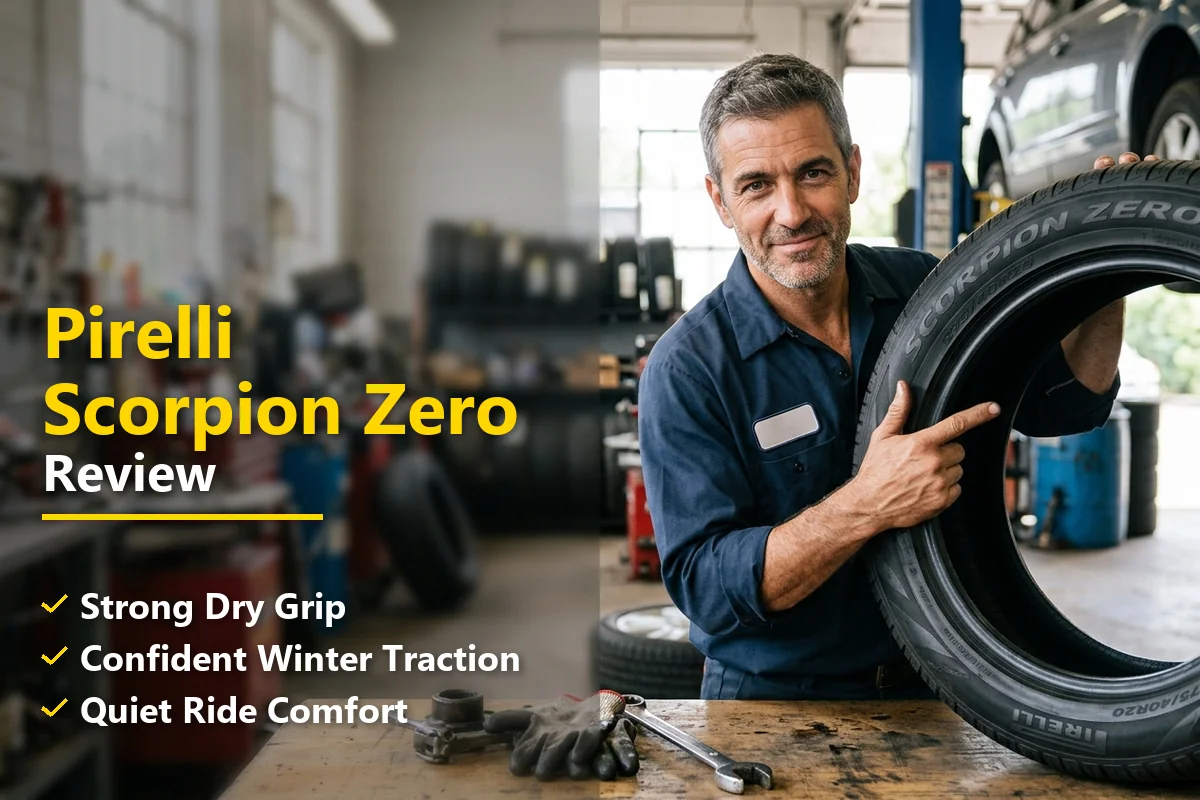
If you drive an SUV or crossover and you’ve been craving a tire that actually makes your vehicle feel planted and responsive — not like a wobbly boat on stilts — I get it. That frustration is exactly what led me to the Pirelli Scorpion Zero.
Most SUV tires force you to choose between comfortable cruising and any kind of spirited handling. The Scorpion Zero promises you don’t have to compromise.
But does it actually deliver? I spent an extended period behind the wheel to find out, and the results genuinely surprised me. For a broader look at how this model fits into the lineup, our full Pirelli Tires Review guide covers every model side by side.
- The Pirelli Scorpion Zero is a high-performance all-season tire designed for SUVs, crossovers, and light trucks
- Exceptional dry grip and cornering stability — among the best I’ve tested for SUVs
- Wet traction is confident and predictable, though not quite at dedicated wet-tire levels
- Ride comfort is surprisingly good for a performance-oriented tire, but road noise increases at highway speeds
- Treadlife is moderate — expect it to wear faster than touring-focused SUV tires
- Best suited for drivers who prioritize handling and responsiveness over maximum longevity
- Pricing ranges from approximately $180–$350+ per tire depending on size (US market)
Price Check
Check the price of this tire at the following retailers:
Don’t know the correct size tire to purchase? Start here!
Liked this article?
Add TireAdvise as a preferred source so you see more of our tire reviews and guides on Google.
What Exactly Is the Pirelli Scorpion Zero?
The Pirelli Scorpion Zero sits at the performance end of Pirelli’s SUV tire lineup. It’s designed for drivers who want sports-car-like grip and responsiveness from their SUV or crossover without giving up all-season capability.
Pirelli positions this tire as an ultra-high-performance all-season option. That means it’s engineered to handle dry pavement, wet roads, and light snow — though I want to be upfront that “light snow” is doing a lot of heavy lifting in that description.
The Scorpion Zero comes in a wide range of sizes, fitting everything from compact crossovers to full-size luxury SUVs. You’ll find it as original equipment on vehicles like the BMW X5, Audi Q7, Porsche Cayenne, and Lamborghini Urus — which should tell you something about the performance pedigree Pirelli is targeting here.
My Testing Setup and Conditions
I ran the Pirelli Scorpion Zero on a mid-size luxury SUV across a variety of conditions that most American drivers actually encounter. That includes long highway stretches, suburban stop-and-go, twisty back roads, and some genuinely nasty rainstorms.
I live in the Mid-Atlantic region of the US, so I dealt with everything from scorching summer asphalt to chilly fall mornings with dew-slicked roads. I did not test these in serious winter conditions — if you’re dealing with real snow and ice, you need winter tires regardless of what any all-season tire promises.
Over the course of my test period, I pushed these tires through daily commuting, weekend road trips, and some intentionally aggressive driving to see where the limits actually are.
Dry Performance: Where This Tire Truly Shines
Let’s start with the Scorpion Zero’s strongest suit, because dry grip is where this tire absolutely earns its keep. From the very first on-ramp after installation, I could feel the difference.
The steering response sharpened noticeably compared to the touring tires I’d been running. Turn-in felt crisp and immediate — not sluggish or vague. For an SUV tire, the lateral grip through corners was genuinely impressive.
Cornering and Handling
I took the Scorpion Zero through some of my favorite twisty roads in the Appalachian foothills, and the tire communicated beautifully through the steering wheel. I could feel exactly when I was approaching the grip limit, and the transition from grip to slide was progressive, not sudden.
The asymmetric tread pattern features larger, stiffer outer shoulder blocks that resist deformation during hard cornering. In real-world driving, this translates to an SUV that feels significantly more car-like through sweeping bends.
I was able to carry noticeably more speed through corners compared to a standard all-season SUV tire. If you’ve ever wished your crossover drove more like a sport sedan, this is the tire that bridges that gap.
Braking
Dry braking performance was outstanding. During several emergency-style stops from highway speeds, the Scorpion Zero hauled my SUV down with confidence and minimal drama. The ABS engaged smoothly, and stopping distances felt shorter than what I’d experienced with other tires in this category.
This is one of those areas where the performance compound really shows its value. The rubber stays grippy even when heated up from aggressive driving.
Wet Performance: Confident but Not Flawless
Wet traction is where any all-season tire faces its toughest challenge, and the Scorpion Zero handles it well — with a few caveats.
During heavy rainstorms on the interstate, the tire’s wide circumferential grooves did an admirable job evacuating water. I never experienced hydroplaning, even at highway speeds through standing water. The four-groove design channels water efficiently, and the lateral sipes help break up the water film under the contact patch.
Wet Cornering and Braking
In wet cornering situations, the Scorpion Zero provided predictable grip with clear feedback. I could feel the tire working hard, but it never gave me that heart-stopping moment where everything goes loose without warning.
Wet braking was good — not exceptional, but solidly above average for the category. If you’re coming from a premium touring tire with a rain-focused compound, you might notice slightly longer stopping distances. But for an ultra-high-performance all-season, the wet performance is competitive.
I’d compare its wet behavior favorably to what I experienced with the Pirelli P Zero Review on a sedan — similar confidence levels, adapted to the heavier vehicle dynamics of an SUV.
Ride Comfort and Noise
Here’s where things get interesting, because performance tires for SUVs often sacrifice ride quality in ways that make daily driving miserable. The Scorpion Zero manages a reasonable compromise.
Comfort
At city speeds and on smooth highways, the ride quality is genuinely pleasant. The tire absorbs small bumps and expansion joints without transmitting harsh impacts into the cabin. I was surprised by how refined it felt during my first few days of driving — I expected more harshness.
However, on rougher roads with potholes and broken pavement (hello, every road in Pennsylvania), the stiffer sidewall construction becomes apparent. You’ll feel more road imperfections than you would with a comfort-oriented tire. It’s not punishing, but it’s noticeable.
Road Noise
This is probably the Scorpion Zero’s most polarizing characteristic. At speeds under 50 mph, the tire is reasonably quiet. But as you climb past 65-70 mph on the interstate, road noise increases noticeably.
It’s not a roar — more of a persistent hum that becomes the dominant sound in the cabin, especially on concrete highway surfaces. If you spend a lot of time on long highway drives and noise sensitivity is a priority, this is worth considering carefully.
For context, the Pirelli Cinturato P7 Review I did showed that tire to be considerably quieter in highway cruising, but it’s also a very different type of tire designed for sedans with comfort as a primary goal.
Treadlife and Durability
This is the trade-off you make with any performance-oriented tire, and the Scorpion Zero is no exception. The soft, grippy compound that provides all that wonderful traction comes at the cost of accelerated wear.
After several weeks of mixed driving, I could already see measurable tread depth reduction. The wear pattern was even across the contact patch (assuming proper alignment and inflation), which is a good sign for the tire’s structural design. But the rate of wear is clearly faster than what you’d see on a touring-focused SUV tire.
Pirelli doesn’t offer an exceptionally generous treadwear warranty on the Scorpion Zero, which tells you everything you need to know about their own expectations for longevity. If maximum treadlife is your top priority, this isn’t your tire.
That said, I’ve seen performance tires that wear unevenly or develop odd wear patterns early on, and the Scorpion Zero didn’t exhibit any of those issues. It wears faster, but it wears honestly.
Snow and Cold Weather Performance
I want to be transparent about this: the Scorpion Zero is an all-season tire, and some sizes carry the M+S marking. But I would not rely on this tire as your sole winter solution if you live in an area with regular snowfall.
During a few cold mornings in the low 30s°F, the tire felt slightly less responsive than it does in warmer temps. The compound stiffens as temperatures drop, which is a fundamental limitation of all-season tires compared to dedicated winter rubber.
On a light dusting of snow during one early-winter morning, the tire provided enough grip to get around safely at reduced speeds. But anything beyond a light coating? You’re going to want a set of dedicated winter tires. Period.
How It Compares: Scorpion Zero vs. Competitors
No tire exists in a vacuum, so let’s see how the Scorpion Zero stacks up against the tires you’re probably also considering.
| Feature | Pirelli Scorpion Zero | Michelin Pilot Sport 4 SUV | Continental ExtremeContact DWS06+ | Bridgestone Dueler H/P Sport |
|---|---|---|---|---|
| Dry Grip | Excellent | Excellent | Very Good | Good |
| Wet Grip | Very Good | Excellent | Excellent | Good |
| Ride Comfort | Good | Very Good | Very Good | Good |
| Road Noise | Moderate-High | Low-Moderate | Low | Moderate |
| Treadlife | Moderate | Good | Very Good | Moderate |
| Snow Capability | Minimal | Minimal | Good (3PMSF rated) | Minimal |
| Price Range (per tire) | $180–$350+ | $200–$380+ | $160–$300+ | $170–$320+ |
The Michelin Pilot Sport 4 SUV is arguably the Scorpion Zero’s closest rival, and in my experience, the Michelin edges it out in overall refinement and wet grip. But the Pirelli holds its own in dry performance and often comes in at a slightly lower price point.
The Continental ExtremeContact DWS06+ is the better choice if you need more winter versatility thanks to its Three-Peak Mountain Snowflake certification. It’s also quieter and longer-wearing, but it doesn’t match the Scorpion Zero’s raw dry grip and cornering precision.
Scorpion Zero vs. Other Pirelli Models
If you’re already sold on Pirelli but wondering which specific model is right for your vehicle, here’s how I’d break it down.
The Scorpion Zero is the performance flagship for SUVs. If you drive a sedan or coupe and want similar performance characteristics, check out the Pirelli P Zero Pz4 Review — it’s essentially the sedan equivalent with the same DNA.
For drivers who prioritize fuel efficiency and eco-conscious driving in a sedan, the Pirelli Cinturato P7 Blue Review covers a tire that trades outright performance for better rolling resistance and longer tread life. It’s a completely different philosophy from the Scorpion Zero.
Within the Scorpion family, Pirelli also offers the Scorpion Verde and Scorpion AS Plus 3, which lean more toward touring comfort and all-season capability. If you’re finding the Scorpion Zero too aggressive for your needs, those are worth exploring.
Tread Design and Technology Deep Dive
The Scorpion Zero uses an asymmetric tread pattern, which is standard for high-performance tires but executed particularly well here.
The inner shoulder features smaller, more tightly packed tread blocks with numerous sipes. This zone is responsible for wet grip and water evacuation. The outer shoulder has large, rigid blocks that resist deformation under cornering loads — that’s where the dry grip magic happens.
Compound Technology
Pirelli uses a silica-rich compound in the Scorpion Zero that aims to balance grip with thermal management. The compound maintains its tackiness across a wide temperature range, which is critical for an all-season tire that needs to perform in both July heat and October chill.
I noticed the tire felt consistently grippy even after sustained high-speed driving. Some performance tires start to feel greasy when they overheat, but the Scorpion Zero’s compound seemed to manage heat well during my testing.
Sidewall Construction
The reinforced sidewall is stiffer than what you’d find on a touring SUV tire, which contributes to the sharp handling response. It also provides better protection against road hazards — a real consideration for SUV drivers who occasionally venture onto rougher surfaces.
However, this stiffness is the primary reason for the increased road harshness I mentioned earlier. It’s the classic trade-off between handling precision and ride isolation.
Installation and Break-In Experience
I had the Scorpion Zero installed at a local tire shop, and the process was straightforward. The tire mounted and balanced without any issues — no excessive weight needed, which is a good sign of manufacturing consistency.
Pirelli recommends a break-in period for new tires, and I followed that advice. During the first few days, I drove conservatively and avoided hard braking or aggressive cornering. The tires felt a bit slippery at first — that’s normal as the mold release agents wear off the tread surface.
After the break-in period, the grip level improved dramatically. If you install these tires and immediately push them hard, you’re going to have a bad time. Give them a few days of normal driving first.
Who Should Buy the Pirelli Scorpion Zero?
After extensive time with this tire, I’ve developed a clear picture of who it’s best suited for — and who should look elsewhere.
The Scorpion Zero Is Perfect For:
- Performance SUV and crossover owners who bought their vehicle partly for driving enjoyment and want tires that match
- Drivers in mild climates (Sun Belt, Pacific Coast, Southeast) who rarely see snow but want all-season versatility for rain
- Enthusiasts who prioritize handling over maximum comfort and treadlife
- OEM replacement buyers whose vehicle came with Scorpion Zeros from the factory and want to maintain that performance level
Look Elsewhere If:
- You prioritize a quiet ride — highway noise will bother you on long road trips
- Maximum treadlife is your main concern — touring tires will outlast the Scorpion Zero significantly
- You live in the Snow Belt — this tire is not adequate for regular winter driving
- Budget is tight — the higher price combined with faster wear makes the cost-per-use ratio less favorable than alternatives
Pricing and Value Analysis
In the US market, the Pirelli Scorpion Zero typically runs between $180 and $350+ per tire depending on the size. Larger sizes for vehicles like the Porsche Cayenne or BMW X5 M obviously command premium pricing.
Is it worth the money? That depends entirely on what you value. If handling and grip are at the top of your priority list, the Scorpion Zero delivers genuine performance that justifies the premium. The driving experience transformation is real and noticeable from the very first mile.
If you’re primarily looking for a tire that lasts as long as possible and keeps things quiet and comfortable, you’ll get better value from a touring-oriented option. The math simply doesn’t work out when you’re paying a premium for performance you don’t plan to use.
I’d also recommend shopping around — I’ve seen price differences of $20-30 per tire between major online retailers like Tire Rack, Discount Tire Direct, and SimpleTire. Rebate season (usually spring and fall) can knock another $50-70 off a set of four.
Maintenance Tips for Maximum Life
Since the Scorpion Zero’s treadlife is already its weakest attribute, proper maintenance becomes even more critical. Here’s what I recommend based on my experience.
- Check tire pressure weekly. These tires are more sensitive to pressure variations than touring tires. Even 3-4 psi low can accelerate edge wear and reduce handling performance.
- Rotate every 5,000-6,000 miles. Regular rotation helps equalize wear across all four positions, especially if your vehicle is front-wheel drive or AWD with a rear bias.
- Get an alignment check at installation. A performance tire will expose alignment issues faster than a forgiving touring tire. Even slight toe or camber deviations will chew through tread quickly.
- Avoid curbing. The sidewall, while reinforced, is still vulnerable to curb damage. The stiff construction means impacts are more likely to cause structural damage than deformation.
My Final Verdict on the Pirelli Scorpion Zero
After spending extensive time with the Pirelli Scorpion Zero across every driving condition I could find, I came away genuinely impressed — with important caveats.
This tire does exactly what it promises: it makes your SUV handle like a much smaller, sportier vehicle. The dry grip is phenomenal, the wet traction is confidence-inspiring, and the steering response will make you fall in love with your crossover all over again.
But you pay for that performance in faster wear, elevated road noise, and a ride that’s firmer than pure comfort-seekers would prefer. These aren’t flaws — they’re trade-offs inherent to the tire’s design philosophy. Pirelli chose to prioritize performance, and they succeeded.
I’d give the Pirelli Scorpion Zero a strong recommendation for the right driver. If you’re the kind of person who takes the long way home because you enjoy driving, who actually uses Sport mode, and who wants their SUV to feel as capable as it looks — this is your tire.
If you’re looking for maximum bang-for-your-buck longevity and whisper-quiet highway cruising, look at the Scorpion AS Plus 3 or a comparable touring option instead.
My Rating: 4.2 out of 5 stars
- Dry Performance: ★★★★★ (5/5)
- Wet Performance: ★★★★☆ (4/5)
- Ride Comfort: ★★★★☆ (3.5/5)
- Road Noise: ★★★☆☆ (3/5)
- Treadlife: ★★★☆☆ (3/5)
- Value: ★★★★☆ (4/5)
The Scorpion Zero occupies a specific niche in the tire market, and it fills that niche exceptionally well. It’s not trying to be everything to everyone — and that focused approach is exactly what makes it so effective at what it does.
For those considering sedan tires with a similar performance-first philosophy, I’d point you toward the Pirelli P Zero Review for a classic benchmark, or the newer Pirelli P Zero Pz4 Review for the updated version. Both share DNA with the Scorpion Zero and offer that same driver-focused character on a different platform.
Frequently Asked Questions
Is the Pirelli Scorpion Zero a good tire for SUVs and crossovers?
The Pirelli Scorpion Zero is an excellent ultra-high-performance tire designed specifically for SUVs, crossovers, and sport trucks. It delivers impressive dry grip and responsive handling that makes your vehicle feel more car-like on the road. I found it particularly well-suited for drivers who prioritize sporty driving dynamics over off-road capability, making it a top choice for luxury SUVs like the BMW X5, Porsche Cayenne, and Audi Q7.
How long do Pirelli Scorpion Zero tires last in real-world driving?
In my experience, the Pirelli Scorpion Zero typically lasts between 25,000 and 40,000 miles depending on your driving style, vehicle weight, and alignment. Because it’s a performance-oriented tire, tread life is shorter than touring or all-season alternatives like the Michelin Defender LTX. Pirelli does not offer a treadwear mileage warranty on the Scorpion Zero, so factor replacement costs into your ownership budget.
How does the Pirelli Scorpion Zero perform in rain and wet conditions?
The Pirelli Scorpion Zero offers solid wet traction thanks to its wide circumferential grooves and silica-enhanced compound that help channel water and resist hydroplaning. That said, it’s primarily engineered for dry performance, so wet grip is good but not class-leading compared to dedicated all-season tires. For drivers in the Pacific Northwest or other rainy regions, I’d recommend pairing these with cautious driving habits in heavy downpours.
Can you drive the Pirelli Scorpion Zero in snow or winter conditions?
The Pirelli Scorpion Zero is not rated for winter or snow driving and lacks the Three-Peak Mountain Snowflake (3PMSF) symbol. Its performance-tuned rubber compound hardens significantly in temperatures below 40°F, reducing grip on cold, icy, or snowy roads. If you live in northern US states with harsh winters, I strongly recommend switching to a dedicated winter tire like the Pirelli Scorpion Winter or running a separate winter set.
How much do Pirelli Scorpion Zero tires cost in the US?
Pirelli Scorpion Zero tires typically range from $200 to $400+ per tire in the US market, depending on the specific size and variant (Zero, Zero All Season, or Zero Asimmetrico). Larger fitments for vehicles like the Range Rover or Mercedes GLE tend to be on the higher end. I recommend checking retailers like Tire Rack, Discount Tire, and Costco for competitive pricing, and look for Pirelli’s seasonal rebate promotions that often save $70-$100 on a set of four.
What is the difference between the Pirelli Scorpion Zero and the Scorpion Zero All Season?
The Pirelli Scorpion Zero is a summer-focused ultra-high-performance tire optimized for maximum dry grip and handling, while the Scorpion Zero All Season uses a broader temperature-range compound to deliver year-round usability including light snow capability. The All Season variant carries the M+S marking and offers longer tread life, making it more practical for US drivers who experience varied weather. If you live in a Sun Belt state and want peak performance, go with the standard Zero; for four-season versatility, the All Season version is the smarter pick.
How does the Pirelli Scorpion Zero compare to the Continental CrossContact and Michelin Pilot Sport 4 SUV?
Compared to the Continental CrossContact LX Sport, the Pirelli Scorpion Zero offers noticeably sharper steering response and better high-speed stability but sacrifices some ride comfort and tread life. Against the Michelin Pilot Sport 4 SUV, the Scorpion Zero is competitive in dry handling but the Michelin edges it out in wet braking performance and overall refinement. I’d choose the Pirelli if you value aggressive styling and dry-road feel, but the Michelin if you want a more balanced all-around performance SUV tire.
