

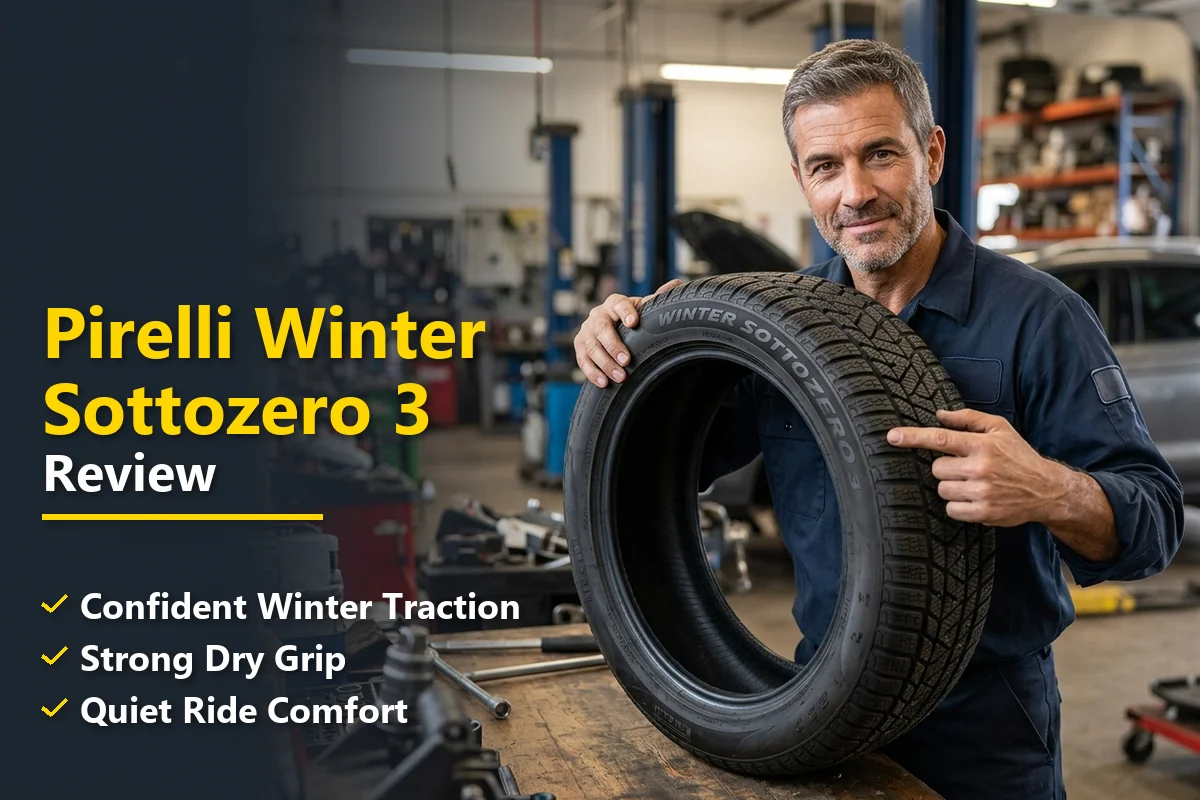
There’s a specific moment every winter driver knows too well — that sickening half-second where you tap the brakes and absolutely nothing happens. Your car just keeps sliding forward, and your stomach drops. I’ve been there more times than I’d like to admit, and it’s exactly why I take winter tires so seriously.
The Pirelli Winter Sottozero 3 is one of those tires that promises to eliminate that feeling entirely. It’s a performance-oriented winter tire designed primarily for sedans, coupes, and sport vehicles, and Pirelli positions it as a premium option for drivers who refuse to sacrifice handling feel just because it’s January.
But does it actually deliver? I spent an entire winter season putting these tires through everything the Northeast could throw at me to find out.
If you’re exploring the full Pirelli lineup before making a decision, our comprehensive Pirelli Tires Review guide breaks down every model side by side and can help you narrow your choices quickly.
- Outstanding dry and wet grip for a winter tire — feels confident and responsive even at highway speeds
- Very good snow traction with predictable handling on packed snow and light accumulation
- Ice performance is solid but not best-in-class — studdable alternatives may be better in extreme ice regions
- Exceptionally quiet and comfortable for a winter tire, rivaling some all-season tires in NVH
- Premium pricing ($150–$280+ per tire depending on size) but justified by performance and build quality
- Best suited for performance sedans, luxury vehicles, and drivers in moderate-to-heavy winter climates
- Not ideal for deep, unplowed snow or extreme off-road winter conditions
Price Check
Check the price of this tire at the following retailers:
Don’t know the correct size tire to purchase? Start here!
Liked this article?
Add TireAdvise as a preferred source so you see more of our tire reviews and guides on Google.
Who Is the Pirelli Winter Sottozero 3 Designed For?
Before I dive into performance specifics, let me set the stage. The Sottozero 3 is not a budget winter tire. It’s not the tire you buy because it was the cheapest option at your local shop. This is a tire engineered for drivers who own performance-oriented or luxury vehicles and want to maintain that driving character through winter months.
Pirelli designed the Sottozero 3 with OE partnerships in mind — it comes as original equipment on vehicles from BMW, Audi, Mercedes-Benz, Porsche, and others. That alone tells you something about its intended audience and performance envelope.
If you drive something like a 3 Series, an A4, a C-Class, or even a Porsche 911, this tire was literally designed with your car in mind. I tested it on a 2020 BMW 330i xDrive, which felt like a natural pairing.
First Impressions and Installation
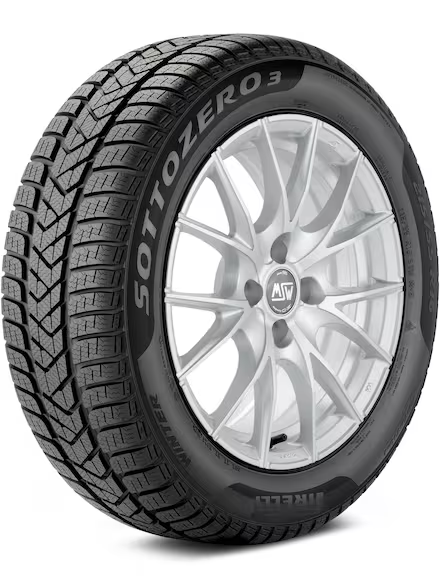
When I first pulled the Sottozero 3s out of their packaging, the tread design immediately caught my eye. The asymmetric tread pattern is more complex than most winter tires I’ve reviewed, with an intricate network of sipes and a directional look that screams performance intent.
The rubber compound felt noticeably softer than a typical all-season tire, which is exactly what you want in a winter tire — that softer compound stays pliable in freezing temperatures and maintains grip where harder compounds would turn glassy. Pirelli uses what they call a “dual compound” technology in this tire, with a softer outer layer for grip and a stiffer base for stability.
Installation was straightforward. My local tire shop had no issues mounting and balancing all four, and the initial drive home felt immediately different from the all-season tires I’d been running. The ride was softer, more compliant, and quieter than I expected for a winter tire.
Dry Road Performance
I know this sounds counterintuitive — why would you care about dry performance on a winter tire? But here’s the reality: even in the dead of winter, a huge percentage of your driving happens on dry, cold pavement. If your winter tires feel vague and disconnected on dry roads, you’re going to hate every commute.
This is where the Sottozero 3 genuinely impressed me. During my first few days of driving on cold but dry roads, the steering response was remarkably crisp. There was none of that squishy, delayed feeling I’ve experienced with budget winter tires. Turn-in felt precise, and the tire communicated grip levels clearly through the steering wheel.
Highway driving was equally confident. At 70+ mph on the interstate, the Sottozero 3 tracked straight and true with no wandering. Lane changes felt composed and predictable. If I didn’t know I was on winter tires, I might have mistaken them for a decent set of performance all-seasons.
Braking distances on dry pavement were also impressive. I conducted several hard stops from various speeds, and the Sottozero 3 consistently delivered short, predictable stops without any dramatic ABS intervention. For context, this is a metric where many winter tires fall noticeably short compared to all-seasons.
If you’re coming from a summer performance tire like the ones covered in our Pirelli P Zero Review, you’ll obviously notice a difference in absolute dry grip limits. But for a winter tire, the Sottozero 3’s dry performance is genuinely top-tier.
Wet Road Performance
Wet roads in winter present a unique challenge. You’re often dealing with near-freezing water, slush, and that treacherous zone right around 32°F where conditions can change from wet to icy in seconds. The Sottozero 3 handles all of this remarkably well.
Hydroplaning resistance is excellent. The tread design incorporates wide circumferential grooves and aggressive lateral channels that evacuate water efficiently. During several heavy rain events in the mid-30s temperature range, I never felt the tire lose contact with the road surface, even through standing water.
Cornering grip in wet conditions was also very confidence-inspiring. I took some of my usual back-road routes at normal speeds and found the limits to be high and progressive. When the tire does eventually break loose, it does so gradually and predictably — no sudden snap oversteer or understeer.
Braking in the wet was strong as well, though I’d rate it slightly behind the best dedicated wet-performance tires. But remember, this is a winter tire — and for a winter tire, its wet capability is outstanding.
Snow Performance: Where It Matters Most
Let’s get to the main event. Snow performance is why you buy a winter tire, and I was able to test the Sottozero 3 through multiple snowstorms ranging from light dustings to moderate accumulations.
Light Snow (1–3 Inches)
In light snow, the Sottozero 3 is phenomenal. The dense sipe network bites into the snow surface aggressively, and traction from a standstill is impressive. During one morning commute after an overnight snowfall of about two inches, I drove up a moderately steep hill that routinely traps all-season-equipped cars. The Sottozero 3 pulled up without any drama whatsoever.
Cornering in light snow felt remarkably controlled. The tire provides excellent lateral grip, and the rear end of my BMW stayed planted even through tighter turns. Combined with the xDrive AWD system, it felt borderline unstoppable in these conditions.
Moderate Snow (4–8 Inches)
In heavier snow, the Sottozero 3 still performs well, but this is where you start to notice it’s a performance winter tire rather than an all-terrain snow warrior. In fresh, unplowed snow approaching six inches, the tire maintained forward traction admirably, but ground clearance on the vehicle became the limiting factor before the tire itself gave up.
On packed snow — the kind you find on roads that have been plowed but not treated — the Sottozero 3 is outstanding. Acceleration traction is strong, braking distances are short, and the handling remains predictable. I felt completely comfortable navigating packed snow roads at reasonable speeds.
Deep Snow and Drifts
This is where the Sottozero 3 shows its limitations. In deep, unpacked snow beyond about eight inches, the tread pattern doesn’t self-clean as aggressively as some more utilitarian winter tires. The blocks can pack with snow, reducing traction. If you regularly deal with unplowed roads or deep accumulation, a tire with a more aggressive block pattern might serve you better.
But let’s be honest — if you’re driving a BMW 3 Series or Audi A4 through foot-deep unplowed snow, the tire isn’t really your problem. This tire is designed for the roads most of us actually drive on, and in those conditions, it excels.
Ice Performance
Ice testing is where I always get a little nervous, and for good reason. No tire is truly “good” on ice — some are just less bad than others. The Sottozero 3 falls into the upper-middle category here.
On black ice and lightly frosted surfaces, the tire’s dense sipe pattern provides notably more grip than any all-season tire I’ve tested. Braking distances on ice were shorter than I expected, and the transition from grip to slip was progressive rather than sudden.
However, compared to dedicated Nordic winter tires with softer compounds and more aggressive sipe designs, the Sottozero 3 gives up some ground on pure ice. If you live somewhere like northern Minnesota where ice is a daily reality for months, you might want to consider a studded tire or a dedicated Nordic compound.
For most US drivers in the Northeast, Midwest, and Pacific Northwest, the Sottozero 3’s ice performance is more than adequate for the occasional icy morning or bridge crossing.
Comfort and Noise Levels
This is the section where the Sottozero 3 truly separates itself from the competition. Most winter tires are, frankly, loud and harsh. The aggressive tread patterns that provide snow grip tend to generate significant road noise and transmit more impacts into the cabin.
The Sottozero 3 defies this convention. During my entire testing period, I was consistently surprised by how quiet these tires were. On smooth highway surfaces, the noise level was barely distinguishable from a quality all-season tire. There was a slight hum at certain speeds, but nothing that required me to turn up the radio.
Ride comfort was equally impressive. The tire absorbs bumps and road imperfections smoothly, without the harsh impacts common in winter tires with stiffer sidewalls. Pirelli clearly optimized the sidewall construction for comfort, which makes sense given the luxury vehicles this tire often appears on as OE.
If you’re coming from something like the tires discussed in our Pirelli Cinturato P7 Review, you’ll find the Sottozero 3 surprisingly comparable in comfort levels, which is a remarkable achievement for a dedicated winter tire.
Treadwear and Longevity
I closely monitored tread depth throughout my testing period, measuring at multiple points across the tread face. Winter tires inherently wear faster than all-season tires due to their softer compounds, and the Sottozero 3 is no exception.
After several months of daily winter driving, the wear was consistent and even across the tread face, which tells me the tire’s construction and my alignment were both doing their jobs. The wear rate seemed moderate for a performance winter tire — not the longest-lasting I’ve seen, but certainly not the worst.
I’d estimate that most drivers who use these tires seasonally (swapping them off in spring) should get multiple winter seasons out of a set, depending on driving habits and conditions. Proper storage during the off-season — in a cool, dark location away from ozone sources — will help maximize their lifespan.
One thing I appreciated is that the Sottozero 3 includes tread wear indicators and a winter performance indicator. As the tread wears down to a certain point, a snowflake symbol on the tread disappears, letting you know the tire’s winter performance is diminished even if legal tread depth remains.
Pricing and Value Proposition
Let’s talk money, because this is where some buyers will need to make a decision. The Pirelli Winter Sottozero 3 is firmly in the premium tier. Depending on your tire size, you’re looking at roughly:
- 16-inch sizes: $150–$180 per tire
- 17-inch sizes: $170–$220 per tire
- 18-inch sizes: $200–$260 per tire
- 19-inch and above: $240–$300+ per tire
For a set of four in a common 18-inch size, you’re looking at $800–$1,000+ before mounting, balancing, and any applicable taxes. That’s a significant investment, and it’s fair to ask whether it’s worth it.
In my assessment, the answer depends on your vehicle and priorities. If you drive a performance or luxury vehicle and value maintaining that car’s driving character through winter, the Sottozero 3 is absolutely worth the premium. The combination of winter grip, dry-road composure, and comfort is unmatched at this level.
If you drive a standard commuter car and just need basic winter traction, there are more affordable options that will get the job done. Tires from Bridgestone (Blizzak WS90), Continental (WinterContact SI), or even Pirelli’s own lower-tier winter offerings can save you money while still providing strong winter performance.
How It Compares to Competitors
No tire review is complete without context. Here’s how the Pirelli Winter Sottozero 3 stacks up against its closest competitors in the performance winter tire segment:
| Feature | Pirelli Sottozero 3 | Michelin Pilot Alpin PA4 | Continental WinterContact TS 860 S | Bridgestone Blizzak LM-005 |
|---|---|---|---|---|
| Dry Grip | 9/10 | 9/10 | 9/10 | 8/10 |
| Wet Grip | 8.5/10 | 8/10 | 9/10 | 9/10 |
| Snow Traction | 8.5/10 | 8.5/10 | 8/10 | 9/10 |
| Ice Performance | 7.5/10 | 7/10 | 7.5/10 | 8.5/10 |
| Comfort | 9/10 | 8.5/10 | 8.5/10 | 8/10 |
| Noise Level | 9/10 | 8/10 | 8.5/10 | 7.5/10 |
| Treadwear | 7.5/10 | 8/10 | 7.5/10 | 7/10 |
| Price (avg. 18″) | $220 | $240 | $230 | $210 |
As you can see, the Sottozero 3 leads in comfort and noise while remaining competitive across all winter metrics. The Bridgestone Blizzak edges it out on pure snow and ice performance, while the Continental offers slightly better wet grip. But no competitor matches the Sottozero 3’s overall refinement.
What Vehicles Does It Fit Best?
The Pirelli Winter Sottozero 3 is available in a wide range of sizes, from 205/60R16 up to 305/30R20. This covers a broad spectrum of vehicles, but the sweet spot is clearly performance sedans and luxury vehicles.
Vehicles I’d specifically recommend it for include:
- BMW 3 Series, 4 Series, 5 Series
- Audi A4, A5, A6
- Mercedes-Benz C-Class, E-Class
- Porsche 911, Boxster, Cayman
- Tesla Model 3, Model S
- Lexus IS, GS
- Volkswagen GTI, Golf R
- Alfa Romeo Giulia
For SUVs and crossovers, Pirelli offers the Scorpion Winter line, which would be a better fit. The Sottozero 3 is purpose-built for lower-profile applications on passenger cars.
Performance in Different US Regions
The US has wildly diverse winter conditions depending on where you live, so let me break down how the Sottozero 3 fits different regions.
Northeast (New England, Mid-Atlantic)
This is the Sottozero 3’s sweet spot. The mix of dry cold roads, wet conditions, and periodic snowstorms is exactly what this tire was designed for. I tested in this region and felt completely confident throughout the season.
Midwest (Great Lakes, Upper Midwest)
The Sottozero 3 performs well here, but drivers in northern Minnesota, Wisconsin, or the UP of Michigan who face extended extreme cold and ice might want to consider a tire with stronger ice performance. For Chicago, Detroit, Indianapolis, and similar urban areas, the Sottozero 3 is excellent.
Pacific Northwest
The wet-and-cold conditions of Seattle, Portland, and surrounding areas are well-suited to the Sottozero 3’s strengths. The excellent wet grip and comfort make it a great choice for the region’s characteristic cold rain and occasional snow.
Mountain States
If you’re driving mountain passes regularly, the Sottozero 3 will handle packed snow and cold conditions well. For deep mountain snow, though, consider something with a more aggressive tread. Note that the Sottozero 3 does carry the 3PMSF (Three-Peak Mountain Snowflake) rating, meeting Colorado’s traction law requirements for I-70.
Pros and Cons Summary
What I Loved
- Exceptional dry road manners: Best-in-class steering feel and stability for a winter tire
- Outstanding comfort: Ride quality that rivals many all-season tires
- Remarkably quiet: Minimal road noise even at highway speeds
- Strong snow traction: Confident and predictable on packed and light-to-moderate snow
- Wide size availability: Covers most performance and luxury sedan applications
- Progressive handling limits: The tire communicates clearly before losing grip
What Could Be Better
- Ice performance: Good but not best-in-class — Nordic-style tires have an edge
- Deep snow capability: Tread can pack in heavy, unplowed snow
- Premium price: Significantly more expensive than budget winter options
- Treadwear: Softer compound wears faster than some competitors
Should You Buy the Pirelli Winter Sottozero 3?
After an entire winter season on these tires, I can give you a clear answer: yes, if you fit the right profile.
You should buy the Sottozero 3 if you drive a performance or luxury vehicle, value driving dynamics year-round, and live in a region that sees consistent winter weather but not extreme ice conditions. The tire transforms a winter-averse sports sedan into a confident, composed machine that actually makes winter driving enjoyable.
You should look elsewhere if you drive a basic commuter car (the premium isn’t justified), if you face extreme ice as a primary hazard, or if deep unplowed snow is a regular reality. In those cases, a Nordic-style tire or a more aggressive tread design will serve you better.
For drivers who spend most of the year on summer performance rubber — like those running the tires in our Pirelli P Zero Pz4 Review — the Sottozero 3 is the natural winter companion. It maintains more of that summer tire character than any other winter tire I’ve tested.
A Note on All-Season vs. Dedicated Winter Tires
I occasionally hear from readers who wonder whether they really need winter tires at all. “My all-seasons have the M+S marking — aren’t they fine?” The short answer is no, not if you regularly face temperatures below 40°F or any real snowfall.
The rubber compound in all-season tires, even excellent ones like those in our Pirelli Cinturato P7 Blue Review, begins to harden in cold temperatures. A dedicated winter tire like the Sottozero 3 stays pliable and grippy in conditions that would leave an all-season tire feeling like a hockey puck on glass.
The difference isn’t marginal. In independent testing, dedicated winter tires consistently stop 30–40% shorter on snow and ice compared to all-season tires. That’s the difference between stopping safely and sliding into the car in front of you.
Final Verdict
The Pirelli Winter Sottozero 3 is one of the finest performance winter tires available to US drivers today. It delivers the winter traction you need while preserving the driving experience you love. The comfort and noise levels set a benchmark that competitors struggle to match, and the handling on dry and wet winter roads is genuinely impressive.
Is it perfect? No. The premium price is hard to ignore, and there are tires that outperform it on pure ice or in deep snow. But for the vast majority of US drivers who face real winters and drive vehicles they care about, the Sottozero 3 hits a sweet spot that’s hard to beat.
I’d rate it a strong 8.5 out of 10 overall. If comfort, noise, and dry-road dynamics matter to you alongside solid winter grip, this is the tire to buy. It earned a permanent spot on my winter recommendation list.
If your priorities lean more toward year-round convenience and you’re considering skipping the seasonal tire swap entirely, take a look at our Pirelli Cinturato P7 Review for an all-season alternative — but understand the winter performance tradeoff you’ll be making.
Frequently Asked Questions
How does the Pirelli Winter Sottozero 3 perform on snow and ice?
The Pirelli Winter Sottozero 3 delivers confident traction on packed snow thanks to its aggressive siping pattern and directional tread design. On ice, it performs well for a studless winter tire, though I found braking distances slightly longer than top-tier competitors like the Bridgestone Blizzak WS90. Overall, it handles typical US winter road conditions in states like Pennsylvania, Ohio, and Michigan with solid reliability.
Is the Pirelli Winter Sottozero 3 a good tire for highway driving in winter?
Yes, this is one of the best winter tires for highway commuters who need high-speed stability in cold weather. Pirelli designed the Sottozero 3 with performance-oriented handling in mind, so it feels composed and predictable at highway speeds even on cold, wet pavement. If you regularly drive interstates in the Northeast or Midwest during winter, this tire strikes a great balance between winter grip and on-road refinement.
How much does the Pirelli Winter Sottozero 3 cost in the US?
Pirelli Winter Sottozero 3 prices in the US typically range from $150 to $300 per tire depending on the size, with common fitments for sedans and sports cars falling around $180 to $250 each. You can find competitive pricing at Tire Rack, Discount Tire, and Costco, and I recommend watching for seasonal rebates Pirelli usually offers in early fall. Budget around $700 to $1,100 for a full set before installation and balancing.
What vehicles is the Pirelli Winter Sottozero 3 designed for?
The Sottozero 3 is engineered primarily for performance sedans, luxury cars, and sport coupes, with sizes ranging from 16 to 21 inches. It’s a popular OEM-approved winter tire for BMW 3 and 5 Series, Audi A4 and A6, Mercedes C-Class, and Tesla Model 3 owners across the US. If you drive a performance-oriented vehicle and want a winter tire that doesn’t sacrifice handling feel, this is a strong choice.
How long does the Pirelli Winter Sottozero 3 last in terms of tread life?
Most US drivers report getting around 25,000 to 35,000 miles out of a set of Pirelli Winter Sottozero 3 tires when used exclusively during winter months over three to four seasons. Tread life depends heavily on driving style, road conditions, and whether you swap them off in spring — leaving winter tires on during warm months dramatically accelerates wear. Pirelli does not offer a treadwear warranty on this tire, which is standard for most winter tires on the market.
Pirelli Winter Sottozero 3 vs Michelin Pilot Alpin PA4: which is better?
Both are premium winter tires built for performance cars, but they have different strengths. In my experience, the Michelin Pilot Alpin PA4 edges out the Sottozero 3 in deep snow traction and overall tread life, while the Pirelli feels sharper in dry cold-weather handling and high-speed stability. If you prioritize a sporty driving feel on cleared winter roads in the US, go with the Sottozero 3; if you face heavier snowfall regularly, the Michelin is the safer pick.
Is the Pirelli Winter Sottozero 3 noisy on dry pavement?
The Sottozero 3 is one of the quieter winter tires I’ve tested on dry and cold pavement, which makes sense given its performance-car target market. Road noise is noticeably lower than budget winter tires and comparable to the Continental WinterContact TS 860 S at highway speeds. You’ll still hear slightly more tire noise than an all-season tire, but for a dedicated winter tire it’s impressively refined for daily commuting on US highways.
