

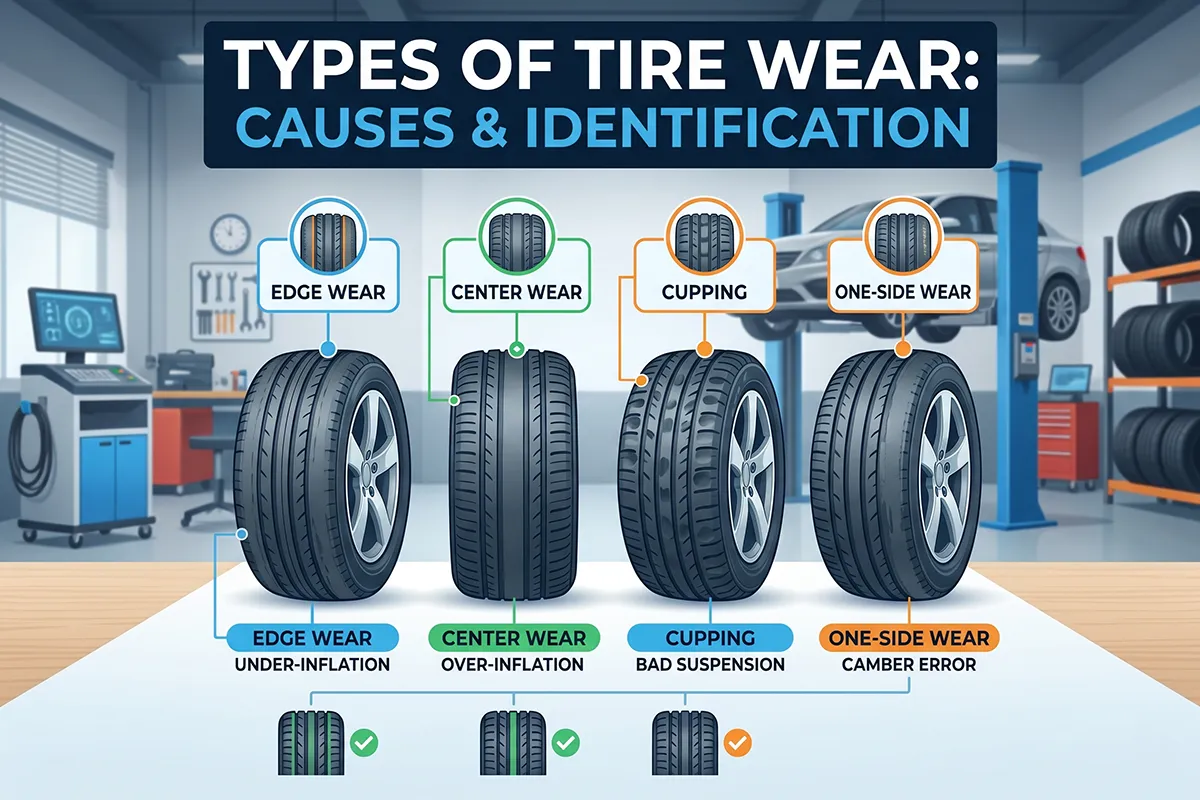
Tire wear patterns are your car’s way of flagging mechanical problems, alignment issues, inflation habits, or driving style concerns before they turn into blowouts or costly repairs. Center wear = overinflation. Edge wear = underinflation. One-sided wear = alignment. Cupping/scalloping = suspension. Diagonal patches = rotation neglect. Catching these patterns early can save you $200–$800+ in preventable damage.
Your tires are leaving you clues every single mile — most drivers just don’t know how to read them.
Before we link out to the broader context: if you’re still trying to decide which tires to buy before worrying about how they wear, our tire buying and maintenance guide covers selection, specs, and what to look for before you ever mount a set.
Liked this article?
Add TireAdvise as a preferred source so you see more of our tire reviews and guides on Google.
Why Tire Wear Patterns Actually Matter
I’ve inspected hundreds of used tires over the years — at tire shops, in driveways, at track days — and the wear pattern on a tire tells you more about a car’s health than almost any other single diagnostic point. It’s like reading tree rings. The rubber doesn’t lie.
The problem is most drivers glance at their tires and think “still got tread, good to go.” That’s the wrong frame. The shape of the remaining tread tells you whether your suspension is collapsing, your alignment is off by a degree or two, or you’ve been running 5 PSI low for six months.
Each of those scenarios puts you in real danger — and each one creates a different, identifiable wear mark.
Let me walk you through every major tire wear pattern I’ve encountered, what causes each one, and what you need to do about it.
The 8 Most Common Tire Wear Patterns
1. Center Wear (Overinflation Wear)
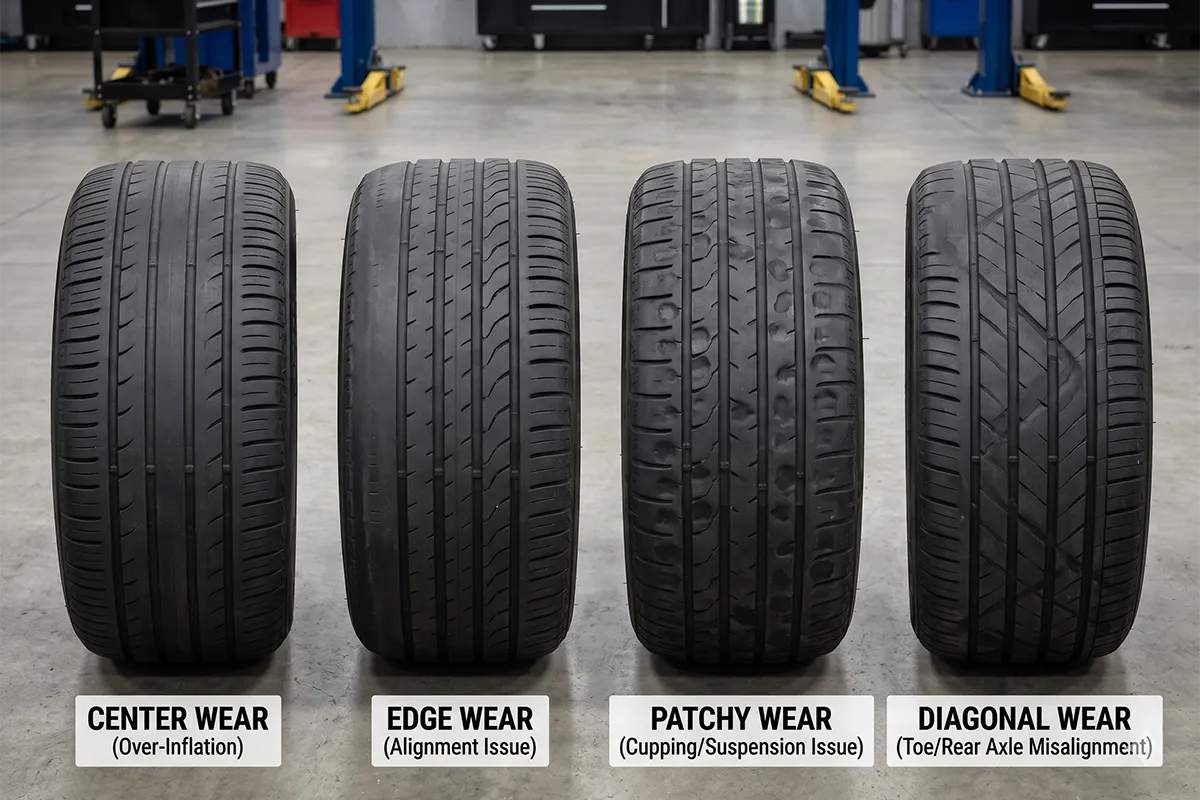
What it looks like: The center strip of the tread wears down faster than the shoulders. If you flip the tire on its side and look across the tread face, the middle will be noticeably bald or slick while the outer edges still show tread depth.
What causes it: Overinflation. When you run too much air pressure, the tire bulges outward in the middle, putting most of the contact pressure on the center of the tread. Only that center band is truly loading the road surface.
I ran into this firsthand on a set of all-season tires on my old daily driver. I’d inflated them to the max pressure listed on the tire sidewall (not the door jamb recommendation — rookie mistake) and by 20,000 miles the center bands were at 3/32″ while the shoulders were still sitting at 6/32″. I’d essentially burned through half the useful life of those tires by ignoring a number.
PSI difference it takes to cause damage: Even 5–8 PSI over the door jamb spec consistently will accelerate center wear over time. It doesn’t take extreme overinflation.
What to do:
- Set your inflation pressure to the spec on your driver’s door jamb sticker — not the tire sidewall max.
- Check pressure cold (before driving), once a month.
- If center wear is already present, the damage is done on that tire. Focus on correcting pressure and rotating to slow the progression.
| PSI vs. Spec | Wear Location | Expected Tire Life Impact |
|---|---|---|
| Correct | Even across tread | Full rated mileage |
| +5 PSI over | Slight center bias | ~10–15% life reduction |
| +10 PSI over | Pronounced center wear | Up to 25% life reduction |
| +15+ PSI over | Rapid center wear | Severe — replace early |
2. Shoulder/Edge Wear (Underinflation Wear)
What it looks like: Both outer edges of the tread wear faster than the center. The center blocks look fine. The shoulders are rounded off, sometimes with a “feathering” effect on the tread blocks.
What causes it: Underinflation. A low tire collapses slightly under the car’s weight, causing the contact patch to spread outward and load the shoulders disproportionately. This is the mirror image of center wear.
This is the most common wear pattern I see on vehicles in daily use — because most drivers are running 3–7 PSI low without knowing it. Tires naturally lose about 1 PSI per month, and with temperature swings it goes faster. Over a 6-month period without a pressure check, you can easily be 5–8 PSI down.
Beyond wear, underinflation generates heat. Heat is the number one enemy of tire longevity and structural integrity. A significantly underinflated tire generates enough internal heat to cause delamination and sidewall failure — this is how blowouts happen.
What to do:
- Inflate to door jamb spec immediately.
- Investigate why the tire went low — slow leak, valve stem issue, or just neglect.
- If wear is uneven but minor, rotate and continue monitoring.
- If the shoulders are badly rounded, the tire has compromised wet-weather grip — replace it.
3. One-Sided Wear (Camber/Alignment Wear)
What it looks like: One edge of the tire wears dramatically faster than the other — either the inner edge or the outer edge. The worn side often has a sharp, knife-like edge. If you run your hand across the tread from outside to inside, you’ll feel a strong directional texture (this is called “feathering”).
What causes it: Camber misalignment. Camber is the vertical tilt of the tire as seen from the front of the car. Negative camber (top of tire tilted inward) causes inner edge wear. Positive camber (top tilted outward) causes outer edge wear.
Toe misalignment also contributes — especially to feathering. If your tires are toed in or out excessively, each tire is slightly dragged sideways with every rotation, which creates diagonal wear across individual tread blocks.
I had a set of tires develop significant inner edge wear on the front axle after a pothole impact. The hit was hard enough to knock the left front suspension geometry out of spec by about 1.5 degrees of camber. Over the next 10,000 miles, the inner shoulder on that tire wore down to 2/32″ while the outer edge was still at 6/32″. One alignment appointment — about $90 — would have saved me from replacing a tire at 30,000 miles instead of 50,000.
What to do:
- Get a four-wheel alignment — immediately. Don’t wait.
- Ask the shop to show you the before/after alignment specs printout. You want to see numbers, not just “we adjusted it.”
- If the car has been in a collision or hit a major pothole, inspect alignment within a few days.
- Rotate tires regularly (every 5,000–7,500 miles) — rotation won’t fix alignment, but it slows the rate at which any single tire bears the brunt.
4. Diagonal Wear / Feathering
What it looks like: Individual tread blocks look rounded on one side and sharp on the other — like a sawtooth when viewed from the side. Run your hand across the tread: it’ll feel rough in one direction and smooth in the other.
What causes it: Primarily toe misalignment. The tire is pointing slightly left or right of the direction of travel, so it’s scrubbing sideways as it rolls. This erodes one side of each tread block consistently.
Diagonal or feathered wear is almost always a rotation neglect + alignment issue working together. Tires that never get rotated spend their lives in one position, and any small alignment deviation compounds continuously on the same contact surface.
What to do:
- Alignment correction is the fix.
- After alignment, rotate immediately — don’t wait for the standard interval.
- Replace tires if feathering is severe; compromised tread blocks generate noise and reduce wet traction significantly.
5. Cupping / Scalloping (Suspension Wear)
What it looks like: Wavy, scooped-out sections around the circumference of the tire — almost like someone took a spoon and scooped shallow divots at regular intervals. The spacing between cups is usually consistent, around 4–6 inches apart.
What causes it: Worn or failing suspension components — most commonly shock absorbers or struts. When a shock absorber loses its damping ability, the wheel literally bounces on the road surface instead of staying in smooth contact. Each bounce hammers a divot into the tread.
This is one of the more dangerous wear patterns because it indicates a suspension failure, not just a tire or pressure issue. A car with severely cupped tires and bad shocks has dramatically reduced braking stability and poor cornering control.
I’ve seen this pattern on a customer vehicle where the rear shocks were so far gone the car was bouncing visibly on rough pavement. The rear tires were cupped so badly the car produced a steady drumming noise at highway speed that the driver assumed was “just road noise.”
The drumming noise test: If your tires produce a rhythmic thudding, wup-wup-wup sound that gets faster as you speed up — especially noticeable between 50–70 mph — that’s almost always cupping from suspension wear.
What to do:
- Replace shocks/struts. This is the root cause — new tires without fixing the suspension will cup again in 15,000 miles.
- Expect to replace affected tires after suspension repair. Cupping doesn’t smooth out.
- Budget roughly $250–$600 per axle for shock/strut replacement depending on vehicle; paired with new tires, this is a significant repair, but necessary.
6. Flat Spot Wear
What it looks like: A localized flat, shiny patch somewhere on the tread circumference — like a small rectangular section that’s been sanded smooth compared to the surrounding tread.
What causes it: Two sources — panic braking (without ABS engaging properly) that locks up the tire and skids it across pavement, or sitting stationary for an extended period under heavy load (think: a car parked for months). Extended storage flat spots are sometimes temporary and round out after driving a few miles in warm conditions; braking flat spots are permanent.
What to do:
- For a braking flat spot: the tire needs to be replaced. The structural cords may be damaged, and the flat section will create a thumping ride and reduced traction permanently.
- For storage flat spots: drive gently for 10–20 miles and assess. If the thumping persists, replace.
7. Patchy / Irregular Wear
What it looks like: Random-looking wear that doesn’t follow a clear edge-to-edge or circumferential pattern. Some tread blocks are worn significantly lower than adjacent ones with no obvious logic.
What causes it: Most often rotation neglect combined with slight balance or alignment issues that never got addressed. The tire essentially accumulated wear unevenly over time in its fixed position.
Wheel imbalance is another common contributor — a tire that vibrates slightly at certain speeds will load certain contact points more heavily than others.
What to do:
- Get wheels balanced and aligned.
- Begin a strict rotation schedule going forward (every 5,000 miles is ideal; 7,500 maximum).
- If the irregular wear is significant (more than 2/32″ variation across tread), the tire’s grip is compromised — especially in wet conditions.
8. Heel-and-Toe Wear
What it looks like: When you look at individual tread blocks around the tire’s circumference, the leading edge of each block (the heel) is more worn than the trailing edge (the toe). It looks like a series of small ramps.
What causes it: This is actually a natural wear pattern caused by the way tread blocks deform under braking and acceleration loads. Some heel-and-toe wear is normal and unavoidable. It becomes a concern when it’s pronounced — at that point it generates road noise and indicates the tire may be nearing the end of its useful life.
Rear tires on front-wheel-drive cars tend to develop this more because they carry less load and don’t receive the same traction inputs, so they’re less “scrubbed clean” and develop more pronounced block-edge wear.
What to do:
- Moderate heel-and-toe wear: rotate regularly and monitor.
- Severe heel-and-toe wear: replace the tire; the noise and ride degradation won’t improve.
Tire Wear Pattern Diagnostic Quick Reference
| Wear Pattern | Location | Primary Cause | Fix |
|---|---|---|---|
| Center wear | Center strip only | Overinflation | Correct PSI |
| Edge/shoulder wear | Both outer edges | Underinflation | Correct PSI |
| One-sided wear | Inner OR outer edge | Camber misalignment | Alignment |
| Diagonal/feathering | Sawtooth on blocks | Toe misalignment | Alignment |
| Cupping/scalloping | Rhythmic scoops, circumferential | Worn shocks/struts | Replace suspension |
| Flat spot | Single localized patch | Lockup braking or storage | Replace tire |
| Patchy/irregular | Random across surface | No rotation + imbalance | Balance + rotate |
| Heel-and-toe | Block edge ramps | Normal + rotation neglect | Rotate regularly |
How to Inspect Your Own Tires in 5 Minutes
You don’t need a lift or a mechanic to do a basic wear pattern diagnosis. Here’s my routine:
Step 1 — The penny/quarter test. Insert a quarter into the tread groove with Washington’s head facing down. If you can see the top of his head, you’re at or below 4/32″ — replace soon. Do this in three locations across the tread width: outer shoulder, center, inner shoulder. If you get different readings across positions, you have a wear pattern.
Step 2 — Run your hand across the tread. With the tire stationary, slowly drag your palm across the tread from outside shoulder to inside shoulder. You’re feeling for: ridges, sharp edges on one side, waviness, or sections that feel lower than others.
Step 3 — Run your hand around the circumference. On one tread rib, drag your finger slowly around the tire. You’re feeling for flat spots, cupping (rhythmic dips), or rough patches.
Step 4 — Visual check of the shoulders. Crouch down and look at the tire from the front while it’s on the car. If the inner edge is worn but not visible, you may need to turn the wheel full lock to see it. Significant inner edge wear is easy to miss from a standing glance.
Step 5 — Check inflation cold. Before driving, check all four tires against the door jamb spec. Do this monthly — it takes 3 minutes and prevents more tire damage than anything else you can do.
When to See a Mechanic vs. When to Just Fix Inflation
Not every wear pattern requires a shop visit. Here’s how I triage it:
Fix yourself at home:
- Center wear or edge/shoulder wear only → check and correct PSI. That’s it.
Schedule an alignment (non-urgent, within 1–2 weeks):
- One-sided wear
- Diagonal/feathering wear
- You’ve recently had a significant pothole hit or minor collision
Go to the shop this week:
- Cupping/scalloping — this is a safety issue (suspension failure)
- Severe one-sided wear — this means serious misalignment under load
- Any tire showing steel cord or fabric through the tread
Replace the tire now:
- Flat spots from hard braking
- Any wear that’s reached 2/32″ tread depth
- Visible cord, cracking, or bulging on the sidewall
Frequently Asked Questions
Q: Can tire wear patterns be fixed, or do I always need new tires?
In most cases, you fix the cause of the wear pattern and then manage the remaining tire life with rotation. The wear itself is permanent rubber loss — you can’t add tread back. What matters is whether the remaining tread depth is still safe (above 4/32″ for wet conditions, above 2/32″ legal minimum), and whether the wear is so severe it’s compromised grip or structural integrity.
Q: How often should I rotate my tires to prevent uneven wear?
Every 5,000 miles is my recommendation — it aligns with oil change intervals on modern cars, which makes it easy to remember. 7,500 miles is the outer limit. Beyond that, wear patterns that have started developing become much harder to equalize out.
Q: Does one-sided wear mean I need to replace the tire or just get an alignment?
Both, typically — in the right order. Get the alignment done first. Then assess whether the worn tire still has enough even tread to continue safely. If the inner shoulder has dropped to 2–3/32″ while the outer is at 6/32″, the tire needs to come off regardless of the alignment fix.
Q: What causes cupping on rear tires specifically?
Rear shock absorber wear most commonly. The rear of a vehicle is often overlooked — drivers notice front-end handling changes more readily, so rear suspension wear progresses undetected longer. Rear tires also often show cupping earlier than fronts on FWD vehicles because they carry less load and aren’t driven. This makes them more sensitive to any bouncing from worn shocks.
Q: Is some uneven wear normal?
A modest amount of heel-and-toe wear is normal and unavoidable. A slight difference in wear rate between the front and rear axle positions is also normal (front tires on FWD cars typically wear faster). What’s not normal: visible differences in tread depth across the width of any single tire, cupping, or sharp one-sided wear.
Q: How much does an alignment cost vs. the cost of ignoring it?
A four-wheel alignment typically runs $80–$150 at a reputable shop. Ignoring a misalignment that causes one-sided wear can kill a tire in 15,000–20,000 miles instead of 40,000–50,000. A set of mid-range all-season tires costs $400–$700. The math is obvious — alignment is one of the highest-ROI maintenance items you can do.
Final Thought
Your tires are the only thing connecting your car to the road. Every wear pattern is a message — and after years of reading them, I can tell you that most of the messages are saying the same thing: this could have been prevented.
Monthly pressure checks, tire rotations every 5,000 miles, and one alignment check per year will prevent 80% of the unusual wear patterns I’ve described here. The tires that wear out right on schedule with even tread across the whole contact surface? Those are on cars driven by people who just stay on top of the basics.
Start with your door jamb sticker, a $15 tire pressure gauge, and a quarterly walk-around. The rest follows from there.
Related reads:
