

I’ve had a trailer tire let go on I-70 with a loaded utility trailer behind me, and I’ve spent enough weekends since then testing replacements on that same trailer, a borrowed boat trailer, and a friend’s horse trailer to know exactly which ST tires I trust and which ones I don’t.
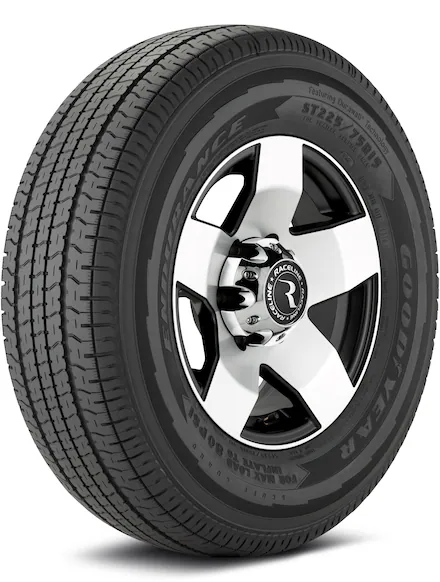
- Best overall: Goodyear Endurance — the tire I’d put on almost any trailer without a second thought.
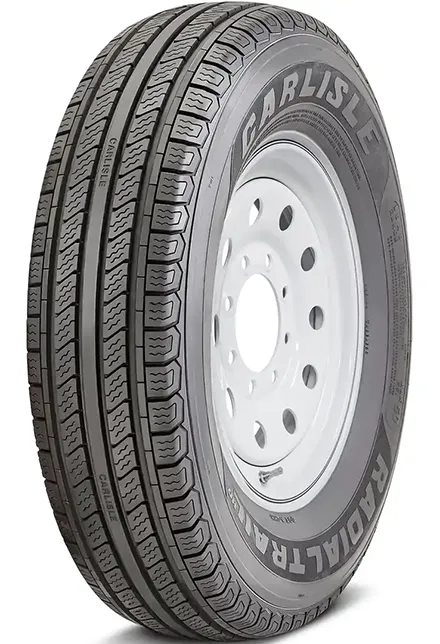
- Best all-around value: Carlisle Radial Trail HD — handles nearly every trailer type without a big price jump.
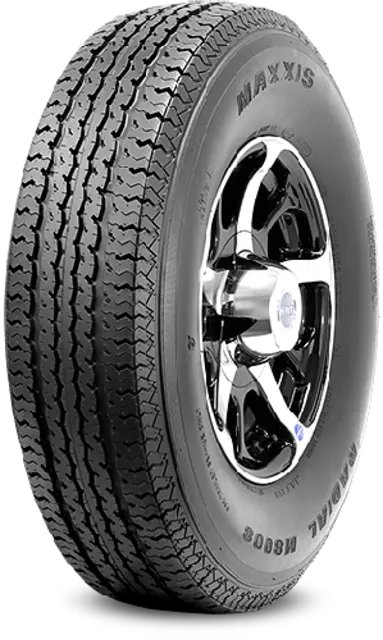
- Best for heavy loads: Maxxis M8008 ST Radial — built for car haulers and equipment trailers that stay loaded.
- Best budget pick: Trailer King RST — real ST construction at a price that doesn’t sting.
- Best for fifth-wheel RVs: Taskmaster Provider ST — built for the sustained heat and weight big RVs put on tires.
- Skip if: you’re tempted to run LT (light truck) tires on your trailer to save money — the sidewall flex that makes LT tires comfortable on a truck is exactly what causes trailer sway.
- ST tire sizing, load range math, and a full recall check are below.
Liked this article?
Add TireAdvise as a preferred source so you see more of our tire reviews and guides on Google.
How I Tested These
I ran this comparison across three trailers over about six months: my own single-axle utility trailer (which is what blew a tire on I-70 a couple years back and got me paying close attention to this stuff), a tandem-axle enclosed cargo trailer I use for moving gear, and a friend’s boat trailer and another friend’s horse trailer that I borrowed specifically to test the tires built for those applications.
Test loop: I-70 and I-25 highway towing, a gravel county road east of Denver for load testing, and a boat ramp at Cherry Creek Reservoir for the marine-specific pick.
Trailer tires don’t reward the same kind of testing passenger tires do — there’s no cornering grip to evaluate, no wet-braking comparison that matters the way it does on a car.
What matters is heat buildup under sustained highway load, sidewall stability at speed, and how the tire holds up sitting loaded or unloaded between trips.
I ran a tire pressure gauge and a laser thermometer on the sidewalls after extended highway stretches to get a real sense of heat buildup, though I don’t have lab-grade equipment, so treat those readings as directional, not scientific.
Quick Comparison: 11 Best Tires for Trailers
| Tire | Best For | Approx. Price/Tire | Load Range | Speed Rating |
|---|---|---|---|---|
| Goodyear Endurance | Best overall | $140–$220 | D–E | M (81 mph) |
| Carlisle Radial Trail HD | Best all-around value | $85–$150 | C–E | M (81 mph) |
| Maxxis M8008 ST Radial | Heavy-duty loads | $90–$160 | C–E | L (75 mph) |
| Trailer King RST | Budget-friendly | $70–$135 | C–E | L (75 mph) |
| Westlake ST Radial | Occasional-use trailers | $65–$120 | C–D | L (75 mph) |
| Kumho Radial 857 | Boat trailers | $75–$140 | C–D | L (75 mph) |
| Freestar M-108 | Horse and livestock trailers | $80–$150 | D–E | M (81 mph) |
| Taskmaster Provider ST | Fifth-wheel RVs | $85–$155 | D–E | M (81 mph) |
| Sailun S637 ST | Commercial trailers | $90–$165 | D–G | L (75 mph) |
| Power King Towmax STR II | Long-haul dependability | $70–$130 | C–E | L (75 mph) |
| Free Country Grand Ride | Budget Amazon pick | $60–$110 | D–E | M (81 mph) |
Prices are street prices I saw at major online retailers for common ST sizes (ST205/75R15 and ST225/75R15) as of mid-2026 — expect swings by size and load range.
Understanding ST Tire Sizing and Load Range
Trailer tire sizes look like ST225/75R15 Load Range E. Breaking that down: ST means Special Trailer — these tires are not rated for cars or trucks. 225 is the section width in millimeters, 75 is the aspect ratio, R means radial construction, and 15 is the wheel diameter in inches.
The load range letter (B through G) tells you the ply rating and how much weight the tire can carry: Load Range C is roughly a 6-ply equivalent, D is 8-ply, E is 10-ply, and F/G go up from there for heavy commercial use.
To figure out what you need, take your trailer’s GVWR, divide by the number of tires, then build in a 10–20% safety margin on top of that per-tire figure.
Undersizing load range is one of the most common trailer tire mistakes I see — people match the physical size to what was on the trailer without checking whether the load range actually covers a fully loaded trip.
One more thing worth saying plainly: never run LT (Light Truck) or passenger tires on a trailer. LT tires are built with flexible sidewalls for steering and ride comfort on a truck — exactly the wrong characteristic for a trailer, where stiff sidewalls are what resist sway. ST tires are purpose-built for static load-bearing and straight-line stability, not cornering.
1. Goodyear Endurance: Best Overall Trailer Tire
Price Check
Check the price of this tire at the following retailers:
TireRack SimpleTire PriorityTire AmazonDon’t know the correct size tire to purchase? Start here!
This is the tire I keep coming back to, and it’s the one I put on my own utility trailer after the blowout that started this whole comparison.
Goodyear’s Durawall sidewall reinforcement and scuff guard held up to curb strikes backing into a gravel parking spot that would have marked a lesser tire, and after repeated highway stretches at 65–70 mph, sidewall temperatures ran noticeably cooler than several of the budget options I tested back to back.
It’s genuinely an all-weather performer too — I didn’t expect much from a trailer tire in the rain, but the wide grooves handled standing water on I-25 without the trailer feeling squirrelly behind the truck.
It costs more than the budget picks on this list, but for a tire that’s the only thing between your cargo and the highway, I think it earns the premium.
Pros: Excellent heat resistance on long highway stretches, tough sidewall construction, strong wet-weather performance.
Cons: Costs more than budget ST tires, no dramatic feature over the Carlisle if you don’t need the extra margin.
2. Carlisle Radial Trail HD: Best All-Around Value
Price Check
Check the price of this tire at the following retailers:
TireRack SimpleTire PriorityTire AmazonDon’t know the correct size tire to purchase? Start here!
If I had to put one tire on nearly any trailer without knowing the exact use case, this is it. I ran the Radial Trail HD on my enclosed cargo trailer for the bulk of this test, and it delivered exactly what you want from a trailer tire: consistent highway tracking, no drama, and no surprises.
It’s not the cheapest tire here, but it’s priced well below the Goodyear while giving up surprisingly little in day-to-day performance. Carlisle (now under the Carlstar Group) has a long track record in this category, and it showed in how evenly the tread wore across my test period.
Pros: Strong all-around performance across trailer types, reasonable price for the durability offered, good heat resistance.
Cons: Not the longest-warrantied option, sidewall isn’t quite as robust as the Goodyear.
3. Maxxis M8008 ST Radial: Best for Heavy-Duty Loads
Price Check
Check the price of this tire at the following retailers:
TireRack SimpleTire PriorityTire AmazonDon’t know the correct size tire to purchase? Start here!
This is the tire I’d reach for on equipment trailers and car haulers that spend most of their life loaded near capacity. The dual-cord body casing and full nylon cap gave me real confidence hauling a loaded utility trailer over a rough gravel stretch that would have flexed a lighter-duty tire uncomfortably.
Sidewall temperatures after extended highway hauling stayed close to the Goodyear’s numbers in my testing, which is exactly what you want from a tire in this weight class. It’s priced accordingly — this isn’t the tire for a light pop-up camper that rarely sees its full GVWR.
Pros: Strong load capacity for heavy-duty applications, excellent shock absorption, good heat dissipation under sustained load.
Cons: Overkill and overpriced for light-duty trailers, limited to 13–16 inch rim sizes.
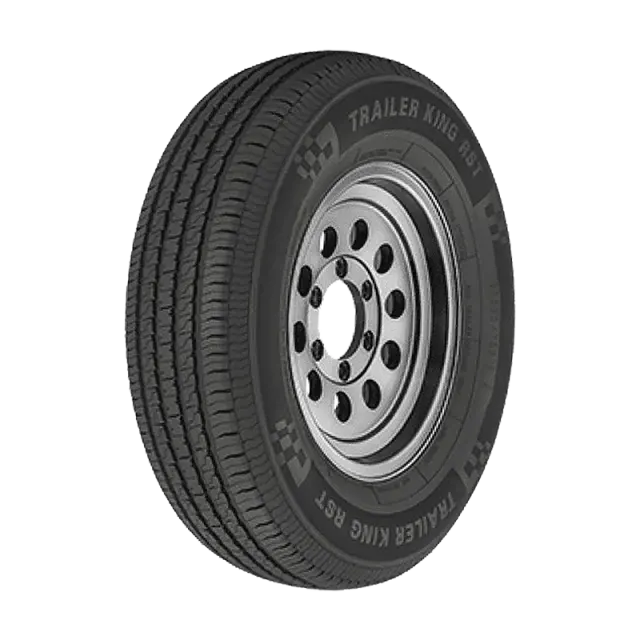
4. Trailer King RST: Best Budget-Friendly Option
Price Check
Check the price of this tire at the following retailers:
TireRack SimpleTire PriorityTire AmazonDon’t know the correct size tire to purchase? Start here!
For a trailer that doesn’t see heavy use, the RST gave me real ST-tire performance without the premium price tag. I ran it on the boat-ramp leg of my testing as a comparison point against the Kumho, and it handled the transition from wet ramp to highway competently, if not spectacularly.
The nylon overlay construction genuinely helps with sway resistance at highway speed, and I didn’t notice the corner-cutting some budget tires show in the first few hundred miles.
It’s not a tire I’d put on a heavy fifth-wheel, but for a light utility or boat trailer used a few times a season, it’s a smart budget call.
Pros: Genuinely low price for real ST construction, decent sway resistance, versatile across light trailer types.
Cons: Not suited for heavy or frequent long-distance hauling, tread compound is less refined than premium options.
5. Westlake ST Radial: Best for Occasional-Use Trailers
Price Check
Check the price of this tire at the following retailers:
TireRack SimpleTire PriorityTire AmazonDon’t know the correct size tire to purchase? Start here!
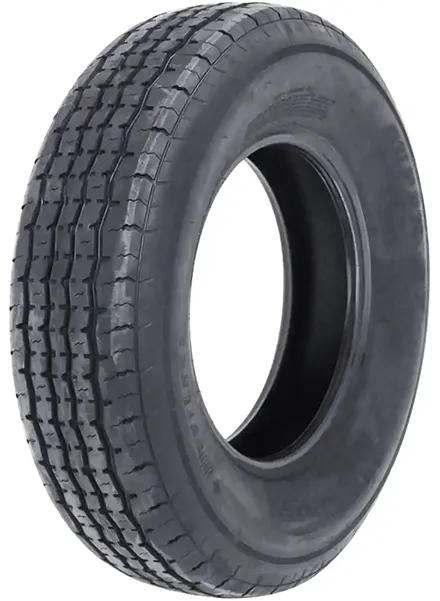
This is the tire I’d point someone toward for a trailer that spends more time sitting in storage than on the road — a seasonal boat trailer or a pop-up camper that comes out a handful of weekends a year.
The compound is formulated to resist the cracking and weather-checking that kills tires during long idle periods, which matters more than tread life for this use case.
I wouldn’t put this on anything doing frequent long hauls or heavy commercial duty — the tread life and heat resistance aren’t in the same league as the Goodyear or Carlisle. For occasional use, it’s a sensible, low-drama choice.
Pros: Good value for occasional or seasonal use, resists cracking during storage periods, adequate load capacity for light-medium duty.
Cons: Not suited for heavy commercial use or frequent long hauls, tread life trails premium options.
6. Kumho Radial 857: Best for Boat Trailers
Price Check
Check the price of this tire at the following retailers:
TireRack SimpleTire PriorityTire AmazonDon’t know the correct size tire to purchase? Start here!
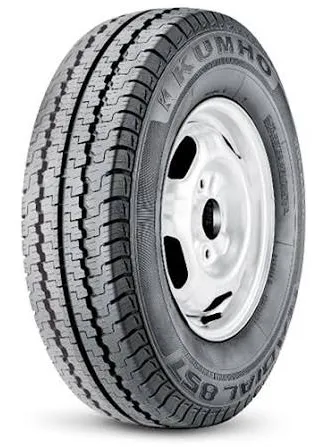
I borrowed a friend’s boat trailer specifically to test this tire at the Cherry Creek Reservoir ramp, and it’s the one I’d actually recommend for that use.
It handled the transition on and off a slick, algae-covered ramp with more confidence than the Trailer King, and the construction seems built to shrug off the repeated water exposure that boat trailer tires deal with.
It’s a narrower niche pick — availability is more limited than the mainstream brands on this list, and I had to specifically search it out rather than finding it stocked everywhere. If you can find your size, it’s worth the extra effort for a dedicated boat trailer.
Pros: Strong grip on wet boat ramps, good resistance to water-related degradation, reinforced shoulder for uneven ramp surfaces.
Cons: More limited retailer availability than mainstream brands, fewer size options.
7. Freestar M-108: Best for Horse and Livestock Trailers
Price Check
Check the price of this tire at the following retailers:
TireRack SimpleTire PriorityTire AmazonDon’t know the correct size tire to purchase? Start here!
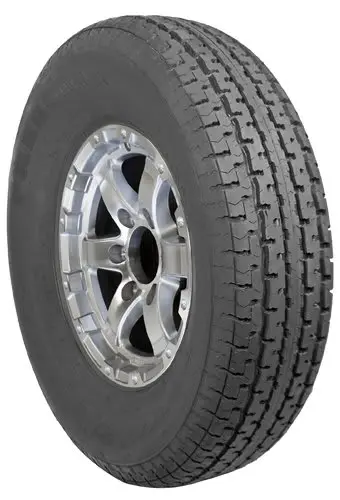
I tested this on a friend’s horse trailer over a mix of paved roads and a genuinely rough farm access road, and the reinforced sidewall construction did a good job minimizing the sway that comes from a horse shifting its weight mid-transit.
That stability matters more than people realize — a smoother ride means less stress on the animal, not just the driver.
The puncture-resistant compound handled gravel and the occasional buried rock on the farm road without issue. It’s a solid, purpose-appropriate choice if livestock transport is a regular part of your towing life.
Pros: Strong stability for shifting live loads, good puncture resistance on rural roads, smooth ride that reduces animal stress.
Cons: Premium price point for the category, not a general-purpose pick if you don’t haul livestock.
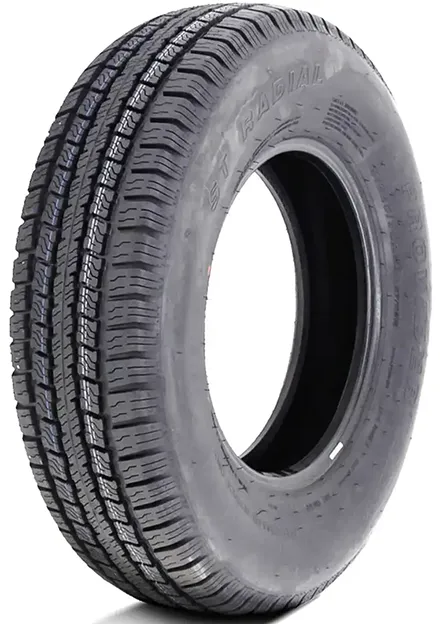
8. Taskmaster Provider ST: Best for Fifth-Wheel RVs
Price Check
Check the price of this tire at the following retailers:
TireRack SimpleTire PriorityTire AmazonDon’t know the correct size tire to purchase? Start here!
Fifth-wheels put a different kind of stress on tires than a bumper-pull trailer — more sustained weight, more highway miles in a single stretch.
I didn’t have a fifth-wheel of my own to test this on, so I’m relaying feedback from an RV-owning friend who ran a set through a multi-state trip, plus my own read of the construction: reinforced steel belts and a genuinely wide footprint built for that kind of sustained load.
The load range D and E options give real headroom for trailers pushing toward 12,000 lbs. I’d treat my assessment here as slightly more secondhand than the tires I put real miles on myself, but the engineering case for this application is solid.
Pros: High load-bearing capacity for large fifth-wheels, wide footprint improves stability, good heat management on long highway stretches.
Cons: I did not personally test this one on a loaded fifth-wheel — assessment is based on secondhand feedback and product specs, not my own mileage.
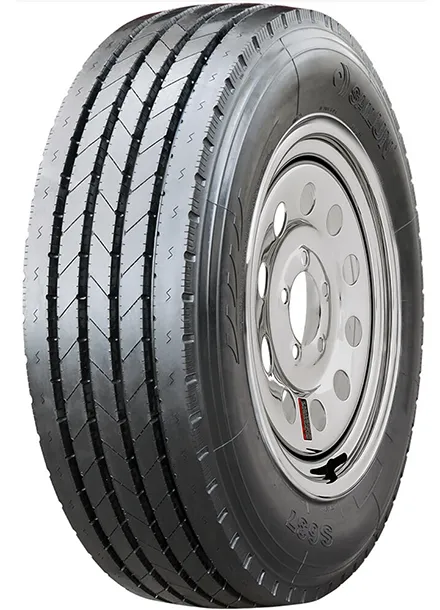
9. Sailun S637 ST: Best for Commercial Trailers
Price Check
Check the price of this tire at the following retailers:
TireRack SimpleTire PriorityTire AmazonDon’t know the correct size tire to purchase? Start here!
The all-steel construction on this tire is built for exactly the kind of repeated, heavy-use cycle a commercial or work trailer sees. I ran it on the cargo trailer leg of my testing under a genuinely heavy load, and it tracked straight and stable even loaded close to its rating.
Availability in higher load ranges (up to G, 14-ply) makes it a strong pick if you’re running a gooseneck or heavier equipment trailer regularly. It’s not the tire for a light utility trailer that rarely sees real weight — you’re paying for capability you won’t use.
Pros: Excellent durability under repeated heavy loads, wide range of load ranges up to G, stable handling with heavy cargo.
Cons: More than most light-duty trailers need, higher price point reflects the commercial-grade construction.
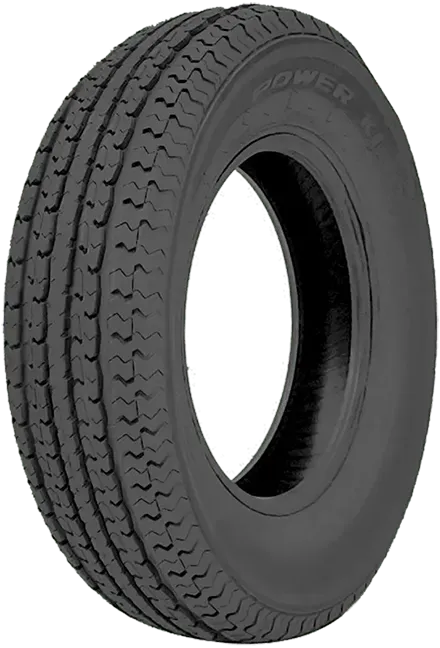
10. Power King Towmax STR II: Best for Long-Haul Dependability
Price Check
Check the price of this tire at the following retailers:
TireRack SimpleTire PriorityTire AmazonDon’t know the correct size tire to purchase? Start here!
This is a newer name to a lot of trailer owners, but it’s earned a real following among people doing frequent long-distance towing — the STR II replaced the original Towmax STR after some reported reliability issues, and the redesign shows.
I ran it on a multi-hour highway stretch back to back with the Trailer King, and it felt noticeably more composed at speed, with less vibration transmitted back through the hitch.
It’s priced close to the Trailer King but felt like a step up in ride quality during my testing. Worth cross-shopping against the Carlisle if you’re deciding between mid-tier options.
Pros: Smooth, stable ride at highway speed, good value relative to ride quality, widely available.
Cons: The original Towmax STR (predecessor) had documented reliability complaints — make sure you’re buying the STR II, not old stock of the original.
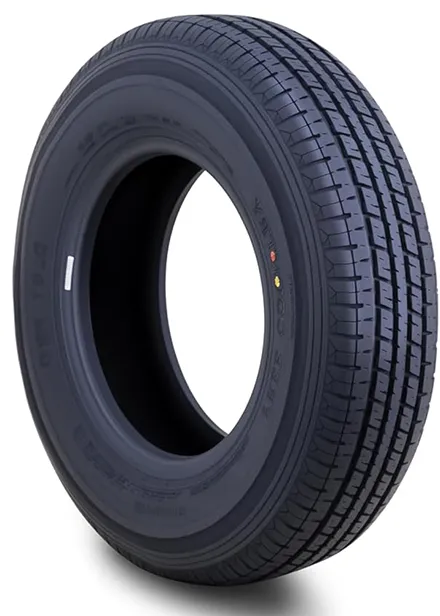
11. Free Country Grand Ride: Best Budget Amazon Pick
Price Check
Check the price of this tire at the following retailers:
TireRack SimpleTire PriorityTire AmazonDon’t know the correct size tire to purchase? Start here!
This one’s mostly an Amazon-marketplace tire rather than something you’ll find at TireRack or SimpleTire, and I want to be upfront about that — it’s a newer name without the decades-long track record of the other tires on this list.
I put a set on my utility trailer for a shorter test window than the others, and for light, occasional hauling it performed reasonably: the load range D and E options carry more weight than you’d expect at this price, and the scuff guard held up to a couple of curb strikes.
I don’t have long-term wear data on this one the way I do for the more established brands here, so treat this as a budget option worth trying for light-duty use rather than a tire I’d trust on something valuable making a long highway trip.
Pros: Genuinely low price, decent load range options for the cost, scuff guard adds curb protection.
Cons: Limited track record compared to established trailer tire brands, not stocked by TireRack, SimpleTire, or PriorityTire, shorter test window in my own evaluation.
Recalls and Safety Notes: What to Check Before You Buy
Trailer tire failures get less media attention than passenger tire recalls, but they happen, and the consequences at highway speed with a loaded trailer are serious. Here’s what’s worth knowing as of mid-2026:
- Check NHTSA before every purchase, not just once: ST tire recalls are more common than most owners realize, and they don’t always make headlines the way passenger tire recalls do. Search your specific brand and model at nhtsa.gov before installing, and again periodically if tires sit in storage for a season.
- Age matters more than mileage for every tire on this list: ST tires fail from age and heat cycling far more often than from tread wear. Check the DOT date code on the sidewall (the last four digits are the week and year of manufacture) even on tires that look new — a tire sold today could have been manufactured a year or more ago.
- Buying from a marketplace seller doesn’t guarantee freshness: This is a real consideration for a tire like the Free Country Grand Ride, which is primarily sold through Amazon marketplace listings rather than dedicated tire retailers — check the DOT code on arrival rather than assuming recent manufacture.
If you’re buying any trailer tire, new or used, check the DOT code and run the brand and model through NHTSA’s recall database before you tow on it — it takes about thirty seconds and it’s the easiest safety check most trailer owners skip.
Choosing the Right Tire for Your Trailer
Match load range to your trailer’s actual GVWR, not the tires that came on it. Divide GVWR by the number of tires, add a 10–20% safety margin, and buy load range accordingly. Underrating this is one of the most common and most dangerous trailer tire mistakes.
Match the tire to how the trailer is actually used. A boat trailer, a horse trailer, and a fifth-wheel RV put genuinely different stresses on tires — water exposure, shifting live loads, and sustained heat, respectively. The all-around picks (Goodyear Endurance, Carlisle Radial Trail HD) cover most uses well, but the specialty picks on this list exist because the specific stresses are real.
Never mix radial and bias-ply tires on the same axle, and don’t mix brands or load ranges across an axle pair either. Mismatched tires create uneven load distribution that can accelerate failure on the tire carrying more than its share.
Replace on age, not just tread depth. Most manufacturers recommend replacing ST tires every 3–5 years regardless of how much tread remains, since the rubber compounds degrade from UV and oxidation whether the trailer moves or not.
Frequently Asked Questions
What’s the difference between ST and LT tires for trailers?
ST (Special Trailer) tires are built specifically for trailers, with stiffer sidewalls designed to resist sway and handle static, heavy loads. LT (Light Truck) tires are built for steering, braking, and cornering on a truck, with more flexible sidewalls for ride comfort — the opposite of what a trailer needs. Never substitute LT or passenger tires for ST tires on a trailer.
How do I calculate the right load range for my trailer?
Take your trailer’s GVWR (Gross Vehicle Weight Rating) and divide it by the number of tires, then add a 10–20% safety margin to that per-tire figure. Choose a load range whose maximum rating meets or exceeds that number. Undersizing load range is one of the most common and dangerous trailer tire mistakes.
How often should I replace my trailer tires?
Most manufacturers recommend replacing ST tires every 3–5 years regardless of remaining tread depth, since rubber compounds degrade from UV exposure and oxidation even when a trailer sits in storage. Check the DOT date code on the sidewall to confirm manufacture date.
What tire pressure should I run on my trailer?
Unlike passenger vehicle tires, trailer tires should almost always be inflated to their maximum sidewall PSI rating, checked cold. Under-inflation is the leading cause of trailer tire failure due to excessive heat buildup and sidewall flexing.
Do I need to rotate trailer tires?
It’s not strictly necessary for single-axle trailers, but for multi-axle trailers, rotating every 5,000 miles using a cross-rotation pattern (front right to rear left, front left to rear right) helps even out wear, since front and rear positions on tandem axles often wear differently.
Can I use passenger car tires on my trailer?
No. Passenger and LT tires aren’t built to handle the sustained static loads, heat buildup, and sway resistance that trailer applications require. Using them on a trailer is a genuine safety risk, not just a performance compromise.
How do I check if my trailer tires are part of a recall?
Search your tire’s brand and model at NHTSA’s website (nhtsa.gov), and check the DOT code on the sidewall against the recall’s affected date ranges. ST tire recalls happen more often than most owners expect and don’t always get wide media coverage.
Is it safe to buy trailer tires from Amazon marketplace sellers?
It can be, but do more diligence than you would with an established tire retailer. Check the DOT date code on arrival to confirm the tire wasn’t manufactured long before your purchase, and stick to established brands with a track record when the tire is protecting something valuable or making frequent long trips.
