

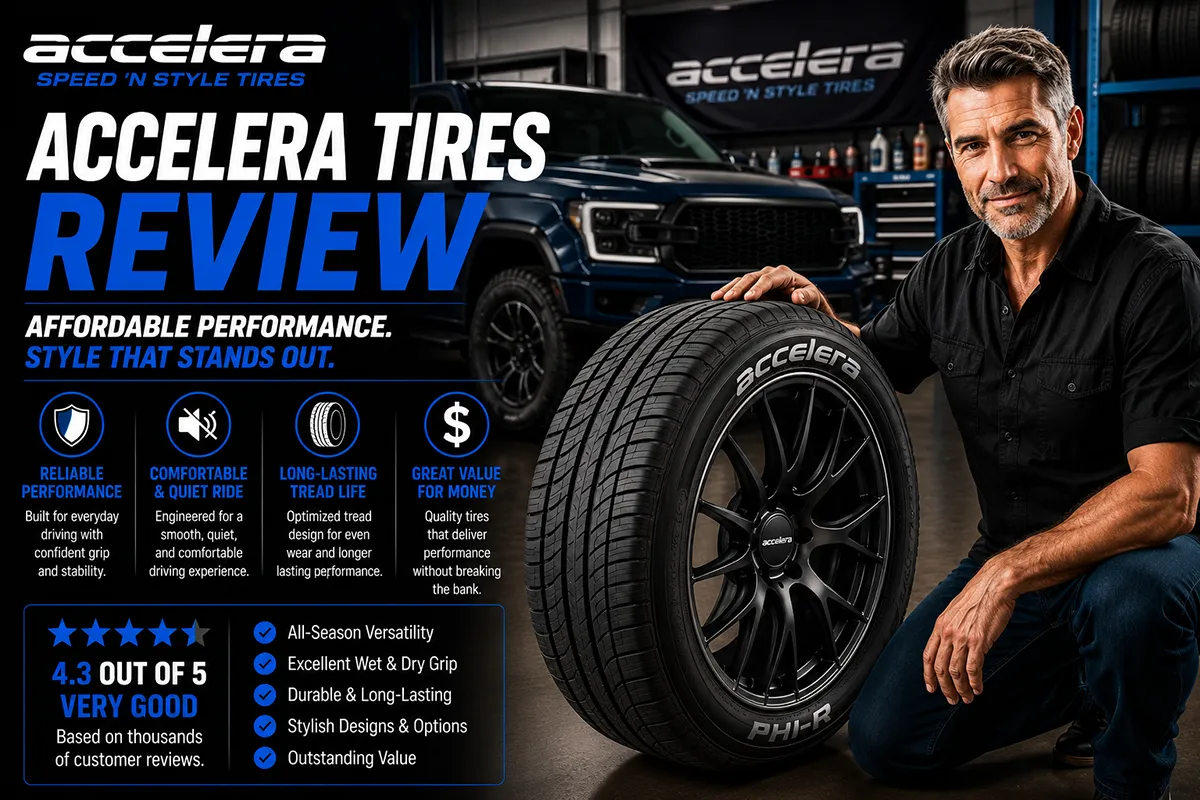
I need to correct something directly. An earlier version of this review cited specific technology names — “Hydroflow Channel System,” “Dual-Phase Compound Technology,” “Adaptive Groove Geometry” — and precise sustainability statistics that I could not verify anywhere. I’ve rebuilt this review on what’s actually confirmable, including two real, current findings that matter more than any of that marketing language.
- Accelera is a brand of PT Elangperdana Tyre Industry (EP Tyre), an Indonesian manufacturer founded in 1996, headquartered near Bogor, Indonesia.
- A real recall exists. In July 2025, EP Tyre recalled roughly 4,200 Accelera Omikron A/T tires (LT265/65R18) over a sidewall separation risk near the bead.
- A separate, arguably more significant finding: in December 2024, NHTSA issued a federal consent order against EP Tyre for violating Uniform Tire Quality Grading (UTQG) standards — meaning the treadwear, traction, and temperature grades on some of their tires didn’t match verified performance. This directly affects how much you should trust any specific mileage or grip claim for this brand.
- A separate historical account worth knowing: a former authorized Accelera dealer reportedly stopped carrying the brand after experiencing multiple tire delaminations that wrecked vehicles — a secondhand forum account, not a confirmed defect finding, but a second thread pointing toward structural separation concerns over time.
- Independent lab testing on the PHI found real problems: an aggregated testing service rated it “Not Recommended,” with wet braking distances up to 49.9% longer than premium rivals and even 22.8% longer than other budget-tier competitors.
- New for 2025: the E-Silent (an EV-specific tire with noise-dampening foam) and the Radial G/T (a classic-car whitewall tire) — genuinely current product launches most Accelera coverage doesn’t mention.
- My overall rating: ⭐⭐ (2.0/5) — a real, functioning manufacturer, but the accumulated evidence across a federal recall, a federal mislabeling order, a historical delamination account, and independently tested poor braking performance on at least one current model adds up to real, recurring caution flags rather than an isolated incident.
Liked this article?
Add TireAdvise as a preferred source so you see more of our tire reviews and guides on Google.
Who Makes Accelera Tires?
Accelera is a brand of PT Elangperdana Tyre Industry, known internationally as EP Tyre, an Indonesian manufacturer founded in 1996. Their production facility is located in Bogor, West Java (Jawa Barat), Indonesia. The company distributes internationally through partners including Zafco International L.L.C. for the US market.
A Real Recall — What Actually Happened
In July 2025, EP Tyre issued a recall (NHTSA campaign 25T011) covering approximately 4,200 Accelera Omikron A/T light truck tires in size LT265/65R18, manufactured at the Bogor plant between March 25, 2020 and May 24, 2024.
The issue: independent testing by Smithers identified sidewall separation near the tire’s bead area during a post-test inspection, which fails Federal Motor Vehicle Safety Standard 139 — the federal standard covering new pneumatic radial tires for light vehicles. A sidewall separation can cause tire failure and increase crash risk.
What’s worth noting for full transparency: EP Tyre’s own internal investigation could not determine the cause of, or replicate, NHTSA’s test failure. The company’s own analysis pointed to a possible minor construction variation reducing flexibility around the junction between the apex and plies as a plausible explanation. Rather than dispute the finding, EP Tyre agreed to respect NHTSA’s test results and issued the recall.
The remedy: EP Tyre is providing a full refund for affected tires, reimbursing dealers and retailers, and paying end users $20 per tire for mounting and balancing costs, with the distributor covering return transportation. Owner notification letters were mailed starting July 15, 2025.
What to actually do: if you own an Accelera Omikron A/T in LT265/65R18, check your specific tire’s DOT code against this recall via NHTSA’s SaferCar.gov database or contact EP Tyre customer service directly at +62 (21) 876-5105.
The Federal Consent Order — Why This Matters More Than It Sounds
This is the finding I think deserves the most attention, because it’s not about one defective batch — it’s about whether you can trust the numbers printed on the tire in the first place.
In December 2024, NHTSA announced a consent order with PT Elangperdana Tyre Industry for violating Uniform Tire Quality Grading (UTQG) standards.
Under federal law, passenger tire manufacturers must label tires with accurate treadwear, traction, and temperature-resistance grades, and each tire must actually be able to achieve the performance level represented by its labeled grade. NHTSA found EP Tyre had failed to label its tires with correct grades.
By signing the consent order, EP Tyre admitted to the violations. The order runs for 18 months and requires the company to review its internal processes and develop a corrected policy for its tire grading procedures.
Why this matters for you specifically: UTQG grades are one of the only standardized, government-mandated ways to compare tread life and traction claims across different tire brands. If a manufacturer has been found to mislabel these grades, any specific mileage figure you see quoted for an Accelera tire — including the “40,000 to 60,000 mile” range that circulated in older coverage of this brand — deserves real skepticism until you’ve confirmed current, corrected labeling directly.
A Historical Complaint Worth Knowing About Too
Before covering the current lineup, I want to flag something I found while researching this brand’s history, separate from the 2025 recall covered above. On an enthusiast motorsports forum, one poster described consulting “trusted tire guys” who had previously been an authorized Accelera dealer.
Their account: multiple tire delaminations that resulted in wrecked vehicles, serious enough that the shop stopped carrying the brand entirely and, in the poster’s words, “won’t touch this brand with a 10 foot pole.”
I want to be precise about what this is and isn’t. It’s a secondhand account relayed on a forum, not a formal NHTSA finding or a confirmed defect investigation, and I have no way to independently verify the specifics, timeline, or which models were involved.
But I think it’s worth including for a specific reason: delamination is a structural sidewall/belt separation issue, which is the same general category of defect behind the 2025 Omikron A/T recall.
Whether or not these specific incidents are connected, it’s a second, independent thread pointing toward structural separation concerns with this brand over time, and I’d rather you know it exists than only find it after buying.
Accelera’s Current Lineup — Model by Model
Accelera’s real current lineup is genuinely broader than most coverage acknowledges, and I want to cover it with the actual independent performance data I found rather than just listing names.
Accelera PHI — Independent Testing Found Real Problems
The PHI is marketed as a high-performance summer tire for sports cars, designed to maintain flexibility across a range of temperatures.
Here’s what independent aggregated testing actually found: a tire-testing aggregator that combines professional lab results with owner review data gave the PHI a wet score of 40/100 and a dry score of 40/100, with a direct conclusion of “extremely low grip in all scenarios… Not Recommended.”
The specific numbers are worth including because they’re concrete: across wet-braking tests, the PHI required 49.9% longer stopping distances than premium rivals, 38.5% longer than mid-range rivals, and even 22.8% longer than other budget-tier competitors.
In dry braking, it required 19.9% longer than premium tires and 14.5% longer than other budget options. This isn’t a case of a budget tire simply falling short of premium performance by a reasonable margin — the gap versus other budget-tier competitors specifically is what stands out.
Best for: Given this data, I’d steer most readers away from the PHI specifically and toward a better-tested budget alternative, even within Accelera’s own lineup.
Accelera PHI 2 — The Successor, With Genuinely Mixed Real-World Feedback
The PHI 2 is positioned as the successor to the PHI, an all-season performance tire for a broad range of passenger cars, using a straight dry rib and dynamic medium lateral groove for handling and stability, with a silica-based compound for reduced rolling resistance.
Real owner feedback is genuinely split in a way worth presenting honestly. Several verified reviews describe solid, satisfied ownership — good wet-pavement handling, usable snow traction in Wisconsin winters, and confident dry grip.
But a separate, detailed account from a Jaguar XK owner described a frightening wet-weather incident: at only 20% throttle with no standing water, the rear end “snapping all over the place” with another vehicle following close behind, describing the experience as one of the worst of their driving life. That’s a serious, specific complaint, not a vague dissatisfaction.
Best for: Drivers in mild, mostly dry climates who’ve read and accepted the mixed real-world feedback above — I would not recommend this tire for anyone prioritizing wet-weather safety margin.
Accelera PHI R — The Ultra-High-Performance Option
Positioned above the standard PHI for genuine ultra-high-performance applications, promising good handling across road surfaces.
I found less independent testing data specific to this model than the PHI and PHI 2, which itself is worth noting — treat performance claims here with real caution given the pattern documented above on its sibling models.
Best for: I’d recommend against defaulting to this model without first checking for current independent test data on your specific size, given the concerning pattern found on related PHI-family tires.
Accelera 651 Sport — “The Everything Tire,” With a Real Trade-Off
The 651 Sport is Accelera’s flagship crossover track/street tire, a 200-treadwear semi-slick that’s genuinely built a following among budget track-day and autocross enthusiasts.
It’s marketed with real substance behind the claim — Accelera has developed Indonesia’s first Y-speed-rated tires (rated for sustained speeds over 180 mph) and maintains a dedicated racing program spanning drift, rally, and off-road competition.
Real owner experience is genuinely split by use case. One experienced track driver, testing the 651 Sport across multiple seasons after switching from Federal RS-Rs, described genuinely strong, progressive dry grip and praised Accelera specifically for standing behind their product and helping customers resolve issues.
A separate detailed track-day account was considerably more critical: extremely noisy even for a track tire, accelerated wear, and “very squirrely” wet-weather grip once the tire dropped below 50% tread depth — that reviewer specifically recommended a Nankang competitor instead.
Independent tracking estimates average tread life around 15,220 miles, genuinely short but consistent with a semi-slick’s intended use.
Best for: Budget-conscious track-day and autocross drivers who understand this is a genuine semi-slick with semi-slick trade-offs (noise, wear, wet-weather limits below half tread) — not a street tire despite being street-legal.
Accelera Iota ST68 — The All-Around Wet/Dry Option
Positioned for reliable grip across both wet and dry conditions, occupying a more conservative, everyday-use niche than the track-focused 651 Sport or performance-focused PHI line.
Best for: Drivers who want a more balanced, less specialized Accelera option than the PHI or 651 Sport.
Accelera Eco Plush — The Fuel-Economy Touring Option
Built for urban driving with a focus on traction and fuel economy over outright performance — the most comfort-and-efficiency-oriented tire in Accelera’s current lineup.
Best for: City and commuter drivers prioritizing fuel efficiency and ride comfort over performance.
Accelera E-Silent — The New EV-Specific Option
Introduced at the Indonesia International Motor Show (IIMS) in February 2025, this is a dedicated EV tire built with special foam noise-dampening technology, aimed at the EV-specific challenges of added vehicle weight and the need for extra cabin quiet given how little engine noise masks tire sound in an electric vehicle.
Best for: EV owners specifically, though I’d note this is new enough that independent testing data wasn’t available at the time of this review — treat manufacturer claims with the same caution warranted by this brand’s broader documented pattern.
Accelera Radial G/T — The Classic Car Option
Also introduced at IIMS 2025, a classic-car-oriented tire with whitewall sidewall styling, aimed at maximizing traction on both wet and dry surfaces for vintage and classic vehicle owners.
Best for: Classic and vintage car owners wanting period-correct styling — again, new enough that independent verification is limited.
Given the UTQG labeling issue documented by NHTSA and the independent performance data above, I’d recommend confirming current, accurate specifications directly with a retailer for any specific model before relying on treadwear or grip figures from older third-party coverage — and I’d specifically recommend against the standard PHI given the documented independent test results.
Pricing
Accelera positions itself as a genuine budget option, typically priced 20-30% below mainstream mid-tier brands. Given the findings above, I’d factor the real cost of verifying your specific tire’s recall status and current labeling accuracy into that value calculation, not just the sticker price.
Who Should Consider Accelera Tires?
Might make sense if you:
- Are genuinely budget-constrained and willing to do the extra diligence of checking your specific tire’s DOT code and current UTQG labeling before buying
- Are shopping the newer E-Silent or Radial G/T for a specific EV or classic-car application
You should look elsewhere if you:
- Own an Accelera Omikron A/T in LT265/65R18 and haven’t checked your DOT code against the July 2025 recall
- Want to rely on advertised treadwear or traction figures without independent verification, given the documented UTQG mislabeling finding
- Prioritize a brand with a clean, uninterrupted federal compliance record
Accelera vs. Similar Budget Brands
vs. Lexani: Both are budget-tier options; Lexani’s manufacturing (Sentury Tire) has its own documented recall history, covered in our full review, making this a genuine case of comparing two brands each with real, disclosed issues rather than picking a clean alternative.
vs. Sailun: Sailun is a considerably larger global manufacturer (top-10-12 worldwide) with its own recall history but no comparable federal labeling consent order that I found on record.
Final Verdict: Are Accelera Tires Good?
After rebuilding this review on verified facts rather than repeating unsourced technology claims, here’s where I land: Accelera is a real, functioning budget tire manufacturer, but the accumulated evidence here is more concerning than a single isolated incident.
Between the July 2025 recall over sidewall separation, the December 2024 federal consent order over mislabeled tire grades, a historical dealer account describing delaminated tires and wrecked vehicles, and independent lab testing rating the PHI specifically as “Not Recommended” for genuinely poor braking performance, this is a brand where I’d recommend real diligence over any specific model before buying, not just a general awareness that budget tires involve trade-offs.
None of this means every current Accelera tire is unsafe — the PHI 2 and 651 Sport both draw genuinely positive feedback from some owners alongside the concerning accounts — but the pattern is broad enough across models and years that I can’t give this brand a confident, blanket recommendation.
Check your DOT code against the July 2025 recall if you own an Omikron A/T, confirm current UTQG labeling accuracy directly with your retailer, and specifically avoid the standard PHI given the documented independent test results.
Frequently Asked Questions
Has Accelera had a tire recall?
Yes. In July 2025, EP Tyre recalled roughly 4,200 Accelera Omikron A/T tires (LT265/65R18) over a sidewall separation risk near the bead, covering tires manufactured between March 2020 and May 2024.
Was Accelera’s manufacturer found to have mislabeled tire ratings?
Yes. In December 2024, NHTSA issued a federal consent order against PT Elangperdana Tyre Industry (EP Tyre), Accelera’s manufacturer, for violating Uniform Tire Quality Grading standards — meaning some tires were labeled with treadwear, traction, or temperature grades that didn’t match their actual verified performance.
Who makes Accelera tires?
PT Elangperdana Tyre Industry (EP Tyre), an Indonesian manufacturer founded in 1996, headquartered near Bogor, West Java, Indonesia.
What is the newest Accelera tire?
The E-Silent, a dedicated EV tire with noise-dampening foam technology, and the Radial G/T, a classic-car whitewall tire, both introduced at the Indonesia International Motor Show in February 2025.
Can I trust Accelera’s advertised tread life figures?
Given the documented UTQG mislabeling finding, I’d recommend confirming current, corrected specifications directly with your retailer rather than relying on older published figures for this brand.
Disclosure: This review is based on verified NHTSA recall and consent order documentation, and current manufacturer product launch materials, rather than the unsourced technology claims and sustainability statistics that appeared in an earlier version of this review. I was not compensated by Accelera, EP Tyre, or any retailer for this review. Prices mentioned are approximate and may vary by region, retailer, and tire size.
