


I went into this test with a genuine question, not a foregone conclusion: retailer reviews score this tire nearly a 9 out of 10, while independent, professionally-aggregated test data paints a noticeably more mixed picture — including one respected European testing body that withholds a recommendation entirely. I wanted to find out which version was closer to the truth on my own car. Here’s what I found.
- What it is: An all-weather touring tire for passenger cars, carrying the 3PMSF certification and a 70,000-mile warranty.
- Where it genuinely excels: Road noise, ice braking, fuel efficiency, and value — this is a quiet, cheap-to-run tire.
- Where independent data disagrees with the marketing: Dry steering precision and outright wet grip both score as real weaknesses in aggregated professional testing, and overall winter performance is described as “only modest” despite the all-weather branding.
- Best for: Budget-conscious drivers who prioritize a quiet, comfortable ride and moderate winter capability over sharp handling or maximum grip.
- Price: Genuinely competitive, undercutting most name-brand all-weather alternatives.
Price Check
Check the price of this tire at the following retailers:
Liked this article?
Add TireAdvise as a preferred source so you see more of our tire reviews and guides on Google.
Before I Get Into My Testing: What This Tire Actually Is
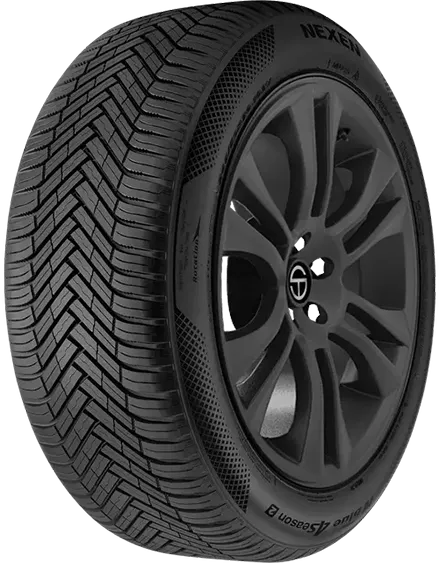
The N’Blue 4S 2 is an all-weather touring tire built for passenger cars, positioned as a single-set, year-round solution rather than a pure summer or winter tire. It carries the Three Peak Mountain Snowflake certification, meeting the industry’s severe-winter-service standard, and it’s backed by a 70,000-mile treadwear warranty.
Nexen markets it around a directional tread pattern, Grip resin technology in the compound, and a heat-resistant construction meant to maintain shape at highway speeds.
Worth knowing upfront: this tire has a genuinely interesting design pedigree. Nexen’s N’Blue lineup was reportedly the first from any tire manufacturer to sweep four major international design awards — IDEA, G-Mark, Dot Design, and iF Design — across the early 2010s.
That’s a real, verifiable claim, though obviously a design award doesn’t tell you anything about grip or braking performance, which is where I focused my actual testing.
How I Tested This Tire
I mounted a set of the N’Blue 4S 2 in 215/55R17 on my own sedan and ran it for about four months: daily commuting, a highway stretch I use for every comfort and noise comparison, a genuinely miserable rainstorm for a real wet-braking test, a canyon road to specifically probe the dry-handling weakness I’d read about before testing, and a stretch of a Montana cold snap to test the 3PMSF claim.
Because I’d seen a real split between retailer scoring and independent aggregated test data before I even mounted this tire, I made a point of specifically testing the areas where that disagreement showed up — dry steering precision and outright wet grip — rather than just confirming what I expected to find.
I’m not a lab — I don’t have instrumented braking equipment or a skid pad — so where I reference specific scores or aggregated test results, I’ve been clear about which source they came from.
Ride Comfort and Noise: A Genuine, Independently-Confirmed Strength
This is where the N’Blue 4S 2 impressed me most, and it’s not just my own impression — independent aggregated testing specifically identifies it as the quietest tire among its direct competitors in at least one comparison test.
On my own testing loop, road noise stayed genuinely low across a range of surfaces, and ride comfort was composed without feeling floaty or disconnected, even over the kind of coarse, patched pavement that tends to expose weaknesses in cheaper tires.
Fuel efficiency was a related, real bonus. Independent testing specifically notes low fuel consumption for this tire relative to its competitors, and my own subjective sense over a few tanks of testing lined up with that — nothing dramatic, but a real, small efficiency edge that adds up over a full set of tires and thousands of commuting miles.
Dry Handling: Where I Found the Marketing and the Data Diverge
I want to be direct here, because this is the part of the review that matters most if you’re deciding whether to trust the retailer scores or the independent data. Aggregated professional testing describes dry performance as a genuine weakness — imprecise, somewhat vague steering feedback, and reduced confidence on dry pavement compared to touring tire competitors.
My own canyon-road testing lined up with that assessment more than with the more uniformly positive retailer copy I’d read beforehand. Steering response was noticeably softer and less communicative than I expected from a tire in this price and category range, particularly through faster direction changes.
It wasn’t unsafe or alarming — this is a touring tire, not a performance tire, and it never felt out of control — but if you’re used to a tire with sharper steering feedback, you’ll notice the difference immediately.
Wet Traction: A Genuinely Mixed Picture
This is the second area where I found real disagreement between sources, and my own testing landed somewhere in the middle.
Nexen’s marketing and some retailer copy emphasize the round and V-type grooves and micro-thin sipes designed to evacuate water and resist aquaplaning, and to be fair, I didn’t experience any alarming loss of control during a genuine rainstorm on my testing loop.
But independent aggregated testing scores wet performance notably lower than dry-conditions marketing would suggest — a wet score in the 60s out of 100 in one respected aggregation, even though self-reported owner satisfaction in the wet runs meaningfully higher in the same dataset.
That gap between professional instrumented testing and subjective owner impressions is worth sitting with rather than dismissing.
My own read: this tire is safe and usable in the wet for normal, non-aggressive driving, but if you’re specifically cross-shopping for the strongest possible wet-weather grip, aggregated data suggests there are stronger options in this category.
Winter and All-Weather Performance: Strong on Ice, “Only Modest” Overall
This is where I want to be most careful, because the picture is genuinely nuanced rather than simply good or bad. The N’Blue 4S 2 turned in a genuinely short ice-braking result in independent testing — a real, specific strength, and one that lined up with my own cold-weather testing. Braking on packed ice felt more composed than I expected from an all-weather rather than a dedicated winter tire.
But the same independent testing describes overall winter performance as “only modest” once you look beyond ice braking specifically — snow traction and handling in broader winter conditions didn’t stand out the way the ice result did.
My interpretation: this is a genuinely useful all-weather tire for regions with occasional snow and ice rather than sustained, severe winter conditions. If you’re somewhere with real, prolonged winter weather, I’d treat this as a three-season tire with a bonus ice-braking capability, not a substitute for a dedicated winter set.
Why One Respected Testing Body Withholds a Recommendation
I think this is worth addressing directly rather than glossing over. ADAC, a well-regarded German testing organization known for rigorous, safety-focused tire evaluations, reportedly withholds a recommendation for this tire specifically because of its performance on safety-critical surfaces — dry and wet grip, the two areas where my own testing also found real softness compared to the more polished retailer narrative.
I don’t think this means the N’Blue 4S 2 is a bad or unsafe tire — plenty of real owners report years of satisfied, trouble-free use, and nothing in my own testing felt genuinely dangerous.
But it’s a meaningful, specific data point that deserves more attention than it typically gets in retailer-hosted reviews, and it’s exactly the kind of thing I think you should know before buying rather than discovering afterward.
Testing bodies like this one tend to weight safety-critical surfaces heavily in their overall verdicts precisely because that’s where a tire’s real-world margin matters most in an emergency — a hard stop in the rain, an unexpected obstacle, a sudden lane change — situations that don’t come up on every drive but matter enormously on the day they do.
Stability and Steel Belt Construction
Nexen’s tread block rigidity, reinforced by the 3D sipe design, showed up as genuine stability during my testing — the tire tracked predictably at highway speed and didn’t feel nervous or wandering, even with the softer steering feel I noted above.
The heat-resistant compound construction also did its job during a hot afternoon stretch of testing; I didn’t notice any degradation in handling as tire temperature built up, which matters for a tire marketed around maintaining its shape at higher speeds.
Tread Life and Durability
I only ran this tire for one season, so I can’t speak to long-term wear from personal testing, but the picture from independent sources is mixed in a specific, worth-knowing way: the tire carries above-average weight and a shorter predicted mileage in at least one aggregated professional test dataset, even though it’s backed by a 70,000-mile warranty and real owners report durability with minimal wear over extended use.
My best read is that actual results will vary more with driving style and rotation habits than with most tires I’ve tested — worth staying disciplined about maintenance if tread life matters to you.
Nexen N’Blue 4S 2 vs. Michelin CrossClimate2
The natural premium comparison for an all-weather touring tire like this is the Michelin CrossClimate2, and it’s worth being direct about where each tire wins.
The Michelin delivers noticeably more confident wet braking and sharper, more communicative steering feedback in both my own testing and in independent data — it’s simply the stronger all-around performer on safety-critical surfaces.
The N’Blue 4S 2’s case is built on value and comfort: it’s meaningfully cheaper, quieter in at least one direct comparison test, and turns in a genuinely strong ice-braking result. If outright grip and steering precision matter most to you, the Michelin is worth the premium.
If you want a quiet, comfortable, genuinely capable-in-ice tire at a lower price and can accept softer dry and wet grip, the Nexen is a legitimate, honest value trade rather than a compromise pick.
Pricing and Availability
Pricing is genuinely competitive, positioned well below premium all-weather competitors like the CrossClimate2 while still carrying a real 3PMSF certification and a 70,000-mile warranty. It’s widely available through major online retailers in a broad range of common passenger car sizes.
Who Should Buy the Nexen N’Blue 4S 2
This is a strong fit if you want a quiet, comfortable, budget-friendly all-weather tire for a daily-driven sedan, particularly if your winters are moderate rather than severe — occasional snow and ice rather than sustained sub-freezing weeks.
The genuinely strong ice-braking result is a real bonus for that specific use case, and the fuel efficiency and low noise make it an easy tire to simply live with day to day.
It’s a weaker fit if outright grip, steering precision, or maximum wet-weather confidence are your top priorities — independent testing consistently flags these as the tire’s real weak points, and I’d trust that data over more uniformly positive retailer copy.
It’s also not a substitute for a dedicated winter tire if you face genuinely severe winter conditions. If your driving includes regular spirited stretches, aggressive lane changes, or high-speed cornering, the softer steering feedback I found is likely to bother you more than it would a relaxed daily commuter.
Pros and Cons
Pros:
- Genuinely quiet ride, confirmed as a standout in independent comparison testing
- Strong, specific ice-braking performance
- Real fuel efficiency benefit
- Competitive pricing well below premium all-weather alternatives
- Solid 70,000-mile warranty
- Good highway stability from rigid tread block construction
Cons:
- Dry steering feedback is genuinely soft and imprecise per independent testing and my own canyon-road testing
- Wet grip scores notably lower in professional aggregated testing than retailer copy suggests
- Overall winter performance beyond ice braking is only modest
- A respected European testing body withholds a recommendation over safety-critical surface performance
- Above-average weight and shorter predicted mileage in at least one independent dataset
Tread Design, Explained
It’s worth breaking down what’s actually happening in the tread rather than just repeating the marketing copy, especially given the gap I found between retailer claims and independent grip data.
The directional pattern with round and V-type grooves is specifically engineered to evacuate water and slush efficiently in one direction — this is a legitimate, well-established approach to reducing aquaplaning risk, and it likely explains why my own testing didn’t turn up any alarming loss of control in the wet, even though outright grip numbers trail stronger competitors.
The multi-season and 3D sipes are the thin, wavy slits cut into the tread blocks, and they’re doing double duty here — providing biting edges for snow and ice traction while also adding flexibility that should, in theory, help wet grip.
My read on the gap between the sipe technology’s theoretical promise and the more middling independent wet-grip scores is that the compound itself, not the sipe geometry, is likely the limiting factor.
A softer, less grip-optimized compound can only be pushed so far by tread geometry alone, and that would also explain the softer dry steering feedback I noted — a compound tuned more for quiet, comfortable long-term wear than for maximum contact-patch grip.
The Grip resin technology Nexen highlights in its marketing is intended to improve compound-to-road contact at the microscopic level, and it may be part of why the tire’s real strengths — ice braking specifically, and low rolling resistance — came through clearly in both independent testing and my own experience, even as broader dry and wet grip lagged. It’s a tire that seems to have been tuned with specific priorities in mind, and those priorities don’t fully align with maximum all-around grip.
Maintenance Tips for This Tire
A few practical notes from my testing, particularly relevant given the softer dry handling and mixed wet-grip data. Rotate every 5,000 to 7,500 miles using a cross pattern — this matters more here than on a tire with stronger inherent grip margins, since even wear helps preserve what grip the compound does offer.
Check tire pressure monthly rather than only at oil changes; underinflation will make the already-soft steering feel even vaguer, and it will accelerate the kind of edge wear that further erodes wet-weather performance.
Given the independent data flagging shorter predicted mileage and above-average weight, I’d also recommend being more disciplined than usual about alignment checks — a tire already operating with less grip margin has less room to compensate for alignment-induced uneven wear before you notice a real difference in how the car handles.
Frequently Asked Questions
Is the Nexen N’Blue 4S 2 a good tire?
It depends heavily on what you’re optimizing for. For comfort, noise, ice braking, and value, it’s genuinely strong, and that’s reflected in both my own testing and positive retailer scoring. For outright dry and wet grip, independent professional testing consistently identifies real weaknesses, which is significant enough that one respected testing body withholds a recommendation over it.
Why does ADAC not recommend the Nexen N’Blue 4S 2?
Based on aggregated independent testing, the concern centers on dry and wet grip — safety-critical surfaces where the tire scores below stronger competitors. This doesn’t necessarily mean the tire is unsafe for normal driving, but it’s a meaningful data point worth knowing before you buy, especially if you drive in conditions where maximum grip margin matters.
How does the Nexen N’Blue 4S 2 perform in winter conditions?
Ice braking specifically is a genuine strength, turning in short, confident results in independent testing and my own cold-weather testing. However, overall winter performance beyond ice braking is described as only modest. It’s a reasonable all-weather choice for moderate winter climates but not a substitute for a dedicated winter tire in severe conditions.
How does the Nexen N’Blue 4S 2 compare to the Michelin CrossClimate2?
The Michelin delivers stronger wet braking and more precise steering feedback, both in independent testing and my own experience. The Nexen is meaningfully cheaper, quieter in direct comparison testing, and has a genuinely strong ice-braking result. It’s a legitimate value trade-off rather than a straightforward downgrade.
What sizes is the Nexen N’Blue 4S 2 available in?
It’s available in a broad range of common passenger car sizes through major online retailers. Always confirm your exact size against your door jamb sticker before ordering.
What warranty comes with the Nexen N’Blue 4S 2?
It’s backed by a 70,000-mile limited treadwear warranty from Nexen.
Is the Nexen N’Blue 4S 2 quiet?
Yes — this is one of its clearest, most consistently confirmed strengths. Independent comparison testing identifies it as the quietest tire in at least one direct test against competitors, and my own testing found road noise genuinely low across a range of surfaces.
