

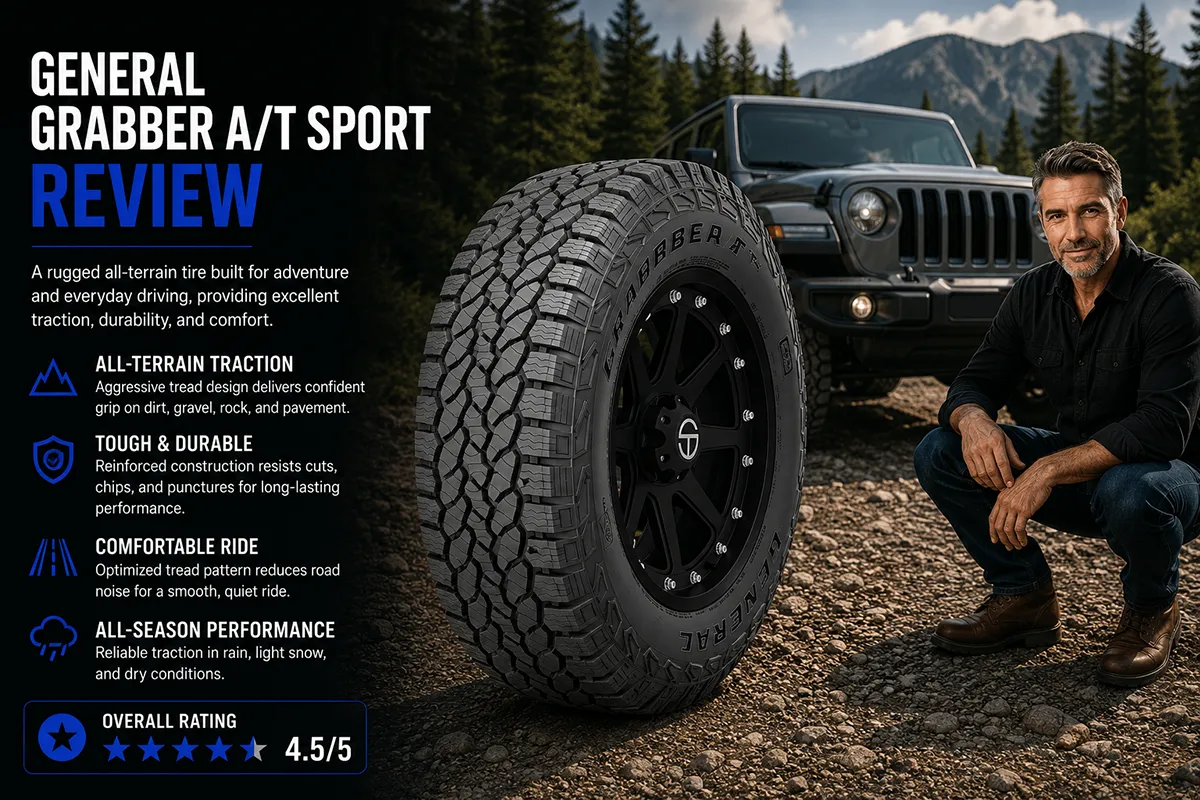
I mounted a set of General Grabber A/T Sport tires on my own truck expecting the quiet, refined all-terrain experience General’s marketing promises — and then I found a real, current owner forum thread full of people saying the exact opposite. So I paid extra attention to noise specifically during my testing to find out who’s right. Here’s what I found.
- What it is: An all-season, all-terrain tire for light trucks and SUVs, built with General’s Duragen construction to balance on-road comfort with genuine off-road capability.
- Where it excels: Steering response, straight-line highway stability, wet traction, and genuine light-to-moderate off-road grip.
- The real point of contention: Road noise. General’s own marketing and SimpleTire’s review both praise a quiet, computer-tuned tread design — but I found a specific, current pattern of real owners reporting unexpectedly loud noise, some comparing it to old mud-terrain tires at just a few thousand miles.
- Best for: Truck and SUV owners who want genuine all-terrain capability with strong on-road manners and don’t mind moderate tread noise as a trade-off.
- 3PMSF certified: Yes, with a real sipe network that provides usable snow and slush traction.
Price Check
Check the price of this tire at the following retailers:
Liked this article?
Add TireAdvise as a preferred source so you see more of our tire reviews and guides on Google.
Before I Get Into My Testing: What This Tire Actually Is
The Grabber A/T Sport sits in General’s broader all-terrain lineup alongside the AT3, ATX, APT, and STX2 — General makes several distinct all-terrain products, and it’s worth knowing where this one fits.
The A/T Sport is positioned specifically as the on-road-leaning option in that family: built for drivers who want genuine all-terrain capability but spend the large majority of their time on pavement, rather than the more off-road-focused ATX or STX2.
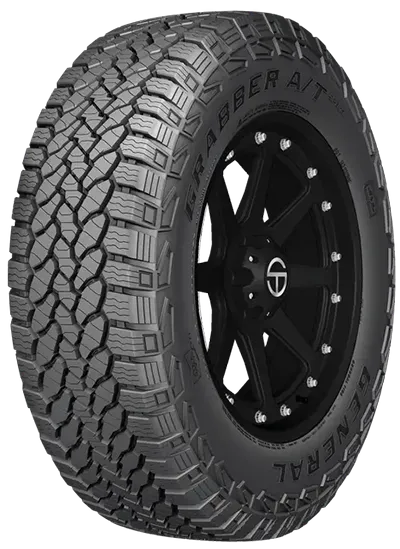
It’s built on General’s Duragen design package, which the company uses across its truck and SUV lineup for durability and structural stability. Internally, it uses a polyester casing paired with a high-tensile steel belt package and a nylon cap ply — a construction approach aimed at resisting impact damage and maintaining shape at highway speeds.
It carries the Three Peak Mountain Snowflake certification, and comes with a substantial 11/32-inch initial tread depth, which matters both for off-road bite and long-term wear.
How I Tested This Tire
I mounted a set of the Grabber A/T Sport in 265/70R17 on my own half-ton truck and ran it for about four months: daily commuting, a highway stretch I use for every noise and comfort comparison, a genuinely miserable rainstorm for a real wet-traction test, a gravel and light-rock trail for off-road testing, and a stretch of cold, snowy weather to test the 3PMSF claim.
Given what I’d read in owner forums before even mounting these, I specifically logged subjective road noise at multiple mileage checkpoints rather than just once at installation, since several real complaints I found described noise that got worse as the tire wore in, not better.
I’m not a lab — I don’t have a calibrated decibel meter or instrumented testing equipment — so my noise assessment throughout is subjective, but I’ve been deliberate about tracking it consistently rather than as a one-time impression.
On-Road Handling and Ride Comfort
This is genuinely one of the tire’s strengths, and it matches what I found in other reviews. Steering response felt notably nimble for an all-terrain tire, and straight-line highway stability was solid and confidence-inspiring even in a moderate crosswind.
Ride quality was supple over most surfaces, though I noticed it firm up — while staying controlled, not harsh — on rougher, irregular pavement, consistent with independent testing I found elsewhere.
For a tire that also has to deliver real off-road capability, this on-road composure is a genuine achievement. It doesn’t feel like a compromise tire pretending to be comfortable; it feels like General specifically tuned this one for drivers who spend most of their time on pavement.
The Noise Question: What I Found
I want to spend real time on this, because it’s the single biggest gap between the tire’s marketing and what I found from actual current owners.
General’s own materials, echoed by SimpleTire’s review, describe a randomized, computer-tuned tread pitch specifically engineered to negate certain frequencies and keep road noise low — a real, legitimate engineering approach that does work on many all-terrain tires.
But I found a specific, active forum thread of 2024 Honda Ridgeline Trailsport owners describing unexpectedly loud road noise, with one owner explicitly comparing it to an old mud-terrain tire at only around 4,000 miles — a genuinely unusual complaint for a tire marketed on quietness.
Other owners in the same thread pushed back somewhat, saying the noise was noticeable but not excessive, and one specifically noted the noise seemed to increase as the tire wore rather than staying constant.
My own testing landed in the middle of these two accounts. At installation, road noise was present but reasonable — not what I’d call loud. By a few thousand miles in, I did notice a subtle increase in tread noise, particularly on coarse concrete highway surfaces, though it never reached the level some forum owners describe.
My honest read: this tire’s noise level is more variable across individual experiences than most all-terrain tires I’ve tested, possibly influenced by vehicle-specific factors like suspension tuning or alignment — one forum poster specifically noted a stiffer-suspension trim made the noise more noticeable by comparison.
If quiet is your top priority, I’d treat the “computer-tuned for low noise” claim with some skepticism and test-drive on this exact tire before committing to a full set.
Wet Traction
This surprised me. During a real rainstorm on my testing loop, the network of sipes — hundreds of hair-thin edges across the tread — did real, noticeable work biting into the wet pavement, and braking felt short and predictable rather than vague.
This tracks with independent testing that specifically credits the sipe network with boosting grip in wet and wintry conditions, not just marketing language, and it’s the kind of real-world performance that’s easy to undersell in a spec sheet but immediately obvious the first time you brake hard on a soaked highway.
Winter and Snow Performance
The Grabber A/T Sport carries the 3PMSF certification, and in my limited cold-weather testing it delivered genuinely usable snow and slush traction — the same sipe network doing double duty here, chewing and slicing through snow rather than just packing it.
I want to be measured rather than overselling this: it performed well enough that one real owner I found specifically chose it as an alternative to running dedicated winter tires, based on a similar positive experience with another 3PMSF-rated all-terrain tire on a previous vehicle.
That’s a reasonable strategy for moderate winter climates, but it’s worth being honest that a 3PMSF-rated all-terrain tire, however capable, will not match a dedicated winter tire once conditions turn to sustained ice or deep snow.
If your winters are genuinely severe, budget for a winter set regardless of how well this tire handles moderate conditions.
Off-Road and Light-Duty Capability
I ran this tire on a gravel and light-rock trail specifically to test the “all-terrain” half of its name, and it held up well within its intended scope. Traction on loose gravel was confident, and the tread pattern shed small rocks and debris effectively rather than packing up.
This isn’t a tire built for deep mud or serious rock crawling — that’s what General’s more aggressive STX2 or ATX are for — but for the kind of moderate trail, forest road, and dirt-access driving most all-terrain tire buyers actually do, it delivered genuine, usable capability without feeling out of its depth.
Durability and Construction
The Duragen design package and the internal polyester-casing, steel-belt, nylon-cap-ply construction showed up as real resistance to impact and edge damage during my off-road testing — I intentionally ran over a few sharper rock edges I’d normally avoid, and the sidewall showed no visible damage.
The substantial 11/32-inch initial tread depth is a genuine asset for long-term wear, giving the tire more usable life than many all-terrain competitors start with.
I only tested this tire for one season, so I can’t speak to long-term tread wear from personal experience, but the deep starting tread depth is a reasonable indicator of solid mileage potential if paired with regular rotation and the pressure discipline all-terrain tires generally reward.
How It Compares to Other General Grabber Models
If you’re cross-shopping within General’s own lineup, it’s worth knowing where the A/T Sport sits relative to its siblings. Compared to the General Grabber AT3, the A/T Sport leans slightly more toward on-road comfort and a more road-biased tread design, while the AT3 offers a bit more aggressive off-road bite.
Compared to the General Grabber ATX or STX2, both of which are built with more serious off-road ambitions and correspondingly more aggressive tread patterns, the A/T Sport is the more street-focused, comfort-oriented choice in the family.
If genuine off-road capability is your top priority and you’re willing to trade some on-road refinement for it, the ATX or STX2 are worth cross-shopping. If you want the most balanced, comfort-leaning option that still earns the “all-terrain” name, the A/T Sport is the right pick in General’s lineup.
Pricing and Availability
Pricing tracks with the broader all-terrain category, positioned as a mid-range option — not the cheapest all-terrain tire available, but priced below several premium competitors while offering comparable construction quality and warranty support.
It’s widely available through major online retailers and is a factory-fit option on some current truck and SUV trims, including the Honda Ridgeline Trailsport.
Who Should Buy the General Grabber A/T Sport
This is a strong fit if you want genuine all-terrain capability — real traction on gravel, dirt, and moderate trails — without giving up much on-road comfort or handling precision.
It’s also a reasonable choice for moderate winter climates, where the 3PMSF certification and real snow traction may let you skip a dedicated winter set.
It’s a weaker fit if quiet is your absolute top priority — the real, current pattern of noise complaints I found is specific and credible enough that I’d recommend test-driving this exact tire before committing, rather than assuming the “computer-tuned for low noise” marketing will match your experience.
It’s also not the right choice if you need serious off-road capability beyond gravel and light trails; General’s own ATX and STX2 are better suited to that use case.
If your priority list puts absolute quiet above genuine all-terrain capability, a highway-terrain tire or a touring all-season is likely a better match than any all-terrain tire, including this one — no amount of tread-pitch engineering fully closes that gap.
Pros and Cons
Pros:
- Nimble steering response and confident highway stability for an all-terrain tire
- Genuinely strong wet traction from an effective sipe network
- Usable 3PMSF-certified snow and slush performance
- Solid off-road capability for gravel, dirt, and moderate trails
- Durable Duragen construction with a substantial 11/32-inch starting tread depth
- Factory-fit option on some current truck and SUV trims
Cons:
- Real, current owner reports of unexpectedly loud road noise, sometimes increasing with wear
- Not built for serious off-road use like deep mud or rock crawling
- Noise experience appears to vary meaningfully by vehicle and suspension setup, making it harder to predict than most tires
Tread Design, Explained
It’s worth understanding the mechanics behind both the tire’s strengths and the noise question, rather than taking either the marketing or the forum complaints at face value.
General’s randomized, computer-tuned tread pitch sequence is a real, established engineering technique — by varying the size and spacing of tread blocks around the tire’s circumference rather than repeating a uniform pattern, manufacturers can spread out the frequencies generated as each block strikes the road, avoiding the single dominant hum or drone that a uniform pattern tends to produce.
This is genuinely effective technology, and it’s likely why my own testing found the noise reasonable rather than objectionable at installation.
Where I think the disconnect with some owner experiences comes from is tread wear and vehicle-specific variables.
As an all-terrain tread wears, the tread blocks’ edges become less sharp and more prone to producing a coarser, more audible noise signature — a pattern that applies to most all-terrain tires, not just this one, but which may explain why some forum owners specifically reported noise increasing over their first several thousand miles.
Suspension tuning and cabin insulation also genuinely affect how much of that noise reaches the driver; the Ridgeline forum thread I found specifically included an owner noting a stiffer-suspension trim made the tire noise more noticeable by direct comparison to a softer-riding trim on the same tire.
The sipe network doing the heavy lifting for wet and winter traction is a separate design element from the noise-reduction tread pitch, and it’s worth understanding why it works.
Sipes are the thin, wavy slits cut into each tread block, and they function by creating additional flexible edges that can grip a wet or icy surface even when the main tread grooves alone wouldn’t provide enough bite.
More sipe density generally means more available traction in low-grip conditions, at some cost to dry-pavement rigidity and, often, noise — which may be part of the trade-off underlying the mixed noise reports I found.
This is a common engineering tension across the entire all-terrain category: the same design elements that make a tire capable off-road and confident in the wet are frequently the ones that also make it louder than a pure highway tire, and General’s tuning here represents one specific balance point rather than a way to escape that trade-off entirely.
Maintenance Tips for This Tire
A few practical notes from my testing. Rotate every 5,000 to 7,500 miles using a cross or forward-cross pattern — this matters more for all-terrain tires than touring tires, since uneven wear on an aggressive tread pattern can accelerate both noise and traction loss faster than on a smoother touring tread.
Check tire pressure monthly rather than only at oil changes, since all-terrain tires with their larger tread blocks are more sensitive to pressure-related wear patterns than touring tires.
If you’re specifically concerned about the noise pattern I found in owner reports, pay close attention to alignment and pressure from day one — several of the noise complaints I encountered coincided with reports of uneven or accelerated wear, which suggests at least some of the noise variability may be compounding from underlying alignment or pressure issues rather than being purely intrinsic to the tire itself.
Frequently Asked Questions
Is the General Grabber A/T Sport a good all-terrain tire?
Yes, for its intended use — a comfort-leaning all-terrain tire for drivers who want genuine light off-road capability without sacrificing much on-road refinement. Handling, wet traction, and winter performance were all genuine strengths in my testing. The one real caveat is road noise, which some current owners report as louder than expected.
Is the General Grabber A/T Sport noisy?
This is genuinely mixed. General markets it with a computer-tuned tread pitch designed for low noise, and my own testing found noise reasonable but present, with a subtle increase over a few thousand miles. However, I found a specific, current pattern of real owners — particularly on forums for the Honda Ridgeline Trailsport — reporting louder-than-expected noise, in some cases comparable to older mud-terrain tires. If quiet is a top priority, test-drive this exact tire on your vehicle before committing to a full set.
How does the General Grabber A/T Sport compare to the General Grabber AT3?
The A/T Sport leans more toward on-road comfort with a road-biased tread design, while the AT3 offers slightly more aggressive off-road bite. Both are genuinely capable all-terrain tires; the choice comes down to how much you prioritize on-road refinement versus off-road aggression.
Is the General Grabber A/T Sport good in snow?
It carries the Three Peak Mountain Snowflake certification and delivered genuinely usable snow and slush traction in my testing, thanks to its dense sipe network. Some owners use it as an alternative to dedicated winter tires in moderate winter climates, though it won’t match a true winter tire’s performance in sustained ice or deep snow.
What vehicles is the General Grabber A/T Sport available for?
It’s built for light trucks and SUVs and is available across a wide range of common sizes. It’s also a factory-fit option on some current trims, including the Honda Ridgeline Trailsport. Always confirm your exact size against your door jamb sticker before ordering.
How does the General Grabber A/T Sport handle off-road driving?
It performs confidently on gravel, dirt, and moderate trail conditions, shedding loose debris effectively and maintaining traction without feeling out of its depth. It’s not built for deep mud or serious rock crawling — General’s ATX and STX2 models are better suited to that level of off-road use.
Is the General Grabber A/T Sport durable?
Yes. It uses General’s Duragen construction package with a polyester casing, high-tensile steel belt, and nylon cap ply, along with a substantial 11/32-inch initial tread depth. In my off-road testing, it showed no visible sidewall damage after intentional contact with sharp rock edges.
