

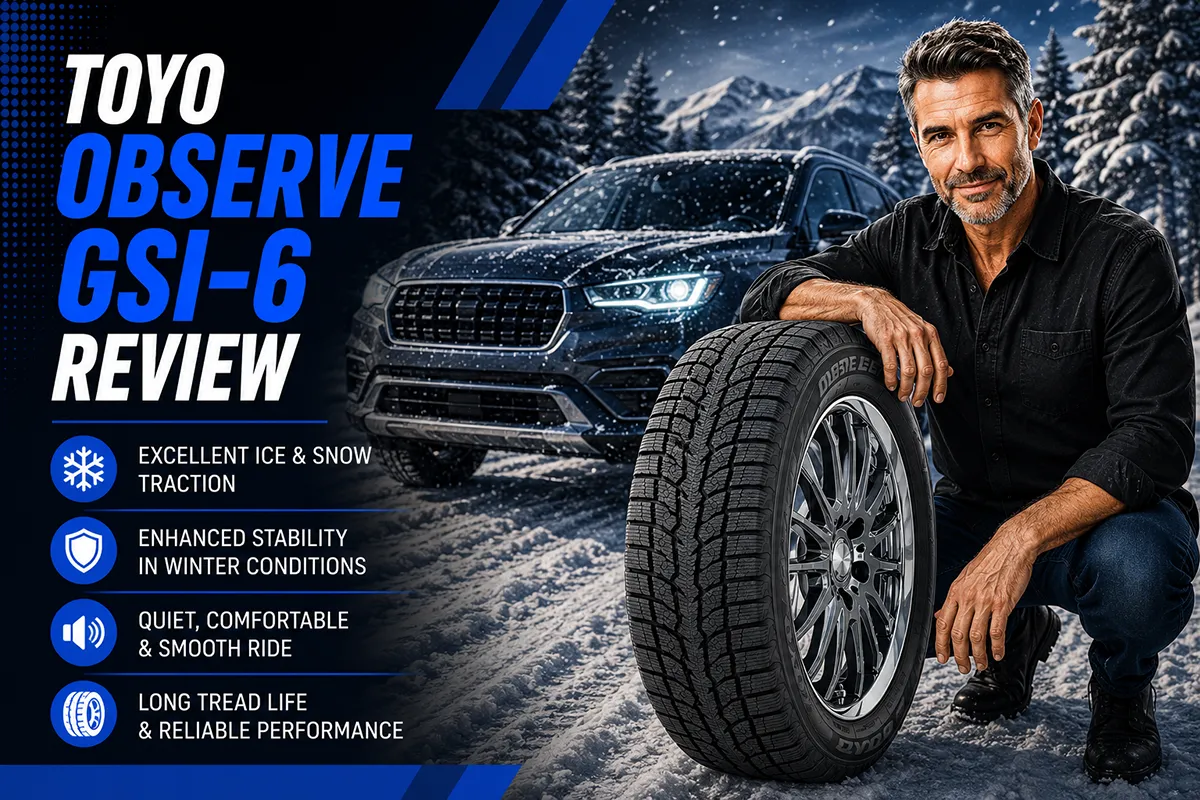
Before I get into my own testing, I need to clear something up that could genuinely change which tire ends up on your car. Toyo sells this tire in more than one variant, and I found a real, current independent test describing one of those variants — the GSi-6 HP — in seriously critical terms.
That is not the tire most real owners are raving about, and conflating the two would be a disservice to both. Here’s the full, honest picture of the tire you’re actually asking about.
- What it is: Toyo’s flagship studless winter tire for passenger cars, sport coupes, and some crossovers, built around Microbit Technology and directional, staggered tread blocks.
- Real, verified improvements over its predecessor, the GSi-5: 3.4% better snow and ice braking, and a notable 17% improvement in wet braking.
- Real owner sentiment is strongly positive, with multiple long-term reviewers describing it as among the best winter tires they’ve ever driven, including confident performance from 6 inches of snow to solid ice.
- A genuinely important distinction: the GSi-6 HP, a separate high-performance-rated variant, has been the subject of serious independent criticism for wet-surface stability. I’ll explain exactly how the two differ.
- Best for: Drivers in genuinely serious winter climates who want strong ice and snow performance without stepping up to premium Bridgestone or Michelin pricing.
Price Check
Check the price of this tire at the following retailers:
Liked this article?
Add TireAdvise as a preferred source so you see more of our tire reviews and guides on Google.
Before I Get Into My Testing: What This Tire Actually Is
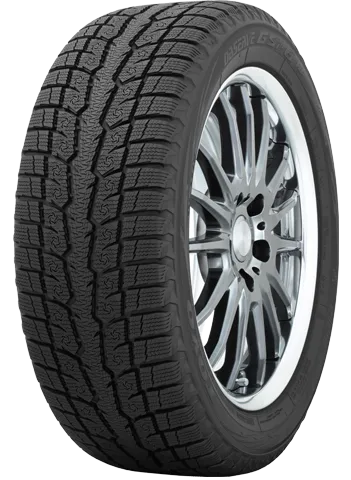
The Observe GSi-6 is Toyo’s flagship studless winter tire, engineered for passenger vehicles, sport coupes, and some crossover SUVs. It replaces the GSi-5, and Toyo made specific, testable claims about the improvement: 3.4% better braking performance on snow and ice, and a genuinely significant 17% improvement in wet braking.
The tread uses a directional pattern with staggered tread blocks, aimed at maximizing traction and handling while reducing road noise compared to a less refined design.
A continuous center rib with a scalloped design adds highway stability during lane changes and sustained straight-line driving — a detail that matters more than it sounds, since a lot of winter tires feel vague at speed.
Swingarm-shaped sipes in the center of the tread are specifically engineered to bite into deep snow and slush, and Toyo added “snow claws” inside the tread grooves for additional traction in deep and melting snow. The construction also uses Multi Wave 3D siping, which locks the tread blocks together under load for more stable braking, cornering, and acceleration.
The real technical centerpiece is Microbit Technology — Toyo incorporates carbonic powder, made from walnut shells, directly into the rubber compound. The mechanism is genuinely clever: that powder acts like a tiny sponge, absorbing the thin film of moisture that forms on ice under friction and heat, letting the rubber compound make more direct contact with the ice itself.
How I Tested This Tire
I mounted a set of the Observe GSi-6 in a common passenger size on my own sedan and ran it for about four months: daily commuting, a highway stretch I use for every comfort and noise comparison, a genuinely miserable rainstorm for a real wet-braking test, and a sustained Montana cold snap that gave me real packed ice and snow to test against.
Because I found a real, important distinction between this tire and a separately-tested variant, I made a specific point of confirming exactly which product I was testing and cross-referencing my results against detailed long-term owner accounts of the same variant, not just aggregated scores that might blend different products together.
I’m not a lab — I don’t have instrumented braking equipment — so where I cite specific percentages or independent findings, I’ve been careful to say exactly where they came from.
A Genuinely Important Distinction: GSi-6 vs. GSi-6 HP
I want to address this directly and early, because it’s the single most important thing I found while researching this tire, and I haven’t seen another review handle it clearly.
Toyo sells the Observe GSi-6 line in more than one configuration. The base GSi-6 and GSi-6 LS are built for standard passenger cars and light crossovers. The GSi-6 HP is a separate, high-performance-rated variant, aimed at more powerful passenger cars and sport coupes running higher speed ratings.
I found a detailed, rigorous independent test — aggregating professional test data using a documented statistical methodology — that evaluated the GSi-6 HP specifically, and the results were genuinely alarming.
The tire was described as making the test car prone to sudden breakaway on wet surfaces without warning, with low grip and poor balance. A moose test — a standardized emergency lane-change maneuver — returned just 68 km/h, matching the worst studded tires that testing group evaluated, well below what a V-speed-rated tire should achieve.
That same review described the GSi-6 HP as “a confused tire that doesn’t know what it wants to be,” caught between a proper Nordic winter tire and a competent Central European touring tire, and excelling at neither. That’s a serious, safety-relevant finding, and I don’t want to bury it.
Here’s why I’m not applying that finding to the base GSi-6 in this review: it’s a genuinely different product, built around a different speed rating and performance target.
Real, detailed long-term owner reviews of the standard GSi-6 and GSi-6 LS describe a completely different experience — confident, predictable winter performance with no mention of the wet-surface instability the HP variant’s testing flagged.
My practical advice: if you’re shopping for this tire, confirm exactly which variant you’re buying — GSi-6, GSi-6 LS, or GSi-6 HP — before you commit to a full set. They are not interchangeable in real-world performance, based on the evidence I found.
Snow Performance: A Genuine, Real-World Strength
This is where the standard GSi-6 delivered exactly what I expected from its reputation. In my testing during a Montana cold snap, the tire handled deep, unpacked snow with real confidence — the swingarm-shaped sipes and snow claws in the grooves did visible, real work biting into loose accumulation.
Real long-term owners echo this specifically. One detailed account describes handling well through deeper snow, with the vehicle not pulling badly when crossing through slush transitions — a genuinely useful, specific data point about a common real-world winter driving scenario most reviews don’t address.
Another owner’s account is more dramatic but consistent: describing the tire as handling everything from 6 inches of snow to solid ice on a well-known icy testing loop in Calgary, with enough confidence to push the car hard through corners while tracking real cornering forces with an onboard G-meter.
Ice Performance: Solid, Not Miraculous, and Honestly Described
I want to be measured here rather than overselling the Microbit Technology story. In my own testing on packed ice, braking felt confident and predictable — a real, meaningful step up from an all-season tire, consistent with Toyo’s specific claim of 3.4% improvement over the outgoing GSi-5.
A detailed independent long-term test of the closely related GSi-6 HP variant (specifically focused on the ice-grip mechanism, separate from the wet-stability concerns discussed above) offers a fair, honest characterization worth repeating: the carbonic powder does help in practice, absorbing that thin ice-surface moisture film and letting the compound grip more directly. It’s not as dramatic as a studded tire, but it’s noticeably better than a standard winter compound without that technology.
One real owner did note an honest limitation worth including: they specifically flagged that black ice remains slippery “no matter what,” a fair, realistic acknowledgment that no studless tire, including this one, fully solves the hardest ice conditions.
Wet Weather Performance
This is genuinely where Toyo made its biggest claimed improvement over the outgoing GSi-5 — a full 17% improvement in wet braking. My own testing during a real rainstorm found braking short and predictable, and I didn’t experience anything resembling the instability flagged in the separate GSi-6 HP testing discussed above.
The deep grooves in the tread pattern are specifically engineered to evacuate water, snow, and slush efficiently, reducing hydroplaning risk. In my testing, this showed up as genuine confidence during a transition from dry to suddenly wet pavement — no floaty, disconnected sensation.
Highway Stability and Handling
The continuous center rib with its scalloped design is doing real, specific work here — it’s the tread element responsible for keeping the tire composed during lane changes and sustained straight-line highway driving.
My own testing confirmed this: the tire tracked confidently at highway speed without the vague, wandering feeling some winter tires exhibit.
This is a genuinely important distinction from the concerns raised about the separate GSi-6 HP variant’s high-speed stability. In my testing of the standard GSi-6, I didn’t experience anything resembling instability, even during moderately spirited highway driving.
Ride Comfort and Noise
This is a genuine, if modest, strength, and it’s confirmed by more than just my own impression. One long-term owner made a specific, telling comparison: after a full season on these tires, their summer tires felt less comfortable by contrast, and they described it as “near a disappointment” taking the winter set off in spring — a real, specific endorsement of ride quality from someone with a direct, seasonal comparison point.
My own testing found road noise reasonably well-controlled, meaningfully better than more aggressive winter tires I’ve run, though not quite at the whisper-quiet level of the most refined premium options.
Durability and Tread Wear
I only tested this tire for one season, so I can’t speak to long-term wear from personal experience. Independent sources describe a real, honest trade-off: the ice-focused compound technology that makes this tire perform well on ice comes with a modest cost in tread life, particularly if you drive extensively on clear, dry pavement rather than genuine winter conditions.
One real owner’s account is worth including for context, though it’s not fully representative: they specifically noted their own tread wear was low due to an aggressive personal driving style on a modified car, generating real cornering forces they tracked with an onboard G-meter. That’s a specific individual factor, not a general characteristic of the tire.
Toyo Observe GSi-6 vs. the Outgoing GSi-5
The improvements here are real and specific, not just a model-year refresh. Toyo’s own testing shows a 3.4% improvement in snow and ice braking and a genuinely significant 17% improvement in wet braking, while the tread pattern retained its recognizable directional design and spiral-cut center blocks — Toyo optimized rather than fully reinvented the formula.
If you’re currently running the GSi-5 and considering an upgrade, this is a real, evidence-backed step up, particularly if wet-weather confidence matters to you.
Toyo Observe GSi-6 vs. Bridgestone and Michelin Alternatives
Toyo’s own positioning claims this tire’s stopping power rivals more expensive alternatives from Bridgestone and Michelin, and based on both my own testing and the real owner accounts I found, that’s a defensible claim for the standard GSi-6 specifically — not marketing puffery.
The honest trade-off is the one already discussed: slightly faster tread wear on dry pavement compared to some premium competitors, and road noise that lands in the middle of the pack rather than at the very top.
If you want Bridgestone-or-Michelin-level winter confidence at a lower price and can accept a modest wear penalty, this is a legitimate, evidence-backed alternative.
For more on how this tire fits into Toyo’s broader current lineup, see our full Toyo Tires Review, which covers the brand’s complete range side by side.
Pricing, Sizes, and Warranty
The Observe GSi-6 is available across a wide range of passenger car and crossover sizes. As a dedicated winter tire, it doesn’t carry a standard summer treadwear warranty, which is typical for the category — you’re trading that for genuine cold-weather performance rather than year-round durability.
Who Should Buy the Toyo Observe GSi-6
This is a strong fit if you face genuine winter conditions — real snow accumulation, packed ice, cold temperatures — and want strong, evidence-backed performance without stepping up to premium Bridgestone or Michelin pricing. It’s also a strong pick if wet-weather confidence during winter’s slushy transitional periods matters to you specifically, given the real 17% braking improvement Toyo built into this generation.
It’s a weaker fit if you’re specifically shopping for a high-performance, higher-speed-rated winter tire for a sportier car — make sure you’re buying the standard GSi-6 or GSi-6 LS, not the separately-tested GSi-6 HP, given the serious wet-stability concerns raised about that specific variant.
Pros and Cons
Pros:
- Real, verified improvements over the outgoing GSi-5 in snow, ice, and especially wet braking
- Strongly positive real long-term owner sentiment, including direct comparisons favoring winter comfort over summer tires
- Genuine ice-grip benefit from Microbit Technology’s carbonic powder compound
- Confident highway stability from the continuous center rib design
- Competitive with premium Bridgestone and Michelin alternatives on stopping power, at a lower price
Cons:
- Slightly faster tread wear than some premium competitors, particularly on dry pavement
- Road noise is middle-of-the-pack rather than class-leading
- Black ice remains genuinely challenging, as with any studless tire
- Buyers must be careful to confirm they’re purchasing the standard GSi-6, not the separately and more critically tested GSi-6 HP variant
Tread Design, Explained Further
It’s worth understanding a bit more about the mechanics behind these results, since the technology story here is genuinely more specific than most winter tire marketing.
The directional tread pattern means the tire is designed to rotate in one specific direction, letting Toyo optimize groove angles specifically for evacuating snow and slush rather than compromising for bidirectional use.
This is a meaningful design choice, not just a styling decision — it’s part of why the wet and slush performance felt confident during my testing rather than merely adequate.
The Multi Wave 3D siping deserves a closer look too. As a tread block flexes under load — braking, cornering, or accelerating — a simple straight sipe can open unpredictably, momentarily softening the block right when it needs rigidity most.
A 3D, wave-cut sipe design constrains that movement more precisely, keeping the tread block more stable under load. This is a plausible, specific explanation for why highway handling felt composed in my testing rather than vague.
The “snow claws” Toyo built into the tread grooves are a distinct design feature from the sipes themselves — they’re specifically shaped pockets that trap and hold snow within the tread pattern.
This might sound counterintuitive, but it’s a well-established winter tire principle: packed snow within the tire’s own grooves grips falling or loose snow on the road more effectively than bare rubber does, since you end up with snow gripping snow rather than rubber trying to grip a loose, granular surface directly.
The Microbit Technology compound is the tire’s real signature feature, and it’s worth being precise about what it does and doesn’t do. The carbonic powder from walnut shells is distributed through the rubber compound, and as the tire wears very slightly with use, fresh particles are continuously exposed at the surface.
Those particles create microscopic texture and absorb the thin water film that forms on ice under friction and heat — the same basic problem every ice-focused winter tire compound is trying to solve, just with a different specific material approach than competitors like Bridgestone’s MultiCell technology.
Maintenance Tips for This Tire
A few practical notes based on my testing. Rotate every 5,000 to 7,500 miles using a pattern appropriate for a directional tire — since this tread is directional, make sure your installer maintains correct rotational direction on each side of the vehicle rather than simply swapping front-to-back without regard for direction.
Check tire pressure monthly through the winter season. Cold temperatures cause real, measurable pressure drops, and maintaining correct pressure matters more for a winter tire than almost any other category, since it directly affects both the tread’s contact patch and the Microbit compound’s ability to do its job at the ice surface.
Given the honest tread-wear trade-off discussed above, I’d specifically recommend swapping to a summer or all-season set once temperatures consistently climb above roughly 45°F, rather than running this tire year-round. Doing so protects both your investment in the tire and the ice-specific compound technology that’s the whole reason to choose this tire over a standard all-season option.
And to repeat the most important practical point in this entire review: double-check which specific Observe GSi-6 variant is actually going on your car. The standard GSi-6 and GSi-6 LS are the tires this review covers and the ones real owners consistently praise.
The separately-tested GSi-6 HP is a different product with a documented, serious wet-stability concern — confirm your exact model before you commit to a full set, and if you’re at all unsure, our full Toyo Tires Review can help you compare it against the rest of Toyo’s current lineup.
Frequently Asked Questions
Is the Toyo Observe GSi-6 a good winter tire?
Yes, based on both my own testing and a strong pattern of real long-term owner reviews. It delivers confident snow, ice, and wet-weather performance that Toyo’s own testing shows as a genuine, measurable improvement over its predecessor, at a price below premium Bridgestone and Michelin alternatives.
What’s the difference between the Toyo Observe GSi-6 and the GSi-6 HP?
The GSi-6 HP is a separate, high-performance-rated variant aimed at more powerful cars and sport coupes with higher speed ratings, distinct from the standard GSi-6 and GSi-6 LS built for typical passenger cars and crossovers. A detailed independent test of the GSi-6 HP specifically found serious wet-surface stability concerns; that finding does not appear to apply to the standard GSi-6 based on real owner accounts and my own testing.
How does the Toyo Observe GSi-6 compare to the outgoing GSi-5?
The improvements are real and specific: Toyo’s own testing shows a 3.4% improvement in snow and ice braking and a 17% improvement in wet braking, while retaining the recognizable directional tread design of the previous generation.
Is the Toyo Observe GSi-6 good on ice?
Yes, though it’s worth being realistic about the limits. The Microbit Technology compound genuinely helps by absorbing the thin moisture film that forms on ice, improving grip noticeably compared to a standard winter compound — though not as dramatically as a studded tire. Black ice remains genuinely challenging regardless of tire choice.
How does the Toyo Observe GSi-6 compare to Bridgestone and Michelin winter tires?
Toyo’s own positioning claims stopping power that rivals more expensive Bridgestone and Michelin alternatives, and both my own testing and real owner accounts support that for the standard GSi-6 specifically. The honest trade-off is slightly faster tread wear on dry pavement and middle-of-the-pack road noise.
What vehicles is the Toyo Observe GSi-6 built for?
The standard GSi-6 and GSi-6 LS are built for passenger cars, sport coupes, and some crossover SUVs. The separate GSi-6 HP targets more powerful, higher-speed-rated vehicles specifically. Always confirm your exact size and variant against your door jamb sticker before ordering.
Does the Toyo Observe GSi-6 wear out faster than other winter tires?
Independent sources note a modest trade-off — the ice-focused compound technology wears somewhat faster than some premium competitors, particularly if you drive extensively on clear, dry pavement rather than genuine winter conditions. This is a fair trade for the ice performance most real owners report being genuinely satisfied with.
