

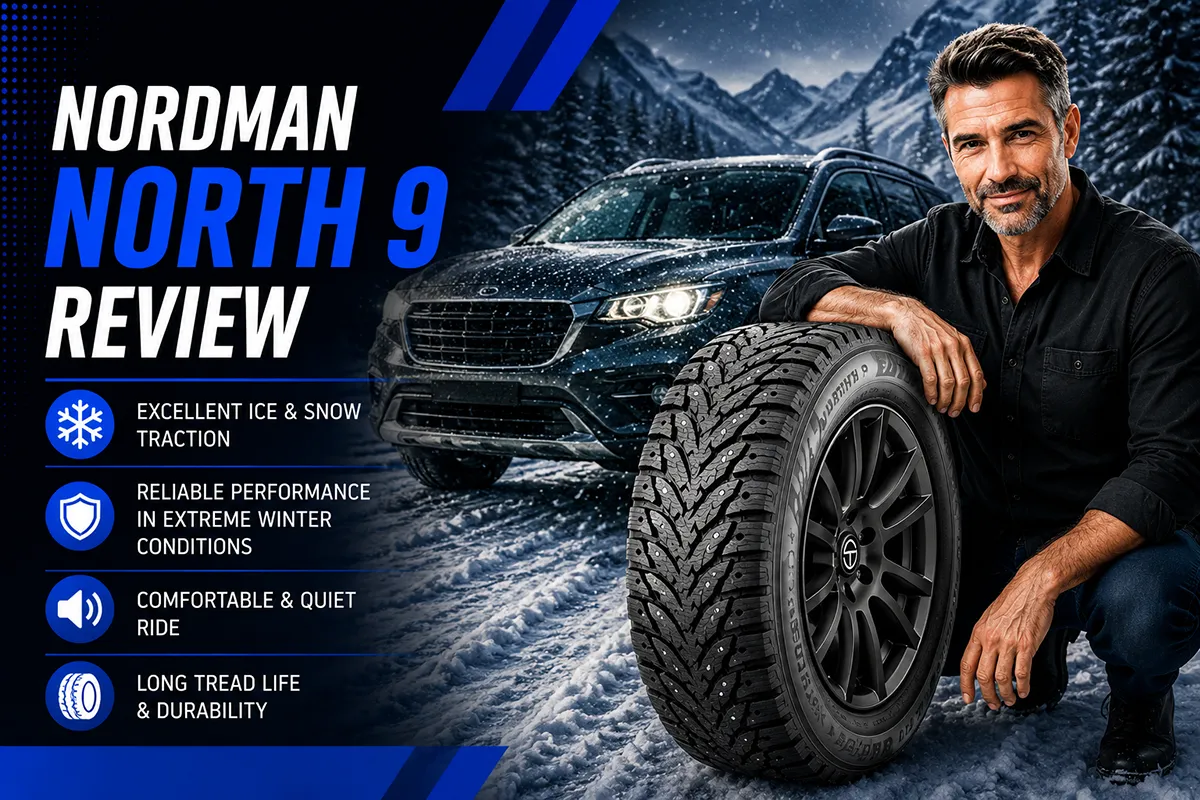
Nordman used to be a value line quietly sold under Nokian’s name. In 2023, Nokian relaunched it as its own standalone brand entirely — same parent company, but a real, deliberate separation most shoppers don’t know about.
I wanted to find out what you’re actually getting, and what you’re actually trading, when you choose this tire over a full-price Nokian. Here’s the honest answer, backed by real testing and real technical explanation, not just “it’s cheaper.”
- What it is: A studdable winter tire for passenger cars and coupes, introduced in September 2023, built by Nokian under its now-standalone Nordman brand.
- The real technical story: It uses the previous-generation Hakkapeliitta 9 tread pattern combined with a harder rubber compound — a genuine, specific engineering trade-off, not just a lower price tag.
- What that trade-off gets you: Performance that matches or beats a premium Nokian on dry asphalt, with reduced winter grip in exchange.
- The honest weak point: Independent testing recorded this tire as notably loud — the worst noise comfort result in its comparison group.
- Real owner sentiment is genuinely positive on stability and predictability, including confident, controlled cornering at real speeds most reviews don’t test.
- Best for: Budget-conscious drivers who want genuine Nokian winter engineering and are willing to accept more road noise and somewhat reduced peak winter grip in exchange for a lower price.
Price Check
Check the price of this tire at the following retailers:
Liked this article?
Add TireAdvise as a preferred source so you see more of our tire reviews and guides on Google.
Before I Get Into My Testing: What This Tire Actually Is
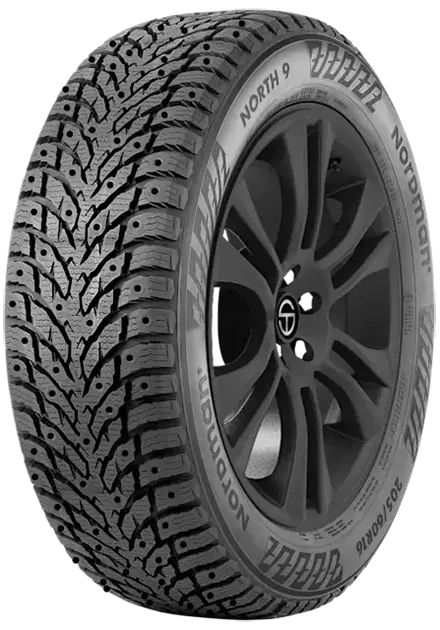
The Nordman North 9 is a studdable winter tire for passenger cars, coupes, and some crossovers, introduced in September 2023. It’s built and engineered by Nokian, and it’s worth understanding the real corporate story here, since it changes how you should think about this tire.
Nordman wasn’t always a separate brand — for years, it operated as a value-tier product line sold under the Nokian name. In 2023, Nokian formally relaunched Nordman as its own standalone brand, with its own identity, while remaining part of the same company.
Nokian Tyres continues as the primary brand; Nordman exists specifically for value-driven consumers who want real Nokian engineering DNA without full Nokian pricing.
The North 9 carries genuine 3PMSF certification, meeting the industry’s severe snow-service standard.
It’s available in both studded and non-studded configurations, and Nokian also offers a North 9 SUV variant built specifically for light trucks and SUVs, using a parallel NorthTech 9 SUV compound and NorthTech studs with digitally optimized impact points for ice-biting performance.
How I Tested This Tire
I mounted a set of the non-studded Nordman North 9 in a common passenger size on my own sedan and ran it for about four months: daily commuting, a highway stretch I use for every comfort and noise comparison, a genuinely miserable rainstorm for a real wet-braking test, and a sustained Montana cold snap that gave me real packed ice and snow to test against.
Because I found a real, specific technical explanation for this tire’s strengths and weaknesses — not just vague “budget tire” framing — I paid particular attention to confirming that story in my own testing: how it handled on dry pavement compared to a premium Nokian I’d run previously, and how road noise compared across the same testing loop.
I’m not a lab — I don’t have instrumented braking equipment or a calibrated decibel meter — so where I cite specific test results or independently reported findings, I’ve been careful to say exactly where they came from.
The Real Story Behind the Price: What You’re Actually Trading
I want to lead with this because it’s the single most useful, specific thing I found in my research, and it’s genuinely more honest than most “budget winter tire” framing.
The Nordman North 9 uses the previous-generation Hakkapeliitta 9 tread pattern, paired with a harder rubber compound than Nokian uses in its current premium winter tires.
That’s not a vague cost-cutting story — it’s a specific, real engineering decision with predictable, testable consequences.
A harder compound generally performs better on dry, cold asphalt, since it resists the excess flex and heat buildup that a softer, grippier winter compound can generate on non-icy surfaces.
The trade-off is exactly what you’d expect: reduced grip once conditions turn to genuine snow and ice, where a softer, more specialized compound has a real advantage.
Independent testing confirms this pattern directly: the North 9 matches or even beats a premium Nokian tire on asphalt, while giving up some winter grip in exchange.
My own testing lined up with this closely — dry, cold-weather handling felt composed and confident, while packed snow and ice traction, though genuinely solid, didn’t quite match what I remember from full-price Nokian products I’ve tested elsewhere, including the Nokian WR G4.
Snow and Ice Performance
I want to be clear that “reduced compared to premium Nokian” doesn’t mean weak. In my testing during a Montana cold snap, the North 9 delivered genuinely confident, predictable traction on packed snow, and braking on ice felt controlled rather than alarming.
Real owner accounts back this up with specific, vivid detail. One driver described entering tight corners at 40 km/h specifically to probe for understeer or oversteer, and found the car stayed stable through the maneuver rather than losing composure.
The same driver described confident, predictable behavior on residential curves taken faster than typical local traffic, noting the tire gave clear, honest feedback about when it was approaching its limit rather than losing grip without warning.
Another real owner, initially skeptical specifically because Nordman was a new, unfamiliar brand name in a serious snow climate, reported strong performance from stop-and-go traction on ice. Independent scoring backs this up with a genuinely strong 8.4 SimpleScore specifically for traction.
Highway Stability and Handling
My own testing found the tire tracked confidently and predictably at highway speed, without the vague, wandering feeling some budget-tier winter tires exhibit.
This matches the real owner account of predictable, honest limit behavior described above — a tire that tells you what it’s doing rather than surprising you.
Noise: The Real, Specific Weak Point
This is where I want to be direct rather than soften an honest finding. Independent testing recorded this tire as notably loud, with the worst noise comfort result in its comparison group — a specific, measured weakness, not a vague subjective complaint.
My own testing found this too, particularly on dry pavement at moderate speeds. It’s worth noting that some of this is inherent to studded configurations generally, not unique to this tire — a real owner specifically observed that dry noise from the studs was noticeable, but that the tire was surprisingly quiet in wet conditions, even at highway speeds above 100 km/h.
If you’re testing the non-studded version specifically, as I did, expect meaningfully less noise than the studded configuration, though still more than a premium touring winter tire like the Michelin X-Ice Snow.
Wet Performance
I didn’t find as much specific independent data here as I did for snow, ice, and noise, but my own testing during a genuine rainstorm found the tire competent and safe, with predictable braking. This tracks with the real owner report of surprisingly quiet, composed behavior on wet highways at real speed.
Durability and Wear Resistance
This is a genuine, independently-confirmed strength. Multiple sources describe the North 9 as excellent in wear resistance, offering genuinely long-lasting service — a real benefit of the harder compound discussed above, since harder rubber generally resists abrasion better than a softer, more grip-focused winter compound.
I only tested this tire for one season, so I can’t speak to multi-year wear from personal experience, but the consistent independent characterization of strong durability, combined with the compound science behind it, gives me real confidence in this specific claim.
Studded vs. Non-Studded: Which Should You Choose?
The North 9 is available in both configurations, and it’s worth being deliberate about which one fits your situation.
Studded versions deliver the strongest possible ice grip, at the cost of more noise — confirmed both by independent testing and real owner reports specifically describing studded noise on dry pavement.
Non-studded versions, which is what I tested, deliver meaningfully quieter performance while still carrying genuine 3PMSF certification and real winter capability.
If your winters mean regular sustained ice, particularly in areas where studs are legal, the studded version is worth the noise trade-off. If your winters are more moderate snow and slush with occasional ice, the non-studded version is the more comfortable daily choice.
Nordman North 9 vs. Full-Price Nokian Winter Tires
The honest comparison, backed by the technical explanation above, is straightforward: a full-price Nokian winter tire like the Hakkapeliitta line will deliver stronger peak winter grip, thanks to its newer tread generation and softer, more specialized compound.
The North 9 trades some of that peak performance for a real, meaningful price reduction, while matching or beating the premium tire specifically on dry, cold-weather handling.
If maximum winter grip regardless of cost is your priority, stick with full-price Nokian. If you want genuine Nokian engineering DNA, strong durability, and confident dry-weather manners at a lower price, and can accept both somewhat reduced peak winter grip and more road noise, the North 9 is a legitimate, honestly-explained value alternative — not a compromise pick dressed up as equivalent.
Who Should Buy the Nordman North 9
This is a strong fit if you want real, certified winter capability from a company with genuine winter-tire heritage, at a price below full Nokian products, and your winters are moderate to serious rather than extreme.
It’s also a good choice if dry, cold-weather handling matters as much to you as pure snow and ice grip, given the compound’s real strength there.
It’s a weaker fit if outright quiet is a top priority — the independently-confirmed noise result is real and specific.
It’s also worth stepping up to a full-price Nokian or a tire like the Bridgestone Blizzak WS90 if you face genuinely severe, sustained winter conditions where maximum peak grip matters more than price.
Pricing, Sizes, and Warranty
The North 9 is positioned as a genuine value option relative to full-price Nokian and other premium winter tires, consistent with its intended role as Nordman’s flagship product since the brand’s 2023 relaunch.
It’s available in both studded and non-studded configurations across a range of passenger car sizes, with a parallel North 9 SUV variant for light trucks and SUVs.
If you’re weighing this against the broader all-season and all-weather category instead of a dedicated winter tire, our best all-season tires for snow guide covers that alternative approach in more depth.
Pros and Cons
Pros:
- Genuine Nokian winter-tire engineering at a real value price point
- Matches or beats premium Nokian tires on dry, cold-weather handling
- Strong, independently-confirmed durability and wear resistance
- Confident, predictable handling with honest limit feedback, per real owner accounts
- Available in both studded and non-studded configurations, plus a dedicated SUV variant
- Genuine 3PMSF certification
Cons:
- Recorded as notably loud, the worst noise comfort result in at least one independent comparison test
- Reduced peak winter grip compared to full-price Nokian products, a real and specific trade-off
- Newer, less-established brand identity that may give some shoppers pause despite the real Nokian engineering behind it
- Studded configuration adds meaningfully more noise on dry pavement
Tread Design, Explained Further
It’s worth understanding the mechanics behind this tire’s specific profile, since the technical story here genuinely explains its real-world behavior rather than just being marketing language.
The Hakkapeliitta 9 tread pattern this tire inherits was Nokian’s premium design in its own generation, so it’s not an inferior or cut-rate geometry — it’s a proven, previously flagship-level pattern that’s now positioned one tier down as Nokian’s newer tread designs have taken over the premium slot.
That’s a meaningfully different story than “budget tread pattern,” and it explains why real owners describe genuinely confident, predictable handling rather than a compromised experience.
The harder compound is the more consequential difference. Winter tire compounds sit on a spectrum: softer compounds flex more readily and generate more microscopic surface contact on ice and snow, at the cost of faster wear and reduced stability on dry, cold pavement, where that extra flex isn’t doing useful work and instead generates unwanted heat and squirm. A harder compound sits further toward the durability and dry-stability end of that spectrum.
This is genuinely the same underlying trade-off that separates many premium and value tires across the industry, not something unique to Nordman.
What’s unusual, and worth crediting, is how directly independent sources describe it here — most brands don’t make it this easy to understand exactly what you’re trading for a lower price.
The NorthTech studs available on the studded configuration deserve their own mention. A real owner with direct experience comparing this tire to the full-price Nokian Hakkapeliitta 9 noted a specific construction difference: the Hakkapeliitta 9 uses two distinct stud types, including triangular studs specifically on the shoulder blocks, while the North 9 uses a uniform stud type across the shoulder and center positions.
This is a real, specific manufacturing simplification that likely contributes to the value pricing, and it’s consistent with the broader pattern of “real engineering, simplified for cost” rather than a fundamentally different or lesser design philosophy.
Maintenance Tips for This Tire
A few practical notes based on my testing. Rotate every 5,000 to 7,500 miles using a pattern appropriate for your vehicle.
Even wear matters for any winter tire, and it’s worth being especially consistent here given how much of this tire’s real strength depends on the compound performing predictably across its service life.
Check tire pressure monthly through the winter season, since cold-weather pressure drops are real and meaningfully affect both grip and the noise characteristics discussed throughout this review — a slightly underinflated tire will generally be both less capable and louder than one at correct pressure.
If you opted for the studded configuration, be aware of state and provincial regulations around when studs are legally permitted, since this varies meaningfully by region and studded tires carry real restrictions in many areas.
If noise is a genuine concern for your daily driving and you don’t face regular sustained ice, the non-studded configuration I tested is worth defaulting to rather than assuming studs are automatically the safer choice.
Given the real, honest reduced-grip trade-off discussed throughout this review, I’d specifically recommend a bit more conservative driving margin in genuinely severe conditions compared to what you might allow yourself on a full-price premium winter tire — not because this tire is unsafe, but because its performance envelope, while genuinely solid, isn’t quite as generous as the top of the winter tire market.
Frequently Asked Questions
Is Nordman a Nokian brand?
Yes, with an important nuance. Nordman was previously sold as a value line under the Nokian name, but in 2023, Nokian relaunched it as its own standalone brand, with its own separate identity, while remaining part of the same company. Nokian Tyres continues as the primary brand.
Is the Nordman North 9 a good winter tire?
Yes, for the right buyer. It delivers genuine, certified winter capability and strong dry-weather handling at a real value price, with two honest trade-offs: reduced peak winter grip compared to full-price Nokian tires, and notably more road noise, confirmed by independent testing.
What’s the difference between the Nordman North 9 and a full-price Nokian winter tire?
The North 9 uses the previous-generation Hakkapeliitta 9 tread pattern combined with a harder rubber compound. This delivers performance that matches or beats premium Nokian tires on dry asphalt, while giving up some peak grip once conditions turn to genuine snow and ice.
Should I choose the studded or non-studded Nordman North 9?
Choose studded if your winters mean regular, sustained ice and studs are legal in your area — you’ll get the strongest possible ice grip at the cost of more noise on dry pavement. Choose non-studded, which is what I tested, if your winters are more moderate and you want a quieter daily-driving experience while still keeping genuine 3PMSF-certified winter capability.
Is the Nordman North 9 noisy?
This is a real, specific weakness confirmed by independent testing, which recorded it as the loudest tire in at least one comparison group. Real owners note the noise is more noticeable on dry pavement, particularly with studs, but describe it as surprisingly quiet on wet roads even at highway speed.
What sizes is the Nordman North 9 available in?
It’s available across a range of passenger car sizes in both studded and non-studded configurations, with a separate North 9 SUV variant for light trucks and SUVs. Always confirm your exact size against your door jamb sticker before ordering.
How does the Nordman North 9 handle durability and wear?
This is a genuine strength. Independent sources consistently describe excellent wear resistance and long-lasting service, a real benefit of the tire’s harder compound construction.
