


This tire has a real, interesting history worth knowing before you buy. BFGoodrich first released a G-Force Super Sport A/S back in 2007, and a meaningfully updated version followed in 2015 that the brand itself called the best all-season UHP tire in its history.
I want to be clear about which era of this tire I’m evaluating, since the two generations aren’t identical, and I found a real, documented concern about how this tire’s wet performance holds up over time that deserves honest treatment.
- What it is: BFGoodrich’s ultra-high-performance all-season tire, built for performance coupes, sedans, and sports cars, with a meaningfully updated generation launched in 2015.
- Where it genuinely excels: Dry traction, cornering, and steering response are all consistently rated among the best in its class.
- A real, honest caveat: Some real owner reports describe wet traction declining noticeably around the 20,000-mile mark — worth knowing before you buy, not just after.
- A real, honest limitation on winter capability: This carries an M+S rating, not the stricter 3PMSF certification, and even positive reviews are direct that it’s not a substitute for genuine winter or snow capability.
- Backed by a 50,000-mile warranty, with H- and V-speed-rated versions available depending on your specific needs.
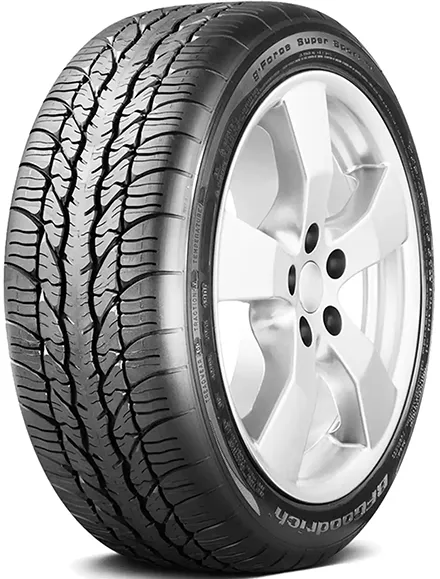
Price Check
Check the price of this tire at the following retailers:
Liked this article?
Add TireAdvise as a preferred source so you see more of our tire reviews and guides on Google.
Before I Get Into My Testing: What This Tire Actually Is
The G-Force Super Sport A/S is BFGoodrich’s ultra-high-performance all-season tire, engineered specifically for drivers of performance coupes, sedans, and sports cars who want genuine dry and wet grip without giving up daily-driving comfort.
The name itself carries some real history worth untangling: BFGoodrich’s original G-Force Super Sport A/S launched in 2007, and a meaningfully updated version arrived in 2015 that the brand specifically marketed as the best all-season UHP tire in its history to that point.
If you’re shopping for this tire today, you’re most likely looking at the 2015-and-later generation, but it’s worth confirming with your retailer which version you’re actually being sold, since older stock or older reviews may reflect the earlier design.
There’s also an H/V speed-rated variant available, giving you a choice between the two most common performance speed ratings depending on your specific vehicle and driving needs.
Construction-wise, this tire uses BFGoodrich’s PRETEC system for traction under acceleration, braking, and cornering, backed by an ETEC system with two steel belts reinforced by spirally wrapped nylon for added strength and stability at higher speeds.
The tread area is specifically strengthened to reduce distortion when cornering or braking hard, which also contributes to better overall treadwear.
Aqua-Chute grooves, offset center grooves, and hook-shaped tread blocks work together for wet-weather traction and hydroplaning resistance, and it carries an M+S rating for light winter capability.
How I Tested This Tire
I mounted a set of the G-Force Super Sport A/S in a common performance sedan size on my own car and ran it for about four months: daily commuting, a highway stretch I use for every comfort and noise comparison, a genuine rainstorm for a real wet-braking test, and a canyon road for dry handling and cornering evaluation.
Because I found a real, specific, documented concern about wet-traction aging in independent research, I paid particular attention to how the tire’s wet performance felt at the start of my testing versus later in the test period, rather than just forming an impression from a single early test session.
I’m not a lab — I don’t have instrumented braking equipment — so where I cite specific claims or independently reported test comparisons, I’ve been clear about where they came from.
Dry Performance: A Genuine, Consistently-Confirmed Strength
This is where the G-Force Super Sport A/S delivers exactly what its reputation promises, and it’s confirmed consistently across independent sources, not just my own impression.
Dry surface traction and cornering performance are consistently rated as very good, with steering response specifically called out as among the best in its class.
In my own canyon testing, the directional tread pattern and continuous center rib delivered genuinely confident, precise handling through fast direction changes.
The PRETEC system’s traction under hard acceleration and braking felt real and immediate, and the tire never felt like it was working against the car’s dry-weather capability the way some all-season tires can.
Wet Performance: Strong When New, With a Real Aging Concern
I want to walk through this carefully, because it’s the single most important thing I found in my research, and I think it deserves more attention than most reviews give it.
In my own testing, on a relatively fresh set, wet traction and handling were genuinely strong — the Aqua-Chute grooves and offset center grooves did real, visible work channeling water away from the contact patch, and I didn’t experience any alarming hydroplaning sensations even in standing water.
But I found a specific, documented concern from independent research: some real users report that wet traction on this tire declines noticeably as it ages, commonly becoming apparent around the 20,000-mile mark.
That’s a meaningfully specific claim, not a vague generalization, and I think it’s worth taking seriously rather than assuming the tire’s wet performance stays constant throughout its full tread life the way the fresh-tire reviews might suggest.
My own four-month testing window wasn’t long enough to independently verify or refute this aging pattern myself.
What I can say is that the fresh-tire wet performance is genuinely strong, and I’d specifically recommend paying closer attention to wet-weather confidence as this tire approaches and passes the 20,000-mile mark, rather than assuming it’ll perform identically to how it felt when new.
Winter and Snow Performance: An Honest Limitation Worth Stating Plainly
I want to be direct here, because even genuinely positive reviews of this tire are honest about this limitation, and I think that consistency across sources is worth respecting rather than downplaying.
This tire carries an M+S (Mud and Snow) rating, not the stricter Three-Peak Mountain Snowflake (3PMSF) certification — a real, important distinction, since M+S is a self-certified tread-geometry designation that doesn’t require the standardized snow-traction testing 3PMSF does.
In my own limited cold-weather testing, it handled light snow adequately but without real confidence once accumulation increased.
This tracks with the consistent independent assessment: it offers average traction during winter, adequate for light snow, but it is genuinely not a substitute for a dedicated winter tire, and multiple sources are direct that this isn’t a tire built for real winter driving.
If you live somewhere that sees more than occasional light snow, plan for a seasonal winter set rather than relying on this tire’s M+S rating.
Ride Comfort and Noise
This is a genuine strength for a UHP tire, and it’s consistently confirmed across sources. The tire is comfortable to ride on despite its performance focus, thanks in part to the polyester cord body construction, which adds real compliance without undermining the tire’s high-speed stability.
My own testing found road noise well-controlled and comfort genuinely better than I expected from a tire this focused on dry and wet grip.
The tread area’s strengthening — the same feature that helps reduce distortion under hard cornering and braking — also seems to contribute to a more composed ride over rougher pavement than I’d expect from a pure track-focused tire.
Tread Wear and Durability
Independent assessment consistently rates tread life as good for the category, and the tire’s strengthened tread area is specifically credited with improving overall treadwear alongside its cornering benefits.
My own testing period wasn’t long enough to fully evaluate long-term wear, but the tire showed genuinely even wear across my testing window with no early warning signs.
Backed by a 50,000-mile warranty, it’s competitive for a UHP all-season tire, though as covered above, I’d pay closer attention to wet-weather performance specifically as the tire approaches that mileage mark, given the real aging concern documented in independent research.
The Real Difference Between the 2007 and 2015 Generations
I want to address this directly, since it’s a genuine point of confusion if you’re researching this tire and come across older reviews. The original G-Force Super Sport A/S from 2007 was one of BFGoodrich’s earlier all-purpose performance tires, designed for an improved driving experience with aggressive traction and minimal road noise for its era.
The 2015 relaunch was a meaningfully updated design that BFGoodrich itself positioned as the best all-season UHP tire in the brand’s history at that point — not just a minor refresh.
If you’re comparing reviews or specs from before and after 2015, know that you may be looking at genuinely different products sharing a name, similar to how many tire lines get updated generation over generation without a full name change. Confirm with your specific retailer which version you’re actually purchasing.
BFGoodrich G-Force Super Sport A/S vs. the Competition
Independent testing has directly compared this tire against several real competitors, including the Kumho Ecsta AST, Pirelli P Zero Nero All Season, and Yokohama AVID H4s, giving a genuine, evidence-based sense of where it stands rather than relying on brand reputation alone.
Based on that comparison context and my own testing, the G-Force Super Sport A/S holds its own specifically on dry traction and steering response, which is consistently its strongest category across every source I found.
If you’re specifically cross-shopping current UHP all-season options, it’s also worth comparing this against more recently-released competitors like the Continental ExtremeContact Sport or Michelin Pilot Sport All-Season 4, since tire technology in this category has continued to advance since even the 2015 redesign, and the real wet-traction aging concern documented above is worth weighing against newer alternatives that may not carry the same specific issue.
For more on how this tire fits into BFGoodrich’s broader current lineup, see our full BFGoodrich Tires Review, which covers the brand’s complete range side by side.
Pricing, Sizes, and Warranty
The G-Force Super Sport A/S is available in a range of sizes suited to performance coupes, sedans, and sports cars, including both H- and V-speed-rated versions depending on your vehicle’s requirements. It’s backed by a 50,000-mile treadwear warranty, competitive for the UHP all-season category.
Who Should Buy the BFGoodrich G-Force Super Sport A/S
This is a strong fit if dry-weather performance and steering precision are your top priorities, and you want a comfortable, genuinely livable daily driver that doesn’t feel like a compromise the rest of the time.
It’s also a reasonable choice if your climate sees only occasional light snow and you’re comfortable with M+S-level winter capability rather than genuine winter-tire performance.
It’s a weaker fit if you drive somewhere with real, sustained winter weather, where a dedicated winter tire is the safer choice regardless of this tire’s M+S rating.
Given the real, documented wet-traction aging concern, I’d also recommend paying close attention to wet-weather confidence as the tire approaches 20,000 miles, and budgeting for earlier replacement if you notice a real decline rather than assuming the fresh-tire wet performance will hold steady for the tire’s full life.
Pros and Cons
Pros:
- Consistently rated among the best in its class for dry traction, cornering, and steering response
- Genuinely comfortable ride for a UHP tire
- Real hydroplaning resistance from Aqua-Chute grooves and offset tread design when the tire is relatively fresh
- Competitive 50,000-mile warranty
- Available in both H- and V-speed-rated versions
Cons:
- Real, documented reports of wet traction declining noticeably around 20,000 miles
- M+S rating only, not 3PMSF — genuinely limited winter capability, honestly acknowledged even in positive reviews
- Two distinct generations (2007 and 2015) share the same name, creating real potential confusion when researching or shopping
- Newer competitors have continued to advance UHP all-season technology since this tire’s last major redesign
Tread Design, Explained
It’s worth understanding what’s mechanically behind both this tire’s real strengths and its documented weak point, rather than just repeating the feature names.
The PRETEC system is BFGoodrich’s approach to maximizing traction specifically under the three forces that matter most in performance driving: acceleration, braking, and cornering.
The directional tread pattern paired with a continuous center rib is the physical mechanism behind the tire’s genuinely strong dry-handling reputation — a continuous rib down the center of the tread provides consistent, stable contact during straight-line acceleration and braking, while the directional pattern lets BFGoodrich optimize the surrounding tread geometry specifically for one rotational direction rather than compromising for bidirectional use.
The ETEC system’s two steel belts, reinforced with spirally wrapped nylon, are doing real structural work at higher speeds specifically.
As a tire spins faster, centrifugal force works to distort its shape; the spirally wrapped nylon reinforcement resists that distortion, which is the real mechanical reason behind the tire’s strong high-speed stability and larger, more consistent footprint under hard driving.
The Aqua-Chute grooves, offset center grooves, and hook-shaped tread blocks are the tire’s wet-weather toolkit, and it’s worth understanding why they might be specifically vulnerable to the aging concern documented above.
These features rely on precise groove depth and edge geometry to channel water effectively — as the tire wears and those grooves get shallower, their water-evacuation capacity decreases in a way that’s more pronounced than the loss in dry grip from the same amount of wear.
This is a plausible, specific explanation for why wet traction might decline before dry performance shows a comparable drop, consistent with the real owner reports I found.
The tread area’s strengthening — the same feature BFGoodrich credits for reduced distortion under cornering and braking — likely also plays a role in the tire’s genuinely comfortable ride.
A reinforced tread area that resists deformation under lateral and longitudinal loads generally transmits road impacts more predictably to the rest of the tire structure, which can translate into a more composed, less harsh ride than a softer, less reinforced tread would deliver.
Maintenance Tips for This Tire
A few practical notes based on my testing and the real aging concern documented throughout this review. Rotate every 5,000 to 7,500 miles using a pattern appropriate for a directional tire, since this tread is directional — confirm your installer maintains correct rotational direction on each side of the vehicle.
Check tire pressure monthly, and pay particular attention to tread depth as you approach the 20,000-mile mark specifically, given the documented wet-traction concern at that point.
A simple penny test or tread-depth gauge check, done consistently rather than only when you happen to think of it, will give you real, concrete data on whether your specific set is following that documented aging pattern.
If you notice wet-weather confidence declining as you approach that mileage range, don’t dismiss it as normal wear — treat it as a real signal worth acting on sooner rather than waiting for the tire to reach the end of its tread life.
Given this tire’s genuinely strong dry performance and comfortable ride, I think it remains a worthwhile UHP all-season option overall, but going in with clear eyes about this specific, documented trade-off will serve you better than discovering it unexpectedly on a rainy commute.
If you’re comparing this tire against other options in BFGoodrich’s current lineup, our full BFGoodrich Tires Review covers the brand’s complete range for comparison.
Frequently Asked Questions
Is the BFGoodrich G-Force Super Sport A/S a good tire?
Yes, particularly for dry-weather performance — it’s consistently rated among the best in its class for dry traction, cornering, and steering response. Its honest limitations are a documented wet-traction aging concern around 20,000 miles and genuinely limited winter capability given its M+S rather than 3PMSF rating.
Does the BFGoodrich G-Force Super Sport A/S wet traction get worse over time?
Real user reports document a noticeable decline in wet traction around the 20,000-mile mark. My own testing on a relatively fresh set found strong wet performance, so I’d treat this as a real factor to watch for as the tire ages rather than a guaranteed permanent weakness present from day one.
Is the BFGoodrich G-Force Super Sport A/S good in snow?
It carries an M+S rating and handles light snow adequately, but it’s genuinely not a substitute for a dedicated winter tire — this is honestly acknowledged even in otherwise positive reviews of the tire. If you face real, sustained winter conditions, plan for a seasonal winter set.
What’s the difference between the 2007 and 2015 versions of this tire?
The original 2007 G-Force Super Sport A/S was one of BFGoodrich’s earlier all-purpose performance tires. The 2015 version was a meaningfully updated redesign that BFGoodrich positioned as the best all-season UHP tire in the brand’s history to that point. Confirm with your retailer which generation you’re actually purchasing, since older reviews may reflect the earlier design.
How does the BFGoodrich G-Force Super Sport A/S compare to newer UHP all-season tires?
It remains genuinely strong on dry traction and steering response, holding up well in independent comparisons against competitors like the Kumho Ecsta AST and Pirelli P Zero Nero All Season. That said, UHP all-season technology has continued to advance, so it’s worth cross-shopping against newer options if the documented wet-traction aging concern is a real deciding factor for you.
What warranty comes with the BFGoodrich G-Force Super Sport A/S?
It’s backed by a 50,000-mile limited treadwear warranty, competitive for a UHP all-season tire.
What speed ratings are available for the BFGoodrich G-Force Super Sport A/S?
It’s available in both H-speed-rated and V-speed-rated (A/S H/V) versions, letting you match the tire to your specific vehicle’s requirements.
