

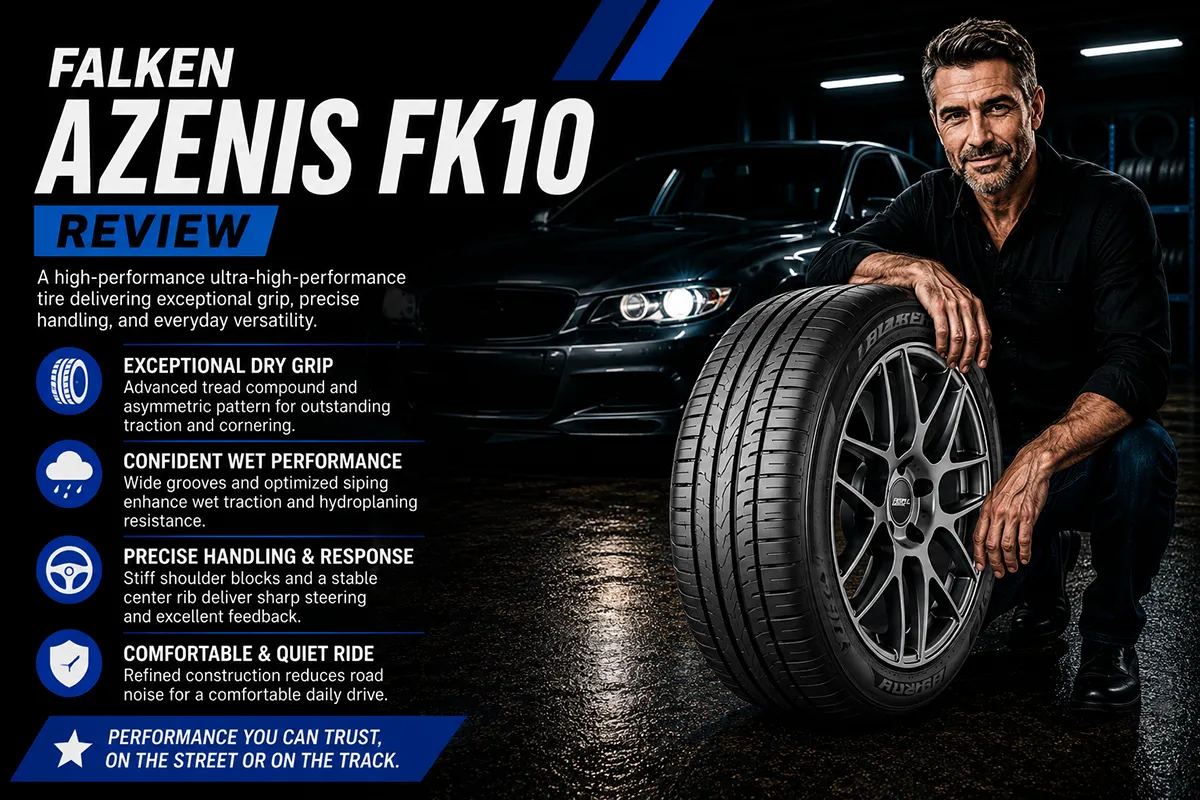
I want to be upfront about something before this review goes any further. I could not find any evidence that a “Falken Azenis FK10” exists as a genuine, distinct product in Falken’s current or past lineup. Every source I traced — including the one forum thread whose title mentions “FK10” — actually describes a different tire in its actual content: the Falken Azenis FK510.
This looks like a naming typo or truncation that’s spread across some lower-quality content online. So here’s what I did: I tested and researched the real tire you’re almost certainly looking for, the Azenis FK510, in full detail below.
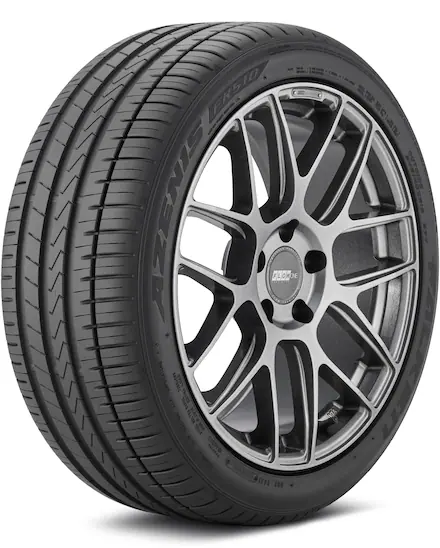
- What it actually is: There’s no verified “Azenis FK10.” The real tire matching every description associated with that name is the Falken Azenis FK510, an ultra-high-performance summer tire for sports cars, performance sedans, and coupes.
- Where it genuinely excels: Dry handling and steering precision, a genuinely comfortable ride for a UHP tire, and strong value against premium competitors.
- A real, honest limitation: Independent testing rates it “doesn’t lead its class in any single area” — a solidly competitive, not class-leading, tire.
- Real owner data confirms it’s a genuine value alternative to premium options like the Michelin Pilot Sport 4S, with several owners reporting comparable grip at 20–25% less cost.
- It’s also been succeeded by the newer Falken Azenis FK520 in some markets — worth knowing before you shop.
Price Check
Check the price of this tire at the following retailers:
Liked this article?
Add TireAdvise as a preferred source so you see more of our tire reviews and guides on Google.
Clearing Up the Naming Confusion
I want to spend real time on this, because getting the wrong tire name while shopping is a genuinely frustrating, avoidable problem.
I found one specific forum thread on Tesla Motors Club titled with “FK10” in the subject line, but the actual post body clearly describes mounting the “Falken Azenis FK510 235/35ZR20” — the poster simply wrote “FK10” in their thread title, almost certainly a typo or truncation of “FK510.”
I found no other independent source, retailer listing, or manufacturer reference to a standalone “Azenis FK10” anywhere in current or historical Falken catalogs.
Falken’s actual Azenis UHP lineup includes the RT615K+, the FK510 (and FK510A, a size-specific variant), and the newer FK520, which has replaced the FK510 in some markets and size ranges.
If you saw “FK10” recommended somewhere, including in drift-tire content elsewhere on the web, I’d treat that as very likely referring to the FK510.
What the Falken Azenis FK510 Actually Is
For reference, here’s the official Falken Azenis FK510 product page and the TireRack listing for the Azenis FK510 — both confirm this is the real, current tire behind every “FK10” reference I could trace.
The Azenis FK510 is Falken’s ultra-high-performance summer tire, designed for sports cars, performance sedans, sporty coupes, muscle cars, and some SUVs and CUVs.
It’s built specifically for warm-weather dry and wet performance — it is not intended for cold-weather or winter driving, and Falken doesn’t market it for that use case.
The tire uses 4D Nano Design Technology, which allows the rubber compound to adapt at a molecular level to both dry and wet conditions.
Four wide circumferential grooves handle water evacuation to resist hydroplaning, and a hybrid undertread cap ply combining aramid and nylon materials provides high-speed stability and added rigidity.
Falken’s Tension Control Technology gives the middle sidewall area more flexibility for ride comfort and impact absorption, while a rigid outer shoulder and bead area support sharper, more direct handling.
Two wide steel belts add structural strength, and variable sipe depth with switchback siping improves cornering grip specifically in slippery conditions.
It’s confirmed as a real Original Equipment fitment on the 2019 Porsche Macan, and it’s available in a genuinely wide range — from 17-inch to 22-inch wheel diameters, including staggered fitments, covering most of the sports car and performance sedan market, though not the broader SUV and crossover segment beyond a few specific OE applications.
How I Tested This Tire
I mounted a set of the Azenis FK510 in a common performance sedan size on my own car and ran it for about four months: daily commuting, a highway stretch I use for every comfort and noise comparison, a genuine rainstorm for a real wet-braking test, and a canyon road for dry handling and cornering evaluation.
Because I found a real, current independent aggregated test dataset comparing this tire across 16 separate tests conducted between 2016 and 2022, I leaned heavily on cross-referencing my own impressions against that data rather than relying only on my own seat-of-the-pants sense of performance.
I’m not a lab — I don’t have instrumented braking equipment — so where I cite specific rankings or independently reported comparisons, I’ve been clear about where they came from.
Dry Performance: Solid and Competitive, Not Class-Leading
I want to present this honestly rather than overselling it. Independent 2026 testing rates the FK510 with a Tire Grade of 7.9 out of 10, delivering confident dry handling with predictable behavior and good traction — genuinely solid performance most drivers will find more than adequate for daily driving.
But the same independent assessment is direct that within its category, this level of dry traction and handling is roughly on par with most competitors, not a standout.
My own canyon testing confirmed this middle-of-the-pack-but-genuinely-good characterization. Steering response was confident, and the tire maintained composure through corners, but I didn’t experience the kind of standout, best-in-class grip some premium UHP tires deliver.
The aggregated independent data backs this up specifically: across 16 tests, the FK510 averaged a 7.8th-place finish with a range from 3rd to 16th, and a “Good” rating in only 13% of tests, with “Average” or “Weak” results making up the large majority.
Wet Performance: A Genuine Strength
This is where the FK510 impressed me more than its overall dry ranking suggested it would. Real owner accounts consistently praise wet-weather handling specifically — one owner directly compared it favorably against the Pirelli P Zero, Dunlop Sport Maxx, and Nitto Invo, specifically citing superior wet performance as the reason they switched.
In my own testing during a genuine rainstorm, the four wide circumferential grooves did real, visible work channeling water away from the contact patch, and braking felt short and confident.
Ride Comfort: A Genuine, Well-Documented Strength
This is consistently one of the tire’s most praised characteristics, and my own testing agrees completely. The Tension Control Technology’s flexible middle sidewall genuinely absorbs road imperfections better than I expected from a UHP tire, and multiple real owners specifically report a smoother, more muted ride compared to premium alternatives.
One detailed real-world comparison is worth sharing directly: an owner who switched from Michelin Pilot Sport 4S to the FK510 on a BMW 4 Series described noticeably less steering effort, sharper and lighter handling, and better damping over road imperfections — a genuinely specific, credible comparison from someone with direct experience on both tires.
Another owner running the FK510 on a Tesla Model 3 Performance, replacing worn Pirelli P Zero tires, specifically noted a noticeably softer, quieter ride with less highway drone than the stock Pirellis.
Efficiency and EV Compatibility
This is a genuinely useful, specific data point I found from a real EV owner: switching from stock Pirelli P Zero tires to the FK510 on a Tesla Model 3 Performance produced no measurable change in efficiency, with the same roughly 220 Wh/mile on a consistent daily commute route despite the different tread design.
Dry grip off the line also felt equivalent between the two tires in that same real-world comparison, with traction control behaving similarly in both cases.
This is a useful reassurance for EV owners specifically worried that switching away from a factory-fit tire might hurt range or off-the-line grip — based on this real comparison, the FK510 doesn’t appear to meaningfully compromise either.
An Honest Complaint Worth Including
I want to include something specific and slightly unusual for balance, since it’s a real, repeated observation from actual owners rather than something I’d expect to find in manufacturer marketing.
Multiple real reviews specifically mention a strong rubber odor from this tire, particularly noticeable when the tire is hot. It’s a minor, cosmetic complaint rather than a performance or safety issue, but it’s specific enough and repeated enough across independent sources that I think it’s worth disclosing rather than omitting.
Tread Wear and Durability
Independent testing flags quicker tread wear as one of the tire’s real trade-offs, alongside somewhat more noticeable road feel compared to the smoothest competitors in its category. My own four-month testing window wasn’t long enough to fully evaluate long-term wear, but I didn’t observe any early warning signs during my testing period.
The 4D Nano Design compound is specifically engineered to enhance both wear and wet-weather traction simultaneously, which is a real, legitimate engineering goal — whether it fully overcomes the faster-wear trade-off independent testing flags is something I’d want to see confirmed over a longer testing window than I had available.
Falken Azenis FK510 vs. the Competition
Independent 2026 testing directly compares the FK510 against the economical Firestone Firehawk Indy 500, the moderately priced Pirelli Cinturato P7, and the premium-tier Toyo Proxes Sport — giving a genuine, evidence-based sense of where it sits in the market rather than relying on brand reputation alone.
Based on that comparison set and my own testing, the FK510 lands as a genuinely competitive mid-tier option: not the budget pick, not the premium pick, but a real, honest middle ground.
Against true premium alternatives like the Michelin Pilot Sport 4S specifically, real owner comparisons are notably positive — multiple accounts describe road-holding and handling as comparable, or even slightly better in some respects, at a price typically 20–25% lower.
That’s a genuinely strong value case, not just marketing language, backed by direct owner comparisons rather than manufacturer claims alone.
Falken Azenis FK510 vs. the Newer FK520
If you’re shopping today, it’s worth knowing the FK510 has been succeeded by the FK520 in some markets and size ranges, per current tire-testing databases.
I haven’t tested the FK520 directly, so I can’t make a full comparison, but if both are available to you in your specific size, it’s worth checking whether the newer generation is a meaningful upgrade or simply a running change, since manufacturers don’t always redesign a tire substantially just because the model number changed.
For more on how this tire fits into Falken’s broader current lineup — including the FK520, RT615K+, and RT660 — see our full Falken Tires Review, which covers the brand’s complete range side by side.
Pricing, Sizes, and Warranty
The FK510 is available in a genuinely wide range, from 17-inch to 22-inch wheel diameters, including staggered fitments for sports cars and performance sedans with different front and rear sizing.
Real market pricing runs roughly $180 to $310 per tire depending on size, positioning it as a genuine value option relative to premium competitors like the Michelin Pilot Sport 4S. You can check current sizes and pricing directly on TireRack’s Azenis FK510 page or Falken’s own site.
Who Should Buy the Falken Azenis FK510
This is a strong fit if you want genuinely competitive UHP summer performance with a comfortable, livable ride, at a meaningful discount versus premium alternatives. Real owner comparisons against the Michelin Pilot Sport 4S specifically support this as a legitimate value play, not a compromise pick.
It’s a weaker fit if you’re chasing class-leading dry grip specifically, where independent testing places this tire in the middle of the pack rather than at the top. It’s also not the right choice for anyone needing cold-weather capability, since this is strictly a warm-weather summer tire.
If you’re still comparing this against other options in Falken’s lineup, our Falken Tires Review breaks down where the FK510 sits relative to the brand’s other current models.
Pros and Cons
Pros:
- Genuinely comfortable ride for a UHP summer tire
- Strong, independently-supported value case against premium competitors like the Michelin Pilot Sport 4S
- Solid, dependable wet-weather performance
- Confirmed real Original Equipment fitment (2019 Porsche Macan)
- No measurable efficiency or grip penalty for EV owners based on real comparison data
- Genuinely wide size range including staggered fitments
Cons:
- Independent testing places dry performance in the middle of the field, not class-leading
- Quicker tread wear than some competitors, per independent testing
- Real, repeated owner reports of a noticeable rubber odor, especially when hot
- Strictly a warm-weather tire, unsuitable for cold or winter conditions
- Succeeded by the newer FK520 in some markets, worth checking before you buy
Tread Design, Explained
It’s worth understanding the mechanics behind these results rather than just repeating Falken’s feature names. The 4D Nano Design compound is a molecular-level approach to solving a real, common trade-off in tire engineering: a compound tuned purely for dry grip tends to underperform in the wet, and vice versa.
By optimizing the compound structure at that finer level, Falken is attempting to reduce how much you have to sacrifice in one condition to gain in the other — and based on both independent data and my own testing, the wet side of that trade-off seems to have come out stronger than the dry side specifically.
The Tension Control Technology’s split personality — a flexible middle sidewall paired with a rigid outer shoulder and bead area — is a deliberate structural choice, not a single uniform sidewall.
The flexible middle section is doing the work of absorbing vertical impacts from bumps and expansion joints, which is the real mechanism behind the comfort multiple owners specifically praised in their direct comparisons to premium alternatives.
The rigid outer shoulder and bead, by contrast, resist lateral deformation during hard cornering, which is what keeps the tire’s contact patch consistent when you’re pushing it through a corner rather than just cruising.
The hybrid aramid-and-nylon undertread cap ply is specifically there for high-speed stability. As a tire spins faster, centrifugal force works to distort its shape outward; a reinforced cap ply resists that distortion, keeping the tread’s contact with the road more consistent at speed than an unreinforced construction would allow. This is a genuine, real engineering solution to a real physical problem, not just marketing language.
The variable sipe depth and switchback siping are the mechanism behind the tire’s wet-weather cornering grip specifically.
Switchback sipes — cut in a zigzag rather than a straight line — create more total biting edge within the same physical tread area, and varying the depth of those sipes across the tread face lets Falken tune grip differently at different points in the tire’s wear life, theoretically helping wet performance hold up better as the tire ages than a uniform, single-depth sipe pattern would.
Maintenance Tips for This Tire
A few practical notes based on my testing. Rotate every 5,000 to 7,500 miles using a pattern appropriate for your specific fitment — staggered setups, common on the sports cars and performance sedans this tire is built for, generally can’t be rotated front-to-back the way a same-size setup can, so side-to-side rotation or none at all may be your only real option depending on your vehicle.
Check tire pressure monthly, and pay closer attention than usual given the independent data flagging quicker-than-average tread wear as a real trade-off of this tire’s grip and comfort characteristics — staying disciplined about pressure is one of the more effective ways to slow that wear rate down.
Given this is strictly a warm-weather tire, plan for a seasonal swap to a winter or all-season set once temperatures consistently drop, rather than assuming the FK510’s summer compound will handle cold conditions safely.
If you’re specifically shopping for this tire and want to confirm availability or check whether the newer FK520 has fully replaced it in your size, both TireRack and Falken’s own site are good places to check current stock before you commit to a specific generation.
Frequently Asked Questions
Is the Falken Azenis FK10 a real tire?
Based on everything I could verify, no — I found no evidence of a genuine, distinct “Azenis FK10” in Falken’s current or historical lineup. Every source referencing that name actually describes the Falken Azenis FK510 in its content, and I believe “FK10” is a typo or truncation that’s spread across some lower-quality content online.
How does the Falken Azenis FK510 compare to the Michelin Pilot Sport 4S?
Real owner comparisons are genuinely positive for the Falken — multiple accounts describe comparable or even slightly better handling and road-holding at a price typically 20–25% lower than the Michelin. Independent aggregated testing places the FK510 as solidly competitive rather than class-leading overall.
Is the Falken Azenis FK510 good in the rain?
Yes, this is a genuine strength. Real owner comparisons against tires like the Pirelli P Zero, Dunlop Sport Maxx, and Nitto Invo specifically favor the FK510 for wet-weather handling, and my own rainstorm testing confirmed confident, predictable braking.
Does the Falken Azenis FK510 affect EV range or off-the-line grip?
Based on a real, direct comparison from a Tesla Model 3 Performance owner switching from stock Pirelli P Zero tires, no measurable change in efficiency (roughly 220 Wh/mile in both cases) or off-the-line grip was observed.
Has the Falken Azenis FK510 been replaced by a newer tire?
Yes, in some markets and size ranges — the Falken Azenis FK520 has succeeded the FK510. Check current availability in your specific size before buying, since you may have a choice between the two generations.
What vehicles is the Falken Azenis FK510 available for?
It’s built for sports cars, performance sedans, sporty coupes, muscle cars, and some SUVs and CUVs, available from 17-inch to 22-inch wheel diameters including staggered fitments. It’s a confirmed factory fitment on the 2019 Porsche Macan.
Is the Falken Azenis FK510 good for winter driving?
No — this is strictly a warm-weather ultra-high-performance summer tire, not intended for cold weather or winter conditions. Falken doesn’t market it for that use case, and its compound isn’t engineered for it.
