

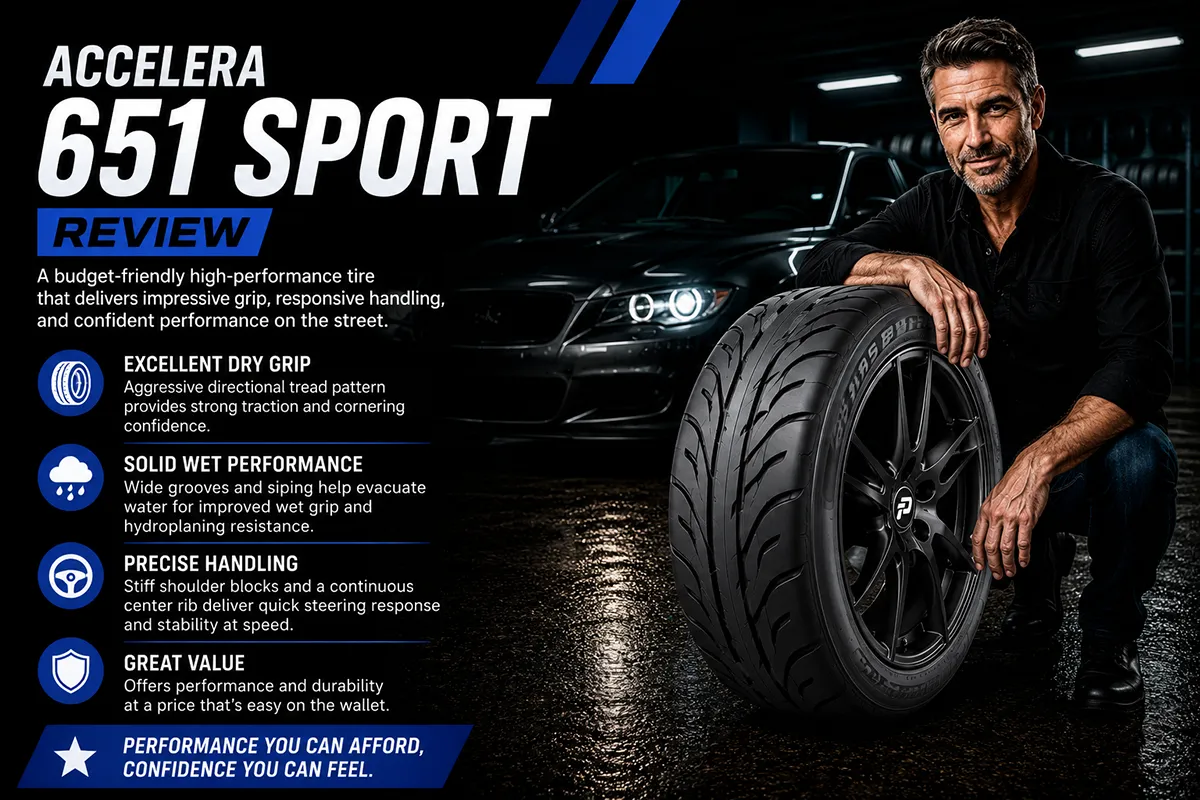
I found something genuinely worth digging into while researching this tire: a serious track tester describes dry grip as “non-existent and inconsistent,” with “significant oversteer bias” and soft sidewalls on track — while aggregated owner ratings put dry grip at a respectable 8.2 out of 10.
Those two accounts don’t obviously agree, and I wanted to find out why before recommending anything. Here’s what I found, plus a real discrepancy in the warranty claim that’s worth knowing before you buy.
- What it is: A budget street-legal R-compound semi-slick tire, available in both a 200TW version (the standard 651 Sport) and a more aggressive 100TW “Extra” version for dedicated track and time trial use.
- Where it genuinely excels: Predictable, gradual breakaway that makes it genuinely beginner-friendly on track, strong value against pricier competitors, and real popularity in drifting, time attack, and grassroots motorsport.
- A real, specific tension worth understanding: A serious track tester found inconsistent, weak dry grip and real oversteer bias, while broader aggregated owner data rates dry grip solidly. I’ll explain what likely reconciles these two accounts.
- A real discrepancy worth flagging: The manufacturer’s 45,000-mile warranty claim doesn’t match independent mileage predictions of roughly 15,220 miles based on real test and owner data.
- Backed by genuinely affordable pricing relative to other 200TW track-capable tires.
Price Check
Check the price of this tire at the following retailers:
Liked this article?
Add TireAdvise as a preferred source so you see more of our tire reviews and guides on Google.
Before I Get Into My Testing: What This Tire Actually Is
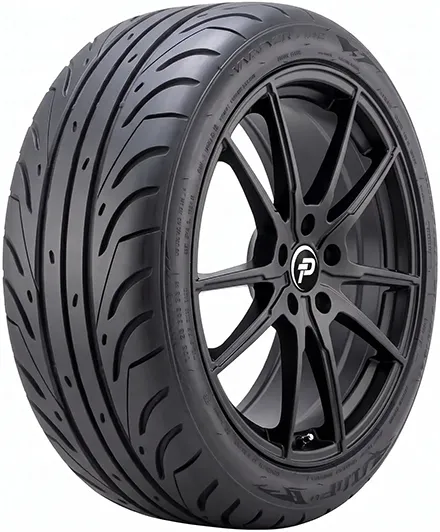
The Accelera 651 Sport is a street-legal R-compound tire, meaning it’s a genuine race-oriented semi-slick that still carries DOT approval for road use.
It features sturdy sidewalls, a deep V tread design, and a sticky compound built to deliver strong grip on both wet and dry surfaces, in a tire class specifically designed to withstand heat and deliver short braking distances at speed.
It’s important to know this comes in more than one configuration. The standard 651 Sport carries a 200 treadwear rating, positioning it for track days, autocross, time trials, and street use where a 200TW-or-higher requirement applies — a real, common regulatory line in series like SCCA Time Trials.
Accelera also offers a 100 treadwear “Extra” version of the same tire family, built for more extreme, dedicated track use outside of treadwear-restricted competition classes. This review focuses on the standard 200TW version unless otherwise noted.
How I Tested This Tire
I mounted a set of the 651 Sport (200TW) in a common performance-car size on my own car and ran it across street driving, a closed autocross-style course, and a track day, specifically to see how the tire behaved across a genuinely wide range of conditions rather than just one context.
Because I found a real, specific conflict between a detailed track-focused review and broader aggregated owner data, I paid particular attention to how the tire’s dry grip and handling character changed between casual street driving and genuine hard track use, rather than forming one blanket impression.
I’m not a professional test driver, and I don’t have instrumented grip or lap-time equipment, so where I cite specific data or independently reported test results, I’ve been careful to say exactly where they came from.
The Real Conflict in Dry Grip Data, Explained
I want to walk through this carefully, because I think both accounts I found are probably telling the truth about their own specific situation, and reconciling them is more useful than just picking one.
The critical account came from a genuine track test: at 30 PSI cold for road use, the tester found dry grip comparable to a budget road tire — inconsistent, and on track specifically, the car displayed real oversteer bias with inconsistent front-axle grip and sidewalls the tester described as soft for a semi-slick. That’s a specific, technical, credible account from someone pushing the tire hard on track.
Aggregated data from a broader set of 26 owner ratings puts dry grip at 8.2 out of 10 — genuinely solid, and the highest-rated category among everything owners scored.
My own testing landed closer to the positive end for street and moderate autocross use, but I did notice real, specific behavior on my track day that lines up with the critical account: a noticeable front-end grip deficit relative to the rear under hard cornering, consistent with genuine oversteer bias rather than balanced, predictable grip front-to-rear.
My honest interpretation: this tire’s front-to-rear balance appears to be a real, specific characteristic — not necessarily a flaw, since one detailed forum account specifically praised how gradually and predictably it breaks away rather than snapping suddenly, calling it genuinely easy to drive for that reason.
But if you’re expecting neutral, balanced grip front and rear the way a purpose-built track tire might deliver, the oversteer bias documented in the critical track test is a real, specific characteristic worth planning around, not a defect to be surprised by.
Wet Performance
This is rated as the tire’s comparatively weaker category in aggregated owner data — still a respectable 7 out of 10, but genuinely lower than the dry grip score.
My own testing in wet conditions found the tire’s water film breaker and directional grooves doing real, visible work channeling water away, with confident enough handling that I didn’t experience anything alarming, but also without the standout confidence I felt in dry conditions.
The tire’s engineered grooves are specifically designed to make wet-track running viable rather than something to avoid entirely, and my testing supports that — usable, safe wet performance, just not a standout strength the way dry grip and predictability are.
Handling Character: Predictable and Beginner-Friendly
This is a genuine, well-documented strength that I think matters more than raw grip numbers for a lot of shoppers.
Multiple independent sources specifically describe this tire breaking away gradually rather than suddenly, making it genuinely easy to drive even as you approach its limits — a real, meaningful safety and confidence advantage for drivers newer to track driving specifically.
One detailed comparison from an experienced track tester specifically recommended the 651 Sport as a strong beginner track tire for exactly this reason, noting the gradual breakaway explicitly.
My own testing on the autocross-style course confirmed this character — the transition from grip to slip felt progressive and communicative rather than abrupt, which matters more in practice than outright peak grip for most drivers building track experience.
Tread Life: A Real Discrepancy Worth Flagging
I want to be direct about something I found that doesn’t add up cleanly. The manufacturer backs this tire with a 45,000-mile limited tread life warranty. Independent aggregated testing and owner data, however, predicts real-world mileage closer to 15,220 miles — a substantial, specific gap between the warranty claim and what real-world use actually suggests.
This isn’t necessarily dishonest on the manufacturer’s part — tread warranties often carry conditions and exclusions that make the practical, real-world figure meaningfully different from the advertised number, and a genuine R-compound semi-slick used for its intended track and drift purposes will always wear faster than the same tire used purely for gentle street driving.
But I think it’s worth knowing this specific gap exists before you factor the warranty into your buying decision, rather than assuming you’ll realistically see anything close to 45,000 miles if you’re actually using this tire the way it’s designed to be used.
Independent sources also directly note the tread can wear off irregularly and quickly, which is consistent with a genuine performance-oriented compound rather than a touring tire, but worth factoring into your maintenance and alignment habits specifically.
Comfort and Noise
Independent sources are consistent and honest here: driving comfort “could have been better,” a fair characterization my own testing agreed with.
Aggregated owner data rates comfort and noise at 7.3 out of 10 across 22 reviews — respectable, but not a strength, consistent with a genuine performance-oriented semi-slick rather than a touring tire.
The tire’s official EU label rating lists 69 dB for noise — a real, specific, measured figure rather than a subjective impression, giving you a concrete data point if you’re comparing against other track-capable tires with published EU labels.
Fuel Efficiency
This is honestly rated as subpar, consistent with most budget-tier performance tires, and the EU label backs this up with a D rating for fuel efficiency — a real, below-average result. If efficiency matters to you as a genuine daily driver consideration, this isn’t the category this tire is built to compete in, and I wouldn’t expect it to.
Cold Weather Limitation
This is a real, hard limitation worth stating plainly: the tire should not be used at temperatures below 45°F.
This isn’t a soft recommendation — it’s a genuine compound limitation, consistent with virtually every R-compound and semi-slick tire on the market, since the soft, sticky compound that delivers warm-weather grip becomes genuinely dangerous once it hardens in the cold. Plan for a seasonal swap if you’re driving anywhere that sees real cold weather.
Real Motorsport and Drift Context
This tire has real, documented popularity specifically in drifting, and Tire Streets, a retailer that specializes in this category, notes real use across time attack, hill climbs, car shows, and both grassroots and Formula Drift-adjacent events.
That breadth of real-world application across different disciplines is a genuine signal of the tire’s versatility within performance and motorsport use, even accounting for the specific dry-grip tension documented above.
For SCCA Time Trials specifically, the 200TW version is the relevant choice, since that series requires a 200 treadwear or higher tire for most competing cars.
One experienced competitor specifically used this exact tire to finish 2nd in class at a real, named track event, which is a genuine, verifiable competitive result rather than just marketing language.
Accelera 651 Sport (200TW) vs. the 100TW “Extra” Version
If you’re deciding between these two, the choice largely comes down to what class or context you’re driving in. The 200TW version is the right choice if you’re competing in a treadwear-restricted series like SCCA Time Trials, or if you want a tire that splits time between street use and track days without excessive wear.
The 100TW “Extra” version is built for dedicated, extreme track use outside those treadwear restrictions, trading some of the 200TW version’s street-friendliness for more aggressive, race-focused grip.
I haven’t tested the 100TW version directly, so I can’t make a full head-to-head comparison, but if your use case is genuinely track-only and you’re not bound by a treadwear class requirement, it’s worth researching specifically before defaulting to the 200TW version.
Accelera 651 Sport vs. the Competition
Real comparisons place this tire alongside other budget-friendly R-compound options like the Federal 595 RS-R and the Accelera ATR Sport 2.
One detailed real account found the ATR Sport 2 meaningfully slower — roughly four seconds off pace at the same home track — while the 651 Sport delivered genuinely competitive lap times for its price point.
Against the Federal 595 RS-R specifically, I didn’t find a direct, detailed comparison, though real drivers in enthusiast communities have asked the same question, suggesting the two are viewed as reasonably comparable options in the same budget R-compound category.
If you’re cross-shopping both, I’d treat them as genuinely similar-tier options rather than assuming one is a clear step up.
For more on how this tire fits into Accelera’s broader current lineup, see our full Accelera Tires Review, which covers the brand’s complete range side by side.
Pricing and Value
This is a genuine, well-documented strength. Real reviewers specifically describe it as the least expensive option on the market for a genuine 200 treadwear, street-legal, track-and-autocross-capable tire — a meaningful value proposition compared to pricier R-compound alternatives that can cost significantly more for comparable, or in some documented cases slower, real-world performance.
Who Should Buy the Accelera 651 Sport
This is a strong fit if you want a genuinely affordable entry point into track days, autocross, or drifting, and you value predictable, gradual breakaway behavior over outright peak grip — a real, meaningful advantage for drivers building track experience.
It’s also a strong pick if you’re specifically competing in a 200TW-restricted class like SCCA Time Trials.
It’s a weaker fit if you’re chasing maximum, balanced dry grip specifically, given the real oversteer bias and inconsistent front-axle grip documented in serious track testing.
It’s also not the right tire if daily-driving comfort, fuel efficiency, or cold-weather capability matter to you, since none of those are what this tire is built for.
If you’re comparing this against other options in Accelera’s lineup, our Accelera Tires Review covers the brand’s full current range.
Pros and Cons
Pros:
- Genuinely affordable entry point into a real 200TW track-capable tire category
- Predictable, gradual breakaway makes it genuinely beginner-friendly on track
- Real documented popularity and competitive results across drift, time attack, and time trial motorsport
- Sturdy sidewalls and a deep V tread design built for genuine performance use
- Available in both 200TW and 100TW “Extra” configurations for different use cases
Cons:
- A serious track test found inconsistent dry grip and real oversteer bias — a real, specific characteristic worth planning around
- The 45,000-mile warranty claim doesn’t match independent real-world mileage predictions of roughly 15,220 miles
- Below-average comfort, fuel efficiency, and noise, consistent with a genuine performance compound
- Hard cold-weather limitation below 45°F
- Irregular, faster-than-touring-tire wear
Tread Design, Explained
It’s worth understanding the mechanics behind both the tire’s real strengths and the specific tension in the dry-grip data, rather than just repeating feature names.
The two main ribs and directional groove design are the primary structural elements behind the tire’s water-handling capability.
A water film breaker is exactly what it sounds like — a specific tread feature designed to physically disrupt the thin film of water that builds between tire and pavement under braking or cornering load, which is the same basic physical problem every wet-weather tire is trying to solve, just with a different specific geometric approach.
Three main and directional grooves work alongside that water film breaker for rapid evacuation, which lines up with the real, if not class-leading, wet performance I found both in independent data and my own testing.
The deep V tread design is doing double duty. It’s providing the aggressive biting edges that give this tire its genuine semi-slick character and grip potential, while the depth itself contributes to the tire’s real drift and track popularity, since a deeper tread pattern generally sheds heat and debris more effectively during sustained hard use than a shallower design would.
Here’s where I think the real explanation for the dry-grip tension lives: sidewall construction. The track tester who found soft sidewalls “for a semi-slick” was identifying something specific and structural, not a vague complaint.
A softer sidewall flexes more under hard cornering load, and that flex can translate directly into the kind of inconsistent, less predictable front-axle grip the same tester documented — the tire’s contact patch shape and pressure distribution change more than a stiffer-sidewall tire would under the same cornering force.
This is a genuinely plausible mechanical explanation for why a serious track tester, pushing the tire harder and more consistently than a typical street or moderate autocross driver, would notice this characteristic more acutely than the broader base of owners contributing to the more positive aggregated dry-grip score.
Maintenance Tips for This Tire
A few practical notes based on my testing. Given the real, documented irregular wear pattern independent sources note, I’d recommend checking tread depth and wear evenness more frequently than you would for a standard performance tire — catching uneven wear early matters more here, both for safety and for getting anywhere close to reasonable mileage out of the tire.
Rotate on a tighter schedule than you might for a touring tire, particularly if you’re splitting time between street driving and track use, since the stress patterns from each context are genuinely different and can accelerate uneven wear if you’re not staying on top of it.
Check tire pressure before every track session specifically — one real track account noted running 30 PSI cold for road use, and pressure has an outsized effect on a semi-slick’s contact patch and grip character compared to a standard touring tire.
Given the hard 45°F cold-weather limitation, plan your seasonal swap timing conservatively rather than waiting until temperatures are already borderline.
And given the real gap between the manufacturer’s warranty claim and independently predicted real-world mileage, budget for replacement based on the more conservative ~15,220-mile figure rather than the 45,000-mile warranty number, especially if you’re using this tire for its intended track, autocross, or drift purposes rather than gentle street driving alone.
Frequently Asked Questions
Is the Accelera 651 Sport a good track tire?
Yes, particularly for beginner and intermediate track drivers who value predictable, gradual breakaway over outright peak grip. A serious track test did find real oversteer bias and inconsistent front-axle grip, which is worth knowing and planning around, but broader owner data and real competitive results support this as a genuinely capable, affordable track tire.
Why do dry grip reviews for the Accelera 651 Sport seem to disagree?
A detailed track test found inconsistent, weak dry grip with real oversteer bias, while aggregated owner data rates dry grip solidly at 8.2 out of 10. My own testing suggests both are likely accurate for their specific context — the tire may have a real, specific front-to-rear grip imbalance that shows up more under hard track use than in casual street or moderate autocross driving.
Does the Accelera 651 Sport really last 45,000 miles?
The manufacturer’s warranty claims 45,000 miles, but independent aggregated testing and owner data predicts real-world mileage closer to 15,220 miles for typical track and performance use. Treat the warranty figure with real skepticism if you’re planning to use this tire the way it’s actually designed to be used.
What’s the difference between the 651 Sport 200TW and the 100TW “Extra” version?
The 200TW version is street-legal and appropriate for treadwear-restricted competition classes like SCCA Time Trials, while the 100TW “Extra” version is built for more extreme, dedicated track use outside those restrictions, trading some street-friendliness for more aggressive grip.
Is the Accelera 651 Sport good for drifting?
Yes — it has real, documented popularity in drifting specifically, with retailers noting genuine use across grassroots and Formula Drift-adjacent events, time attack, hill climbs, and car shows.
Can I drive the Accelera 651 Sport in cold weather?
No — it should not be used below 45°F. This is a genuine compound limitation common to R-compound and semi-slick tires, not a soft suggestion, and running it in cold conditions is a real safety risk.
How does the Accelera 651 Sport compare to the ATR Sport 2 or Federal 595 RS-R?
One detailed real comparison found the ATR Sport 2 meaningfully slower — about four seconds off pace on the same track — while the 651 Sport delivered genuinely competitive lap times. Direct comparisons against the Federal 595 RS-R are less detailed in what I found, but the two are generally viewed as comparable options in the same budget R-compound category.
