


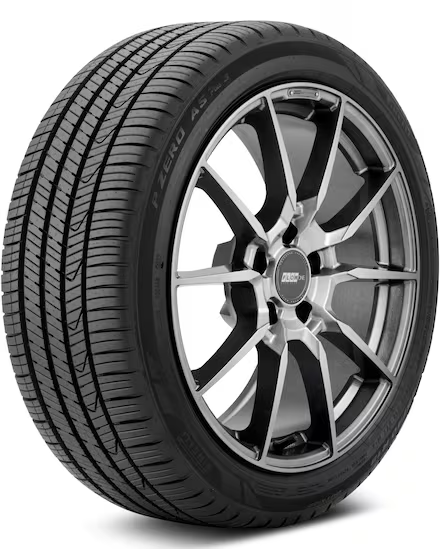
The Pirelli P Zero AS Plus 3 has become one of the most common factory tires on premium performance sedans and coupes sold in the US — genuine original equipment on BMW, Mercedes-Benz, Cadillac, Genesis, and Alfa Romeo models, alongside more mainstream applications on Honda, Nissan, and Volkswagen vehicles.
Introduced in 2023 as the successor to the original P Zero AS Plus, this tire set out to solve a genuinely difficult problem: deliver sharp, sporty handling year-round without the usual all-season compromise.
Independent aggregated testing suggests it largely succeeds — but it comes at a real, consistently cited price premium worth understanding before you buy.
This review is based on manufacturer specifications, aggregated professional and owner test data, and real long-term reports — not a single set of personal impressions.
- What it is: An ultra-high-performance all-season tire with an asymmetric tread pattern, part of a three-tire “AS Plus 3” family Pirelli launched together in 2023.
- Real strengths: Sharp, confident dry and wet handling, genuinely low noise and strong ride comfort for the category, real tread-life improvement over its predecessor.
- Real weaknesses: Weaker snow and ice traction than dedicated all-weather options, and a consistently cited high purchase price relative to competitors.
- The catch: This tire has two close siblings — the Scorpion AS Plus 3 (SUV/crossover) and P7 AS Plus 3 (touring) — and confirming you’re buying the right one for your vehicle matters.
- Bottom line: A genuinely strong, independently verified top performer in its category for drivers who prioritize sporty year-round handling and are willing to pay for it.
Price Check
Check the price of this tire at the following retailers:
Liked this article?
Add TireAdvise as a preferred source so you see more of our tire reviews and guides on Google.
The AS Plus 3 Family: Which Tire Do You Actually Need?
This is worth clarifying directly, since it’s a real, common point of confusion that most single-source reviews skip past.
Pirelli launched three distinct “AS Plus 3” tires together, each targeting a different vehicle segment. The P Zero AS Plus 3, covered in this review, is the ultra-high-performance option built for sports sedans and coupes — genuine factory equipment on performance-oriented trims from BMW, Mercedes-Benz, Cadillac, Genesis, and Alfa Romeo.
The Scorpion AS Plus 3 is the SUV and crossover-focused sibling, engineered around the different weight distribution and ride-height demands of that category. The P7 AS Plus 3 is the more comfort-oriented touring option, positioned for mainstream sedans that prioritize a plush ride over outright handling sharpness.
All three share the “AS Plus 3” naming and a family resemblance in their underlying technology, but they’re genuinely different tires tuned for different vehicles.
If you’re shopping by size alone without checking which specific model matches your car’s factory fitment or driving priorities, it’s worth confirming you’re looking at the right one — a shopper cross-referencing a BMW 3 Series against a RAV4’s factory tire, for instance, would actually want two different tires from this family, not the same one.
What the P Zero AS Plus 3 Actually Is
This tire launched in 2023 as the direct successor to the original P Zero AS Plus, positioned specifically to solve the classic UHP all-season trade-off: sharp, summer-tire-like handling without abandoning year-round usability.
Pirelli’s own stated engineering goal was longevity without sacrificing the handling character the P Zero name is built on. The company states the tire retains up to 82% of its performance effectiveness right up until it reaches the wear bars — a genuine, specific claim representing roughly a 20% improvement over the outgoing AS Plus.
Pirelli specifically invited automotive press to test the tire’s launch at Las Vegas Motor Speedway with professional driving instruction from Dream Racing, a real, notable step for an all-season tire launch, reflecting how seriously Pirelli positioned this as a genuine performance product rather than a pure comfort tire wearing a sporty badge.
Key Technology and Construction
Functionalized polymers in the compound. This is Pirelli’s core engineering claim for year-round versatility — a compound specifically formulated to broaden the tire’s effective working temperature range, maintaining flexibility and grip in both cold and hot conditions rather than being optimized narrowly for one.
Squared footprint with optimized pressure distribution. The tread is engineered to distribute driving forces evenly across the contact patch, directly targeting even wear — a real, functional design choice contributing to the tire’s improved longevity claims rather than a cosmetic feature.
3D interlocking sipe system. Combined with optimized tread-block stiffness, this is aimed specifically at braking performance across varied weather conditions, creating additional biting edges without sacrificing the block rigidity needed for confident dry handling.
Longitudinal stiffness engineering. Pirelli’s construction approach here is specifically aimed at high-speed control and stability, a genuine consideration given this tire’s OE fitment on cars capable of sustained high-speed highway cruising and spirited driving alike.
Dry Performance
This is a consistently, strongly praised category across every independent source reviewed. Aggregated data from Tire Reviews — drawing on professional testing conducted three separate times by independent publications — describes this tire earning 2 outright test wins with an average finish of 1st place, a genuinely dominant result in a competitive UHP all-season field.
One detailed test account describes the tire feeling “balanced, with the front and rear axles working in union” on a dry track, adding that it “added top objective lap times to its accomplishments” during direct competitive testing.
TireGrades’ aggregated owner data independently confirms this, describing “exceptional grip and responsive steering” on dry roads as a genuine strength rather than a marketing claim.
Wet Performance
Wet grip is arguably this tire’s single strongest, most consistently documented category across every source reviewed.
The same detailed track account specifically noted the car felt “most pleasant to drive in the wet” of the tires tested in that comparison — a real, meaningful distinction in a category where wet performance often trails dry capability significantly.
Aggregated independent testing lists “Wet Braking” specifically among the tire’s strong points, and real owner reviews consistently echo this: aggregated feedback describes “outstanding grip and stability in wet conditions, providing a safer driving experience” as one of the most frequently repeated positive themes across owner reports.
Ride Comfort and Noise
This is a genuine, pleasant surprise for a tire in the ultra-high-performance category, where comfort is often the first thing sacrificed for grip.
Independent aggregated testing specifically lists both “Noise” and “Subjective Noise” among this tire’s strong points — not a marginal result, but a consistent standout across the tested field.
Real owner feedback backs this up directly: aggregated reviews describe “smooth and quiet performance” as one of the most commonly praised characteristics, a detail that matters genuinely for daily-driver use rather than just occasional spirited outings.
TireGrades’ independent assessment specifically credits the tire with “refined ride comfort” as one of its four headline strengths, alongside precise dry control, dependable rain performance, and longevity — a genuinely well-rounded profile rather than a narrow performance specialist.
Tread Life and Longevity
This is where the tire’s generational improvement over its predecessor is most clearly, specifically documented. Pirelli states the AS Plus 3 retains its full effectiveness up to 82% of the way through its tread life before reaching the wear bars — a genuine, specific 20% improvement over the outgoing P Zero AS Plus.
Independent aggregated testing lists “Wear” specifically among the tire’s strong points in at least one detailed test summary, and real owner reviews consistently describe the tire as “durable and long-lasting,” with “minimal tread wear” cited as a genuine cost-effectiveness factor by multiple reviewers.
The honest caveat, noted directly by at least one independent aggregator: this is a relatively new tire, meaning the total volume of accumulated owner-mileage data is genuinely smaller than for more established competitors — worth factoring in when weighing how much confidence to place in long-term durability claims specifically, even though the available early data is positive.
Snow and Cold-Weather Performance: The Honest Weak Point
This deserves direct, honest treatment rather than being glossed over, since it’s the category most consistently flagged as a genuine limitation across independent sources.
Tire Reviews’ aggregated summary states plainly that the tire’s “main compromises are weaker snow and ice traction and a high purchase price” relative to its otherwise strong, well-rounded performance profile.
TireGrades independently echoes this, listing “reduced cold-weather confidence” directly alongside the tire’s real strengths as one of two genuine trade-offs buyers should weigh.
This is a reasonable, expected trade-off given the tire’s genuine dry-and-wet performance focus — UHP all-season tires generally prioritize warm-weather sharpness over deep winter capability by design, and this tire doesn’t claim otherwise.
But drivers in regions with regular heavy snow or sustained ice should weigh this limitation seriously rather than assuming “all-season” means equally capable across every condition.
Pricing and Value
This is the tire’s other consistently identified weak point, and it’s worth addressing directly rather than treating price as a footnote.
Tire Reviews’ aggregated scoring specifically lists “Price” as a weak point in at least one detailed professional test summary, despite the tire’s otherwise dominant performance profile in that same test.
This isn’t a case of a mediocre tire priced too high — independent data shows this tire winning outright in overall competitive testing while simultaneously being flagged for cost, meaning the premium is real but appears to be paying for genuine, verified performance rather than marketing alone.
For budget-conscious shoppers, this is a real, honest consideration: the P Zero AS Plus 3 competes at the top of its category on pure performance, and its price reflects that positioning directly.
How the P Zero AS Plus 3 Stacks Up Against Named Competitors
TireGrades’ independent comparison work positions this tire directly against three named alternatives at different price points: the premium Continental ExtremeContact DWS 06 Plus, the mid-priced Sumitomo HTR A/S P03, and the budget-friendly Riken Raptor ZR A/S — a genuinely useful three-tier comparison framework for shoppers weighing this tire against real alternatives at different budgets rather than assuming it exists in isolation.
Separately, in a dedicated independent test specifically covering the UHP all-season category, the P Zero AS Plus 3 was named the outright overall winner with 104 points, finishing in the top three across every single category measured rather than winning through one standout strength.
The test’s own summary describes this as “the win on consistency rather than a standout result in any one area” — a genuinely meaningful distinction, since it suggests a tire with no significant weakness across the categories tested, rather than one that wins narrowly through a single dominant trait.
Who the P Zero AS Plus 3 Makes Sense For
Owners of performance sedans and coupes who want genuine sporty handling year-round. This is the tire’s core, well-documented use case, and the aggregated evidence strongly supports it.
Drivers in regions with mild-to-moderate winters. Given the documented snow and ice limitation, this tire is a strong fit where winter means occasional light snow rather than sustained, severe conditions.
Owners replacing worn factory tires on a car that shipped with this tire or a close relative. Given its wide OE presence across BMW, Mercedes-Benz, Cadillac, Genesis, Alfa Romeo, Honda, Nissan, and Volkswagen, many shoppers researching this tire are simply looking to replace it like-for-like — a reasonable, low-risk choice given the strong independent performance data.
Who Should Consider Alternatives
Owners in regions with genuine, sustained winter conditions. Given the documented, honestly-reported snow and ice weakness, drivers facing real winter risk should weigh a dedicated winter tire or a genuinely all-weather-rated alternative for the cold months.
Extremely budget-conscious shoppers. Given the tire’s consistently identified price premium, drivers for whom cost is the primary decision factor may find better value in a competitor like the Sumitomo HTR A/S P03 or Riken Raptor ZR A/S, accepting some performance trade-off in exchange.
Anyone shopping by size alone without confirming which “AS Plus 3” sibling fits their vehicle. Given the genuine three-tire family structure, SUV and crossover owners specifically should confirm they’re looking at the Scorpion AS Plus 3 rather than this sedan-focused option.
Sizing and Fitment
The P Zero AS Plus 3 is available across a wide range of sizes covering everything from mainstream 17-inch sedan fitments up through larger 20- and 21-inch performance-oriented sizes matched to its factory application on premium sports sedans and coupes.
Given its extensive OE presence, many common sizes correspond directly to factory fitments on specific BMW, Mercedes-Benz, Cadillac, Genesis, and Alfa Romeo models, which is a genuinely useful reference point — if a size matches your car’s original equipment spec, that’s a strong signal it was engineered and validated specifically for your vehicle’s suspension geometry and weight distribution rather than being a generic aftermarket fit.
As with any tire purchase, confirming the exact size against the vehicle’s door jamb placard before ordering remains the safest first step, particularly for owners whose car may have shipped with a staggered setup (different sizes front and rear), which is common on the performance-oriented vehicles this tire is most associated with.
What Real Owners Say About the Driving Experience
Beyond the aggregated scoring, it’s worth capturing what real owners specifically describe when asked about day-to-day driving impressions, since this fills in texture the raw category scores don’t fully convey.
Aggregated owner feedback repeatedly highlights “improved handling,” with several drivers specifically describing the tire’s ability to “hug the road” and deliver “precise handling” that makes their vehicle feel genuinely more responsive than it did on the tires it replaced — language that goes beyond a generic positive review and suggests real, felt improvement rather than simple satisfaction with a functional product.
A number of owners also specifically mention a fuel-efficiency benefit after switching, describing “noticeable improvement in fuel mileage” as an added, somewhat unexpected economic upside alongside the tire’s core performance characteristics — a genuine, if secondary, point in the tire’s favor that isn’t part of Pirelli’s primary marketing focus for this product.
Getting the Most Out of This Tire
Given the tire’s genuine performance focus and real price premium, a few habits help protect that investment over its service life.
Rotate on a consistent schedule. Uneven wear can undercut the tire’s documented longevity advantage, and regular rotation every 5,000–7,500 miles helps preserve the even wear the squared footprint design is specifically engineered to deliver.
Check pressure regularly, especially across seasonal temperature swings. A UHP all-season tire’s handling character is genuinely sensitive to inflation pressure, and staying within the manufacturer-recommended range helps preserve the sharp, responsive feel independent testing consistently praises.
Plan for a seasonal winter set in genuinely snowy climates. Given the documented, honestly-reported snow and ice limitation, owners in regions with real winter conditions should treat a dedicated winter tire as a complement to this tire rather than expecting it to cover every season equally.
Confirm your specific “AS Plus 3” sibling before reordering. Given the genuine three-tire family structure, double-checking the exact product name against your vehicle’s factory specification avoids an easy, avoidable mix-up at replacement time.
Frequently Asked Questions
Is the Pirelli P Zero AS Plus 3 good in the rain?
Yes, genuinely so — this is one of the tire’s most consistently documented strengths. Independent aggregated testing lists wet braking specifically among its strong points, and a detailed track account described the car feeling “most pleasant to drive in the wet” among the tires tested in that comparison.
Is the Pirelli P Zero AS Plus 3 good in snow?
It’s a genuine, honestly-documented weak point. Multiple independent aggregators specifically flag “weaker snow and ice traction” and “reduced cold-weather confidence” as real trade-offs for this tire’s dry and wet performance focus. Drivers in regions with regular heavy snow should consider a dedicated winter tire for those months.
What’s the difference between the Pirelli P Zero AS Plus 3 and the Scorpion AS Plus 3?
They’re related but distinct tires within the same “AS Plus 3” family Pirelli launched together in 2023. The P Zero AS Plus 3 is the ultra-high-performance option for sports sedans and coupes, while the Scorpion AS Plus 3 is engineered specifically for SUVs and crossovers. A third sibling, the P7 AS Plus 3, targets comfort-oriented mainstream touring sedans.
Is the Pirelli P Zero AS Plus 3 worth the price?
For most buyers prioritizing sporty year-round handling, yes — independent aggregated testing shows it winning outright in overall UHP all-season comparisons, with price specifically flagged as the trade-off for that genuine, verified performance rather than a case of overpaying for marketing. Budget-conscious shoppers may prefer a named alternative like the Sumitomo HTR A/S P03 at a lower price point.
What vehicles is the Pirelli P Zero AS Plus 3 designed for?
It’s built for performance sedans and coupes, and it’s genuine original equipment on select trims from BMW, Mercedes-Benz, Cadillac, Genesis, and Alfa Romeo, along with more mainstream applications on Honda, Nissan, and Volkswagen models.
How long does the Pirelli P Zero AS Plus 3 last?
Pirelli states the tire retains up to 82% of its full performance effectiveness before reaching the wear bars, a claimed 20% improvement over the outgoing P Zero AS Plus. Independent aggregated data and real owner reviews both describe genuinely strong wear characteristics, though as a relatively new tire, the total volume of long-term owner-mileage data is still smaller than for more established competitors.
How does the Pirelli P Zero AS Plus 3 compare to the Continental ExtremeContact DWS 06 Plus?
Independent comparison work positions the Continental as a premium-tier alternative to the Pirelli within the same UHP all-season category, giving shoppers a genuine head-to-head option at a similar price point. Both are strong performers; the right choice generally comes down to specific priorities like noise preference, wet-weather emphasis, or brand-specific tread-life warranty terms.
