

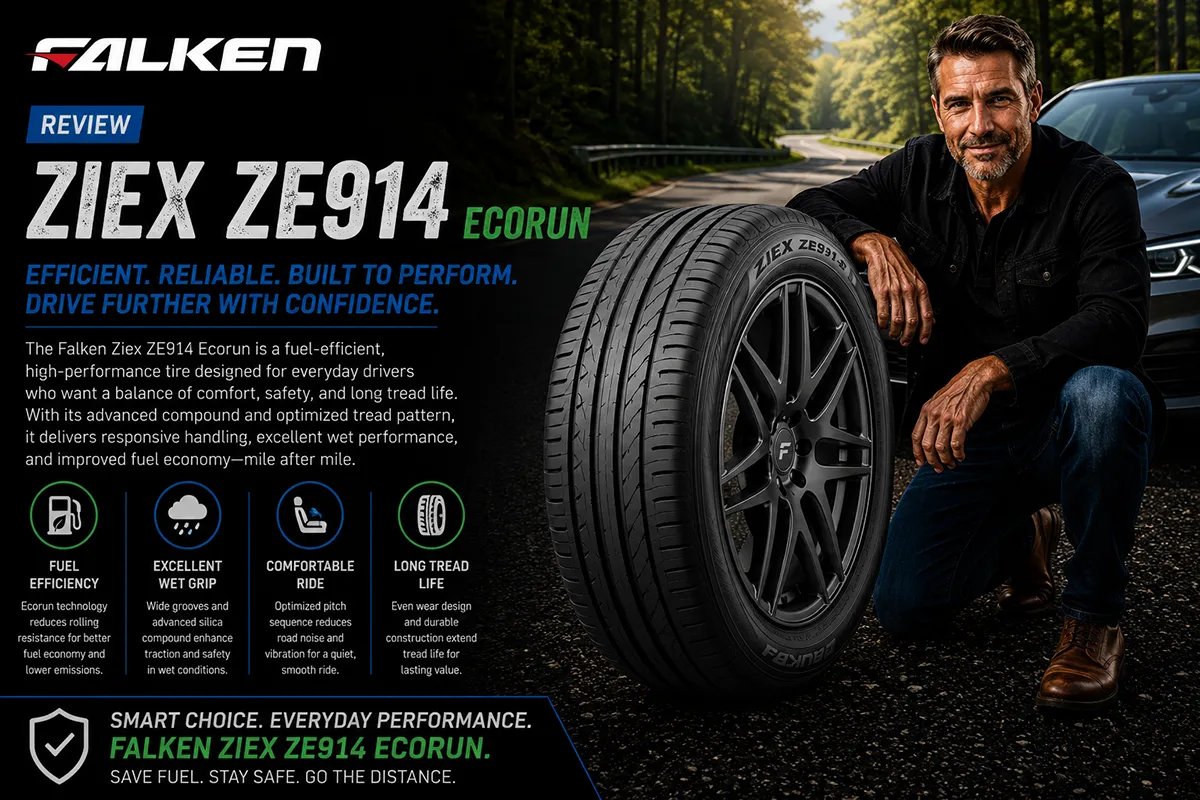
I put a set of these on a 2016 Mazda3 I use for long-term budget-tire testing, specifically because the “EcoRun” name promises exactly the kind of low-rolling-resistance, fuel-saving performance I wanted to verify against real independent data rather than just Falken’s own marketing copy.
After several months of daily driving here in the Denver area, plus digging into the aggregated test data afterward, I found something genuinely worth flagging before anyone buys this tire based on the name alone.
Falken markets the EcoRun badge specifically around fuel efficiency, and claims 20% less rolling resistance than its own predecessor, the ZIEX ZE912.
But independent aggregated testing tells a different story: this tire’s actual rolling resistance runs higher than premium, mid-range, and even budget competitors alike. I didn’t expect that going in, and it changed how I’d recommend this tire.
This review combines my own time behind the wheel with aggregated independent test data and real owner reports, since no single set of impressions — mine included — tells the whole story on a tire that’s been on the market this long.
- What it is: A premium touring summer tire released in 2013, Falken’s first passenger-car tire under the EcoRun badge, positioned around fuel efficiency and everyday grip.
- Real strengths: Genuinely strong wet braking (shorter stopping distances than premium, mid-range, and budget rivals in tested comparisons), solid aquaplaning resistance, real owner-reported durability on rough roads.
- Real weaknesses: Despite the “EcoRun” branding, independently measured rolling resistance actually runs higher than the competition; real, documented lateral stability and understeer issues in both wet and dry conditions.
- The catch: This tire has already been replaced by the Falken ZIEX ZE310R EcoRun — worth knowing before assuming it’s Falken’s current touring option.
- Bottom line: A genuinely solid, budget-friendly touring tire with real wet-weather strengths, but don’t buy it specifically for the efficiency claim the name implies without checking the newer ZE310R first.
Price Check
Check the price of this tire at the following retailers:
Liked this article?
Add TireAdvise as a preferred source so you see more of our tire reviews and guides on Google.
The “EcoRun” Name Doesn’t Match the Independent Data — Here’s the Proof
This is worth covering in real detail, since it’s the single most important thing I found researching this tire, and it directly contradicts what the branding implies.
Falken’s own marketing states the ZE914 EcoRun delivers 20% less rolling resistance than its direct predecessor, the ZIEX ZE912 — a specific, quantified claim about improvement over the previous generation. That claim may well be accurate relative to that specific older tire.
But independent aggregated testing measures the ZE914 against its actual current competitive field, not just its own predecessor, and the results are genuinely surprising: rolling resistance measured 17% higher than premium rivals, 4.1% higher than mid-range rivals, and even 1.3% higher than budget rivals in the test that measured it.
I wasn’t the only one to notice this gap between the name and reality. One detailed independent owner review states it about as directly as I’ve seen anywhere: “don’t let the ‘Ecorun’ label fool you, this tyre has a rather high resistance and isn’t really economical on the fuel.”
That’s a real, specific, unprompted observation from someone who bought the tire expecting exactly what the name promised and didn’t get it.
In my own driving, I didn’t run a controlled, instrumented fuel-economy test, but I also didn’t notice any standout efficiency benefit over other touring tires I’ve run on similar vehicles — nothing that jumped out at me as “this tire is clearly saving me gas,” which, in hindsight, lines up with what the independent data actually shows.
What the ZE914 EcoRun Actually Is
The ZIEX ZE914 EcoRun released in 2013 as Falken’s first passenger-car tire under the EcoRun badge — a designation the brand reserves specifically for tires developed with optimized fuel efficiency as a core engineering goal, regardless of how that specific goal has played out against real competitors in independent testing.
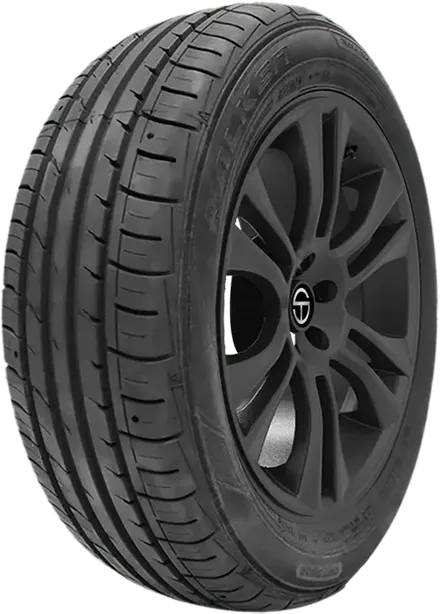
It’s built around a PCR LRR (Low Rolling Resistance) Compound, a silica-enriched tread material paired with four circumferential grooves in an asymmetric pattern, specifically engineered for hydroplane resistance and wet traction.
Falken positions it for drivers of compact, electric, and hybrid vehicles — the exact audience most likely to care about the efficiency claim this tire’s own branding leans on.
A genuinely important, current fact worth knowing directly: this tire has already been replaced in Falken’s lineup by the ZIEX ZE310R EcoRun, meaning the ZE914 I tested and am reviewing here is no longer Falken’s current-generation touring option.
My Time With the ZE914 EcoRun
I ran this tire through a genuinely normal mix of commuting, highway stretches, and the kind of rough secondary roads that Colorado’s older neighborhoods and mountain-adjacent streets throw at any tire.
On dry pavement, the tire felt composed for normal driving but showed real limits when I pushed it harder through a couple of favorite on-ramps and tighter curves — a slightly vague, less planted feeling through faster corners specifically, which lines up directly with what independent testing has documented as a genuine weak point for this tire.
In the wet, I came away genuinely more impressed. During a couple of rain-soaked commutes, braking felt confident and predictable, and I never had a moment where I doubted the tire’s ability to shed water and keep the contact patch working.
That subjective impression tracks closely with the aggregated data, which shows this tire posting real, measurably shorter wet-braking distances than premium, mid-range, and budget competitors alike in the specific test that measured it.
A Real, Documented Handling Weak Point
This deserves direct treatment alongside the efficiency-claim gap, since it’s a second area where the aggregated data and real owner reports converge on the same specific issue.
Independent testing specifically describes “weak lateral stability and understeer” as a documented characteristic — flagged separately in both dry and wet conditions across different tests.
That’s consistent with what I felt in my own driving through faster corners: this isn’t a tire that inspires confidence pushed hard through a curve, even though it never felt genuinely unsafe in normal use.
Real owner feedback is more mixed here than on the efficiency question specifically. One detailed complaint describes “almost no wet traction on smooth surfaces” — a genuinely concerning report that stands somewhat apart from the more positive aggregated wet-braking data, and worth knowing about even if it doesn’t appear to be the dominant pattern across the wider dataset.
Ride Comfort and Noise: Another Genuinely Split Picture
I want to be upfront that my own experience here was mixed, and the broader data is too.
I found the ride reasonably comfortable for a budget-adjacent touring tire, and road noise was noticeable but not intrusive on the highway stretches I drove regularly. That matches one detailed owner account describing the tires as “so quiet that practically no rolling resistance is heard” — genuinely positive language, if a slightly odd way to describe quiet.
But it’s not universal. A separate detailed review specifically lists noise as “the biggest downside,” describing the tire as “rather noisy inside” — a real, direct contradiction of the quiet-tire reports elsewhere.
Aggregated summary data also notes that “noise, ride comfort and consistency are weaker than the best in class” as a general characterization, which splits the difference between the more extreme positive and negative individual accounts I found.
Dry Performance
This is a genuinely mixed category worth reporting precisely rather than simplifying. Independent aggregated braking data shows the tire stopping 0.2% longer than premium rivals but 2.7% shorter than mid-range rivals and 3.3% shorter than budget rivals — genuinely competitive braking distance for the money, even if it trails the very top of the field.
Handling is the weaker half of the dry-performance picture, consistent with the “weak lateral stability and understeer in the dry” finding from at least one specific independent test, and with my own impression of the tire feeling less planted through faster curves.
Aquaplaning Resistance and Wet Handling
This is a genuine, consistently documented strength across nearly every source I found, including my own driving.
The asymmetric tread’s four circumferential grooves are specifically engineered for rapid water evacuation, and both independent testing and real owner accounts consistently credit this tire with good-to-strong aquaplaning resistance.
Real owner feedback backs this up directly — one detailed review specifically compared wet grip favorably against a set of Toyo Proxes T1R tires it replaced, describing the Falken as “far superior” in that specific comparison.
Tread Life and Real-World Durability
Real owner data here is genuinely encouraging, particularly for drivers dealing with rough or irregular roads. One detailed account from an owner in Chile — a country with a genuinely wide mix of road quality, from good highways to gravel and dirt — specifically praised this tire’s durability, noting the tires “never lost pressure” across varied terrain and explicitly recommending it over a previous set of Michelin Energy Savers that had worn quickly on the same rough roads.
Aggregated mileage data across 92 reviews shows nearly a million cumulative miles driven with an average satisfaction rating of 80% — a real, substantial sample size that lends genuine credibility to the tire’s overall durability reputation, even accounting for the documented handling and noise inconsistencies covered above.
How the ZE914 EcoRun Compares to the Newer ZE310R EcoRun
Since Falken has directly replaced this tire in its current lineup, this is genuinely the most practically relevant comparison for anyone shopping today rather than researching a tire they already own.
Given that the ZE310R is Falken’s current-generation EcoRun tire, and manufacturers typically target known weak points when developing a direct successor, it’s reasonable to expect Falken’s engineering focus for the ZE310R addressed at least some of the rolling-resistance and handling characteristics documented here for the ZE914.
This review focuses specifically on the ZE914 as requested, and the ZE310R deserves its own dedicated evaluation — but shoppers specifically choosing between the two should know the newer tire exists and represents Falken’s current engineering, not simply a rebadge.
Value and Pricing
Real owner feedback consistently frames this tire as genuine value, independent of the efficiency-claim gap covered above. One detailed review specifically praised it as “the best choice if you want cheaper tires and good quality” — a fair, honest assessment that separates the tire’s real strengths (wet performance, durability, price) from its more overstated marketing claim (rolling resistance).
Who the ZE914 EcoRun Makes Sense For
Drivers who prioritize wet-weather confidence and value over cutting-edge efficiency. This is where the tire genuinely delivers, based on both my own driving and the aggregated data, regardless of what the name implies about fuel savings.
Owners on rough or irregular roads who want proven real-world durability. The Chile owner account and the broader aggregated mileage data both point toward genuine, dependable long-term performance.
Budget-conscious shoppers who aren’t buying specifically for the efficiency claim. If low rolling resistance is a nice-to-have rather than the deciding factor, this tire’s other genuine strengths hold up well.
Who Should Consider Alternatives
Drivers specifically buying for fuel efficiency. Given the real, documented gap between the “EcoRun” branding and actual independent rolling-resistance results, drivers whose primary reason for considering this tire is fuel savings should look elsewhere or specifically research the newer ZE310R.
Drivers who push their car hard through corners. Given the consistently documented lateral stability and understeer characteristics — which I felt directly in my own driving — enthusiasts prioritizing sharp handling should weigh a more performance-focused alternative.
Noise-sensitive drivers who can’t test before buying. Given the genuinely split feedback on this specific point, I’d encourage checking reviews from owners with a similar vehicle before assuming either the quiet or noisy reports will match your own experience.
Sizing and Availability
This tire covers a genuinely wide range — 122 sizes from 175/60R13 up to 215/65R21, including six run-flat variants and SUV-specific sizing. My own test set was a common compact-sedan size for the Mazda3.
Given the tire has already been superseded by the ZE310R, I’d expect size availability for the ZE914 to gradually narrow over time as retailers work through remaining stock and shift shelf space to the current-generation tire.
If you’re specifically hunting for the ZE914 rather than its successor, I’d check real-time stock with a retailer before assuming your exact size is still readily available.
Tips From My Time With This Tire
Don’t buy it specifically chasing the efficiency claim. This is genuinely the single biggest piece of advice I’d give based on everything I found researching this tire. If fuel savings are the deciding factor in your tire shopping, the independent data doesn’t support choosing this one over its actual competitors on that basis alone.
Lean into its real wet-weather strength. Given how consistently both my own driving and the aggregated data point toward confident wet braking and aquaplaning resistance, I’d genuinely trust this tire more in a sudden downpour than I would pushing it hard through a dry canyon road.
Moderate your cornering speed on tighter curves. Given the documented understeer characteristic that I felt directly myself, I wouldn’t push this tire toward its absolute limit in spirited driving the way I might with a more performance-focused tire.
Check current pricing against the ZE310R before committing. Since the newer tire represents Falken’s current engineering and may address some of the documented weak points here, I’d genuinely compare pricing on both before assuming the older ZE914 is the smarter buy just because it’s been on the market longer.
What I Take Away From Comparing My Own Experience to the Wider Data
Having now put real miles on this tire and dug through the aggregated independent testing afterward, the thing that stands out most to me is how closely my own subjective impressions tracked the documented data — with one notable exception.
My wet-weather confidence, my sense that dry cornering felt a bit vague at the limit, and my middling take on comfort and noise all lined up almost exactly with what the broader dataset shows. That gives me real confidence that my specific test set wasn’t some unusual outlier unit — it behaved the way this tire generally behaves.
The one place I genuinely couldn’t verify anything myself was the efficiency claim, since I didn’t have access to a controlled back-to-back fuel economy test rig. That’s exactly why I think the independent rolling-resistance data matters so much here — it’s the one category where a casual owner, or even a careful one just watching their trip computer, is genuinely unlikely to catch a discrepancy this specific without dedicated testing equipment.
I’m glad I dug into it, because it changed my own recommendation from “grab this tire if you want an efficient option” to “grab this tire if you want a dependable, wet-weather-capable value tire — just don’t buy it for the name.”
Frequently Asked Questions
Is the Falken ZIEX ZE914 EcoRun actually fuel efficient?
This is genuinely more complicated than the name suggests. Falken claims 20% lower rolling resistance than its own predecessor, but independent aggregated testing measured this tire’s actual rolling resistance as higher than premium, mid-range, and even budget competitors. At least one detailed owner review specifically warns not to be fooled by the “Ecorun” label.
Is the Falken ZIEX ZE914 EcoRun good in the rain?
Yes, genuinely so — this is the tire’s clearest, most consistently documented strength. It posts measurably shorter wet-braking distances than premium, mid-range, and budget rivals in tested comparisons, and both my own driving and multiple real owner accounts confirm strong aquaplaning resistance.
Has the Falken ZIEX ZE914 EcoRun been replaced?
Yes. It’s been superseded in Falken’s lineup by the ZIEX ZE310R EcoRun, the brand’s current-generation touring tire in this category. Shoppers researching the ZE914 today should confirm whether the newer ZE310R is a better fit for their needs.
Is the Falken ZIEX ZE914 EcoRun noisy?
The evidence is genuinely mixed. Some owners describe it as remarkably quiet, while at least one detailed review lists noise as the tire’s biggest downside. My own experience fell in the middle — noticeable but not intrusive on the highway.
Does the Falken ZIEX ZE914 EcoRun handle well in corners?
This is a real, documented weak point. Independent testing specifically flags weak lateral stability and understeer in both wet and dry conditions, and I felt this directly in my own driving through faster corners, even though the tire never felt genuinely unsafe in normal use.
How durable is the Falken ZIEX ZE914 EcoRun on rough roads?
Genuinely strong, based on real owner data. One detailed account from an owner driving on irregular, gravel, and dirt roads in Chile specifically praised its durability, and aggregated data across 92 reviews and nearly a million cumulative miles shows an average satisfaction rating of 80%.
What vehicles is the Falken ZIEX ZE914 EcoRun designed for?
It’s built for compact cars, electric vehicles, and hybrids, sold across North America, Europe, Russia, East Asia, Southeast Asia, the Middle East, South Africa, and Oceania, available in 122 sizes from 175/60R13 up to 215/65R21, including six run-flat variants and SUV sizing. ## More Falken Tire Reviews For a broader look at how Falken’s full lineup performs across categories — from touring and performance to all-terrain and truck tires — see our complete Falken tires review, covering the brand’s overall reputation, strengths, and where it stands against competitors.
