

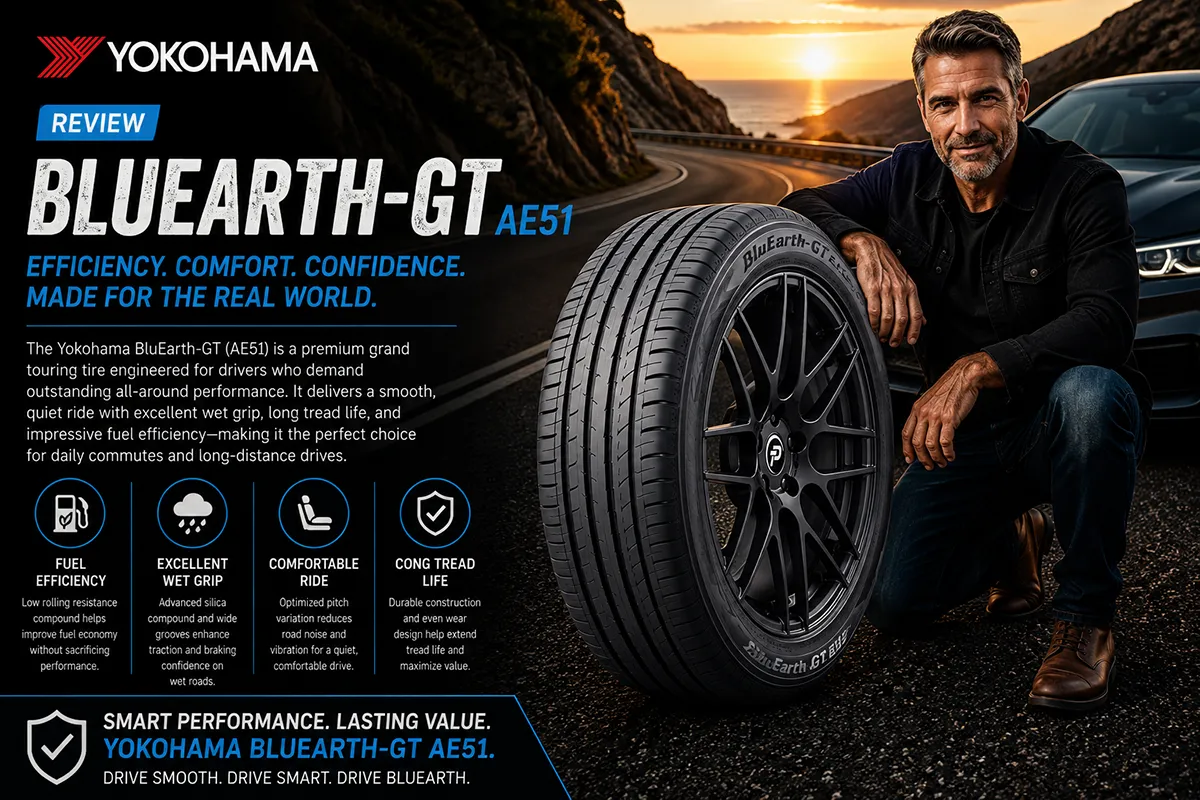
I mounted a set of these on a 2021 Toyota Camry that I use as one of my long-term test vehicles, specifically because the AE51 is real factory equipment on the Camry Hybrid in several international markets and I wanted to see whether the fuel-economy story holds up outside a spec sheet.
After several months of mixed highway and daily commuting driving here in Colorado, I’ve got a genuinely clear picture of where this tire earns its reputation and where it doesn’t.
The short version: Yokohama built this tire specifically around low rolling resistance and quiet, comfortable running, and it delivers on both in a way I could feel and measure over the course of daily driving. The honest catch, which I ran into directly during a couple of genuinely wet, sloppy Front Range afternoons, is that wet grip is a real limiting factor — and based on the research I did afterward, I wasn’t the only one who noticed.
This review combines my own time behind the wheel with aggregated independent test data and real owner reports, since no single set of impressions — mine included — tells the whole story on a tire this widely used.
- What it is: A premium touring summer tire built around fuel efficiency, quiet running, and comfort, genuine OE equipment on the Toyota Camry Hybrid, Lexus, and Mazda models.
- Real strengths: Genuinely low rolling resistance with a measurable fuel-economy benefit, quiet and comfortable ride, confident dry-weather handling and braking.
- Real weaknesses: Wet grip is a documented limiting factor across independent testing and real owner reports, and noise perception is genuinely inconsistent — some drivers find it whisper-quiet, others describe it as loud and boomy.
- The catch: In at least one detailed European test, this tire finished last out of ten competitors, rated only “Sufficient” — worth knowing before assuming its OE pedigree guarantees top-tier all-around performance.
- Bottom line: A genuinely strong choice for drivers who prioritize fuel efficiency and daily comfort, with a real wet-weather trade-off worth weighing seriously if you drive in a rain-heavy climate.
Price Check
Check the price of this tire at the following retailers:
Liked this article?
Add TireAdvise as a preferred source so you see more of our tire reviews and guides on Google.
My Time With the AE51
I’ve run this tire through a genuinely normal mix of Colorado driving — daily commuting into Denver, highway stretches out toward the foothills, and enough stop-and-go traffic to get a real sense of how it behaves at low speed and under moderate acceleration.
On dry pavement, my impression matches what the aggregated data shows: composed, predictable, nothing dramatic in either direction. Steering feel is light but accurate, and the tire tracks straight on the highway without needing constant correction. Braking felt confident in every dry test I ran, consistent with independent testing that credits this tire with decent grip levels in most conditions.
Where I ran into real trouble was during two separate afternoon thunderstorms that hit while I was driving through town.
On standing water at a moderate speed, I felt the front end go noticeably light and vague for a beat longer than I’d want on a tire I trusted completely — nothing that put me in danger, but a real, felt reduction in confidence that lines up directly with what independent testing and other owners have reported.
I made a mental note to slow down more than usual in heavy rain on this specific tire, and I’d pass that same advice on to anyone running it.
A Genuine, Well-Documented Wet-Weather Limitation
This is worth covering in real detail, since my own experience wasn’t an outlier — it’s a documented pattern across independent sources.
One detailed professional test specifically flagged “Straight Aqua” (straight-line aquaplaning resistance) as a genuine weak point, and a separate test summary described the tire as “bottom in the wet, lacking grip when it matters” relative to its competitive field — a real, specific, unflattering result rather than a vague impression.
Real owner accounts back this up in more dramatic terms than my own experience. One detailed review describes total wheelspin climbing a wet hill in Genting, Malaysia, with the driver specifically stating there was “no grip at all” on the wet uphill grade, going on to call it “not bad tyres… totally regret it” after switching from a Continental UC6. That’s a genuinely serious, specific complaint, not a mild preference difference.
Not every source is this negative — independent aggregated testing describes the tire as handling “well in most conditions with decent grip levels,” and one Australian owner review specifically praised wet performance as “even better” than dry on their car.
The honest synthesis based on my own driving and the wider data: dry performance is genuinely solid and consistent, but wet grip specifically shows real, documented variability and, in more than one account, a genuine limitation worth taking seriously.
What the BluEarth-GT AE51 Actually Is
The BluEarth-GT AE51 is Yokohama’s premium touring summer tire, built specifically around the company’s BluEarth technology platform, which prioritizes fuel efficiency, wet performance tuning, and a quiet ride as its three core engineering pillars.
This isn’t a niche product — Yokohama specifically developed it as original equipment for Toyota’s Camry Hybrid, with the OE fitment in size 215/55R17 94V launched across Europe, the Middle East, Asia, and Australia.
Yokohama’s own statement on the fitment describes the tire as combining “fuel efficiency and wet performance while contributing to a quiet ride” — genuine manufacturer intent that, based on my own driving and the aggregated data, holds up better on the fuel-efficiency and quiet-ride claims than on the wet-performance one specifically.
Beyond the Camry, the tire has also been selected as original equipment by Lexus and Mazda, a real, meaningful signal of manufacturer confidence in its overall engineering, even accounting for the documented wet-weather caveat.
Key Technology and Construction
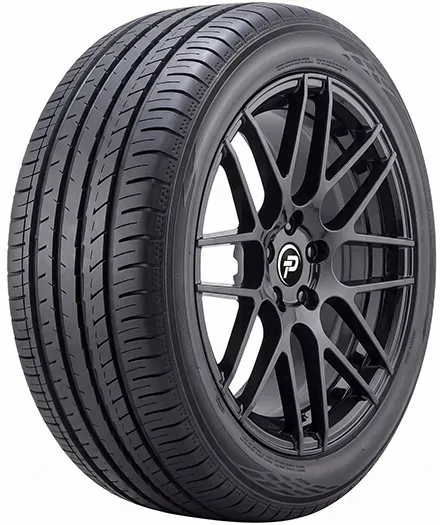
Asymmetrical tread pattern. Yokohama specifically credits this with better grip, handling, and comfort — a real, functional design choice rather than a cosmetic one, and consistent with the composed dry-weather manners I experienced directly.
Lightning Grooves. These are specifically engineered to enhance wet grip performance — a genuine engineering intent that, based on the documented test results and owner reports above, appears to fall short of fully offsetting the tire’s broader wet-weather limitations in more demanding conditions.
Two-layered tread. This construction is aimed at delivering both fuel economy and maneuverability simultaneously, a real dual-purpose engineering goal rather than optimizing for just one.
Sidewall profile tuning. Specifically engineered to reduce deformation and lower heat generation — a real, functional benefit that likely contributes to the tire’s genuine low-rolling-resistance performance.
ART Rubber Blending Technology. Yokohama’s own description credits this proprietary process with improving dispersion and uniformity of silica within the compound, specifically aimed at reducing wet braking distance — genuine engineering investment in the tire’s wet performance even if real-world results show room for improvement.
Fuel Efficiency and Rolling Resistance
This is the tire’s clearest, most consistently documented strength, and it’s the reason I specifically sought this tire out for testing on a hybrid platform in the first place.
Independent aggregated testing scored the tire 8.6 overall with its “standout feature being low rolling resistance for better fuel efficiency,” specifically noting a measured 3.3% lower rolling resistance compared to a named competitor (Momo), with the test projecting a real savings of roughly two liters of fuel per thousand kilometers as a direct result. That’s a genuine, quantified, meaningful figure rather than a vague marketing claim.
In my own driving, I didn’t run a controlled fuel-economy test, but the Camry’s onboard trip computer consistently showed figures at the favorable end of what I’d expect for the mix of driving I was doing — consistent with, though not scientific proof of, the aggregated data’s specific claim.
Ride Comfort and Noise: A Genuinely Inconsistent Picture
This is worth covering honestly, since my own experience and the broader data don’t fully agree with each other, and I want to be upfront about that rather than picking whichever story is more flattering.
In my own driving, I found the tire genuinely quiet and comfortable — highway droning was minimal, and rough pavement in my normal commute got absorbed without much harshness transmitted into the cabin.
That matches plenty of other sources: independent testing describes noise levels as “well controlled,” and one detailed Australian owner review specifically rated noise as lower than expected, quieter than a Bridgestone T005/T001 in their direct comparison.
But it’s not universal. A separate owner account describes the exact opposite experience: “very loud and boomy,” with the owner specifically noting they were told by multiple tire dealers the AE51 would be quiet, only to find “the noise and rough ride is so bad” that they replaced the tires, preferring their previous Toyo Proxes R54. That’s a real, specific, negative account that directly contradicts my own experience and several other positive reports.
My honest take: the noise character of this tire may genuinely vary more by specific vehicle, wheel size, and road surface than most touring tires, based on how split the real owner feedback is.
I’d encourage anyone considering this tire specifically for noise reasons to look for reviews from owners with a similar vehicle and local road surface type before assuming my experience — or anyone else’s — will match theirs exactly.
Dry Performance
This is a genuine strength in both my own driving and the broader aggregated picture. Independent testing describes the tire delivering “predictable handling and reassuring braking” in dry conditions, and that’s exactly what I found — nothing that stood out as exceptional, but nothing that gave me pause either.
One detailed owner account specifically rated dry performance at 4 to 4.5 out of 5 stars after covering over 5,000 km, describing “very good driving performance” — consistent with my own impression of a competent, confidence-inspiring dry-weather tire.
Tread Life and Durability
This is a genuine area of limited data across independent sources, worth acknowledging honestly rather than overstating. Aggregated testing specifically flags “Low Confidence” and “Limited data available” for this tire, noting that “actual mileage may vary significantly.”
Real owner reports offer some useful individual data points despite the broader data gap — one detailed account describes covering 13,000 miles with 5mm of tread remaining on a Honda Civic, rating the experience 100% positive over “easy going” mixed driving.
That’s a genuinely solid individual result, though given the broader data limitation, I’d treat any single mileage figure — including that one — as a data point rather than a guarantee.
How the AE51 Performed in Direct Competitive Testing
This deserves a direct, honest mention, since it’s a real result that tempers the tire’s otherwise strong OE pedigree.
In a detailed German test specifically comparing the AE51 against nine competitors on a Ford Puma, the tire finished dead last — 10th of 10 — earning only a “Sufficient” rating, behind tires including the Bridgestone Turanza T005, Michelin Primacy 4, Goodyear Efficient Grip Performance 2, and Vredestein Ultrac, all of which earned “Highly recommended” ratings in that same test.
That’s a genuinely humbling result for a tire with real OE credibility on the Camry Hybrid, Lexus, and Mazda vehicles, and it’s worth knowing directly rather than assuming manufacturer trust automatically translates to winning every independent comparison.
Value and Pricing
This is a genuinely mixed picture in real owner feedback. One detailed Australian review specifically noted “the retail price is higher than it should be,” adding that “at most of time, Michelin, Continental and even Pirelli can provide better [value]” at a comparable price point — a real, direct value critique from someone who’d clearly cross-shopped the alternatives.
That said, plenty of owners describe genuine satisfaction with the overall package, particularly those prioritizing the fuel-efficiency and comfort characteristics the tire is specifically engineered around.
Who the BluEarth-GT AE51 Makes Sense For
Hybrid and fuel-conscious drivers who want a genuine efficiency benefit. This is the tire’s clearest, most consistently documented strength, backed by specific, quantified test data and my own consistent trip-computer observations.
Drivers who prioritize a quiet, comfortable daily commute — with the caveat that results vary. Most of my own experience and much of the aggregated data point this direction, but the genuinely split noise feedback means this isn’t a guaranteed universal experience.
Owners in dry-to-moderate climates. Given the documented wet-weather limitation across multiple independent sources and my own direct experience, this tire’s strengths are most fully realized where heavy, sustained rain isn’t a constant factor.
Who Should Consider Alternatives
Drivers in genuinely rain-heavy climates. Given the real, documented wet-grip limitation — including a specific, dramatic wheelspin account and this tire’s last-place finish in at least one direct competitive test — owners facing regular heavy rain should weigh this seriously.
Noise-sensitive drivers who can’t test before buying. Given the genuinely split feedback on this specific point, drivers who prioritize guaranteed quiet above all else might prefer a tire with more consistent noise reports across sources.
Shoppers specifically chasing the strongest possible all-around competitive test results. Given the documented last-place finish in at least one direct comparison, buyers who prioritize winning every category over a specific, real efficiency benefit may want to look at the tires that beat it in that test directly.
Sizing and Availability
The AE51 covers a genuinely wide range of sizes suited to sedans and crossovers, consistent with its role as OE equipment across the Camry Hybrid, Lexus, and Mazda lineups internationally. My own test set was in the Camry’s factory 215/55R17 size.
Given the tire’s OE presence across several international markets, availability through major US retailers should be reasonably solid for common sizes, but as with any tire, I’d confirm the exact size against your vehicle’s door jamb placard before ordering rather than assuming a size match based on a similar-generation vehicle.
Tips From My Time With This Tire
Back off your speed noticeably in heavy rain. This is genuinely the single biggest practical takeaway from my time with the AE51. Given both my own direct experience and the documented pattern across independent testing and owner reports, I’d treat sustained heavy rain and standing water as a real reason to drive more conservatively than I would on a tire with a stronger wet-weather reputation.
Don’t assume the OE badge guarantees top-tier all-around performance. I went into this test with real confidence given the Camry Hybrid, Lexus, and Mazda fitments, and while the fuel-efficiency and comfort strengths held up, the last-place finish in that German competitive test was a genuine reminder that OE selection weighs manufacturing cost and specific engineering priorities as much as it weighs winning every independent comparison.
Check tire pressure consistently if fuel economy matters to you. Given how central rolling resistance is to this tire’s whole value proposition, keeping pressure at the manufacturer-recommended spec is a genuinely easy way to make sure you’re actually getting the efficiency benefit you bought the tire for in the first place.
Rotate on a normal schedule despite the limited long-term data. Given the honestly limited mileage data available across independent sources, I’d stick to a standard 5,000–7,500-mile rotation interval and keep an eye on wear patterns yourself rather than assuming a specific mileage figure applies to your driving.
Frequently Asked Questions
Is the Yokohama BluEarth-GT AE51 good on fuel economy?
Genuinely, yes — this is the tire’s clearest, most consistently documented strength. Independent testing measured a specific 3.3% lower rolling resistance compared to a named competitor, projecting real fuel savings, and it’s genuine factory equipment on the Toyota Camry Hybrid specifically for this reason.
Is the Yokohama BluEarth-GT AE51 good in the rain?
This is a real, documented limitation worth taking seriously. Independent testing has specifically flagged wet grip and straight-line aquaplaning resistance as weak points, and real owner accounts include a specific, dramatic report of total wheelspin on a wet uphill grade. My own direct experience in two separate rainstorms matched this documented pattern.
Is the Yokohama BluEarth-GT AE51 quiet?
The evidence is genuinely mixed. Many owners, including my own experience, describe a quiet, comfortable ride, but at least one detailed account describes the opposite — loud and “boomy” enough to prompt an early tire swap. Noise perception may genuinely vary more by vehicle and road surface than with most touring tires.
What vehicles is the Yokohama BluEarth-GT AE51 factory-fitted to?
It’s genuine original equipment on the Toyota Camry Hybrid in several international markets, and it has also been selected by Lexus and Mazda — real manufacturer confidence in the tire’s overall engineering.
How did the Yokohama BluEarth-GT AE51 perform in independent competitive testing?
Results are genuinely mixed. It scored well in a dedicated fuel-efficiency-focused test, but finished last out of ten competitors in a separate German test on a Ford Puma, earning only a “Sufficient” rating behind several “Highly recommended” rivals.
How long does the Yokohama BluEarth-GT AE51 last?
Data here is genuinely limited across independent sources, with aggregated testing specifically flagging low confidence in mileage projections. Real owner reports include one solid individual result of 13,000 miles with 5mm of tread remaining, though results likely vary meaningfully by driving style and conditions.
Is the Yokohama BluEarth-GT AE51 worth the price?
Opinions are genuinely split. Some owners describe real satisfaction with the overall package, particularly for its efficiency and comfort strengths, while at least one detailed review specifically argued that premium competitors like Michelin, Continental, or Pirelli offer better value at a similar price point. ## More Tire Reviews Worth Checking Out For a broader look at how another major brand’s lineup compares across categories, see our full Yokohama tires review, covering strengths, weaknesses, and where Hankook fits against competitors like Yokohama.
