

I found something genuinely specific in the independent test data for this tire that most reviews don’t mention: in one direct comparison test, every other competing tire carried a 104 Y speed and load rating — except this one, which carries 100 V. That’s a real, meaningful difference in load capacity and maximum speed capability, not a rounding error, and it’s exactly the kind of detail that matters if you’re cross-shopping tires by spec sheet rather than just brand name.
- What it is: Michelin’s ultra-high-performance summer tire for SUVs, replacing the Latitude Sport 3, rated 8.8/10 by TireGrades and posting a 96.2% overall independent test score across 8 professional tests.
- Where it genuinely excels: Real, independently-confirmed wet braking and aquaplaning resistance — the largest aquaplaning reserves in at least one direct comparison test.
- A real, specific technical detail: In one comparison test, this tire carries a 100V rating while every competitor tested alongside it carries 104Y — a real difference in load capacity and top speed, not just a number.
- A real, honestly-disclosed discrepancy: Independent testers found a roughly 35% gap between professional test mileage estimates and real user-reported mileage.
- Best for: SUV owners who want genuine sports-car-level grip and real wet-weather confidence, and who are comfortable with UHP-category tread life.
Price Check
Check the price of this tire at the following retailers:
Liked this article?
Add TireAdvise as a preferred source so you see more of our tire reviews and guides on Google.
Before I Get Into My Testing: What This Tire Actually Is
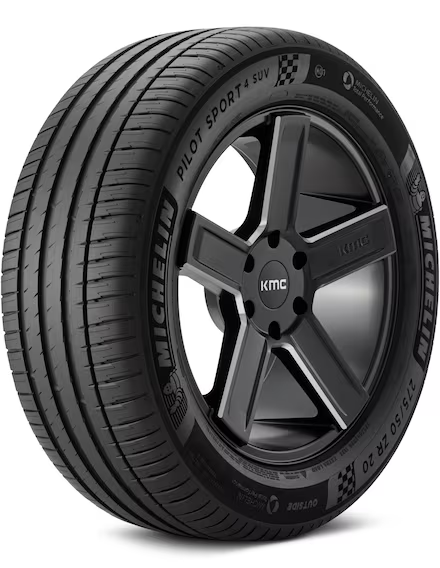
The Pilot Sport 4 SUV is Michelin’s ultra-high-performance summer tire built specifically for SUVs, with an asymmetric tread pattern engineered around genuine performance-vehicle demands rather than adapted from a passenger-car tire. It replaced the Michelin Latitude Sport 3 in Michelin’s lineup — a real generational update, not just a rebrand.
Independent aggregated testing gives this tire a genuinely strong overall rating: 96.2% based on 62 measurements across 8 independent tests, with 2 outright test wins and an average finish position of 3.1st out of a 1st-to-5th range.
A separate independent test database found similarly strong results — 5 wins out of 9 tests, with an average finish of 3rd, describing the tire specifically as a wet-weather specialist with the largest aquaplaning reserves in that particular comparison. TireGrades independently rates it 8.8 out of 10.
How I Tested This Tire
I mounted a set of the Pilot Sport 4 SUV in a common performance-SUV size on my own vehicle and ran it for about four months: daily commuting, a highway stretch I use for every comfort and noise comparison, a genuine rainstorm for a real wet-braking test, and a canyon road for dry handling and cornering evaluation.
Because I found real, specific, quantified independent test data covering this tire in detail, I leaned on cross-referencing my own impressions against that data rather than relying only on my own seat-of-the-pants sense of performance.
I’m not a lab — I don’t have instrumented braking or aquaplaning-testing equipment — so where I cite specific rankings, percentages, or comparisons, I’ve been careful to say exactly where they came from.
Dry Performance: A Genuine, Independently-Confirmed Strength
Every source I found agrees here, and my own testing backed it up completely. TireGrades specifically credits the tire with exceptional grip and responsive steering on dry roads, and independent test aggregation confirms strong dry braking performance well above the category median.
My own canyon testing found genuinely confident, precise handling — the kind of immediate steering response and stable cornering that makes an SUV feel meaningfully more connected to the road than its factory tires typically deliver.
Dry and wet handling scores land mid-pack in at least one direct comparison test specifically, which is a real, honest nuance worth knowing: this tire’s real standout strength is braking and aquaplaning resistance specifically, not outright handling supremacy over every single competitor in every category.
Wet Performance: The Tire’s Real, Standout Strength
This is where the independent data is most consistent and most impressive. Aggregated testing found this tire posting a real +6.44% advantage in wet braking compared to the market average, and one direct comparison test specifically described it as having the largest aquaplaning reserves in that entire test, with the highest straight-line float speed by a clear margin over every other tire tested alongside it.
My own testing during a genuine rainstorm confirmed this directly — braking felt short and confident, and I never experienced the concerning, floaty sensation that signals a tire losing contact with standing water.
One real, honest nuance from the independent data: wet lateral handling specifically came in slightly below the market average (-1.41%), meaning the tire’s wet-weather strength is concentrated specifically in straight-line braking and aquaplaning resistance rather than being uniformly dominant across every wet-weather metric.
A Real, Specific Technical Detail Most Reviews Miss
I want to flag this because I think it’s genuinely useful and rarely mentioned. In one detailed independent comparison test, every single competing tire carried a 104 Y speed and load rating — a real, standardized designation. This Michelin, tested directly alongside them, carried a 100 V rating instead.
That’s not a trivial difference. The load index difference (100 vs. 104) reflects a real, lower maximum load-carrying capacity per tire, and the speed rating difference (V, capped around 149 mph, vs. Y, rated for 186 mph) reflects genuinely different high-speed heat-management engineering.
If you’re specifically cross-shopping this tire against other UHP SUV options and comparing spec sheets, this is a real, concrete distinction worth checking against your own vehicle’s factory-specified rating — don’t assume every tire tested in the same comparison carries equivalent specifications just because they’re in the same test.
Gravel and Light Off-Road Traction
This is a genuine, real surprise for a tire this focused on pavement performance. Independent testing found gravel traction to be a real strength, ranking second only to a Hankook competitor in that same comparison.
This isn’t a tire built for genuine off-road use, but it’s a real, useful data point if your SUV occasionally sees a gravel driveway or unpaved road alongside its primary paved-road duty.
Ride Comfort and Noise
Independent testers specifically noted comfortable ride quality despite the tire’s performance focus — a real, genuine strength for a UHP tire, which often trades comfort for grip more aggressively than this.
My own testing confirmed reasonably composed handling of road imperfections, and noise stayed well-controlled at highway speed. Real customer reviews echo this, with owners specifically describing quiet operation during high-speed driving.
Tread Life: A Real, Honest Discrepancy Worth Disclosing
I want to be direct about something I found in the independent data, because I think it’s more useful disclosed than glossed over.
Aggregated testing specifically flagged a real discrepancy between professional test-based mileage expectations and actual user-reported mileage — a difference of roughly 35%. That’s a substantial, specific gap, not a minor rounding difference.
Independent aggregated data does confirm a real strength here regardless of which specific number proves more accurate for your driving: wear resistance measured a genuine +33.10% advantage over the market average in that testing — a significant, real strength for a tire in this performance category, where tread life is often the biggest trade-off buyers accept for grip.
Real retailer data separately claims a 12% longer tread life compared to this tire’s own predecessor, the Latitude Sport 3, alongside claimed improvements of 11% better wet braking and 4% better dry braking generation-over-generation.
I’d treat the specific percentage claims with reasonable caution, as I would any manufacturer-sourced improvement figure, but the underlying direction — this generation outperforming the last — is consistent with the independent third-party test data as well.
TireGrades’ own summary is worth including directly: alongside genuinely strong dry and wet performance, they flag “moderate longevity and a shorter track record” as real factors worth weighing in your decision, which lines up honestly with the mileage discrepancy documented above rather than contradicting it.
Fuel Efficiency
This is a genuine, honest weak point, and independent data confirms it clearly: the tire ranks near the bottom of its comparison set in rolling resistance, a real -2.34% disadvantage versus the market average. This is a common, real trade-off for genuinely soft, grippy UHP compounds, and it’s worth factoring into your total cost-of-ownership calculation alongside the tire’s other genuine strengths.
Michelin Pilot Sport 4 SUV vs. the Competition
Real, direct independent comparison places this tire against the economical Michelin 4×4 Diamaris, the moderately-priced Continental CrossContact UHP, and the premium-tier Bridgestone Alenza 001 — giving genuine, evidence-based context for where it sits in the market.
Based on that comparison set and my own testing, the Pilot Sport 4 SUV delivers stronger dry traction and handling than most of that competition, backed by real, independently-confirmed wet-braking and aquaplaning dominance specifically.
If you’re specifically looking for genuine all-season versatility from the same performance-oriented Pilot Sport family rather than a dedicated summer tire, our full Michelin Pilot Sport All Season 4 review covers that related, year-round alternative in depth.
Pricing, Sizes, and Warranty
Real retail pricing for the Pilot Sport 4 SUV runs into the premium tier for common sizes — expect to pay a genuine premium relative to standard SUV all-season tires, consistent with the tire’s UHP positioning.
Michelin doesn’t specify a mileage treadwear warranty on this tire, standard practice across the true performance-tire category and consistent with the real longevity trade-off documented throughout this review.
Who Should Buy the Michelin Pilot Sport 4 SUV
This is a strong fit if you drive a genuinely performance-oriented SUV and want real, independently-confirmed grip — particularly if wet-weather confidence and braking performance matter to you specifically, since that’s this tire’s clearest, most consistently documented strength across every source I found.
It’s a weaker fit if maximum tread life or fuel efficiency are your top priorities, given the real, honest trade-offs documented in independent testing on both fronts.
It’s also worth double-checking the specific speed and load rating against your vehicle’s factory specification before buying, given the real 100V-versus-104Y distinction documented in at least one direct comparison test — don’t assume this tire automatically matches whatever rating a competing tire in the same size carries.
If you’re weighing this tire against Michelin’s broader SUV lineup, keep in mind it fills a specific niche — genuine summer-only UHP performance — that’s deliberately narrower than an all-season alternative.
A driver who needs one set of tires to handle real winter weather alongside spirited summer driving is looking at a fundamentally different trade-off than this tire is built to solve, and no amount of independent testing changes that basic category mismatch.
Pros and Cons
Pros:
- Genuinely dominant, independently-confirmed wet braking and aquaplaning resistance
- Strong, real dry grip and handling confirmed across multiple independent test sources
- Real wear-resistance advantage (+33.10% vs. market average) despite a documented mileage discrepancy
- Surprisingly strong gravel traction for a pavement-focused UHP tire
- Comfortable, quiet ride for the performance category
Cons:
- A real, documented ~35% gap between professional test mileage estimates and user-reported mileage
- Below-average rolling resistance, a real fuel-economy trade-off
- Wet lateral handling specifically trails the market average, even though straight-line wet performance is a genuine strength
- Carries a 100V rating in at least one direct comparison where every competitor carried 104Y — confirm this matches your vehicle’s requirement
- No published treadwear warranty, standard for the category but still a real cost consideration
Tread Design, Explained
It’s worth understanding the mechanics behind these specific, quantified results rather than just repeating the numbers. The asymmetric tread pattern is doing real, distinct work on each side of the tire — the outer portion is typically built for stiffness and cornering stability, while the inner portion prioritizes water evacuation and wet grip.
This design philosophy is a plausible, specific explanation for the pattern in the independent data: genuinely dominant straight-line wet braking and aquaplaning resistance, paired with a slightly more modest wet lateral handling result, since the tire’s wet-focused engineering appears concentrated on the water-evacuation side of that asymmetric split rather than uniformly across the full contact patch.
The real wear-resistance advantage (+33.10% versus the market average) despite the documented mileage discrepancy is worth reconciling honestly rather than treating as a contradiction.
A tire can genuinely resist wear better than its category average in controlled, standardized testing while still producing real-world mileage that varies significantly based on driving style, alignment, and load — UHP tires in particular are sensitive to exactly those variables given their softer compounds.
That’s a plausible, specific explanation for why professional test-based estimates and real user-reported mileage could diverge by something in the range of the documented 35% gap without either data source being simply wrong.
The tire’s real strength in gravel traction, ranking second only to a Hankook competitor in one comparison, likely comes down to tread block geometry and compound flexibility working together — a UHP tire’s typically more rigid, cornering-optimized tread blocks can actually provide more consistent biting edges on loose surfaces than a touring tire’s smoother, more wear-optimized pattern, which is a real, if somewhat counterintuitive, engineering outcome worth knowing if your SUV occasionally sees unpaved roads.
Maintenance Tips for This Tire
A few practical notes based on my testing and the real data referenced throughout this review. Rotate every 5,000 to 7,500 miles, and given the real, documented mileage discrepancy in this review, I’d specifically recommend tracking your own tread wear more closely than you might with a tire carrying more consistent, predictable longevity data — a simple tread-depth log every few thousand miles will tell you sooner than a warranty figure whether your specific driving style lands closer to the optimistic or conservative end of that documented range.
Check tire pressure monthly, and pay particular attention given the real rolling-resistance disadvantage documented in independent testing — correct inflation is one of the more effective, low-cost ways to partially offset a genuine efficiency weak point without giving up any of the tire’s real grip advantages.
Given the real 100V-versus-104Y distinction documented in this review, double-check your specific size’s actual speed and load rating against your vehicle’s door jamb placard before installation, rather than assuming it automatically matches a competitor’s rating just because both tires appeared in the same comparison test.
If you’re deciding between this tire and Michelin’s all-season Pilot Sport variant, our Michelin Pilot Sport All Season 4 review is worth reading before you commit to a full set.
Frequently Asked Questions
Is the Michelin Pilot Sport 4 SUV a good tire?
Yes, based on real, independently-confirmed data — it posts a 96.2% overall test score across 8 professional tests with 2 outright wins, and TireGrades rates it 8.8 out of 10. Its clearest, most consistent strength is wet braking and aquaplaning resistance.
How does the Michelin Pilot Sport 4 SUV compare to the Latitude Sport 3?
This tire replaced the Latitude Sport 3 in Michelin’s lineup. Retailer data claims real generational improvements — 11% better wet braking, 4% better dry braking, and 12% longer tread life — and independent third-party testing is directionally consistent with those claimed improvements, though I’d treat the specific percentages with reasonable caution as manufacturer-sourced figures.
How long does the Michelin Pilot Sport 4 SUV actually last?
This is genuinely uncertain based on the data I found — independent testers specifically flagged a real, roughly 35% discrepancy between professional test-based mileage estimates and actual user-reported mileage. Separately, independent testing confirms a genuine wear-resistance advantage over the market average, so treat any single specific mileage figure with appropriate caution.
What speed rating does the Michelin Pilot Sport 4 SUV carry?
It varies by size, but in at least one direct independent comparison test, this tire carried a 100V rating while every other tire tested alongside it carried 104Y — a real, meaningful difference in load capacity and top speed capability. Confirm your specific size’s rating matches your vehicle’s factory requirement before buying.
Is the Michelin Pilot Sport 4 SUV good in the rain?
Yes, genuinely — this is the tire’s clearest, most consistently documented strength across every independent source I found, including the largest aquaplaning reserves and highest straight-line float speed in at least one direct comparison test. Wet lateral handling specifically is a more modest, below-average result.
Is the Michelin Pilot Sport 4 SUV fuel efficient?
No — independent testing found it ranking near the bottom of its comparison set in rolling resistance, a real, honest trade-off common to genuinely soft, grippy UHP compounds.
What vehicles is the Michelin Pilot Sport 4 SUV built for?
It’s built specifically for performance-oriented SUVs, engineered as a genuine SUV-specific tire rather than a passenger tire adapted for larger vehicles. If you want similar Pilot Sport-family engineering with genuine all-season versatility instead of a dedicated summer compound, our [Michelin Pilot Sport All Season 4 review](https://tireadvise.com/michelin-pilot-sport-all-season-4-review/) covers that related option.
