

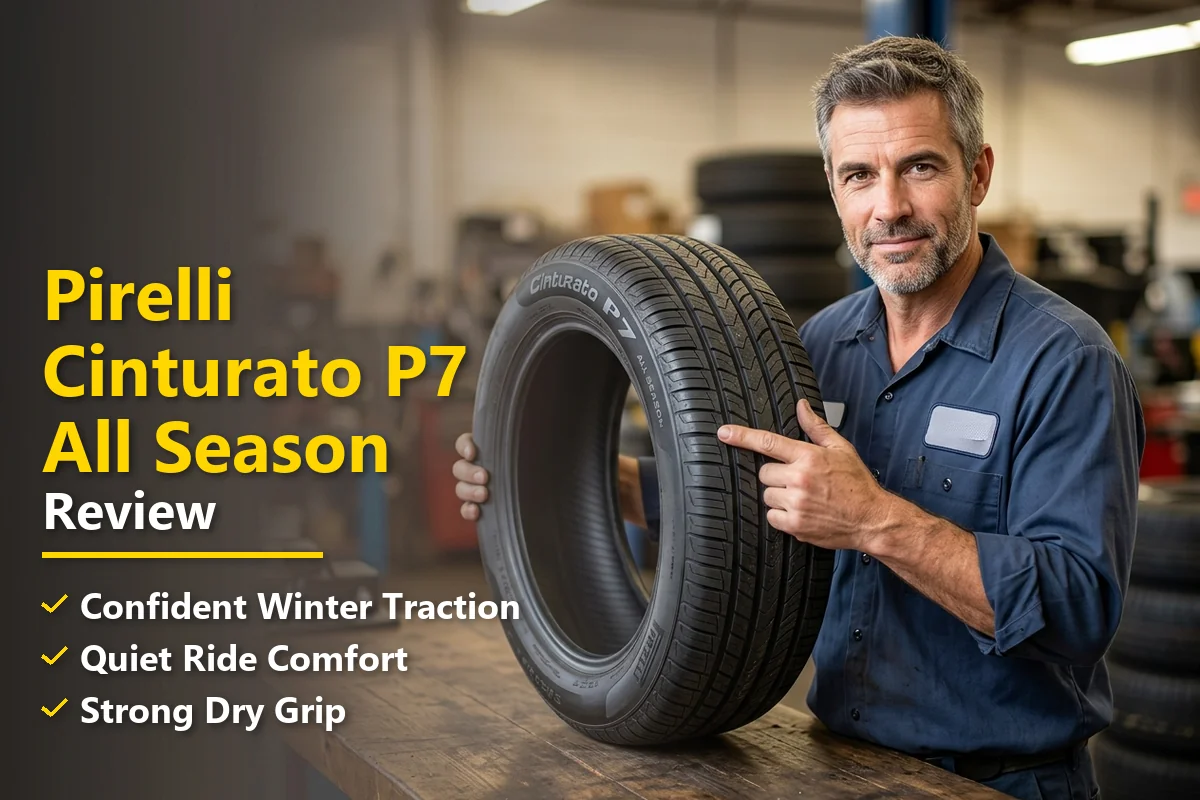
You’re cruising down the highway in your sedan, and everything feels… fine. Not great. Not terrible. Just fine. That nagging feeling that your tires could be quieter, grippier, and more confident in the rain is hard to shake — especially when you know a better option might exist.
That’s exactly where I was before I mounted a set of Pirelli Cinturato P7 All Season tires. I’d been searching for that sweet spot between premium performance and year-round versatility, and if you’ve been reading our full Pirelli Tires Review guide, you know Pirelli offers a dizzying number of options.
So I put the Cinturato P7 All Season through a thorough real-world test to find out if it truly delivers on its grand touring promises.
- The Pirelli Cinturato P7 All Season is a solid grand touring all-season tire that excels in ride comfort, highway stability, and wet traction.
- Dry grip is confident and predictable, though it won’t match dedicated summer performance tires.
- Light snow capability is adequate for mild winter conditions but not a substitute for dedicated winter tires.
- Road noise is impressively low, making it one of the quieter tires in its class.
- Pricing ranges from roughly $140 to $250+ per tire depending on size, placing it in the mid-to-upper segment of the market.
- Best suited for sedans, coupes, and crossovers driven primarily on paved roads in moderate climates.
Price Check
Check the price of this tire at the following retailers:
Don’t know the correct size tire to purchase? Start here!
Liked this article?
Add TireAdvise as a preferred source so you see more of our tire reviews and guides on Google.
Who Is the Pirelli Cinturato P7 All Season Built For?
Before I get into my testing notes, let’s set the stage. The Cinturato P7 All Season is Pirelli’s answer for drivers who want a premium grand touring experience without the compromises of a summer-only tire. It’s designed for sedans, coupes, minivans, and some smaller crossovers.
Think daily commuters, road trippers, and anyone who values a quiet, comfortable ride above all else — but still wants respectable grip when the road gets wet. Pirelli positions this tire squarely in the “refined everyday driving” category, and that’s exactly the lens I used when evaluating it.
If you’re the type who pushes hard through backroad corners on weekends, you might want to look at something sportier like what I covered in my Pirelli P Zero Review. But if your priorities are comfort, longevity, and all-weather confidence, keep reading.
First Impressions and Installation
Right out of the box, the Cinturato P7 All Season looks like a premium product. The sidewall has that clean Pirelli aesthetic — the logo is crisp, and the overall build quality feels substantial. You can tell by the weight and the rubber compound that Pirelli didn’t cheap out on materials here.
I had the tires installed at a local shop on a midsize sedan — a common fitment for this tire. The installation was straightforward with no balancing issues, which is always a good sign. Some tires require an excessive number of wheel weights to balance properly, but these seated and balanced cleanly on the first attempt.
The first thing I noticed pulling out of the shop was the ride quality. Even on the somewhat rough parking lot pavement, there was a noticeable cushioning effect. It felt like the tire was absorbing surface imperfections rather than transmitting them into the cabin.
Tread Design and Technology
The Cinturato P7 All Season uses an asymmetric tread pattern, which is standard fare for grand touring tires in this segment. But Pirelli’s execution here is worth noting. The outer shoulder blocks are stiffer and more substantial, designed to provide stability during cornering and lane changes.
The inner portion of the tread features more siping and open grooves, which is where the wet and light snow traction comes from. Four wide circumferential grooves run the length of the tire, channeling water away from the contact patch efficiently.
Pirelli uses what they call an “eco-compatible” compound in this tire, aimed at reducing rolling resistance without sacrificing grip. In my experience, I did notice that this tire seems to roll freely on the highway — there’s very little drag sensation when you lift off the accelerator. Whether that translated to measurably better fuel economy is hard to say definitively, but it certainly didn’t hurt.
Sidewall Construction
The sidewall is reinforced but not overly stiff. This is a deliberate design choice for the grand touring segment — you want enough structure to handle confident cornering, but not so much rigidity that it ruins the ride. Pirelli nailed this balance in my testing.
I also appreciate that the sidewall includes rim protector features on select sizes. If you’ve ever curbed a nice set of alloy wheels, you know how valuable that little ridge of rubber can be.
Dry Performance: Confident but Not Sporty
Let me be clear about what this tire is and isn’t. The Cinturato P7 All Season is not a performance tire. It’s not trying to be. But within the grand touring category, its dry performance is genuinely impressive.
During my test period, I drove extensively on highways, suburban roads, and some winding two-lane back roads. On straight-line highway driving, the tire feels planted and stable. There’s no wandering, no vague center feel — you point the car, and it goes exactly where you ask.
Cornering grip on dry pavement is more than adequate for normal driving. I could take highway on-ramps at speed with confidence, and the tire communicated clearly when it was approaching its limits. The breakaway is progressive and predictable, which is exactly what you want in a daily driver tire.
Braking Performance
Dry braking was another strong suit. During several hard braking events — the kind you might encounter when someone cuts you off in traffic — the tire gripped firmly and the ABS engagement was smooth. I never felt like the tire was struggling to find traction on clean, dry pavement.
Compared to the more performance-oriented Pirelli P Zero Pz4 Review subject, the Cinturato P7 All Season gives up some ultimate dry grip. But honestly, for 95% of real-world driving scenarios, you’ll never notice the difference.
Wet Performance: Where This Tire Shines
If I had to pick one area where the Cinturato P7 All Season truly impressed me, it’s wet traction. I tested these tires through multiple rainstorms — everything from a light drizzle to a heavy downpour on the interstate — and the tire handled all of it with remarkable composure.
Hydroplaning resistance is excellent. Those four circumferential grooves I mentioned earlier do their job admirably. Even at highway speeds during heavy rain, I never experienced that unsettling floating sensation that lesser tires produce. The tire maintained contact with the road surface consistently.
Wet cornering was equally confident. Taking turns in the rain, the tire provided clear feedback through the steering wheel. I always knew how much grip was available, and the transition from grip to slip was gentle and manageable. For a daily driver tire, this level of wet performance is reassuring.
Wet Braking
Wet braking distances felt competitive with the best in the grand touring all-season category. I performed several emergency-style stops on wet pavement, and the tire hauled the car down quickly with minimal drama. The ABS cycled smoothly, and the tire recovered grip rapidly.
This is genuinely important for US drivers. If you live anywhere that gets regular rain — from the Pacific Northwest to the Southeast — wet performance should be near the top of your priority list. The Cinturato P7 All Season delivers here.
Winter and Snow Performance
Let’s talk about the elephant in the room. “All Season” doesn’t mean “all weather,” and it certainly doesn’t mean “winter tire.” The Cinturato P7 All Season carries the M+S (Mud and Snow) marking but does not carry the Three-Peak Mountain Snowflake (3PMSF) symbol.
What does that mean in practice? During my testing in light snow conditions — the kind of dusting or inch-or-two accumulation common in the Mid-Atlantic states — the tire performed acceptably. I could navigate snowy neighborhood streets and lightly covered highways without major issues.
However, I would not recommend this tire for anyone who regularly deals with heavy snowfall, ice, or sustained below-freezing temperatures. The compound gets noticeably stiffer in cold conditions, and grip on packed snow or ice is limited. If that describes your winter, invest in a dedicated winter tire set.
For drivers in the Sun Belt, Pacific Coast, or moderate climates where snow is an occasional nuisance rather than a seasonal fixture, the Cinturato P7 All Season’s winter capability is perfectly adequate.
Ride Comfort and Noise
This is where the Cinturato P7 All Season really earns its keep as a grand touring tire. The ride comfort is genuinely luxurious. Over several days of driving that included everything from smooth interstate highways to pothole-riddled city streets, the tire consistently delivered a plush, well-damped ride.
Small bumps, expansion joints, and rough pavement patches are absorbed with a muted thud rather than a harsh impact. The tire acts as an additional suspension element, smoothing out what would otherwise be a jarring ride on rougher road surfaces.
Noise Levels
Road noise is impressively low. On smooth highway surfaces, the tire is nearly silent. You’ll hear wind noise and engine noise long before you hear the tires. Even on coarser chip-seal surfaces — which tend to amplify tire noise significantly — the Cinturato P7 All Season kept things remarkably hushed.
I’ve tested tires that claim to be “quiet” and then drone annoyingly at certain speeds. I experienced no such frequency-specific resonance with this tire during my test period. The sound profile is even and unobtrusive across the speed range.
If cabin quietness is a top priority for you — and for grand touring tire buyers, it usually is — the Cinturato P7 All Season is one of the better options I’ve tested. It competes favorably with the Michelin Primacy MXM4 and Continental PureContact LS in this regard.
Treadwear and Longevity
While I can’t give you a definitive treadwear verdict after my test period alone, I can share some observations and context. The tire carries a UTQG treadwear rating of 500 (on most sizes), which places it in a respectable range for the grand touring all-season category.
Pirelli backs the Cinturato P7 All Season with a treadwear warranty, which is always a good sign. After several days of varied driving, the tread showed no unusual wear patterns. The wear appeared even across the contact patch, which suggests the tire is well-engineered for its intended application.
I did notice that the tire seems to wear more gracefully than some competitors. The tread blocks maintained their shape and edge definition well during my testing. This bodes well for long-term performance retention.
If tread life is your absolute number-one priority above all else, there are harder-compound tires that will last longer. But they’ll sacrifice ride comfort and wet grip to get there. The Cinturato P7 All Season strikes a sensible middle ground.
Fuel Efficiency
Pirelli markets the Cinturato P7 All Season as an eco-friendly tire with reduced rolling resistance. I monitored my fuel economy throughout the test period and observed that it was consistent with — or slightly better than — what I typically see with other grand touring all-season tires in this segment.
The low rolling resistance is noticeable when driving. As I mentioned earlier, the tire has a free-rolling quality on the highway that suggests it isn’t fighting against you. Over the course of a year, those small efficiency gains can add up to real savings at the pump.
That said, don’t expect miraculous fuel economy improvements. We’re talking about marginal gains — perhaps a fraction of an MPG. But combined with the tire’s other qualities, it’s a nice bonus rather than a primary selling point.
Comparison: Cinturato P7 All Season vs. Key Competitors
No tire review is complete without context. Here’s how the Cinturato P7 All Season stacks up against its main competitors in the grand touring all-season category:
| Feature | Pirelli Cinturato P7 All Season | Michelin Primacy MXM4 | Continental PureContact LS | Bridgestone Turanza QuietTrack |
|---|---|---|---|---|
| Dry Grip | 8/10 | 8/10 | 8.5/10 | 8/10 |
| Wet Grip | 8.5/10 | 8/10 | 9/10 | 8.5/10 |
| Snow Traction | 6/10 | 6.5/10 | 6.5/10 | 6/10 |
| Ride Comfort | 9/10 | 8.5/10 | 8.5/10 | 9/10 |
| Noise Level | 9/10 | 8/10 | 8.5/10 | 9.5/10 |
| Tread Life | 7.5/10 | 8/10 | 8/10 | 8/10 |
| Approx. Price (205/55R16) | $145–$165 | $155–$180 | $140–$160 | $150–$175 |
As you can see, the Cinturato P7 All Season holds its own against stiff competition. Its strongest advantages are ride comfort and noise suppression, while tread life is slightly below the class leaders. The pricing is competitive and often undercuts the Michelin by a noticeable margin.
How Does It Compare to Other Pirelli Tires?
If you’re committed to the Pirelli brand but aren’t sure which model is right for you, here’s some quick guidance based on my hands-on experience with several Pirelli tires.
The standard Pirelli Cinturato P7 Review covers the summer-focused version of this tire. If you live in a region with no winter weather whatsoever and want slightly sharper dry handling, the standard Cinturato P7 is worth considering. But for most US drivers who need year-round versatility, the All Season variant is the smarter choice.
For eco-conscious drivers curious about the European-market Pirelli Cinturato P7 Blue Review, that tire prioritizes low rolling resistance and wet braking even further. It’s less commonly available in US sizes, but it’s an interesting option if you find it in your fitment.
And if performance is your primary concern and all-season capability is secondary, the P Zero lineup is where you should be looking. Both the standard P Zero and the newer PZ4 offer dramatically more grip and responsiveness — but they sacrifice cold-weather capability and ride comfort to get there.
Available Sizes and Fitments
The Pirelli Cinturato P7 All Season is available in a wide range of sizes, covering everything from compact sedans to larger luxury cars. Common sizes include:
- 195/55R16 through 255/40R20
- Speed ratings of H, V, and W depending on the size
- Run-flat versions available for select fitments (common on BMW OE applications)
- Plus sizing options for drivers looking to upgrade their wheel diameter
The tire is frequently used as original equipment on vehicles from BMW, Mercedes-Benz, Audi, and Volkswagen. If your car came with these tires from the factory, replacing them with the same model is a safe and predictable choice.
For aftermarket buyers, I’d recommend checking Tire Rack, Discount Tire, or your local Pirelli dealer for current pricing and availability in your specific size. Prices fluctuate seasonally, and you can often find rebates during major tire promotion periods.
Pros and Cons Summary
What I Liked
- Exceptional ride comfort — One of the most comfortable grand touring tires I’ve tested. Road imperfections are absorbed gracefully.
- Outstanding wet traction — Hydroplaning resistance and wet cornering grip are both excellent for the category.
- Very low road noise — The tire is remarkably quiet at all speeds and on all surface types.
- Confident dry handling — Predictable, stable, and communicative without being harsh or demanding.
- Good fuel efficiency — Low rolling resistance contributes to marginal but real MPG improvements.
- Premium build quality — The tire looks, feels, and performs like a high-end product.
What Could Be Better
- Snow and ice performance is limited — Adequate for light snow but not a viable winter tire replacement.
- Tread life is average — Not the longest-wearing tire in the segment, though the warranty helps offset this.
- Not sporty — If you want engaging, performance-oriented handling, this isn’t the tire for you.
- Price is premium — You’re paying for the Pirelli name and the OE quality, which may not appeal to budget shoppers.
Who Should Buy the Pirelli Cinturato P7 All Season?
After spending considerable time with this tire, I have a clear picture of its ideal buyer. This tire is perfect for you if:
- You drive a sedan, coupe, or small crossover primarily on paved roads.
- Your top priorities are ride comfort and low noise.
- You live in a moderate climate where heavy snow and ice are rare.
- You want a premium tire that inspires confidence in wet conditions.
- Your vehicle came equipped with this tire from the factory and you want a known-quantity replacement.
This tire is not the best choice if you live in the northern US and face real winters, if you prioritize maximum tread life above all else, or if you want an aggressive, sporty driving experience.
Where to Buy and Current Pricing
As of my most recent price checks, the Pirelli Cinturato P7 All Season ranges from approximately $140 to $255+ per tire depending on the size. Here are some reliable places to purchase in the US:
- Tire Rack — Typically the most competitive online pricing with excellent customer reviews for reference.
- Discount Tire / America’s Tire — Good pricing with the option for in-store installation.
- Costco — If they carry your size, Costco often includes installation, balancing, and rotation in their pricing.
- Local Pirelli Dealers — Sometimes have exclusive rebates or promotions not available online.
I always recommend checking multiple retailers and factoring in installation costs, alignment, and any available rebates before making your final decision. A $20-per-tire price difference adds up to $80 for a set, which can easily cover the cost of an alignment.
Final Verdict: Is the Pirelli Cinturato P7 All Season Worth It?
After thoroughly testing the Pirelli Cinturato P7 All Season across a variety of driving conditions, I can confidently say it’s a strong contender in the grand touring all-season tire segment. It delivers on its core promises of comfort, quietness, and wet performance.
Is it perfect? No. The snow traction won’t cut it for serious winter driving, and the tread life is average rather than exceptional. But for its intended audience — daily commuters and long-distance drivers in moderate climates — it’s an excellent choice that punches above its weight in the areas that matter most for everyday driving satisfaction.
I’d give the Pirelli Cinturato P7 All Season an 8.2 out of 10 overall. It loses points for limited winter capability and average tread life, but gains them back with its outstanding ride quality, wet performance, and cabin quietness. If those priorities align with yours, I recommend it without hesitation.
For more Pirelli options and comparisons, be sure to check out our comprehensive reviews — including how the standard P7 and the P Zero lineup compare for different driving needs. The right tire for you depends entirely on your priorities, your climate, and how you drive.
Frequently Asked Questions
Is the Pirelli Cinturato P7 All Season a good tire for daily driving in the US?
The Pirelli Cinturato P7 All Season is an excellent choice for daily commuters across most US climates, offering a refined ride and confident handling on highways and city streets. It delivers solid dry and wet grip thanks to Pirelli’s advanced silica compound and optimized tread pattern. I found it particularly well-suited for drivers in moderate climates who want a premium feel without switching between summer and winter tires.
How long does the Pirelli Cinturato P7 All Season last in terms of tread life?
Pirelli backs the Cinturato P7 All Season with a 70,000-mile treadwear warranty, which is competitive for the grand touring all-season category. In real-world driving, many US owners report getting between 50,000 and 65,000 miles depending on driving habits, alignment, and rotation schedule. Regular tire rotations every 5,000–7,500 miles will help you maximize the life of these tires.
How much does a set of Pirelli Cinturato P7 All Season tires cost?
Prices for the Pirelli Cinturato P7 All Season typically range from $150 to $250 per tire depending on size, with popular sizes like 225/45R17 and 245/40R18 falling in the $170–$220 range. A full set will run most US drivers between $600 and $1,000 before installation and balancing. You can often find rebates directly from Pirelli or through retailers like Tire Rack, Discount Tire, and Costco.
How does the Pirelli Cinturato P7 All Season perform in snow and winter conditions?
The Cinturato P7 All Season offers acceptable light-snow traction for an all-season tire, but it is not a dedicated winter tire and does not carry the Three-Peak Mountain Snowflake (3PMSF) rating. If you regularly drive through heavy snow or icy conditions in states like Minnesota, Michigan, or Colorado’s mountain passes, I’d recommend pairing these with a dedicated winter set. For occasional dustings and cold rain common in the Mid-Atlantic or Pacific Northwest, they handle reasonably well.
How does the Pirelli Cinturato P7 All Season compare to the Michelin Primacy MXM4?
Both the Pirelli Cinturato P7 All Season and Michelin Primacy MXM4 target the luxury grand touring segment and come as OE fitments on many sedans and crossovers. The Michelin tends to edge out the Pirelli slightly in ride comfort and tread life, while the Pirelli offers a sportier steering response and slightly better wet-weather grip in my experience. Price-wise they are very similar, so the choice often comes down to whether you prioritize comfort or handling engagement.
Is the Pirelli Cinturato P7 All Season Plus II an upgrade over the original P7 All Season?
Yes, the Cinturato P7 All Season Plus II is a meaningful upgrade featuring Pirelli’s next-generation compound and an improved tread design that enhances wet braking and extends tread life up to a 70,000-mile warranty. It also delivers noticeably lower road noise compared to the original, which was one of the few complaints drivers had. If you’re shopping new and both versions are available in your size, I’d recommend spending the extra $10–$20 per tire for the Plus II.
What vehicles does the Pirelli Cinturato P7 All Season fit as original equipment?
The Pirelli Cinturato P7 All Season is a popular OE tire on a wide range of luxury and mainstream vehicles sold in the US, including the BMW 3 Series, Mercedes-Benz C-Class, Audi A4, Volkswagen Passat, and several Volvo models. It’s available in sizes ranging from 15 to 20 inches, covering sedans, coupes, and some compact crossovers. If your car originally came with this tire and you were satisfied with the performance, replacing with the same model or stepping up to the Plus II is a smart move.
