

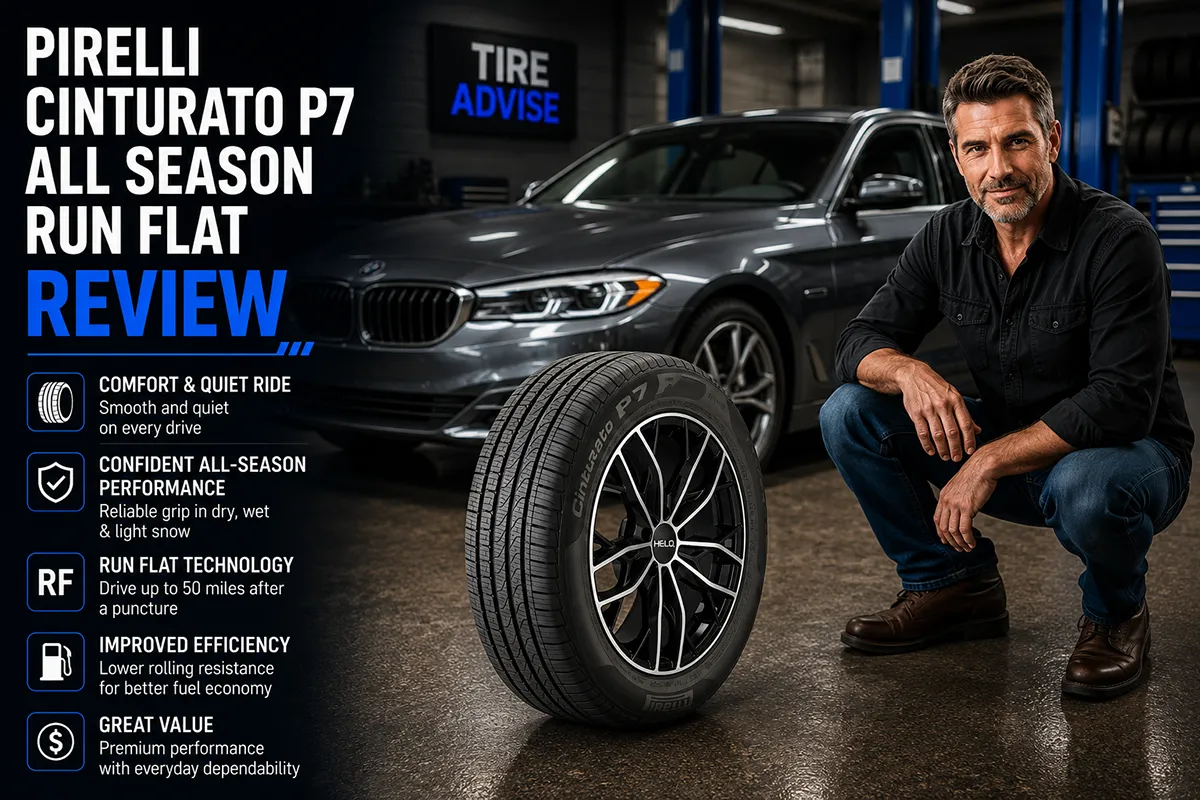
If you drive a BMW, Mercedes, or MINI with run-flat tires, you already know the struggle. You want something that rides comfortably, handles all four seasons, and doesn’t leave you stranded — but most run-flat options feel like driving on hockey pucks.
The Pirelli Cinturato P7 All Season Run Flat promises to solve that exact problem. It’s an OE favorite for luxury brands and claims to deliver year-round grip without sacrificing ride quality.
I put a set on my 3 Series and spent an extended test period pushing them through rain, dry highways, and even an early-season snowfall to see if they live up to the hype.
If you’re comparing several options from this Italian manufacturer, our full Pirelli Tires Review guide covers every model side by side and can help you narrow things down before you buy.
- One of the most comfortable run-flat all-season tires I’ve tested — noticeably smoother than competitors
- Strong wet and dry grip for daily commuting and highway driving
- Light snow capability is adequate but don’t expect winter-tire performance
- Road noise is well-controlled, especially at highway speeds
- Tread life is solid for a run-flat, though not class-leading
- Priced between $180–$280 per tire depending on size — competitive for the segment
- Best suited for BMW, Mercedes-Benz, and MINI owners who need an OE-quality run-flat replacement
Price Check
Check the price of this tire at the following retailers:
Don’t know the correct size tire to purchase? Start here!
Liked this article?
Add TireAdvise as a preferred source so you see more of our tire reviews and guides on Google.
Who Is the Pirelli Cinturato P7 All Season Run Flat Built For?
Let me be direct — this tire exists for a very specific audience. If your vehicle came equipped with run-flat tires from the factory and you need a replacement that can handle spring rain, summer heat, fall leaves, and light winter conditions, the Cinturato P7 All Season Run Flat is designed exactly for you.
It’s an OE tire for numerous BMW models, several Mercedes-Benz vehicles, and select MINI variants. Pirelli stamps these with their specific OE markings (like the star symbol for BMW), which means the tire compound and construction were tuned to match the suspension and handling characteristics of those vehicles.
If you don’t need run-flat capability, you might want to look at the standard version instead — I cover that in my Pirelli Cinturato P7 Review, which dives into the non-run-flat variant’s performance differences.
First Impressions and Installation
The first thing I noticed when I picked up the tires was the weight. Run-flats are always heavier than standard tires due to their reinforced sidewalls, and the Cinturato P7 All Season Run Flat is no exception. Each tire felt noticeably heftier than a conventional all-season in the same size.
Installation was straightforward at my local tire shop, though I always recommend going to a shop experienced with run-flat tires. The reinforced sidewalls require specific mounting equipment and technique. My installer noted that these were easier to work with than some competitor run-flats — a small but meaningful detail.
After the first few minutes of driving off the lot, I was genuinely surprised. The ride was smoother than the worn-out OE run-flats I’d just replaced. There was an immediate improvement in road feel without that harsh, jarring quality that gives run-flat tires their bad reputation.
Tread Design and Technology Breakdown
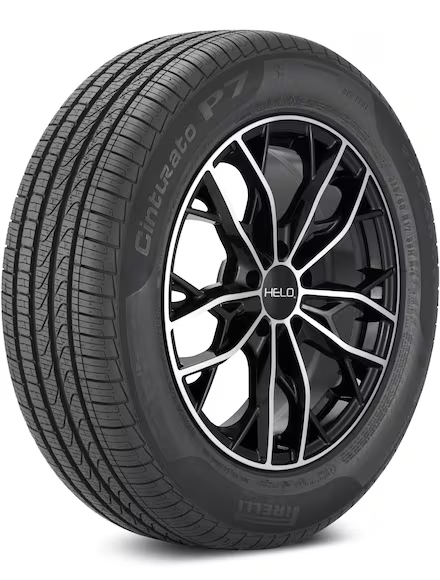
Pirelli uses what they call an asymmetric tread pattern on the Cinturato P7 All Season Run Flat, and it’s worth understanding why this matters for everyday driving. The outer shoulder blocks are larger and stiffer, which helps with cornering stability. The inner portion features more sipes and grooves, which channel water and improve wet-weather grip.
The four wide circumferential grooves are the workhorses for hydroplaning resistance. During my testing in heavy rainstorms, I could visually see water being evacuated from under the tire — the spray pattern behind the car was impressive and gave me confidence that the contact patch was staying connected to the pavement.
Run-Flat Technology Explained
Pirelli’s run-flat system uses reinforced sidewalls that can support the vehicle’s weight even with zero air pressure. In the event of a puncture, you can continue driving at reduced speeds (typically up to 50 mph) for a limited distance to reach a service station. This eliminates the need for a spare tire and the roadside tire-changing experience that nobody enjoys.
The trade-off has always been ride comfort, and this is where the Cinturato P7 All Season Run Flat makes a real effort to close the gap. Pirelli has worked on optimizing the sidewall stiffness profile so that it provides the structural support needed during a flat event while still flexing enough during normal driving to absorb road imperfections.
Compound and Eco-Friendly Design
Pirelli positions the Cinturato line as their eco-conscious range, and this tire uses a silica-rich compound designed to reduce rolling resistance. In practical terms, this means slightly better fuel economy compared to a performance-oriented run-flat. I didn’t notice a dramatic change on my fuel readout, but every little bit counts when gas prices fluctuate.
The compound also contributes to the tire’s all-season capabilities. The silica helps maintain flexibility in colder temperatures, which is critical for maintaining grip when temperatures drop below 45°F in the fall and spring shoulder seasons.
Dry Performance: My Real-World Experience
I’ll start with where this tire spends most of its life for the average US driver — dry pavement. During my test period, I drove the Cinturato P7 All Season Run Flat through a mix of urban commuting, suburban errands, and extended highway drives.
On dry roads, the tire feels planted and predictable. Steering response is crisp without being overly nervous, which is exactly what you want for a daily driver. I pushed the tire through highway on-ramps at enthusiastic speeds, and it held its line without drama. The outer shoulder blocks do their job well, providing progressive and communicative feedback through the steering wheel.
Highway Cruising
This is where the Cinturato P7 All Season Run Flat truly shines. During several long highway drives, the tire was remarkably composed. Stability at sustained speeds of 70-80 mph was excellent — no wandering, no vague center feel, just a locked-in sensation that makes long drives less fatiguing.
The reinforced sidewalls actually work in the tire’s favor here. At highway speeds, the stiffer construction resists the flex and squirm that can plague softer tires, resulting in a more direct, confidence-inspiring feel. It’s one of the few scenarios where run-flat construction is an advantage rather than a compromise.
Spirited Driving
Let’s be honest — if you’re buying an all-season run-flat, you’re probably not tracking your car. But I still wanted to see how it handled when pushed. The Cinturato P7 All Season Run Flat is competent but clearly not designed to compete with performance tires.
Grip limits are predictable and the tire breaks away gradually, which is exactly the kind of behavior you want in an all-season tire. There’s no sudden snap of oversteer or alarming understeer — just a gentle push that lets you know you’re approaching the limit. If you want genuinely sporty performance from Pirelli, I’d point you toward the Pirelli P Zero Pz4 Review for a tire that prioritizes handling above all else.
Wet Performance: Rain, Puddles, and Standing Water
Wet grip is where I really scrutinize all-season tires, because this is where safety margins matter most. The Cinturato P7 All Season Run Flat impressed me in wet conditions from the very first rainstorm.
Braking on wet pavement felt controlled and confident. I performed multiple hard-braking tests from highway speeds on wet roads, and the tire maintained composure without the ABS intervening aggressively. The stopping distances felt competitive with some of the better all-season tires I’ve tested in this segment.
Hydroplaning Resistance
Those four circumferential grooves I mentioned earlier really earn their keep during heavy rain. I drove through several intense downpours during my testing, including stretches of highway with standing water in the wheel tracks. The tire evacuated water efficiently and I never experienced the unsettling lightness that indicates hydroplaning is beginning.
On surface streets with puddles, the tire cut through without any pulling or loss of directional control. This is a critical safety feature that many drivers don’t think about until they experience it — or rather, until they experience the absence of it with cheaper tires.
Wet Cornering
Taking corners on wet roads revealed solid mid-corner grip. The tire communicates well through the steering, so you always have a sense of how much traction is available. I did notice a slight reduction in ultimate wet grip compared to Pirelli’s premium performance tires, which is expected in an all-season compound. For context on what Pirelli’s performance-focused options feel like in the wet, check out my Pirelli P Zero Review.
Winter and Cold Weather Performance
Let me set expectations clearly: this is an all-season tire, not a winter tire. It does not carry the Three-Peak Mountain Snowflake (3PMSF) symbol, which means it has not been tested and certified for severe snow conditions. If you live in Minnesota, Michigan’s Upper Peninsula, or anywhere that regularly sees heavy snowfall, you need dedicated winter tires.
That said, I did get to test the Cinturato P7 All Season Run Flat during an early-season snowfall that dropped about two inches of slushy, wet snow on the roads. The tire managed reasonably well in these conditions. Traction was adequate for careful driving — I could accelerate gently without excessive wheel spin and the ABS didn’t go into panic mode during braking.
Cold Pavement Grip
Where I was more impressed was on cold, dry pavement. During several weeks of sub-40°F morning commutes, the tire maintained good grip levels on cold asphalt. The silica compound stayed pliable enough to provide confident braking and cornering performance, which isn’t always the case with all-season tires that use harder compounds.
On icy surfaces, the tire struggled — but so does every all-season tire. I hit a patch of black ice during one morning drive and the traction control worked overtime. This is simply outside the design parameters of this tire, and no amount of tread design wizardry will change the fundamental physics of rubber on ice.
Ride Comfort and Noise
This is the section that matters most for run-flat tire shoppers, because ride quality has historically been the Achilles’ heel of run-flat technology. I’m happy to report that the Cinturato P7 All Season Run Flat is one of the more comfortable run-flats I’ve tested.
Impact Absorption
Over the first few days of driving, I deliberately sought out the worst roads in my area — the potholed urban streets, the frost-heaved suburban roads, the rough concrete highway sections. The tire absorbed these impacts better than I expected. There’s still a firmer ride compared to a standard (non-run-flat) tire, but it’s far less punishing than older-generation run-flats.
Small imperfections like manhole covers, painted road markings, and expansion joints were filtered out reasonably well. Larger impacts like potholes still transmitted a noticeable thud into the cabin, but without the harsh crash that makes your fillings rattle. For a run-flat tire, this is genuinely good performance.
Noise Levels
Road noise is the other major concern with run-flat tires, and again, the Cinturato P7 All Season Run Flat performs well for its category. At highway speeds, the tire produces a low, consistent hum that blends into the background. It’s not whisper-quiet like a touring tire on a Lexus, but it’s remarkably civil for a run-flat.
On coarse-textured asphalt — the kind that’s common on many US highways — there’s a slightly elevated noise level, but it never becomes intrusive or fatiguing during long drives. I was able to hold conversations at normal volume and listen to podcasts without cranking the volume.
The tire does produce a slightly higher-pitched sound on concrete surfaces compared to asphalt, which is typical of most tires. It’s noticeable if you’re listening for it but won’t bother most drivers.
Tread Life and Durability
Tread life is always difficult to assess definitively during a review period, but I can share my observations and provide context. After several weeks of varied driving, the tread showed minimal visible wear. The wear pattern was even across the entire face of the tire, which suggests good alignment compatibility and balanced construction.
Pirelli rates the Cinturato P7 All Season Run Flat with a UTQG treadwear rating of 500-600 (depending on the specific size), which places it in the mid-range for all-season tires. For reference, budget all-season tires often rate above 700, while performance tires can rate below 300. This rating suggests a reasonable balance between grip and longevity.
Warranty Coverage
Pirelli backs this tire with a limited treadwear warranty, though the specifics vary by size and OE marking. I always recommend checking the warranty details for your exact tire size at the point of purchase. Many Pirelli dealers and online retailers like Tire Rack and Discount Tire provide this information clearly on their product pages.
It’s worth noting that run-flat tires generally don’t last as long as their standard counterparts due to the heavier construction and different flex characteristics. Set your expectations accordingly — if you’re coming from a standard all-season tire, you may notice a shorter usable tread life with any run-flat option.
How It Compares to the Competition
The run-flat all-season segment has several strong competitors. Here’s how the Cinturato P7 All Season Run Flat stacks up against the most common alternatives I’ve tested:
| Feature | Pirelli Cinturato P7 AS RF | Bridgestone DriveGuard Plus | Michelin Primacy MXM4 ZP | Continental PureContact LS RF |
|---|---|---|---|---|
| Dry Grip | 8.5/10 | 8/10 | 8.5/10 | 8.5/10 |
| Wet Grip | 8/10 | 7.5/10 | 8.5/10 | 8/10 |
| Ride Comfort | 8/10 | 7.5/10 | 8.5/10 | 8/10 |
| Road Noise | 8/10 | 7/10 | 8.5/10 | 8/10 |
| Light Snow | 6.5/10 | 7/10 | 6.5/10 | 7/10 |
| Tread Life | 7.5/10 | 7.5/10 | 8/10 | 8/10 |
| Approx. Price (225/45R18) | $210–$240 | $180–$210 | $230–$270 | $200–$240 |
The Michelin Primacy MXM4 ZP edges ahead in comfort and tread life, but it’s also pricier. The Bridgestone DriveGuard Plus offers strong value and slightly better snow performance but falls behind in noise and comfort refinement. The Continental PureContact LS in run-flat form is a strong all-rounder that matches the Pirelli closely across the board.
In my experience, the Pirelli’s biggest strength compared to these competitors is its balanced overall performance. It doesn’t lead any single category, but it doesn’t fall behind significantly in any either. It’s a tire you can install and forget about, which is exactly what most daily drivers want.
Pirelli Cinturato P7 All Season Run Flat vs. Standard Cinturato P7
A question I get asked frequently is whether there’s a significant difference between the run-flat and standard versions of this tire. The answer is yes, but the gap is smaller than you might think.
The standard Cinturato P7 (which I reviewed in our Pirelli Cinturato P7 Review) rides more comfortably, weighs less, and tends to last slightly longer. However, the run-flat version isn’t dramatically worse in any of these areas. If your car requires run-flat tires to maintain its tire pressure monitoring and mobility system, the trade-offs are entirely livable.
I wouldn’t recommend switching from run-flat to standard tires (or vice versa) without understanding the implications for your vehicle. Cars designed for run-flat tires typically don’t carry a spare, and the suspension tuning accounts for the stiffer sidewalls. Consult your dealer or a knowledgeable tire shop before making that switch.
How Does It Compare to the Cinturato P7 Blue?
Some shoppers also wonder about the Cinturato P7 Blue, which is Pirelli’s more eco-focused variant. I covered that tire in detail in my Pirelli Cinturato P7 Blue Review. The Blue emphasizes fuel efficiency and wet grip even further, but it’s not widely available in run-flat fitments for the US market.
If you can find the Blue in your size with run-flat construction, it’s worth considering for its edge in wet performance. For most US shoppers, though, the standard Cinturato P7 All Season Run Flat will be the easier tire to find and purchase.
Available Sizes and Fitment
The Pirelli Cinturato P7 All Season Run Flat is available in a solid range of sizes, primarily targeting luxury sedans and compact crossovers. Common sizes include:
- 205/55R16 — popular for MINI Cooper and older 3 Series
- 225/45R17 — fits many BMW 3 Series and 4 Series models
- 225/45R18 — one of the most popular sizes for current-gen BMWs
- 225/50R17 — common on Mercedes C-Class
- 245/40R18 — rear fitment for staggered BMW setups
- 245/45R18 — fits several BMW 5 Series and Mercedes E-Class models
- 255/40R18 — performance sedan rear fitment
- 275/35R19 — larger luxury sedan and GT car fitments
Speed ratings are typically V (149 mph) or W (168 mph), which is more than adequate for any legal driving in the US. Make sure to match the OE marking on your tire to the recommended specification for your vehicle — a BMW-specific star-marked tire may have slight compound differences compared to the same size without the marking.
Pricing and Value Assessment
In the US market, the Pirelli Cinturato P7 All Season Run Flat typically ranges from $180 to $280 per tire, depending on size. The most popular sizes (225/45R17 and 225/45R18) generally fall in the $200–$250 range.
Is it a good value? I think so, with some caveats. You’re paying a premium over standard (non-run-flat) all-season tires, which is unavoidable in this segment. But compared to other premium run-flat options, the Cinturato P7 All Season is competitively priced. It undercuts the Michelin Primacy MXM4 ZP in most sizes and is roughly comparable to the Continental PureContact LS run-flat.
I recommend shopping online retailers like Tire Rack, Discount Tire, and SimpleTire for the best pricing. Many of these retailers offer free shipping and can connect you with local installers. I’ve also seen competitive pricing at Costco for members, though their run-flat selection can be more limited.
Pros and Cons Summary
What I Liked
- Comfortable ride quality — genuinely impressive for a run-flat tire, especially on highway trips
- Strong wet grip — four circumferential grooves provide excellent hydroplaning resistance
- Predictable handling — progressive grip limits and good steering communication
- Low road noise — quieter than most run-flat competitors at highway speeds
- OE quality and fitment — purpose-built for the vehicles that use it, with proper OE markings
- Run-flat peace of mind — eliminates the worry of being stranded with a flat tire
What Could Be Better
- Light snow performance is limited — adequate but not confident; no 3PMSF rating
- Tread life isn’t class-leading — mid-pack for the segment, and run-flat construction may reduce longevity slightly
- Ride still firmer than standard tires — improved for a run-flat but still noticeably stiffer than a non-RF tire
- Price premium — run-flat technology adds cost, as always
- Not for performance driving — competent but clearly outclassed by dedicated performance tires in cornering grip
Who Should Buy This Tire?
Based on my thorough testing, I recommend the Pirelli Cinturato P7 All Season Run Flat for the following drivers:
- BMW, Mercedes, and MINI owners replacing OE run-flat tires who want a reliable, high-quality replacement
- Highway commuters who value comfort, low noise, and stability at speed
- All-season drivers in moderate climates — Mid-Atlantic, Pacific Northwest, and similar regions that see rain and cool temperatures but not severe winter conditions
- Drivers who prioritize safety and want the peace of mind of run-flat capability without carrying a spare
I would not recommend this tire for drivers in the Snow Belt who need serious winter capability, performance enthusiasts who want maximum cornering grip, or budget shoppers who don’t specifically need run-flat technology.
My Final Verdict
After extensive testing across dry highways, rain-soaked streets, cold morning commutes, and even a surprise snowfall, I can confidently say the Pirelli Cinturato P7 All Season Run Flat is one of the best-balanced run-flat all-season tires available in the US market today.
It won’t blow you away in any single performance metric, but it delivers genuinely competent performance across every condition an average US driver is likely to encounter. More importantly, it does so while maintaining a level of ride comfort and noise control that was simply unheard of in run-flat tires just a few years ago.
If your car requires run-flat tires and you need year-round capability, this tire deserves serious consideration. It’s the kind of tire that does its job so well that you stop thinking about your tires entirely — and for a daily driver, that’s the highest compliment I can give.
My overall rating: 8.2 out of 10
For drivers who don’t need run-flat capability but want to stay within Pirelli’s lineup, I’d suggest exploring the standard Cinturato P7 or stepping up to a performance-oriented option. Our reviews of the Pirelli Cinturato P7 and the Pirelli P Zero PZ4 can help you decide which direction makes the most sense for your driving style and vehicle.
Frequently Asked Questions
Is the Pirelli Cinturato P7 All Season Run Flat a good tire for everyday driving?
Yes, the Pirelli Cinturato P7 All Season Run Flat is a solid choice for daily commuters and everyday driving across US roads. It delivers a comfortable, quiet ride on highways and city streets while offering the added security of run-flat technology, so you can safely drive up to 50 miles at reduced speed after a puncture. I found it particularly well-suited for drivers who prioritize convenience and don’t want to deal with roadside tire changes.
How long does the Pirelli Cinturato P7 All Season Run Flat last in real-world driving?
Most drivers report getting between 40,000 and 55,000 miles out of the Pirelli Cinturato P7 All Season Run Flat, depending on driving habits and road conditions. Pirelli backs this tire with a 50,000-mile treadwear warranty on most sizes, which is competitive for a run-flat all-season tire. Regular tire rotations every 5,000–7,500 miles will help you maximize tread life and get the most value out of your investment.
How much does the Pirelli Cinturato P7 All Season Run Flat cost per tire?
Pricing for the Pirelli Cinturato P7 All Season Run Flat typically ranges from $180 to $280 per tire depending on the size, with popular fitments for BMW, Mercedes, and MINI models falling in the $200–$250 range. You can often find rebates directly from Pirelli or through US retailers like Tire Rack, Discount Tire, and Costco. While it’s pricier than standard non-run-flat all-season tires, you save on carrying a spare and the peace of mind is worth it for many drivers.
How does the Pirelli Cinturato P7 All Season Run Flat perform in rain and light snow?
The Cinturato P7 All Season Run Flat handles wet roads confidently thanks to its wide circumferential grooves that resist hydroplaning at highway speeds. In light snow and cold conditions common in states like Pennsylvania, Ohio, and the Mid-Atlantic region, it provides adequate traction for occasional winter weather but is not a substitute for dedicated winter tires. If you regularly drive through heavy snow or ice, I’d recommend switching to a winter tire setup for those months.
What cars come with Pirelli Cinturato P7 All Season Run Flat tires as OEM?
The Pirelli Cinturato P7 All Season Run Flat is a popular original equipment tire on many BMW 3 Series and 5 Series models, select Mercedes-Benz C-Class and E-Class vehicles, and certain MINI Cooper variants sold in the US market. Pirelli manufactures this tire in a wide range of sizes from 16 to 19 inches to match these OEM specifications. If your vehicle came with these tires from the factory, replacing them with the same model ensures you maintain the ride quality and handling your car was engineered for.
Is the Pirelli Cinturato P7 Run Flat ride quality harsh compared to regular tires?
Run-flat tires are generally known for a stiffer ride due to their reinforced sidewalls, but the Pirelli Cinturato P7 All Season Run Flat is one of the more comfortable options in the run-flat category. I noticed a slight increase in road firmness compared to conventional all-season tires, but it’s far less jarring than older-generation run-flats. Most US drivers on forums and reviews agree that the ride comfort is very livable for a run-flat, especially on well-maintained highways and suburban roads.
Pirelli Cinturato P7 All Season Run Flat vs Bridgestone DriveGuard: which is better?
The Pirelli Cinturato P7 All Season Run Flat tends to offer a quieter, more refined ride and is designed primarily as an OEM replacement for European luxury vehicles, while the Bridgestone DriveGuard is a more budget-friendly aftermarket run-flat that fits a broader range of vehicles. In terms of wet traction and handling, the Pirelli has a slight edge, but the DriveGuard often costs $30–$50 less per tire and carries a 60,000-mile treadwear warranty versus Pirelli’s 50,000 miles. If you drive a BMW or Mercedes and want to match OEM feel, the Pirelli is the better pick, but the DriveGuard is a strong value alternative for other vehicles.
