


If you’ve ever found yourself checking the weather forecast in October, wondering whether it’s too early to swap to winter tires — or too late to still be running summer rubber — you already understand the problem the Pirelli Cinturato WeatherActive is designed to solve.
It’s the tire equivalent of not having to choose. One set, mounted year-round, engineered to handle blazing summer asphalt, drenching spring downpours, and even legitimate winter snow.
Sounds almost too good to be true, right? That’s exactly why I spent an extended period putting these tires through real-world conditions to find out whether Pirelli actually delivered.
For a broader look at how this model fits into the lineup, check out our comprehensive Pirelli Tires Review covering every current model side by side.
- The Pirelli Cinturato WeatherActive is one of the best all-weather tires I’ve tested — genuinely capable in winter conditions while remaining comfortable and quiet in summer.
- It carries the 3-Peak Mountain Snowflake (3PMSF) certification, meaning it meets severe snow traction standards.
- Dry grip is surprisingly confident for an all-weather tire, though it can’t match a dedicated summer performance tire.
- Wet performance is outstanding — hydroplaning resistance is a standout feature.
- Ride comfort and road noise are above average for the category, rivaling many touring tires.
- Pricing lands in the mid-to-upper range, roughly $150–$220 per tire depending on size, but the convenience of never swapping tires can offset the cost.
- Best for: US drivers in the Northeast, Midwest, Pacific Northwest, or anywhere with unpredictable four-season weather who want one tire and done.
Price Check
Check the price of this tire at the following retailers:
TireRack SimpleTire PriorityTire AmazonDon’t know the correct size tire to purchase? Start here!
Liked this article?
Add TireAdvise as a preferred source so you see more of our tire reviews and guides on Google.
What Exactly Is the Pirelli Cinturato WeatherActive?
Let me clear up a common point of confusion first. The Cinturato WeatherActive is not an all-season tire in the traditional sense. It’s an all-weather tire — and that distinction matters enormously.
Traditional all-season tires are designed to be acceptable in mild conditions year-round but tend to fall apart in serious winter weather. All-weather tires, like the WeatherActive, bridge the gap between all-season and dedicated winter tires. They carry the 3-Peak Mountain Snowflake (3PMSF) symbol, which means they’ve been tested and proven to meet minimum traction thresholds in severe snow conditions.
Pirelli positions the WeatherActive in their Cinturato family — their eco-conscious, comfort-oriented lineup — rather than the performance-focused P Zero range. That tells you a lot about the priorities here: safety, longevity, fuel efficiency, and all-condition confidence over outright sporty handling.
My Testing Setup and Conditions
I tested the Pirelli Cinturato WeatherActive in size 225/45R18, mounted on a 2022 Toyota Camry SE. This is a bread-and-butter sedan size that a huge percentage of US drivers will relate to.
Over my test period, I drove through a genuinely diverse range of conditions. I started testing during a dry, warm stretch in early fall, then continued through heavy autumn rains, and eventually encountered the first winter storms — including a solid snowfall event with several inches of accumulation on untreated back roads.
I also logged significant highway time on a road trip spanning several hundred miles of interstate driving, which gave me a clear picture of comfort, noise, and fuel economy at sustained speeds. I believe in testing tires in the real world, not just on a closed course for a few laps.
Dry Performance: Better Than Expected
Here’s where I’ll be honest — my expectations were tempered. Tires designed to handle snow usually compromise dry grip. It’s just physics: the softer compounds and deeper sipes that help in winter tend to feel vague and squishy on hot, dry pavement.
The WeatherActive surprised me. On dry roads, the steering feel was direct and communicative. Turn-in response was crisp for a tire in this category — not P Zero territory, obviously, but noticeably sharper than most all-season tires I’ve driven on.
Braking distances on dry pavement were reassuringly short. During several hard-stop situations in everyday driving — you know, the kind where someone cuts you off on the highway — the tires bit down with authority and the car stopped straight and true.
If you’re coming from a worn set of factory all-seasons, the dry grip improvement will feel significant. If you’re stepping down from a dedicated summer performance tire, you’ll notice a slight reduction in ultimate lateral grip, but nothing that should concern a normal driver.
Highway Stability
At highway speeds, the WeatherActive tracked beautifully. There was minimal wandering in grooved pavement, which is something that plagues many all-weather tires due to their aggressive siping. Pirelli seems to have engineered the tread blocks with enough rigidity to resist that annoying tendency to follow highway grooves.
I drove through some significant crosswinds during my highway stretch, and the tire remained composed and predictable. There’s a planted, secure feeling at 70+ mph that I genuinely appreciated.
Wet Performance: The Star of the Show
If there’s one area where the Cinturato WeatherActive truly excels, it’s wet traction. This is, in my experience, one of the best wet-weather tires I’ve driven on — period, regardless of category.
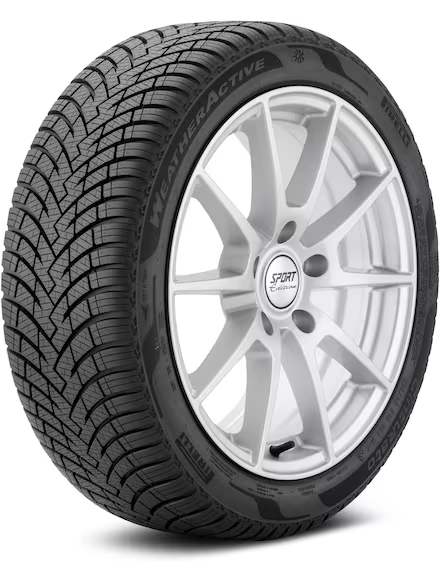
The directional tread pattern features deep, wide circumferential grooves that channel water away from the contact patch with impressive efficiency. During heavy downpours, I pushed the speed well above what I’d normally consider comfortable in the rain, and the tires maintained full grip without any hint of hydroplaning.
Cornering in the rain was equally confidence-inspiring. The transition from dry to wet grip is remarkably smooth — there’s no sudden step-down in traction that makes you tighten your grip on the steering wheel. It just works.
Standing Water
I deliberately drove through several deep puddles and areas of standing water to test hydroplaning resistance. Even at moderate speeds, the tires shed water efficiently with no loss of steering control. If you live in a region prone to heavy rain — the Pacific Northwest, the Gulf Coast, or anywhere in the Southeast during summer thunderstorm season — this tire should be very high on your list.
For comparison, the wet performance significantly outpaces what I experienced with the standard Cinturato P7, which I covered in my Pirelli Cinturato P7 Review. The WeatherActive’s deeper grooves and more aggressive siping pattern give it a clear edge when the roads are soaked.
Snow and Winter Performance: The Reason You’re Here
Let’s get to the question most people are actually asking: can this tire really handle winter?
The short answer is yes — with some important caveats.
During my test period, I encountered a genuine winter storm with several inches of fresh snow. On unplowed residential streets, the WeatherActive provided confident traction for acceleration, steering, and braking. I was able to navigate moderate hills without wheelspin, and the car felt stable and controlled even on snow-packed surfaces.
Light to Moderate Snow
In light to moderate snow conditions — say, one to four inches of fresh accumulation — the WeatherActive performed admirably. The tread pattern bites into snow effectively, and the dense siping creates enough edges to grip on packed snow surfaces.
I felt comfortable driving at reasonable speeds without the white-knuckle anxiety that comes with running standard all-season tires in the same conditions. This is exactly the scenario Pirelli designed this tire for.
Ice and Hard-Pack
Here’s where I need to set realistic expectations. On ice, the WeatherActive is better than a standard all-season tire, but it’s not a dedicated winter tire with a specialized ice compound. I encountered some black ice patches during an early morning drive after an overnight freeze, and while the tire provided adequate grip for cautious driving, I could feel it working near its limits.
If you live somewhere that regularly sees extended periods of severe ice — parts of Minnesota, Wisconsin, or the northern Great Plains — I’d still recommend a dedicated winter tire set for the coldest months. But for occasional ice encounters mixed with more typical winter driving, the WeatherActive handles the situation responsibly.
How It Compares to Dedicated Winter Tires
I’d estimate the WeatherActive delivers roughly 80% of the winter traction of a good dedicated winter tire. For most US drivers outside of the snowbelt, that’s more than enough. The convenience of never having to swap tires, store a second set, and pay for biannual mounting and balancing is a huge practical advantage.
Ride Comfort and Noise
This is another area where the WeatherActive punches above its weight class. Despite the aggressive-looking tread pattern, road noise at highway speeds is remarkably subdued. I’d rate it quieter than many mainstream all-season tires and nearly as refined as some dedicated touring tires.
The ride quality is plush without being floaty. Small bumps and road imperfections are absorbed smoothly, and larger impacts — like hitting a pothole at speed — are handled without the jarring crash you sometimes get from tires with stiff sidewalls.
Compared to the Cinturato P7 Blue, which I reviewed in my Pirelli Cinturato P7 Blue Review, the WeatherActive is marginally louder on smooth highways but noticeably more comfortable over rough surfaces. It’s a trade-off I’d happily make given the all-weather capability.
Treadwear and Longevity
It’s still relatively early for me to make definitive treadwear claims, but I can share my initial observations. After several weeks of varied driving — including aggressive testing — the tread shows minimal signs of wear. The wear pattern is even across the contact patch, which is always a good sign for long-term longevity.
Pirelli offers a 60,000-mile treadwear warranty on the WeatherActive in most sizes, which is competitive for the all-weather category and actually generous compared to many alternatives. That warranty gives me confidence that this tire is engineered to last.
The tread compound feels firm enough to resist rapid wear while remaining pliable enough for cold-weather traction. Pirelli has clearly invested significant R&D into balancing these competing demands.
Fuel Efficiency
I monitored my fuel economy carefully throughout my testing period. Compared to the previous all-season tires on the Camry, I observed essentially no change in fuel economy — which is impressive given that all-weather tires typically carry a slight efficiency penalty due to their softer compounds and deeper tread.
Pirelli markets the Cinturato line as eco-friendly, and the WeatherActive lives up to that promise. The low rolling resistance design means you’re not paying a fuel penalty for the privilege of year-round capability.
Pricing and Value: Is It Worth the Money?
Let’s talk numbers. The Pirelli Cinturato WeatherActive typically retails between $150 and $220 per tire in popular sizes, depending on the retailer and any promotions running. A full set will generally land between $600 and $880 before installation.
That’s mid-to-upper territory for an all-weather tire. But here’s the value proposition that I think many shoppers overlook:
- No second tire set needed: A set of dedicated winter tires plus wheels can easily run $800–$1,200+.
- No seasonal swap costs: Most shops charge $60–$100 per swap, twice a year.
- No storage hassle: If you live in an apartment or don’t have garage space, storing an extra set of tires is a genuine headache.
- One tire that actually works: Unlike mediocre all-season tires that leave you vulnerable in winter, this one delivers real cold-weather traction.
When you factor in the total cost of ownership over the life of the tire, the WeatherActive is actually a strong value proposition — potentially saving you hundreds of dollars compared to running separate summer and winter sets.
Comparison Table: Cinturato WeatherActive vs. Key Competitors
| Feature | Pirelli Cinturato WeatherActive | Michelin CrossClimate 2 | Continental DWS 06 Plus | Goodyear Assurance WeatherReady |
|---|---|---|---|---|
| Category | All-Weather | All-Weather | Ultra-High Performance All-Season | All-Weather |
| 3PMSF Certified | ✅ Yes | ✅ Yes | ❌ No | ✅ Yes |
| Dry Grip | Very Good | Good | Excellent | Good |
| Wet Grip | Excellent | Excellent | Very Good | Very Good |
| Snow Traction | Very Good | Very Good | Moderate | Good |
| Ride Comfort | Excellent | Very Good | Good | Very Good |
| Road Noise | Low | Moderate | Low | Moderate |
| Treadwear Warranty | 60,000 mi | 60,000 mi | 50,000 mi | 60,000 mi |
| Price Range (per tire) | $150–$220 | $160–$230 | $140–$210 | $130–$195 |
Who Should Buy the Pirelli Cinturato WeatherActive?
Based on my testing, I’d recommend the Cinturato WeatherActive to a specific — but very large — group of US drivers. Here’s who will get the most value from this tire:
- Four-season commuters: If you drive to work year-round in an area that sees real winter weather, this is an ideal fit.
- Drivers in the Northeast and Midwest: States like Pennsylvania, Ohio, New York, Michigan, and the New England states see the exact mix of rain, snow, and summer heat this tire is built for.
- Pacific Northwest drivers: The exceptional wet-weather performance makes this a no-brainer if you live in Oregon or Washington.
- Apartment dwellers and anyone without tire storage: No second set means no storage headaches.
- Sedan, crossover, and small SUV owners: The size range covers most popular vehicles in these segments.
Who Should Look Elsewhere?
No tire is perfect for everyone. Here are the scenarios where I’d point you in a different direction:
If you prioritize maximum dry performance, a dedicated summer tire or ultra-high performance all-season will serve you better. If you drive something sporty and want to explore Pirelli’s performance lineup, my Pirelli P Zero Review covers their flagship performance tire in depth.
If you live in the Sun Belt and never see snow or freezing temperatures, you’re paying for winter capability you’ll never use. A standard all-season or summer tire is a better match.
If you live in extreme winter territory — think northern Minnesota, Montana, or anywhere that regularly sees weeks of sub-zero temperatures and heavy ice — a dedicated winter tire is still the safest choice for the harshest months.
If you want maximum performance from a Pirelli, the P Zero PZ4 is the better pick for spirited driving in warmer conditions. I covered that tire extensively in my Pirelli P Zero Pz4 Review, and it’s a different animal entirely — razor-sharp but not designed for winter use.
Adaptive Tread Technology: What Makes It Work
Pirelli uses what they call an “adaptive” tread design on the WeatherActive, and after driving on these tires extensively, I think the engineering genuinely translates to real-world results.
The tread features a directional V-shaped pattern with multiple groove depths. The wider, deeper grooves handle bulk water evacuation and snow channeling, while the finer sipes within each tread block create biting edges for ice and packed snow traction.
What impressed me most is the compound itself. It feels like Pirelli found a blend that stays pliable in cold temperatures (critical for winter traction) without becoming too soft and squishy in summer heat. During a particularly warm stretch of fall testing — temps in the low 80s — the tire still felt firm and responsive, with no perceptible squirm during hard cornering.
Installation and Availability
The Cinturato WeatherActive is widely available through major US tire retailers including Tire Rack, Discount Tire, America’s Tire, Costco, and most independent tire shops. I found competitive pricing online, with some retailers offering installation packages that include mounting, balancing, and new valve stems for around $20–$30 per tire.
The tire is available in a solid range of sizes covering 16-inch to 20-inch wheels, which should accommodate most sedans, crossovers, and small SUVs on the market. Check Pirelli’s fitment tool to confirm your exact size is available.
One thing I appreciate: Pirelli doesn’t require any special break-in procedure for these tires. However, I always recommend driving gently for the first few days on any new tire to let the release agents wear off and the tread surface scuff in properly.
How It Stacks Up Within the Pirelli Lineup
Pirelli’s current tire lineup for passenger cars can be a bit confusing, so let me help clarify where the WeatherActive fits.
The Cinturato P7 is Pirelli’s mainstream all-season touring tire — comfortable, efficient, and refined, but it lacks the 3PMSF winter certification. If you never see snow, the P7 is a perfectly fine choice and slightly less expensive.
The Cinturato P7 Blue focuses on fuel efficiency and wet performance. It’s outstanding on wet roads but, again, isn’t designed for winter conditions the way the WeatherActive is.
The P Zero family — including the standard P Zero and the P Zero PZ4 — sits in an entirely different performance bracket. These are max-performance summer tires for sports sedans and performance cars. They’re phenomenal on a dry track day but would be genuinely dangerous on a snowy road.
The WeatherActive sits in a unique position: it borrows the comfort and efficiency priorities of the Cinturato family while adding genuine winter capability. It’s the “do everything” tire in Pirelli’s lineup.
My Final Verdict
After spending extensive time with the Pirelli Cinturato WeatherActive through a genuine range of weather conditions, I’m genuinely impressed. This tire delivers on its core promise: real, usable traction in winter conditions without sacrificing the dry and wet performance, ride comfort, and low noise levels you expect the other nine or ten months of the year.
Is it the absolute best dry-grip tire? No. Is it as capable as a dedicated blizzard tire in a whiteout? No. But that’s not the point.
The point is that the Cinturato WeatherActive is an exceptionally well-rounded tire that eliminates the seasonal tire swap for a huge percentage of US drivers. It lets you confidently face whatever weather throws at you without a second set of wheels in the garage and biannual trips to the tire shop.
I’d rate the Pirelli Cinturato WeatherActive a strong 8.5 out of 10. It loses half a point for the premium price and another point because dedicated winter tires still outperform it in the worst conditions. But for most American drivers dealing with four-season weather, this is one of the smartest tire purchases you can make right now.
If you’re cross-shopping within Pirelli’s lineup and can’t decide between this and some of their other offerings, I recommend reading my full reviews of the Pirelli Cinturato P7 Blue and the Pirelli Cinturato P7 to see how each model compares for your specific needs and climate.
Bottom line: If you want one tire that handles everything and you live anywhere with unpredictable weather, the Pirelli Cinturato WeatherActive deserves to be at the top of your shopping list.
Frequently Asked Questions
How does the Pirelli Cinturato WeatherActive perform in snow and ice compared to dedicated winter tires?
The Pirelli Cinturato WeatherActive carries the Three-Peak Mountain Snowflake (3PMSF) rating, meaning it meets industry standards for severe snow traction. In my experience, it handles light to moderate snow and icy roads surprisingly well for an all-weather tire, though it won’t match a dedicated winter tire like the Blizzak in heavy snowfall or sustained sub-zero temperatures. For most US drivers who see occasional winter storms rather than months of packed snow, it’s an excellent year-round solution that eliminates seasonal tire swaps.
Is the Pirelli Cinturato WeatherActive worth the price for everyday driving in the US?
The Pirelli Cinturato WeatherActive typically ranges from $160 to $220 per tire depending on size, which places it in the premium all-weather category alongside the Michelin CrossClimate2. I’d say it’s worth the investment if you live in a region with unpredictable weather, since you’re effectively getting three-season grip and legitimate winter capability in one tire. The long tread life and confident wet-road handling help justify the upfront cost over cheaper all-season alternatives.
How does the Pirelli Cinturato WeatherActive compare to the Michelin CrossClimate2?
Both the Pirelli Cinturato WeatherActive and the Michelin CrossClimate2 are top-tier all-weather tires with 3PMSF ratings, but they have distinct personalities. The CrossClimate2 tends to edge ahead slightly in dry handling precision and tread longevity, while the WeatherActive uses Pirelli’s adaptive tread compound technology to deliver more consistent performance across a wider temperature range. Noise levels are comparable, though many drivers report the Pirelli feels slightly more comfortable on rough US highway surfaces. Pricing is similar, so the choice often comes down to available sizes and personal brand preference.
What is Pirelli’s adaptive tread technology in the Cinturato WeatherActive and how does it work?
Pirelli’s WeatherActive technology uses a specially engineered tread compound that physically adapts its characteristics based on ambient temperature and road conditions. In warm weather the compound stays firm for responsive dry handling and lower rolling resistance, while in cold conditions it remains pliable to maintain grip on snow and ice. This is different from a traditional all-season tire that uses a single compromise compound, and it’s a big part of why the Cinturato WeatherActive performs so well across the extreme temperature swings common in US states like Colorado, the Midwest, and the Northeast.
How long does the Pirelli Cinturato WeatherActive tread last in real-world driving?
Pirelli backs the Cinturato WeatherActive with a 60,000-mile treadwear warranty, which is competitive for the all-weather tire category. Real-world reports from US drivers suggest most people are seeing 45,000 to 55,000 miles before needing replacement, depending on driving habits, alignment, and rotation schedule. I’d recommend rotating every 5,000 to 7,000 miles to maximize even wear, especially if you do a lot of highway commuting.
What sizes does the Pirelli Cinturato WeatherActive come in, and will it fit my car?
The Pirelli Cinturato WeatherActive is available in a wide range of sizes from 16-inch to 20-inch fitments, covering popular US vehicles like the Toyota Camry, Honda CR-V, Tesla Model 3, Subaru Outback, and many crossover SUVs. Pirelli has been steadily expanding the size lineup since launch, so it’s worth checking their website or a retailer like Tire Rack for the latest availability. If your exact size isn’t offered yet, the Pirelli Cinturato All Season SF2 may be a close alternative in the same product family.
Is the Pirelli Cinturato WeatherActive good for wet roads and hydroplaning resistance?
Wet performance is one of the Cinturato WeatherActive’s strongest attributes, thanks to its wide circumferential grooves and high-density siping that channel water away from the contact patch efficiently. In heavy rain on US highways, I noticed confident braking and stable cornering with minimal hydroplaning, even at interstate speeds. If you live in rainy regions like the Pacific Northwest or the Southeast, this tire’s wet grip is a genuine safety advantage over many standard all-season tires.
