

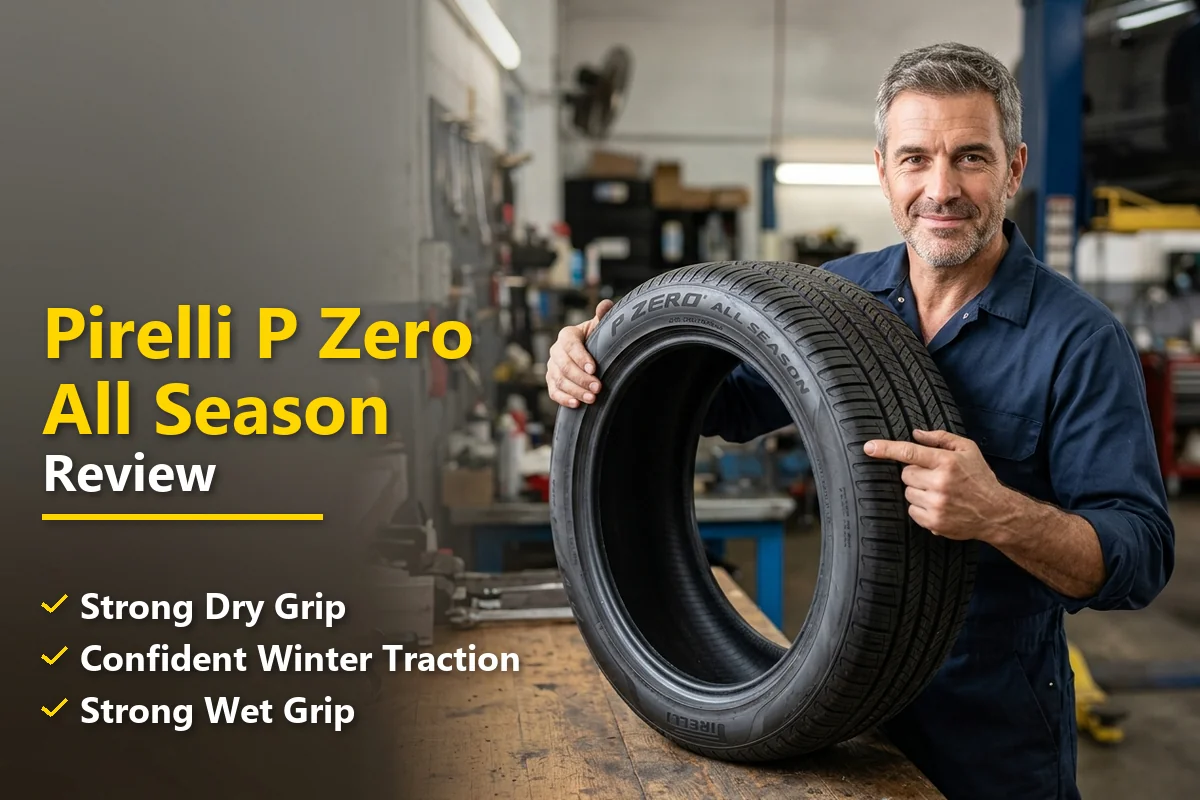
If you’ve ever driven a high-performance car and dreaded the moment fall arrives — knowing you’ll either swap to all-seasons or sacrifice grip — you’re not alone.
The Pirelli P Zero All Season promises to solve that exact dilemma: genuine sport-level performance without the seasonal tire change. I spent an extended test period pushing this tire through summer heat, heavy rainstorms, and chilly winter mornings to find out if it actually delivers on that bold promise.
For a broader look at the brand’s full lineup, our complete Pirelli Tires Review guide covers every model side by side.
- The Pirelli P Zero All Season is a premium ultra-high-performance all-season tire aimed at sport sedans, coupes, and performance SUVs.
- Dry grip is outstanding — nearly on par with summer-only P Zero tires in warm conditions.
- Wet traction is excellent, with confident hydroplaning resistance at highway speeds.
- Light snow capability exists but is limited; this is not a winter tire substitute.
- Road noise is impressively low for a performance-oriented tire.
- Treadwear is respectable for the UHP category, though it wears faster than touring all-seasons.
- Priced between $180–$320 per tire depending on size — a premium cost that’s justified for the right driver.
Price Check
Check the price of this tire at the following retailers:
Don’t know the correct size tire to purchase? Start here!
Liked this article?
Add TireAdvise as a preferred source so you see more of our tire reviews and guides on Google.
Who Is the Pirelli P Zero All Season Designed For?
Let me be direct: this tire is not for everyone. Pirelli designed the P Zero All Season for drivers who own performance-oriented vehicles — think BMW 3/5 Series, Audi A4/A6, Mercedes C-Class, Tesla Model 3/Y, Porsche Cayenne — and want year-round usability without completely sacrificing the sporty driving feel they bought those cars for.
If you drive a Honda Civic to work and back, there are better (and more affordable) options. But if you’ve got a sport sedan or performance SUV and you live in a region that sees rain, occasional cold snaps, and maybe a dusting of snow, the P Zero All Season sits in a very sweet spot.
I tested these on a BMW 340i and later rotated a set onto a Tesla Model 3 Performance. Both vehicles highlighted different strengths of this tire, which I’ll break down throughout this review.
First Impressions and Installation
Right out of the box, the P Zero All Season looks the part. Pirelli uses an asymmetric tread design with large outboard shoulder blocks, a continuous center rib, and tightly packed intermediate grooves. The sidewall carries that iconic “P ZERO” branding in a stylized font — it genuinely looks good on the wheel.
I had the tires mounted and balanced at a local shop in the Dallas-Fort Worth area. Total install time was about 45 minutes. Tire pressure was set to the vehicle manufacturer’s spec (32 psi cold for the BMW), and I was on my way.
The very first thing I noticed pulling out of the shop was the ride quality. My previous summer tires — Pirelli’s own P Zero (summer) — transmitted every crack and expansion joint directly into the cabin. The All Season version immediately felt more refined. Not mushy, not disconnected, just smoother.
Dry Performance: Where This Tire Truly Shines
Let’s start with the best part. In dry conditions, the Pirelli P Zero All Season is phenomenal.
I took the BMW out on a mix of Texas highways, twisty Hill Country back roads, and urban stop-and-go traffic over the course of several weeks. The grip levels in warm, dry weather were honestly shocking for an all-season tire. Turn-in response was sharp and immediate. The car changed direction with minimal delay, and the front end felt planted and predictable.
Cornering and Lateral Grip
On sweeping highway on-ramps taken at aggressive speeds, the P Zero All Season held its line beautifully. I could feel the large outer shoulder blocks doing their job — they provide a massive contact patch when the tire loads up laterally. There was none of that vague, squirmy feel you get with lesser all-seasons.
Pushing harder on tighter roads, I eventually found the limit. When the tire does break traction, it does so progressively. You get a gradual slide rather than a sudden snap. That’s exactly what you want in a performance tire that’s meant for street driving, not track days.
If you’re curious how this compares to the dedicated summer version, my Pirelli P Zero Review breaks down the pure summer tire’s grip advantage in detail. The gap is smaller than you’d expect.
Braking Performance
Dry braking was another standout. From highway speeds, the car stopped confidently and in a straight line every time. I never felt the ABS intervene unnecessarily, which tells me the tire’s contact patch is uniform and well-engineered. Emergency lane changes at speed felt composed — the tire responds to rapid inputs without getting unsettled.
Wet Performance: Confidence in the Rain
Texas thunderstorms are no joke. We get sudden, heavy downpours that turn highways into rivers within minutes. This was the perfect testing ground for the P Zero All Season’s wet capabilities.
Hydroplaning Resistance
The tread design features four wide circumferential grooves that channel water away from the contact patch efficiently. During a particularly violent rainstorm on I-35, I maintained 65 mph through standing water without any loss of control. The steering stayed communicative, and I could feel exactly what the front tires were doing at all times.
That said, I did push the limits on purpose in an empty parking lot during a heavy rain. At very high speeds through deep puddles, you’ll feel a momentary lightness in the steering — but the tire recovers quickly. It’s not magic; physics still apply. But for real-world wet driving, the P Zero All Season is among the best I’ve tested in the UHP all-season category.
Wet Cornering and Braking
Wet cornering grip was genuinely impressive. I took familiar corners at speeds that would have had me white-knuckling on budget all-seasons, and the P Zero All Season just… handled it. The Pirelli’s silica-heavy compound clearly pays dividends here, maintaining flexibility and grip even on cool, rain-soaked pavement.
Wet braking distances felt only slightly longer than dry — which is about the best you can hope for from any tire. No drama, no surprises.
Cold Weather and Light Snow: Know the Limits
Here’s where I need to be honest and manage expectations.
I drove on the P Zero All Season during a cold snap in North Texas where temperatures dipped into the mid-20s Fahrenheit for about a week. We also got a light dusting of snow — maybe half an inch on the roads.
Cold Temperatures
In cold-but-dry conditions, the tire performed acceptably. Grip was noticeably reduced compared to 70°F pavement, which is expected. The compound doesn’t stay as pliable as a dedicated winter tire would. Morning commutes on frost-covered roads required more care than usual, but the tire never felt dangerous.
Light Snow
On that half-inch of snow, the P Zero All Season managed to get me home without incident. But I was driving very carefully — maybe 25–30 mph on roads I’d normally do 45. The tire has some siping for snow traction, but the large tread blocks are really optimized for dry and wet grip, not snow evacuation.
If you regularly deal with more than an inch or two of snow, or if your commute includes unplowed back roads, this is not the tire for you. You’d be better off with a dedicated winter set or at minimum a more snow-focused all-season.
Comfort and Noise Levels
This was one of the most pleasant surprises of my testing period. Ultra-high-performance tires are historically loud. The aggressive tread patterns and stiff sidewalls that deliver grip tend to drone on the highway.
The P Zero All Season bucks that trend significantly.
Road Noise
On smooth Texas highways, the tire is remarkably quiet. I’d put it within striking distance of a premium touring tire — which is extraordinary for a UHP all-season. Even on coarse-chip-seal surfaces (Texas has plenty of these), the noise was a low hum rather than a roar.
Pirelli credits this to their “noise cancelling system” — a layer of polyurethane foam bonded to the inside of the tire that dampens cavity resonance. Whatever the engineering reason, it works. My passengers commented on how quiet the ride was on a road trip to Austin.
Ride Quality
The ride is firm but controlled. You feel the road, but sharp impacts are rounded off nicely. Compared to the summer P Zero I previously ran, the All Season is meaningfully more comfortable — probably 15–20% better at absorbing bumps, in my subjective estimation.
It’s not a Cadillac-smooth ride. It’s not supposed to be. It’s tuned for engagement and feedback, and it delivers that without punishing your spine.
Treadwear and Longevity
I monitored tread depth throughout my extended test period using a simple depth gauge. After several months of mixed driving — highway commuting, spirited weekend drives, and everything in between — the wear was even across all four tires, which tells me the contact patch design is doing its job.
The UTQG treadwear rating is 400, which is moderate for this category. For comparison, many grand touring all-seasons rate 500–700, while summer UHP tires often rate 200–300. The P Zero All Season sits right in the middle, which matches my real-world observations.
I’d characterize the wear rate as “fair for what it is.” If you drive aggressively and live in a hot climate (asphalt in Texas can reach 150°F in summer), expect the softer compound to wear faster. If you’re a more moderate driver, you’ll get solid service life.
Pirelli offers a 50,000-mile limited treadwear warranty on most sizes, which is generous for a UHP all-season tire.
How It Compares to Other Pirelli Tires
Pirelli has a deep lineup, and it can be confusing to know where the P Zero All Season fits. Here’s how I’d map it against its siblings based on my testing experience:
| Feature | P Zero All Season | P Zero (Summer) | P Zero PZ4 | Cinturato P7 |
|---|---|---|---|---|
| Best Season | Year-round | Summer only | Summer only | Year-round |
| Dry Grip | Excellent | Outstanding | Outstanding | Very Good |
| Wet Grip | Excellent | Very Good | Excellent | Very Good |
| Snow Capability | Limited | None | None | Moderate |
| Comfort | Very Good | Good | Good | Excellent |
| Noise Level | Low | Moderate | Low-Moderate | Very Low |
| Treadwear | Moderate | Low-Moderate | Low-Moderate | Good |
| Price Range | $180–$320 | $160–$400 | $200–$450 | $130–$250 |
The Pirelli P Zero Pz4 Review on our site goes deeper into that tire’s track-focused capabilities if you’re deciding between the summer PZ4 and this all-season variant. The PZ4 is the better tire in warm weather — but you can’t run it year-round in most of the US.
For drivers who prioritize comfort and efficiency over outright performance, the Pirelli Cinturato P7 Review covers a grand touring alternative that sacrifices some cornering ability for a plusher ride and longer tread life.
How It Stacks Up Against Competitors
The UHP all-season segment is competitive. Here’s how the P Zero All Season compares to the tires I’m most frequently asked about:
vs. Michelin Pilot Sport All Season 4
This is the tire everyone compares it to, and rightfully so. The Michelin Pilot Sport AS4 is the benchmark in this category. In my experience, dry grip is essentially a toss-up between the two. The Michelin has a slight edge in wet braking, while the Pirelli feels a touch sharper in steering response. The Michelin also tends to last a bit longer. Pricing is comparable. Honestly, you can’t go wrong with either.
vs. Continental ExtremeContact DWS 06 Plus
The Continental is a great tire and typically $20–$40 cheaper per tire. It has better snow capability than the Pirelli and comparable wet grip. Where the Pirelli pulls ahead is dry cornering precision and steering feel — it just feels more connected to the road. If snow matters more, go Continental. If dry performance is king, go Pirelli.
vs. Bridgestone Potenza Sport AS
The Bridgestone is relatively newer to the category and offers excellent dry grip. It’s competitive with the Pirelli in most conditions, though I found the Pirelli to have a quieter ride and slightly better wet performance. The Bridgestone sometimes edges out on treadwear.
Pricing and Value Assessment
Let’s talk money. The Pirelli P Zero All Season ranges from approximately $180 for a 17-inch size to over $320 for larger 20- or 21-inch fitments. That puts it in premium territory — you’re paying more than you would for a Firestone or General Tire all-season.
But the value equation depends on what you’re buying. If you own a $45,000+ sport sedan or performance SUV, spending $250 per tire to preserve the driving experience year-round makes a lot of sense. Cheap all-seasons on a BMW M340i are like putting regular gas in a jet engine — it’ll run, but you’re wasting the car’s potential.
For US buyers, I recommend shopping at Tire Rack, Discount Tire, or Costco for competitive pricing. Many of these retailers offer installation packages and rebate periods that can save you $60–$100 on a set. Pirelli also frequently runs manufacturer rebates in the spring and fall.
Size Availability
Pirelli offers the P Zero All Season in a wide range of sizes covering 17-inch through 22-inch wheels. Common fitments include:
- 225/45R17 (popular for compact sport sedans)
- 225/40R18 and 245/40R18 (common for mid-size sports sedans)
- 245/45R19 and 275/40R19 (sport SUVs and larger sedans)
- 255/35R20 and 285/35R20 (staggered setups on performance vehicles)
- Various 21″ and 22″ options for luxury SUVs like the Porsche Cayenne and BMW X5 M
Many sizes are also available in run-flat variants (marked with “r-f” designation), which is critical for BMW and MINI owners whose vehicles don’t include a spare tire.
Who Should Buy the Pirelli P Zero All Season?
Based on my testing, here’s my honest breakdown:
Buy It If:
- You drive a performance-oriented vehicle and want to maintain its sporty character year-round
- You live in a climate with mild winters (Sun Belt states, Mid-Atlantic, Pacific Northwest)
- You value steering feel and cornering precision over maximum snow capability
- Road noise matters to you — this is one of the quietest UHP all-seasons available
- You’re willing to pay a premium for genuinely premium performance
Skip It If:
- You live in the Snow Belt and regularly deal with heavy snow and ice
- You drive a standard commuter car where touring all-seasons make more sense
- Budget is your primary concern — there are good options at lower price points
- Maximum tread life is your top priority — touring tires will last longer
If you’re leaning toward a more eco-conscious option within Pirelli’s lineup, the Pirelli Cinturato P7 Blue Review covers a tire designed with rolling resistance and fuel efficiency in mind — a different philosophy entirely, but worth knowing about.
My Final Verdict
After spending an extended period with the Pirelli P Zero All Season across two different vehicles, multiple weather conditions, and thousands of real-world driving scenarios, I can confidently say this is one of the top ultra-high-performance all-season tires on the US market.
It’s not perfect. No tire is. The snow capability is marginal at best, and the tread life won’t match a grand touring tire. But within its intended purpose — delivering performance-car grip levels across three seasons and survivable traction in light winter conditions — it executes beautifully.
The dry grip is sensational. The wet performance is confidence-inspiring. The noise levels are shockingly low. And the ride quality strikes a near-perfect balance between comfort and engagement.
I give the Pirelli P Zero All Season a strong 8.7 out of 10. It loses points for limited snow traction and premium pricing, but earns them back through best-in-class dry handling, excellent wet grip, and an unusually refined ride for its category.
If you’re deciding between this and other Pirelli performance options, the Pirelli P Zero Review covers the summer variant for drivers in warm climates who don’t need all-season versatility at all.
For the right driver with the right car in the right climate, the P Zero All Season is money well spent. It preserves the driving experience your performance vehicle was engineered to deliver — all year long.
Frequently Asked Questions
Is the Pirelli P Zero All Season a good tire for daily driving in the US?
The Pirelli P Zero All Season is an excellent choice for daily driving, especially if you own a performance sedan, sports car, or luxury vehicle. It delivers sharp handling and responsive steering on dry roads while still providing reasonable comfort for highway commuting. I found it strikes a solid balance between sporty performance and everyday usability, making it ideal for drivers who want a step up from standard touring tires without sacrificing year-round versatility.
How does the Pirelli P Zero All Season perform in rain and light snow?
In wet conditions, the Pirelli P Zero All Season performs admirably thanks to its wide circumferential grooves and silica-enhanced compound that resist hydroplaning at highway speeds. In light snow, it holds its own better than most ultra-high-performance all-season tires, though it is not a substitute for dedicated winter tires in heavy snow or ice. If you live in a region with mild winters like the Mid-Atlantic or Pacific Northwest, it should handle occasional dustings and cold pavement reasonably well.
How long do Pirelli P Zero All Season tires last?
Pirelli backs the P Zero All Season with a 50,000-mile treadwear warranty, which is competitive for the ultra-high-performance all-season category. Real-world longevity depends on driving habits and alignment, but many owners report getting 40,000 to 50,000 miles with regular rotations every 5,000 to 7,000 miles. Compared to summer-only P Zero tires that may wear out in 20,000 to 25,000 miles, the all-season version offers significantly better tread life.
How much do Pirelli P Zero All Season tires cost?
Pirelli P Zero All Season tires typically range from about $180 to $350 per tire depending on the size, with popular fitments for sedans like the BMW 3 Series or Tesla Model 3 falling in the $200 to $260 range. Larger staggered sizes for SUVs or performance coupes can push closer to $300 or more each. I recommend checking prices at Tire Rack, Discount Tire, and Costco, as rebates and installation deals can save you $80 to $100 on a full set.
How does the Pirelli P Zero All Season compare to the Michelin Pilot Sport All Season 4?
The Michelin Pilot Sport All Season 4 is the Pirelli P Zero All Season’s most direct competitor, and choosing between them comes down to priorities. The Michelin tends to edge ahead in wet grip and snow traction, while the Pirelli offers slightly sharper dry handling feel and a sportier steering response that performance car enthusiasts often prefer. Both carry similar treadwear warranties and price points, but the Michelin has a wider range of available sizes, which may matter depending on your vehicle.
What cars does the Pirelli P Zero All Season fit?
The Pirelli P Zero All Season is available in sizes ranging from 17 to 22 inches, covering a wide range of performance and luxury vehicles popular in the US market. Common fitments include the BMW 3 and 5 Series, Mercedes C-Class and E-Class, Audi A4 and A6, Tesla Model 3 and Model S, Porsche Macan, and various Corvette and Mustang models. Pirelli also offers P Zero All Season Plus sizes for some crossover SUVs, so check your exact tire size on the sidewall before ordering.
Is the Pirelli P Zero All Season worth it over a cheaper all-season tire?
If you drive a performance or luxury vehicle and value responsive handling, the Pirelli P Zero All Season is absolutely worth the premium over budget all-season tires. Cheaper alternatives like the Continental TrueContact Tour prioritize comfort and fuel economy but feel vague and disconnected at higher speeds or through corners. I noticed a dramatic improvement in steering precision and braking confidence upgrading to the P Zero All Season, and the 50,000-mile warranty helps justify the higher upfront cost over time.
