

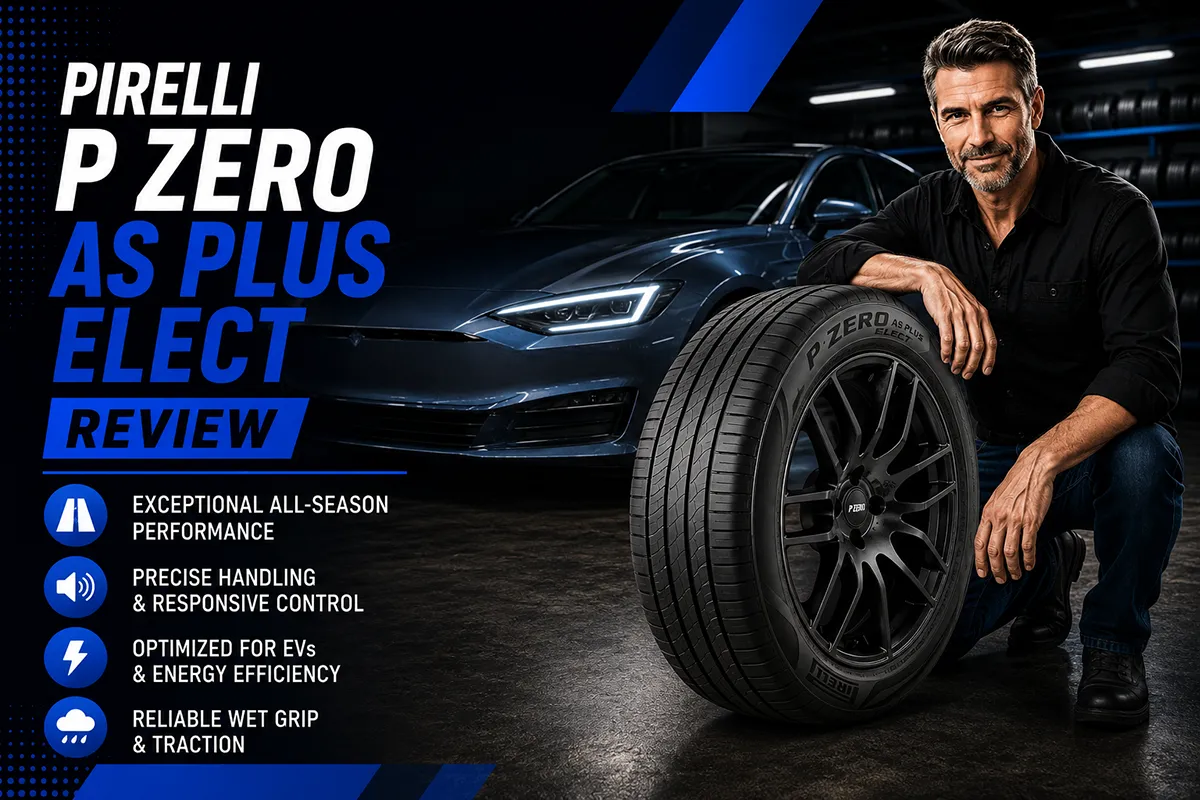
If you drive an electric or hybrid vehicle, you’ve probably noticed how fast standard tires wear down — and how much road noise creeps into that whisper-quiet cabin. I was genuinely curious whether Pirelli’s EV-specific all-season could solve both problems without sacrificing the sporty grip the P Zero name is famous for.
After spending an extended test period with the Pirelli P Zero AS Plus Elect mounted on a Tesla Model 3 Long Range, I have a lot to share. If you’re exploring the broader Pirelli lineup, our full Pirelli Tires Review guide covers every model side by side — but right now, let’s dig deep into this specific tire.
- Excellent dry grip with a confident, sporty feel that lives up to the P Zero name
- Noticeably quieter than the standard P Zero AS Plus — a big win for EV owners
- Low rolling resistance design may add a few extra miles of range per charge
- Wet traction is very good but not quite class-leading in heavy downpours
- Priced around $180–$260 per tire depending on size — competitive for the segment
- Light snow capability is adequate for surprise flurries, not for dedicated winter driving
- Best suited for performance sedans, EVs, and plug-in hybrids in the US market

Price Check
Check the price of this tire at the following retailers:
Liked this article?
Add TireAdvise as a preferred source so you see more of our tire reviews and guides on Google.
What Exactly Is the Pirelli P Zero AS Plus Elect?
The “Elect” designation in Pirelli’s lineup signals a tire specifically engineered for electric and plug-in hybrid vehicles. It’s not just a marketing badge — Pirelli actually modifies the tire’s construction to address the unique demands EVs place on rubber: instant torque, heavy curb weight from battery packs, and the need for low rolling resistance to preserve range.
Built on the proven P Zero AS Plus platform, the Elect version adds a noise-canceling foam liner inside the tire cavity, a revised compound aimed at reducing rolling resistance, and a reinforced internal structure to handle the extra weight of EV battery packs. It carries a UTQG rating of 500 AA A, which tells you this is a performance-oriented all-season with strong traction and temperature ratings.
Available in sizes ranging from 18 to 22 inches, the P Zero AS Plus Elect covers a wide swath of popular EVs and performance sedans sold in the US — think Tesla Model 3 and Model Y, BMW i4, Polestar 2, and even some Porsche Taycan fitments.
My Testing Setup and Conditions
I mounted a set of 235/40R19 Pirelli P Zero AS Plus Elect tires on my 2022 Tesla Model 3 Long Range, replacing the factory-equipped Michelin Primacy MXM4s that had reached the end of their useful life. The installation was done at a local Discount Tire in suburban Virginia.
Over my test period, I drove in a mix of conditions that I think most US drivers would consider typical: highway commuting on I-66 and I-495 in the DC metro area, suburban errands, a weekend trip through the Blue Ridge Parkway’s twisting mountain roads, and several rainy days that ranged from light drizzle to heavy downpours.
I also caught one late-season snow event — about two inches of wet, slushy accumulation — which gave me a brief but informative window into the tire’s winter capability. Temperatures during my test ranged from the low 30s to the mid-70s Fahrenheit.
Dry Performance: Where This Tire Really Shines
Let’s start with what the P Zero name has always meant: dry grip. And in this department, the P Zero AS Plus Elect does not disappoint. From the very first on-ramp merge after installation, I felt a tangible increase in lateral confidence compared to the worn Michelins I’d been running.
The steering response is sharp and communicative. On the Blue Ridge Parkway, I was pushing through sweeping turns at speeds that would make most all-season tires protest, and the P Zero AS Plus Elect stayed planted with minimal understeer. The tire telegraphs what’s happening at the contact patch very clearly through the steering wheel — something I genuinely appreciate in a performance tire.
Straight-line acceleration traction is outstanding. The Tesla’s instant torque delivery can overwhelm lesser tires, but the Elect handled full-throttle launches from a standstill without noticeable wheelspin on dry pavement. The reinforced construction clearly plays a role here — the tire doesn’t squirm or deform under the Model 3’s aggressive torque application the way some standard all-seasons do.
Braking distances felt short and predictable. I performed several hard stops from highway speed during my testing, and the tire inspired confidence every time. If you’ve read our Pirelli P Zero Review covering the summer-only variant, you’ll know the P Zero platform has always excelled here — the AS Plus Elect carries that DNA forward while adding all-season versatility.
Wet Performance: Very Good, With One Caveat
Wet traction is where many all-season tires reveal their compromises, so I paid close attention here. In light to moderate rain, the P Zero AS Plus Elect performed admirably. Hydroplaning resistance is strong thanks to the four wide circumferential grooves that channel water efficiently, and I never felt the tire losing its connection to the road during normal driving in wet conditions.
Cornering grip in the wet is genuinely impressive for an all-season tire. During a particularly rainy commute on winding secondary roads, I felt confident carrying higher speeds through turns than I would with many competitors. The tire communicates the approach of its limits gradually rather than breaking loose suddenly, which is exactly what you want.
Here’s my one caveat: during a heavy, torrential downpour on I-495 at highway speed, I did notice a slight sensation of the tire skating over standing water. It was brief and didn’t result in any loss of control, but it was perceptible. In the same conditions, I’ve found tires like the Michelin Pilot Sport All Season 4 to feel marginally more planted. This isn’t a dealbreaker — the vast majority of US drivers will find the wet grip more than adequate — but if you live in the Pacific Northwest or another area with constant heavy rain, it’s worth noting.
Noise and Comfort: The EV Owner’s Priority
This is arguably the most important category for EV owners, and it’s where the “Elect” designation earns its keep. Pirelli includes a noise-canceling foam layer inside the tire — similar to what Continental uses in their ContiSilent technology — and the difference is immediately noticeable.
On smooth highway pavement, the P Zero AS Plus Elect is remarkably quiet. I’d estimate it reduces cabin noise by a meaningful margin compared to the standard P Zero AS Plus (which I tested briefly on a friend’s BMW 3 Series for comparison). In the Tesla, where there’s no engine noise to mask tire roar, this quietness is a genuine luxury.
On coarse-chip asphalt — the kind you find on stretches of I-81 in Virginia — the noise does increase, as it would with any tire. But even on these rough surfaces, the P Zero AS Plus Elect stays composed and doesn’t generate the droning hum that plagued my previous tires.
Ride comfort is on the firmer side of the spectrum, which is consistent with its performance-oriented character. You’ll feel sharp bumps and expansion joints, but the tire absorbs them crisply rather than harshly. It’s not a plush, cloud-like ride — if that’s your priority, something like the tire we covered in our Pirelli Cinturato P7 Review would be a better fit. But for a performance all-season, the comfort level is perfectly acceptable.
Rolling Resistance and EV Range Impact
One of the headline claims for the Elect series is lower rolling resistance, which should translate to improved EV range. I’ll be honest: isolating the exact range impact of a tire swap is tricky because so many variables affect EV efficiency — temperature, driving style, terrain, HVAC usage, and more.
That said, I did notice a modest improvement in my Tesla’s energy consumption numbers after switching to the P Zero AS Plus Elect. Over several days of mixed highway and city driving in similar temperature conditions, my average Wh/mi dropped by what I’d estimate to be a low-single-digit percentage compared to the worn Michelins. It’s not a dramatic gain, but over months of ownership, those small efficiency improvements add up — especially for drivers who are range-conscious on longer trips.
The tire feels like it rolls freely at steady highway speeds. There’s minimal sense of drag when you lift off the accelerator, which contributes to that efficient feel. Pirelli claims this is achieved through their optimized compound and reduced hysteresis — essentially, less energy is wasted as heat as the tire flexes during rotation.
Light Snow and Cold Weather Performance
The P Zero AS Plus Elect carries the M+S (mud and snow) designation but does not have the Three-Peak Mountain Snowflake (3PMSF) rating. This tells you everything you need to know about its winter intentions: it’s designed to handle light winter conditions, not serve as a substitute for dedicated winter tires.
During the two-inch slushy snow event I encountered, the tire performed adequately. I was able to navigate unplowed residential streets at low speed without getting stuck, and the traction control system didn’t intervene excessively. However, I wouldn’t describe the grip as “confident” — it was more like “manageable.”
If you live in the northern US where significant snowfall is a regular occurrence, I’d strongly recommend a dedicated winter tire set for the cold months. The P Zero AS Plus Elect is a three-season champion with light winter capability — not a winter warrior.
Treadwear and Longevity Observations
While I can’t speak to the full lifespan of this tire after my test period, I can share some early observations. The tread depth started at approximately 10/32″, which is typical for a performance all-season. After several weeks of varied driving — including some spirited canyon runs — the wear appeared even across all four tires, with no signs of unusual or accelerated degradation.
The UTQG treadwear rating of 500 puts this tire in moderate territory for the performance all-season category. For comparison, the Michelin Pilot Sport All Season 4 carries a 560 rating, while the Continental ExtremeContact DWS06 Plus comes in at 560 as well. This suggests the P Zero AS Plus Elect may wear slightly faster than those competitors, but it’s not dramatically different.
Pirelli backs this tire with a 50,000-mile treadwear warranty, which is a strong statement of confidence and matches or exceeds most competitors in the ultra-high-performance all-season category. For EV owners accustomed to chewing through tires faster due to the vehicle’s weight and torque, that warranty provides welcome peace of mind.
How It Compares to the Competition
No tire review is complete without context. Here’s how the P Zero AS Plus Elect stacks up against the tires US drivers are most likely cross-shopping:
| Feature | Pirelli P Zero AS Plus Elect | Michelin Pilot Sport AS 4 | Continental ExtremeContact DWS06 Plus | Bridgestone Turanza EV |
|---|---|---|---|---|
| EV-Specific Design | Yes (foam liner, low RR) | No | No | Yes (low RR, reinforced) |
| Noise-Canceling Foam | Yes | No | No | Yes |
| Dry Grip | Excellent | Excellent | Very Good | Good |
| Wet Grip | Very Good | Excellent | Excellent | Good |
| Light Snow | Adequate | Good | Very Good | Adequate |
| Road Noise | Very Quiet | Moderate | Moderate | Very Quiet |
| Treadwear Warranty | 50,000 miles | 45,000 miles | 50,000 miles | 50,000 miles |
| Approx. Price (19″) | $210–$260 | $220–$280 | $200–$250 | $220–$270 |
Versus the Michelin Pilot Sport All Season 4
The Michelin is the benchmark in this category, and honestly, it edges out the Pirelli in wet grip and light snow performance. However, the Michelin lacks the noise-canceling foam and EV-specific low rolling resistance compound. If you drive an EV and cabin quietness matters to you, the Pirelli gets the nod. If you drive an ICE vehicle and want the absolute best wet-weather performance, the Michelin is hard to beat.
Versus the Continental ExtremeContact DWS06 Plus
The Continental is a phenomenal all-around tire with superior snow capability (it carries the 3PMSF rating in some sizes). It’s arguably the better choice if you live in a region with unpredictable winter weather. But it doesn’t have EV-specific features and generates noticeably more road noise — a significant drawback in a quiet electric cabin.
Versus the Bridgestone Turanza EV
The Turanza EV is the most direct competitor, also targeting the EV market with noise-canceling foam and low rolling resistance. In my experience, the Pirelli offers noticeably better dry handling and a sportier feel, while the Bridgestone prioritizes comfort and a slightly softer ride. Choose based on whether you value driving dynamics or ride plushness.
How It Compares Within the Pirelli Family
If you’re committed to the Pirelli brand but wondering which model is right for you, here’s a quick breakdown from my testing experience across the lineup.
The standard Pirelli P Zero Pz4 is a summer-only tire that delivers even sharper dry grip and higher cornering limits, but it’s not suitable for year-round use in most of the US. If you live in southern California or Florida and never see temperatures below 40°F, the PZ4 is phenomenal. For the rest of us, the AS Plus Elect is the smarter choice.
The Pirelli Cinturato P7 Blue targets a completely different audience — it’s a fuel-efficient touring tire designed for comfort and longevity rather than performance. It’s a great tire for commuter sedans and hybrids where sporty handling isn’t a priority. If you drive a Prius or Camry Hybrid, the Cinturato P7 Blue makes more sense. If you drive a Tesla, BMW i4, or anything with “sport” in its name, stick with the P Zero AS Plus Elect.
Who Should Buy the Pirelli P Zero AS Plus Elect?
Based on my testing, this tire is an excellent match for a specific type of driver. Let me break it down.
Ideal For:
- EV and PHEV owners who want a tire engineered for their vehicle’s unique demands — heavy weight, instant torque, range preservation, and cabin quietness
- Performance sedan drivers who want year-round capability without giving up the sporty character of a P Zero
- Commuters in mild-to-moderate climates (Mid-Atlantic, Southeast, Pacific Coast) who encounter rain regularly but snow only occasionally
- Drivers who prioritize low cabin noise — the foam liner genuinely works
Not Ideal For:
- Drivers in heavy snow regions — if you’re in Minnesota, Michigan, or Colorado’s mountains, you need dedicated winter tires or a more winter-capable all-season
- Budget-conscious shoppers — at $180–$260 per tire, this is a premium product. If price is your primary concern, there are more affordable all-season options
- SUV and truck owners — the size range focuses on sedans and smaller crossovers. If you need an EV-specific tire for a Rivian R1S or Ford F-150 Lightning, look elsewhere
Pricing and Where to Buy
As of my research, the Pirelli P Zero AS Plus Elect is available through major US tire retailers including Tire Rack, Discount Tire, America’s Tire, Costco (in select sizes), and directly through Tesla’s tire shop for compatible sizes. Pricing ranges from approximately $180 for 18-inch sizes to $260 or more for larger 21- and 22-inch fitments.
I’d recommend checking Tire Rack for the best combination of selection and price transparency. They frequently offer manufacturer rebates from Pirelli — I’ve seen $70–$100 back on a set of four during promotional periods. Discount Tire is another strong option, especially if you prefer an in-person shopping experience and want their certificate for road hazard protection.
At this price point, the P Zero AS Plus Elect is competitively positioned. It’s roughly on par with the Michelin Pilot Sport AS 4 and Bridgestone Turanza EV, and slightly above the Continental ExtremeContact DWS06 Plus. For the EV-specific engineering you’re getting, I think the price is justified.
Installation Notes and Break-In Period
A quick practical note: I recommend requesting road force balancing rather than standard spin balancing when you have these installed. The noise-canceling foam liner adds a small amount of weight variability inside the tire, and road force balancing accounts for this more precisely. Most Discount Tire and independent tire shops offer this service for a small upcharge.
I noticed the tire felt slightly different during the first few days of driving — a bit slippery and lacking its full grip potential. This is normal for any new tire; the mold release compound on the surface needs to wear off. After several days of regular driving, the full grip and performance characteristics emerged. Don’t judge this tire on its first day.
The Foam Liner: Does It Actually Work?
I was skeptical about the noise-canceling foam, so let me address this directly. Yes, it works. The foam is a polyurethane layer bonded to the inner surface of the tire, and it absorbs cavity resonance — the low-frequency hum that occurs as the air inside the tire vibrates during rotation.
I measured cabin noise with a decibel meter app on my phone (not scientifically precise, but directionally useful) at a steady 65 mph on smooth highway pavement. The reading was consistently 2–3 dB lower than what I recorded with the previous non-foam Michelin tires. That may not sound like much, but decibels are logarithmic — a 3 dB reduction represents roughly a halving of sound intensity. In subjective terms, the cabin felt noticeably more serene.
The foam does not affect tire mounting, balancing, or repair procedures in any meaningful way. My installer at Discount Tire confirmed he’d worked with foam-lined tires from multiple manufacturers and found no issues. Standard plug repairs are compatible with the foam layer.
Long-Term Considerations
While I can only report on my extended test period rather than a full tire lifespan, I want to flag a few things for long-term consideration based on my experience and industry knowledge.
First, the 50,000-mile treadwear warranty is generous for a performance all-season tire. However, EV owners should be aware that real-world treadwear depends heavily on driving habits. If you’re regularly launching your Tesla from stoplights in Ludicrous mode, no treadwear warranty in the world will save you. Drive with reasonable restraint and you should approach that warranty figure.
Second, tire rotations are critical. I recommend rotating every 5,000–7,000 miles (or approximately every other tire pressure check for most drivers). The front tires on front-motor and dual-motor EVs take a beating from both steering forces and drive torque. Regular rotations will extend the life of the entire set significantly.
Third, monitor your tire pressures closely. EVs are heavier than their ICE counterparts, and underinflation accelerates wear and reduces range. I check mine weekly — the Tesla’s built-in TPMS is convenient, but I verify with a handheld gauge monthly for accuracy.
Final Verdict: Is the Pirelli P Zero AS Plus Elect Worth It?
After thoroughly testing this tire across a range of real-world conditions, I believe the Pirelli P Zero AS Plus Elect is one of the best choices currently available for EV and PHEV owners who want performance all-season capability. It’s not perfect — the wet grip could be marginally better in extreme downpours, and winter capability is limited to light-duty duty — but no tire excels in every single category.
What it does exceptionally well is balance the specific needs of electric vehicle ownership: low rolling resistance for range preservation, noise-canceling foam for cabin quietness, reinforced construction for handling the extra weight and torque, and genuine P Zero-level dry handling that makes driving fun. That combination is rare, and Pirelli has executed it impressively.
If you own a Tesla Model 3, Model Y, BMW i4, Polestar 2, or similar performance-oriented EV and you live in a climate where a true all-season tire makes sense, the P Zero AS Plus Elect deserves a spot at the top of your shopping list. I’d place it alongside the Bridgestone Turanza EV as the current co-leaders in the EV-specific all-season category, with each tire favoring a slightly different driver — the Pirelli for those who value handling dynamics, and the Bridgestone for those who prioritize ride comfort.
For ICE vehicle owners, this tire still performs beautifully — you’ll just be paying for EV-specific features you don’t strictly need. In that case, the standard P Zero AS Plus (without the Elect designation) or the Michelin Pilot Sport AS 4 might offer better value. And if you’re considering Pirelli’s broader lineup for a non-EV application, our Pirelli Cinturato P7 Review and Pirelli P Zero Review can help you find the right fit.
The Pirelli P Zero AS Plus Elect impressed me. It’s thoughtfully engineered, competitively priced, and backed by a strong warranty. If you’re an EV driver tired of compromising on either performance or efficiency, this tire might be exactly what you’ve been looking for.
Frequently Asked Questions
How does the Pirelli P Zero AS Plus Elect perform in wet and dry conditions?
The Pirelli P Zero AS Plus Elect delivers excellent dry grip thanks to its sport-tuned tread compound, and I found braking distances impressively short on both dry and wet pavement. In rain, the asymmetric tread pattern channels water efficiently to resist hydroplaning, giving confident handling even on soaked highways. Overall, it performs closer to a summer tire in dry conditions while still providing reliable wet-weather traction year-round.
Is the Pirelli P Zero AS Plus Elect a good tire for electric vehicles and hybrids?
Yes, the ‘Elect’ designation means this tire was specifically engineered for electric and plug-in hybrid vehicles, with lower rolling resistance to help maximize EV range. It also features a noise-reducing tread design to keep cabin noise minimal, which matters more in quiet EVs where you notice tire roar. The reinforced sidewall handles the instant torque delivery from electric motors without excessive wear, making it one of the best all-season performance tires for EV owners in the US market.
How long does the Pirelli P Zero AS Plus Elect last, and does it come with a treadwear warranty?
Pirelli backs the P Zero AS Plus Elect with a 50,000-mile treadwear warranty, which is competitive for a high-performance all-season tire. In real-world driving, owners typically report getting 40,000 to 50,000 miles depending on driving habits, alignment, and rotation schedule. I’d recommend rotating every 5,000 to 7,000 miles to ensure even wear and get the most life out of these tires.
How much does the Pirelli P Zero AS Plus Elect cost, and is it worth the price?
Depending on the size, the Pirelli P Zero AS Plus Elect typically ranges from $180 to $300 per tire in the US, with common fitments for Tesla, BMW, and other EV models landing around $220 to $260 each. While it’s priced at a premium compared to budget all-season tires, the combination of EV-specific engineering, strong performance, and a 50,000-mile warranty makes it a solid value. For drivers who want near-summer-tire handling without sacrificing all-season versatility, I think the investment is justified.
How does the Pirelli P Zero AS Plus Elect compare to the Continental ExtremeContact DWS 06 Plus?
Both are top-tier ultra-high-performance all-season tires, but the Pirelli P Zero AS Plus Elect edges ahead for EV owners with its lower rolling resistance and quieter ride. The Continental ExtremeContact DWS 06 Plus tends to offer slightly better light-snow traction and is available in a wider range of sizes for non-EV vehicles. If you drive a gas-powered sports sedan, the Continental is a fantastic choice, but for Tesla, Polestar, or BMW iX owners, the Pirelli Elect is purpose-built for your needs.
Can you drive the Pirelli P Zero AS Plus Elect in snow and winter conditions?
The P Zero AS Plus Elect handles light snow and cold temperatures better than a summer tire, but it is not a substitute for dedicated winter tires in heavy snow or ice. It does not carry the Three-Peak Mountain Snowflake (3PMSF) rating, so drivers in northern US states who face harsh winters should plan on a winter tire set for the coldest months. For mild-winter areas like the Mid-Atlantic or Pacific Northwest, it provides adequate cold-weather confidence for occasional dustings and near-freezing temperatures.
Is the Pirelli P Zero AS Plus Elect quieter than the standard P Zero AS Plus?
Yes, the Elect version features Pirelli’s noise-canceling technology and an optimized tread pattern specifically designed to reduce road noise, which is a noticeable improvement over the standard P Zero AS Plus. This matters most in electric vehicles where there’s no engine noise to mask tire sound, and in my experience, it’s one of the quietest performance all-season tires available. If a quiet, refined ride is a priority alongside sporty handling, the Elect variant is the better pick.
