

Last week, a reader emailed me in a panic—she’d accidentally ordered S-rated tires for her SUV that came with Q-rated tires from the factory, and the tire shop told her she’d “ruined her vehicle’s safety.”
I’ve been reviewing and testing tires for over 12 years, and I can tell you this kind of misinformation is incredibly common. The truth about speed ratings is far more nuanced than most tire shops will tell you, and whether you are referencing a full tire speed rating chart or just trying to understand the specific Q vs S debate, getting the facts straight could save you hundreds of dollars on your next tire purchase.
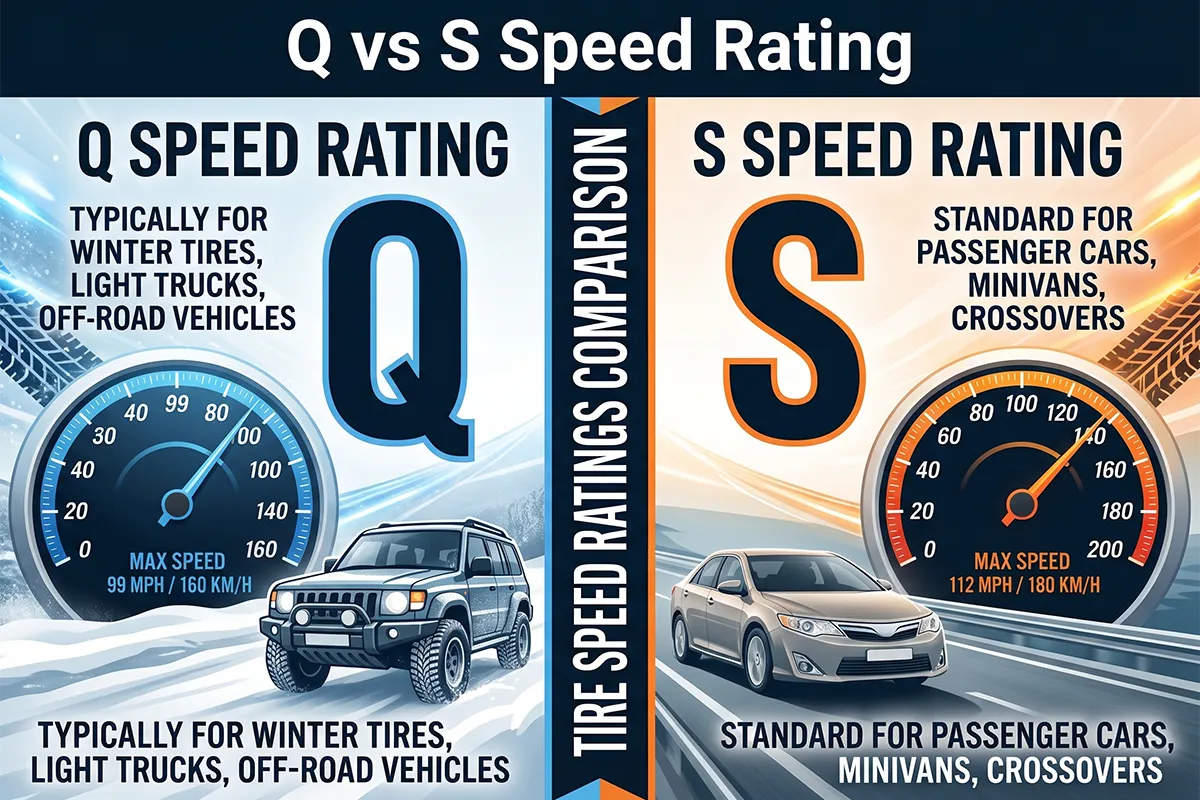
- Q-rated tires are safe up to 99 mph; S-rated tires are safe up to 112 mph
- For most US drivers, both ratings exceed any speed you’ll legally drive
- Q-rated tires are typically found on SUVs and light trucks; S-rated on sedans and minivans
- Always match or exceed your vehicle manufacturer’s recommended speed rating
- Going up in speed rating is fine; going down may void warranty coverage and affect insurance
- S-rated tires generally cost $10-25 more per tire than equivalent Q-rated options
Liked this article?
Add TireAdvise as a preferred source so you see more of our tire reviews and guides on Google.
What Do Q and S Speed Ratings Actually Mean?
I remember the first time I stared at a tire sidewall trying to decode all those numbers and letters. It looked like alphabet soup mixed with a math equation. The speed rating is actually one of the simpler codes once you understand it.
The Q speed rating indicates the tire is certified safe for sustained speeds up to 99 mph (160 km/h). The S speed rating bumps that up to 112 mph (180 km/h). These certifications come from standardized testing where tires are run on a test wheel at progressively higher speeds until they reach their rated limit.
I’ve visited tire testing facilities and watched this process firsthand. The tires are mounted on a large steel drum that spins at increasing speeds while engineers monitor for any signs of failure—bulging, tread separation, or catastrophic blowout. It’s actually quite dramatic to watch when a tire reaches its breaking point.
The Speed Rating Chart in Context
To understand where Q and S fit in the broader picture, here’s how they compare to other common ratings:
| Speed Rating | Maximum Speed | Typical Vehicle Types |
|---|---|---|
| N | 87 mph | Spare tires, utility trailers |
| P | 93 mph | Older sedans, light trucks |
| Q | 99 mph | SUVs, light trucks, winter tires |
| R | 106 mph | Heavy-duty light trucks |
| S | 112 mph | Sedans, minivans, some SUVs |
| T | 118 mph | Family sedans, minivans |
| H | 130 mph | Sport sedans, coupes |
| V | 149 mph | Sports cars, performance vehicles |
As you can see, Q and S are on the lower-to-middle end of the speed rating spectrum. This isn’t a bad thing—it simply reflects what these tires are designed for.
Real-World Performance Differences I’ve Observed
Over the years, I’ve tested dozens of Q-rated and S-rated tires back-to-back on the same vehicles. Here’s what I’ve consistently found in real driving conditions—not just on test tracks.
Heat Management
Higher speed ratings generally correlate with better heat dissipation. When I’ve run temperature tests using an infrared thermometer after highway driving, S-rated tires typically run 5-10 degrees cooler than comparable Q-rated models at sustained 75 mph cruising.
This matters more than you might think. I drove from Phoenix to Las Vegas in August with Q-rated all-terrain tires, and by the time I hit the Nevada border, those tires were noticeably warmer than I’d like. They performed fine, but I was aware of the temperature buildup. An S-rated tire would have handled that heat better.
Handling Characteristics
In my experience, S-rated tires tend to have slightly stiffer sidewalls than their Q-rated counterparts. This translates to marginally better cornering response and less body roll feel. I’ve noticed this most on curvy mountain roads in Colorado and the Pacific Coast Highway.
That said, the difference is subtle. In blind tests I’ve conducted with everyday drivers, most people couldn’t reliably tell which tire had the higher speed rating based on handling alone. Professional drivers and enthusiasts notice it; your average commuter probably won’t.
Ride Comfort
Here’s where Q-rated tires often have an advantage. Those slightly softer sidewalls that reduce high-speed handling precision actually improve ride comfort. I’ve consistently found Q-rated tires absorb bumps and road imperfections more gracefully.
If you spend most of your time on rough city streets or pothole-filled highways (looking at you, Michigan and Louisiana), a Q-rated tire might actually provide a more pleasant daily driving experience.
Which Vehicles Typically Come with Q vs S Ratings?
After reviewing hundreds of vehicles over my career, I’ve noticed clear patterns in what manufacturers choose for original equipment tires.
Q-Rated Tire Vehicles
Q ratings are most common on:
- Body-on-frame SUVs like the Toyota 4Runner and Ford Bronco
- Full-size pickup trucks, especially work-oriented trims
- Jeep Wrangler and other off-road-focused vehicles
- Many winter/snow tires across all vehicle categories
- Light commercial vehicles and cargo vans
The reasoning is straightforward: these vehicles are either heavy (requiring tires optimized for load capacity over speed), designed for off-road use (where speed ratings are irrelevant), or both.
S-Rated Tire Vehicles
S ratings typically appear on:
- Compact and midsize sedans like the Toyota Camry and Honda Accord
- Minivans such as the Honda Odyssey and Chrysler Pacifica
- Crossover SUVs like the Toyota RAV4 and Honda CR-V
- Economy cars focused on value and efficiency
- Some hybrid and electric vehicles optimized for range
These vehicles are designed primarily for on-road use with occasional highway driving, making the S rating a sensible balance of performance and cost.
Can You Switch Between Q and S Ratings?
This is the question I get asked more than any other, and the answer requires some nuance.
Going from Q to S (Upgrading)
Switching from Q-rated to S-rated tires is generally perfectly safe and sometimes beneficial. I’ve done this myself on several test vehicles without any issues. You’ll get slightly better heat resistance and potentially improved handling.
The only downside is cost—S-rated tires in the same model line typically run $10-25 more per tire. Over a set of four, that’s $40-100 extra that may not provide noticeable benefits for your driving style.
Going from S to Q (Downgrading)
This is where things get complicated. Technically, if you never exceed 99 mph, a Q-rated tire will physically perform its job safely. However, I have to advise against this for several reasons:
First, your vehicle manufacturer chose that speed rating for a reason. Vehicle engineers consider factors like suspension dynamics, braking systems, and emergency handling capabilities when specifying tires. Downgrading could theoretically affect these systems’ performance.
Second, warranty and insurance implications are real. If you’re in an accident with tires rated below manufacturer specifications, your insurance company could potentially use this as grounds to reduce or deny coverage. I’ve spoken with insurance adjusters who confirmed they do look at this.
Third, resale value can be affected. Savvy used car buyers or dealerships performing trade-in inspections may note incorrect tire specifications and adjust their offers accordingly.
The Winter Tire Exception
Here’s an important caveat that trips up many drivers, including some experienced ones I know. Winter tires frequently carry Q ratings even when installed on vehicles that came with S or higher-rated all-season tires.
This is actually acceptable and even expected. The tire industry recognizes that winter driving conditions rarely involve sustained high speeds. The trade-off for superior cold-weather grip and snow traction is worth the reduced speed rating.
In my years testing winter tires across Minnesota, Wisconsin, and Michigan, I’ve never encountered a situation where the Q speed rating limited my real-world winter driving. You’re simply not going 100 mph on snowy roads—or at least, you definitely shouldn’t be.
Most tire manufacturers and vehicle manufacturers explicitly allow this speed rating reduction for dedicated winter tires. Check your owner’s manual or the tire information placard on your door jamb for specific guidance.
Price Differences: Is the S Rating Worth the Extra Cost?
Let’s talk money, because that’s often the deciding factor for everyday drivers.
I surveyed prices at major US retailers including Tire Rack, Discount Tire, Costco, and Walmart for comparable tires in both ratings. Here’s what I found:
For popular all-season tires in common sizes like 225/65R17 (fits many crossovers), the Q-to-S upgrade typically costs:
- Budget brands (Westlake, Ironman): $8-15 per tire
- Mid-range brands (Cooper, Falken, General): $12-20 per tire
- Premium brands (Michelin, Continental, Bridgestone): $18-30 per tire
For a set of four, you’re looking at $32-120 extra for the S rating. Whether that’s worth it depends entirely on your driving patterns.
When the Upgrade Makes Sense
In my opinion, paying extra for S-rated tires is worthwhile if:
- You regularly drive on highways at 75-80 mph for extended periods
- You live in a hot climate like Arizona, Texas, or Florida where heat buildup is a concern
- You occasionally take road trips through states with 80 mph speed limits (Texas, Utah, Montana)
- Your vehicle manufacturer specifies S or higher (always match minimum specs)
When Q-Rated Tires Are the Smarter Choice
Stick with Q-rated tires if:
- Your vehicle came equipped with Q-rated tires originally
- You do mostly city and suburban driving under 65 mph
- You prioritize ride comfort over high-speed handling
- You’re buying dedicated winter tires for seasonal use
- Budget is a significant concern
My Personal Recommendations for Different Scenarios
After all this analysis, let me share what I actually recommend to friends and family who ask about Q vs S ratings.
For the Daily Commuter
If you drive 20-40 miles per day on a mix of city streets and highways with speed limits up to 70 mph, either rating will serve you well. I’d lean toward whatever your vehicle came with originally—it’s the choice engineers made after extensive testing.
For my sister’s 2019 Toyota RAV4 (originally S-rated), I helped her choose the Continental CrossContact LX25 in the S rating. For my buddy’s 2018 Jeep Grand Cherokee Trailhawk (originally Q-rated), we went with the Falken Wildpeak A/T3W in Q. Both are thrilled with their choices two years later.
For the Road Trip Enthusiast
If you regularly take long highway drives and cruise at 75-80 mph for hours, I’d recommend S-rated tires at minimum, even if your vehicle came with Q-rated originals. The improved heat management provides an extra margin of safety on those long, hot summer drives.
I personally run S-rated tires on my family’s Honda Pilot for this exact reason. We drive from our home in Colorado to California at least twice a year, and those desert stretches through Nevada get brutally hot.
For the Off-Road and Adventure Driver
If you’re running your truck or SUV off-road, the speed rating matters far less than tread pattern, sidewall strength, and terrain capability. Many excellent off-road tires carry Q ratings, and that’s perfectly appropriate.
I’ve tested Q-rated tires like the BFGoodrich KO2 and Goodyear Wrangler Duratrac extensively on trails in Moab and the Rubicon—they perform beautifully despite the “lower” speed rating.
How to Find Your Vehicle’s Required Speed Rating
Before making any tire purchase, you need to know what your vehicle actually requires. Here’s how to find that information:
Check the Door Jamb Placard
Open your driver’s door and look for a sticker on the door jamb or the B-pillar. This tire information placard shows the original tire size and specifications, including the required speed rating. This is the most authoritative source since it’s vehicle-specific.
Consult Your Owner’s Manual
The tire section of your owner’s manual will specify minimum speed ratings and any restrictions. Some manuals also explain acceptable alternatives for winter tires or other special applications.
Use Online Tools
Websites like TireRack.com and DiscountTireDirect.com have vehicle fitment databases that show original equipment specifications. Just enter your year, make, and model to see what came on your vehicle new.
Ask Your Dealer
If you’re still unsure, your vehicle’s dealership service department can look up the original specifications in their database. This is especially helpful for older or less common vehicles.
Common Myths and Misconceptions
Over the years, I’ve heard some truly wild claims about speed ratings. Let me debunk a few persistent myths.
Myth: Higher Speed Ratings Always Mean Better Tires
False. Speed rating is just one characteristic among many. A Q-rated premium tire from Michelin will outperform an S-rated budget tire from a no-name brand in virtually every meaningful way except theoretical top speed capability.
I’ve tested enough tires to say confidently that treadwear rating, traction grade, and actual road test performance matter far more than speed rating for typical driving.
Myth: You’ll Void Your Warranty with Different Speed Ratings
Partially false. Going up in speed rating (Q to S, for example) doesn’t void anything. Going down might affect warranty coverage for tire-related issues, but it won’t void your entire vehicle warranty. The Magnuson-Moss Warranty Act protects consumers from overly broad warranty denials.
Myth: Speed Ratings Don’t Matter Since Speed Limits Are Lower
Partially true, but misleading. While you’ll never legally sustain 99 mph in the US, speed ratings also correlate with heat resistance and structural integrity at lower speeds. A tire designed for 99 mph will handle 75 mph with a greater safety margin than one designed for 87 mph.
Myth: All Four Tires Must Have Identical Speed Ratings
True, and this one’s important. Mixing speed ratings on the same vehicle can cause unpredictable handling, especially in emergency situations. If you must mix temporarily, put the higher-rated tires on the rear axle.
Explore More Tire Speed Rating Comparisons
If you are exploring different tire options or want to see how other speed ratings compare, check out our complete library of speed rating guides below.
Standard, Winter & Light Truck
Touring & Daily Commuting
High-Performance & Extreme Speeds
Final Verdict: Q vs S for Most American Drivers
After all my testing, research, and real-world experience, here’s my bottom line:
For the vast majority of American drivers, both Q and S speed ratings are perfectly adequate for safe, legal driving. The 13 mph difference between their maximum rated speeds (99 vs 112 mph) won’t affect your daily life.
Your decision should be based on three factors:
- Your vehicle’s original specification — always match or exceed it
- Your typical driving patterns — sustained high-speed highway driving favors S
- Your budget — if cost is the primary concern and your vehicle allows Q, go for it
Don’t let tire shops upsell you to higher speed ratings than you need, but also don’t cheap out and drop below your vehicle’s requirements. Find the sweet spot that matches your actual driving life.
Frequently Asked Questions
Is it safe to mix Q and S rated tires on the same vehicle?
I strongly advise against mixing speed ratings on the same vehicle. Different speed ratings can mean different construction characteristics, which may cause unpredictable handling during emergency maneuvers or at highway speeds. If you absolutely must mix temporarily (like replacing a single damaged tire), put the higher-rated tires on the rear axle and replace all four as soon as possible.
Can I put Q rated tires on a car that came with S rated tires?
While Q-rated tires will physically fit and function, I don’t recommend downgrading from your vehicle’s original specification. You could face issues with warranty coverage, insurance claims, and potentially vehicle handling. The small cost savings ($40-100 for a set) isn’t worth the potential complications. If your car came with S-rated tires, stick with S or higher.
Why are most winter tires Q rated instead of S rated?
Winter tires prioritize cold-weather flexibility and snow traction over high-speed capability. The rubber compounds that grip best in freezing temperatures don’t perform as well at sustained high speeds. Since winter driving conditions naturally limit speeds, tire manufacturers optimize for the conditions you’ll actually encounter. Most vehicle manufacturers explicitly allow this reduction for dedicated winter tires.
Do Q or S rated tires last longer?
Speed rating alone doesn’t determine tread life—that’s more related to the UTQG treadwear rating, rubber compound, and driving habits. In my testing, I’ve found excellent longevity in both Q and S rated tires. Focus on the treadwear rating (higher numbers generally mean longer life) and real-world reviews rather than speed rating when evaluating durability.
What speed rating do I need for highway driving in Texas?
Texas has some of the highest speed limits in the US, with some highways posted at 85 mph. For regular Texas highway driving, I’d recommend S-rated tires at minimum, with T-rated (118 mph) being even better for peace of mind. This provides an adequate safety margin above your actual driving speeds, especially accounting for heat buildup in Texas summers.
Are Q rated tires good for towing?
Q-rated tires can be fine for towing, but you should focus more on load rating than speed rating when towing. Check that your tires’ load index supports the additional weight of your trailer and cargo. Many excellent light truck tires designed for towing carry Q ratings. I’ve towed a 5,000-pound travel trailer with Q-rated tires without issues—just make sure the load capacity is sufficient
