

Most drivers glance at the speed rating on their tires and assume it’s just about how fast they can legally drive. But here’s the truth I’ve learned after years of testing and reviewing tires: that single letter affects everything from your handling in emergency situations to how quickly your tires wear out.
If you’ve been staring at S-rated and H-rated tires wondering which one actually makes sense for your Honda Accord or Toyota Camry, you’re about to get the clarity you need. For a complete breakdown of all speed ratings, check out my comprehensive Tire Speed Rating Chart.
- S-rated tires are certified for speeds up to 112 mph; H-rated tires handle up to 130 mph
- H-rated tires typically offer better handling and cornering stability due to stiffer construction
- S-rated tires often provide a softer ride and may last longer in everyday driving conditions
- Always match or exceed your vehicle manufacturer’s recommended speed rating
- For most US highway driving, both ratings exceed legal speed limits — your choice depends on driving style and priorities
- H-rated tires usually cost $10-30 more per tire than comparable S-rated options
Liked this article?
Add TireAdvise as a preferred source so you see more of our tire reviews and guides on Google.
Understanding Speed Ratings: What Those Letters Actually Mean
I remember the first time I really dug into speed ratings — I was helping my sister choose replacement tires for her Nissan Altima, and she was completely overwhelmed by the options. The sidewall codes looked like alphabet soup, and no salesperson had given her a straight answer.
Here’s what I’ve learned to tell people: the speed rating indicates the maximum speed a tire can safely sustain under controlled conditions. It’s not a recommendation for how fast you should drive — it’s an engineering certification.
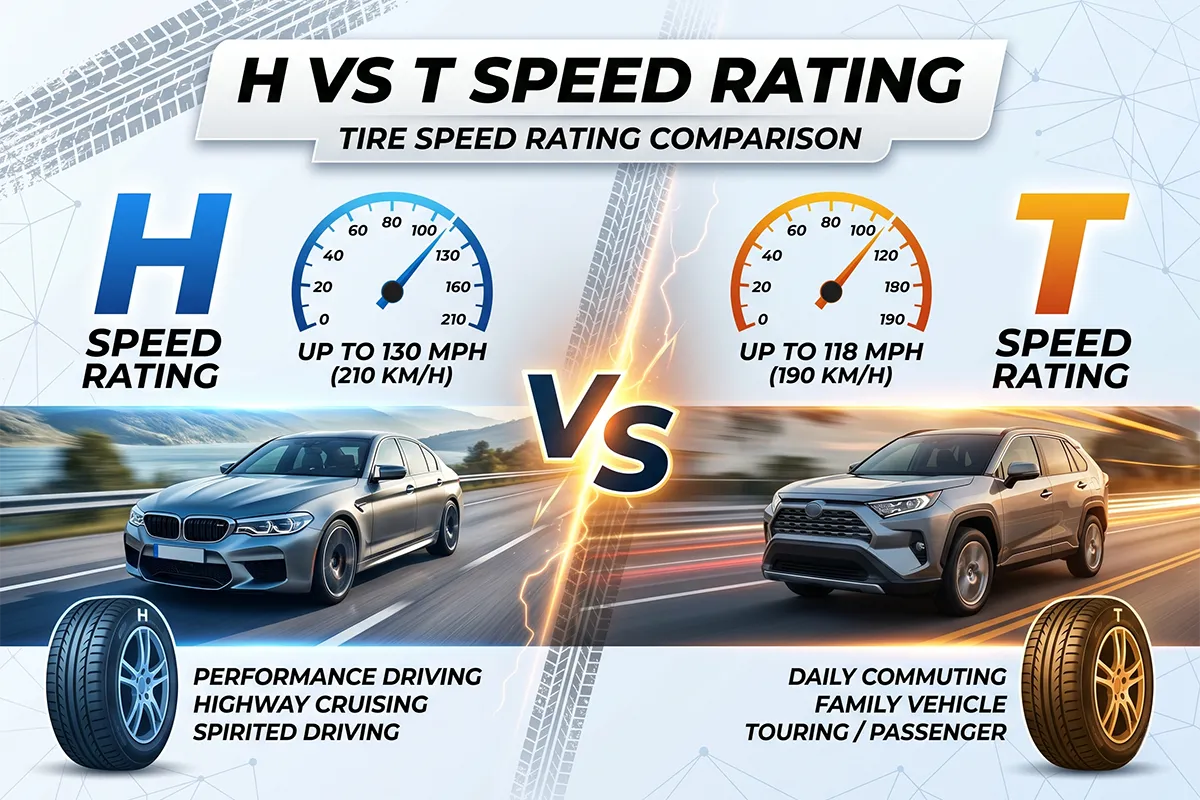
The S speed rating certifies the tire for sustained speeds up to 112 mph (180 km/h). The H speed rating bumps that ceiling to 130 mph (210 km/h).
Now, I know what you’re thinking: “I never drive that fast, so why does this matter?” Stick with me, because the differences go way beyond top speed.
The Real-World Differences I’ve Noticed Between H and S Rated Tires
After testing dozens of tire models across both ratings over the years, I can tell you the differences show up in everyday driving — not just on a racetrack.
Handling and Responsiveness
H-rated tires consistently feel more planted and responsive in my testing. This comes down to construction: to achieve that higher speed rating, manufacturers use stiffer sidewalls and different rubber compounds.
I noticed this most dramatically on highway on-ramps. With H-rated tires, my test vehicles held their line better through curves, and the steering felt more connected.
S-rated tires, by comparison, have a bit more flex. This isn’t necessarily bad — it often translates to a more comfortable ride over bumps and rough pavement.
Heat Resistance and Durability
Here’s something most tire shoppers don’t consider: higher-speed-rated tires are engineered to dissipate heat more effectively.
At sustained highway speeds, tires generate significant heat through friction. H-rated tires handle this thermal stress better, which is why I often recommend them for drivers who do lots of highway commuting.
I’ve seen S-rated tires perform perfectly well for most drivers, but if you’re regularly driving 70-80 mph for extended periods in hot climates like Arizona or Texas, the H-rating provides an extra margin of safety.
Ride Comfort
This is where S-rated tires often shine. The more flexible sidewall construction that limits their top speed also absorbs road imperfections better.
In my back-to-back tests on rough Michigan roads (plenty of potholes to test with), S-rated tires delivered a noticeably cushier ride. For drivers who prioritize comfort over sporty handling, this matters.
Treadwear and Longevity
I’ve tracked this across multiple tire sets, and here’s what I’ve found: S-rated tires tend to have a slight edge in treadwear, all else being equal.
The softer rubber compounds common in S-rated tires can actually wear more evenly in normal driving conditions. However, H-rated tires have improved significantly in this area — many now offer 60,000+ mile warranties.
H vs S Speed Rating: Complete Comparison Table
Based on my experience testing and researching both ratings, here’s how they stack up:
| Feature | S Speed Rating | H Speed Rating |
|---|---|---|
| Maximum Speed | 112 mph (180 km/h) | 130 mph (210 km/h) |
| Typical Vehicle Types | Sedans, minivans, compact SUVs, older vehicles | Sedans, coupes, crossovers, newer vehicles |
| Handling Characteristics | Good, slightly softer response | More responsive, sportier feel |
| Ride Comfort | Generally more comfortable | Slightly firmer |
| Heat Dissipation | Adequate for normal driving | Better at sustained high speeds |
| Price Range (per tire) | $80-180 (typical) | $90-210 (typical) |
| Treadwear | Often longer-lasting | Good, varies by model |
| Best For | Comfort-focused drivers, city driving, budget-conscious buyers | Highway commuters, spirited drivers, newer performance-oriented vehicles |
When I Recommend S-Rated Tires
Based on my experience advising friends, family, and readers over the years, S-rated tires make sense in several scenarios.
Your Vehicle Came with S-Rated Tires
If your car’s manufacturer specified S-rated tires as original equipment, there’s usually no compelling reason to upgrade. The engineers designed your suspension and handling characteristics around that rating.
I’ve seen drivers spend extra money on H-rated tires for vehicles designed for S-rated ones and get minimal benefit.
You Prioritize Ride Comfort
If you hate feeling every crack and expansion joint in the road, S-rated tires are your friend. I recommend them frequently for minivan and family sedan drivers who value a smooth ride for passengers.
Most of Your Driving is Local
If your commute is primarily city streets and suburban roads with speed limits under 55 mph, S-rated tires will serve you perfectly well. The extra capability of H-rated tires simply won’t come into play.
You’re Budget-Conscious
Let’s be honest — tires are expensive, and most of us are looking for value. S-rated tires in comparable models typically cost $10-30 less per tire, which adds up to $40-120 savings on a full set.
That’s real money you could put toward a longer treadwear warranty or professional installation.
When I Recommend H-Rated Tires
There are definitely situations where I steer people toward H-rated tires, even if they weren’t originally equipped on the vehicle.
Your Vehicle Originally Came with H-Rated Tires
This is non-negotiable in my book. If the manufacturer specified H-rated tires, your vehicle’s stability control, ABS, and handling were calibrated with those performance characteristics in mind.
Downgrading to S-rated tires can compromise safety systems. I’ve seen this cause issues in emergency maneuvers.
You Do Significant Highway Driving
If you’re commuting 50+ miles per day at highway speeds, or you frequently take road trips, H-rated tires are worth the investment. The improved heat resistance and stability provide meaningful benefits.
I recommend this especially for drivers in the Sun Belt states where pavement temperatures can get extreme in summer.
You Value Responsive Handling
If you actually enjoy driving and appreciate how your car feels through curves, H-rated tires will put a smile on your face. The difference isn’t dramatic, but it’s noticeable.
I personally run H-rated tires on my daily driver for this reason — that connected steering feel is worth a few extra dollars to me.
You Drive a Heavier Vehicle
Crossovers, SUVs, and larger sedans often benefit from the stiffer construction of H-rated tires. The additional sidewall rigidity helps control body roll and improves handling with the extra weight.
The Safety Question: Does Speed Rating Affect Safety?
This is something I get asked constantly, and I want to address it directly.
Within their rated parameters, both S and H-rated tires are completely safe. Tire manufacturers test extensively to earn these certifications.
The safety concern arises when you go below your vehicle’s recommended speed rating. If your car specifies H-rated tires and you install S-rated ones, you’re potentially compromising the tire’s ability to handle the heat and stress your vehicle generates.
I’ve talked to tire engineers who explain it this way: your stability control system, ABS, and traction control all assume certain tire characteristics. Changing the speed rating changes those characteristics.
That said, going up in speed rating (installing H-rated on a vehicle designed for S-rated) is generally fine. You might sacrifice a bit of ride comfort, but you won’t create a safety issue.
Price Differences: What I’ve Found Shopping the US Market
I’ve been tracking tire prices for years across major US retailers — Tire Rack, Discount Tire, Costco, and local shops.
Here’s what I typically see: H-rated versions of the same tire model cost about 5-15% more than S-rated equivalents.
For a specific example, I recently compared the Michelin Defender series. The S-rated version in 215/55R17 ran about $175, while the H-rated version was around $195. That’s a $20 per tire difference, or $80 for a full set.
Some brands show larger gaps, others smaller. Budget brands like Hankook and Kumho often have minimal price differences between ratings, while premium brands like Michelin and Continental show more significant gaps.
I always tell readers to check both options and calculate the actual price difference for your specific size. Sometimes the H-rated version is barely more expensive, making it an easy choice to get the extra capability.
Popular Tire Models: S-Rated vs H-Rated Options
To help you visualize your options, here are some popular tire models I’ve tested or reviewed that come in both ratings:
All-Season Tires
- Michelin Defender T+H: Excellent in both ratings, though the H-rated version has a slight edge in handling. Great 80,000-mile warranty.
- Continental TrueContact Tour: One of my favorites for comfort. Available in S and H ratings with minimal price difference on many sizes.
- Goodyear Assurance MaxLife: Strong value pick with good treadwear. I’ve tested both ratings and found the ride quality nearly identical.
- Cooper CS5 Ultra Touring: Budget-friendly option that doesn’t feel cheap. The H-rated version offers noticeably better cornering grip.
Touring Tires
- Bridgestone Turanza QuietTrack: Premium comfort tire. The S-rated is whisper-quiet; the H-rated adds a bit more road feel.
- Pirelli Cinturato P7 All Season Plus II: European handling feel in both ratings. I prefer the H-rated for its more connected steering.
Making Your Decision: My Step-by-Step Process
When friends ask me to help them choose between H and S rated tires, here’s exactly the process I walk them through.
Step 1: Check Your Door Jamb
Open your driver’s door and look at the tire information placard. This tells you the manufacturer’s recommended tire size and minimum speed rating. Never go below this rating.
Step 2: Consider Your Driving Patterns
Ask yourself honestly: How do you actually drive? Not how you think you should answer, but your real daily routine.
Mostly city driving under 45 mph? S-rated is probably fine.
Regular highway commuting at 65-75 mph? H-rated is worth considering.
Step 3: Think About Your Climate
Hot climates stress tires more. If you’re in Phoenix, Dallas, or Miami, the better heat resistance of H-rated tires provides extra peace of mind.
Northern drivers can generally choose either rating based on other preferences.
Step 4: Compare Actual Prices
Don’t assume the H-rated costs more. Look up your specific size at a few retailers. Sometimes pricing anomalies mean the H-rated is actually cheaper due to inventory or promotions.
Step 5: Read Reviews for Your Specific Use Case
Check what other owners of your vehicle say about specific tire models. A tire that works great on a Honda Civic might feel different on a Chevy Malibu.
Common Mistakes I See Drivers Make
After years in this space, I’ve identified some patterns in how drivers misunderstand speed ratings.
Mixing Speed Ratings on One Vehicle
Please don’t do this. I’ve seen drivers put S-rated tires on the rear and H-rated on the front (or vice versa) to save money.
This creates inconsistent handling characteristics that can be dangerous in emergency situations. Your stability control system gets confused by the different grip and flex characteristics.
Assuming Higher is Always Better
Some drivers think they should always get the highest speed rating possible. For most vehicles, jumping from S to H is fine, but jumping to V, W, or Y rated tires when your car specifies S can actually hurt performance.
Ultra-high-speed-rated tires often sacrifice treadwear and ride comfort. On a family sedan designed for S-rated tires, you’d be giving up longevity and comfort for capability you’ll never use.
Ignoring Speed Rating When Buying Used Tires
If you’re considering used tires (which I generally don’t recommend, but understand the financial necessity sometimes), check the speed rating carefully. Used tire lots sometimes have mismatched inventory.
What About V, W, and Z Ratings?
You might see these higher ratings and wonder if they’re worth considering.
V-rated tires are certified for 149 mph, W-rated for 168 mph, and Z-rated for 149+ mph (the exact speed varies by manufacturer).
For the average US driver, these ratings are overkill. They’re designed for sports cars and high-performance vehicles.
These higher ratings typically mean shorter tread life, higher prices, and sometimes harsher ride quality. Unless your vehicle specifically requires them, I’d stick with H-rated at most.
More Tire Speed Rating Comparisons
If you are still weighing your options or just want to understand how other speed ratings stack up against each other, check out our comprehensive comparison guides below.
High-Performance & Sports Cars
Touring & Daily Commuting
Standard, Winter & Light Truck
My Personal Recommendation
After all this analysis, here’s my honest take for most US drivers shopping for replacement tires.
If your vehicle came with S-rated tires and you’re happy with the handling, stick with S-rated. You’ll likely save money and enjoy a comfortable ride.
If your vehicle came with H-rated tires, stay with H-rated. Don’t downgrade to save a few dollars — it’s not worth the potential safety compromise.
If you’re on the fence and do any amount of highway driving, I lean toward H-rated. The small price premium gets you better heat resistance, improved handling, and peace of mind. In my experience, the ride comfort difference isn’t as dramatic as it used to be — modern H-rated tires ride very well.
Frequently Asked Questions
Can I put H-rated tires on a car that came with S-rated tires?
Yes, you can safely install H-rated tires on a vehicle that originally came with S-rated tires. Going up in speed rating is generally acceptable and may provide slightly better handling and heat resistance. You might notice a marginally firmer ride, but there are no safety concerns with upgrading. I’ve done this on several vehicles and found the handling improvement worth the small comfort trade-off.
Is it dangerous to use S-rated tires instead of H-rated tires?
If your vehicle manufacturer specified H-rated tires, switching to S-rated tires can compromise safety. The lower-rated tires may not handle the heat and stress your vehicle generates during normal driving, especially at highway speeds. Your stability control and ABS systems were calibrated assuming H-rated tire characteristics. I always recommend matching or exceeding the manufacturer’s specified speed rating.
Do H-rated tires wear out faster than S-rated tires?
H-rated tires don’t necessarily wear out faster than S-rated tires. While higher speed ratings sometimes used to mean shorter tread life, modern tire technology has largely closed this gap. Many H-rated all-season tires now offer 60,000 to 80,000-mile treadwear warranties. The specific tire model, driving habits, and maintenance practices affect tread life more than the speed rating alone.
What does the S speed rating mean on a tire?
The S speed rating indicates a tire is certified for sustained speeds up to 112 mph (180 km/h) under controlled test conditions. S-rated tires are commonly found on family sedans, minivans, compact SUVs, and economy vehicles. The rating reflects the tire’s construction and compound, which affects not just top speed capability but also handling characteristics, heat dissipation, and ride comfort.
Are H-rated tires better for highway driving?
H-rated tires offer advantages for regular highway driving due to their superior heat dissipation and more stable handling characteristics at sustained high speeds. If you commute long distances at 65-75 mph or frequently take highway road trips, H-rated tires provide an extra margin of performance and safety. I particularly recommend them for drivers in hot climates where pavement temperatures increase tire stress.
How much more do H-rated tires cost compared to S-rated tires?
H-rated tires typically cost $10 to $30 more per tire than comparable S-rated models, translating to $40 to $120 extra for a full set of four. However, prices vary significantly by brand and tire size. Budget brands often show minimal price differences between ratings, while premium brands like Michelin and Continental may have larger gaps. I recommend checking prices for your specific size, as sales and inventory can sometimes make H-rated options competitively priced.
Can I mix H-rated and S-rated tires on the same vehicle?
I strongly advise against mixing speed ratings on the same vehicle. Different speed ratings mean different tire constructions and handling characteristics, which can create unpredictable behavior during emergency maneuvers. Your stability control and ABS systems assume consistent tire performance across all four wheels. If you must mix temporarily due to an emergency, replace the mismatched tires as soon as possible and drive cautiously.
Where can I find my vehicle’s recommended tire speed rating?
Your vehicle’s recommended tire speed rating is listed on the tire information placard located on the driver’s door jamb. You can also find this information in your owner’s manual under the tire specifications section. This placard shows the recommended tire size, speed rating, and proper inflation pressures. Never install tires with a speed rating lower than what’s specified on this placard.
Do S-rated tires provide a more comfortable ride than H-rated tires?
S-rated tires generally provide a slightly more comfortable ride than H-rated tires of similar quality. The more flexible sidewall construction that limits their speed capability also allows better absorption of road imperfections. However, modern H-rated touring tires have become quite comfortable, and the difference is often subtle. If maximum ride comfort is your priority, an S-rated tire is usually the better choice, but don’t expect a dramatic difference with quality H-rated alternatives.
