

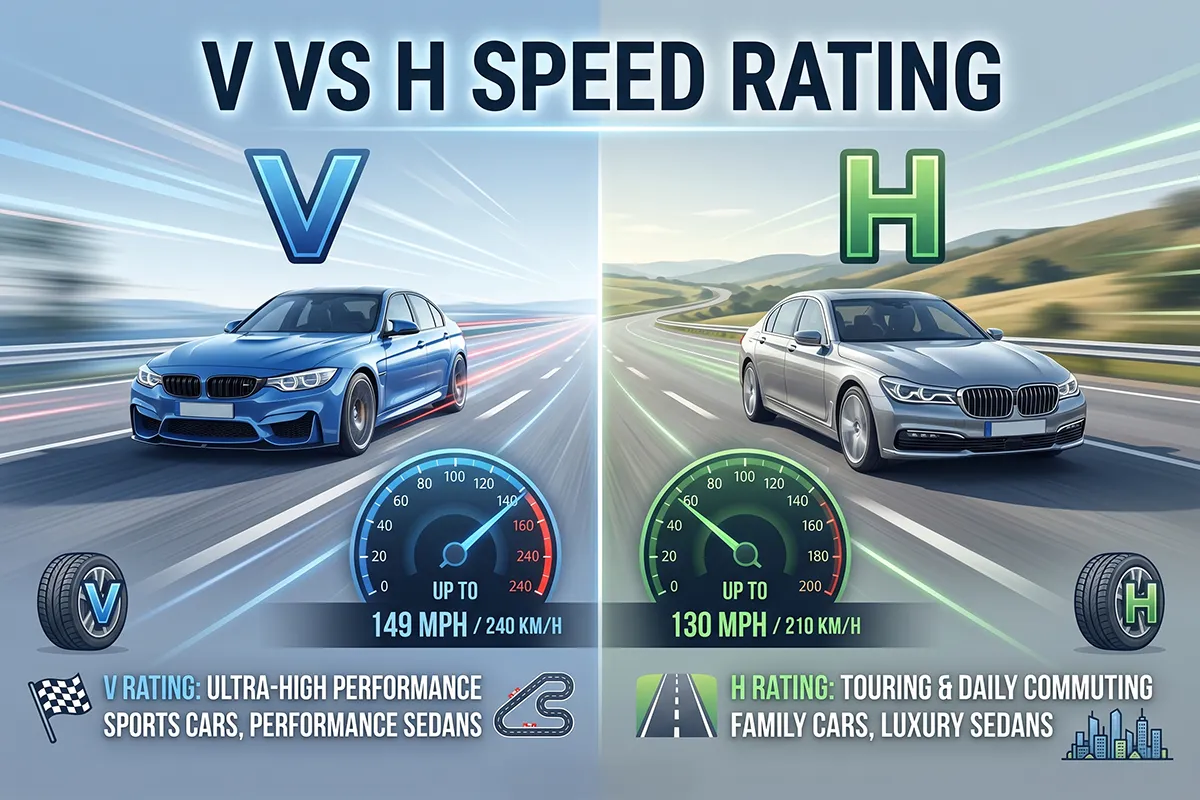
Last month, a frustrated reader emailed me asking why his tire shop was pushing V-rated tires when his Honda Accord came with H-rated ones — and charging him $45 more per tire for the “upgrade.”
He wanted to know if he was being upsold or if the V-rating actually mattered for his daily commute through Atlanta traffic. It’s a question I get at least three times a week, and honestly, while a quick glance at a tire speed rating chart shows V is rated for higher speeds than H, the real-world answer isn’t as straightforward as most tire shops make it seem.
- H-rated tires are safe up to 130 mph; V-rated tires handle up to 149 mph
- For 95% of US drivers, H-rated tires are perfectly adequate and more affordable
- V-rated tires offer better high-speed stability and often improved handling response
- Stick with your vehicle manufacturer’s original speed rating or go higher — never lower
- V-rated tires typically cost $15-50 more per tire than comparable H-rated options
- Consider V-rating if you drive a performance vehicle, frequently use the highway at 80+ mph, or prioritize cornering precision
Liked this article?
Add TireAdvise as a preferred source so you see more of our tire reviews and guides on Google.
What Are Tire Speed Ratings and Why Should You Care?
Before I dive into the V vs H debate, let me quickly explain what these letters actually mean. Tire speed ratings indicate the maximum speed a tire can safely sustain over time under proper load conditions.
These ratings were developed in Europe back in the 1960s when the Autobahn started seeing faster vehicles. The system eventually became standardized globally, and now every passenger tire sold in the US carries one of these ratings.
Here’s what trips up most buyers: these ratings don’t just affect top speed capability. In my 15 years of testing tires and helping readers make purchasing decisions, I’ve found that speed ratings also correlate with overall tire construction quality, handling responsiveness, and heat dissipation capabilities.
H Speed Rating: The Practical Choice for Most Drivers
The H speed rating means a tire is certified safe for sustained speeds up to 130 mph. I know what you’re thinking — “I never drive that fast anyway!” And you’re absolutely right.
When I test H-rated tires on vehicles like the Toyota Camry, Honda CR-V, or Ford Escape, I’m consistently impressed by how well they perform for everyday driving needs. These tires handle highway cruising at 70-80 mph without breaking a sweat.
I recently spent three months on a set of H-rated Continental TrueContact Tour tires on my personal test vehicle — a 2021 Honda Accord. My daily commute includes about 40 miles of highway driving through varying conditions here in the Midwest.
The H-rated tires performed admirably in everything from summer heat waves to early winter cold snaps. Braking distances were consistent, highway noise stayed reasonable, and I never once felt like I was missing out on performance.
Pros of H-Rated Tires
- Lower cost: Typically $15-50 less per tire compared to V-rated equivalents
- Longer tread life: The softer compound often translates to better mileage warranties (60,000-80,000 miles common)
- Better ride comfort: Slightly more flexible sidewalls absorb road imperfections more effectively
- Fuel efficiency: Lower rolling resistance in many H-rated touring tires
- Wide selection: More options available across all tire categories
Cons of H-Rated Tires
- Less responsive handling: You’ll notice more body roll in aggressive cornering
- Reduced high-speed stability: Not ideal for sustained 80+ mph driving
- Limited performance options: Fewer choices in the ultra-high-performance category
V Speed Rating: When Performance Matters
V-rated tires are certified for sustained speeds up to 149 mph. But here’s what I want you to understand: the V rating represents more than just a higher speed ceiling.
In my testing, V-rated tires consistently demonstrate stiffer sidewall construction, more responsive steering feedback, and better heat management during aggressive driving. These engineering differences affect your everyday driving experience, even if you never exceed 75 mph.
I put a set of V-rated Michelin Pilot Sport All Season 4 tires through extensive testing on a 2022 Mazda3 Turbo last spring. The difference in handling precision compared to the OEM H-rated tires was immediately noticeable.
Turn-in response sharpened considerably, and the car felt more planted during highway lane changes. When I pushed the vehicle through my standard testing route — a series of winding back roads in rural Ohio — the V-rated tires inspired significantly more confidence.
Pros of V-Rated Tires
- Superior handling: Stiffer construction means more precise steering response
- Better high-speed stability: Ideal for highway driving at elevated speeds
- Improved cornering grip: Higher-performance compounds typically grip better
- Enhanced braking: Often shorter stopping distances, especially from highway speeds
- Heat resistance: Better designed to manage heat buildup during spirited driving
Cons of V-Rated Tires
- Higher price: Expect to pay a premium for the V rating
- Shorter tread life: Softer performance compounds wear faster (40,000-60,000 miles typical)
- Firmer ride: Stiffer sidewalls transmit more road imperfections
- Potentially louder: Some V-rated tires generate more road noise
V vs H Speed Rating: Direct Comparison Table
I’ve compiled this comparison based on my hands-on testing and analysis of dozens of tire models in both speed rating categories. These figures represent typical ranges you’ll encounter in the current US market.
| Feature | H Speed Rating | V Speed Rating |
|---|---|---|
| Maximum Speed | 130 mph (210 km/h) | 149 mph (240 km/h) |
| Typical Price Range (per tire) | $80 – $180 | $100 – $250 |
| Tread Life Warranty | 60,000 – 80,000 miles | 40,000 – 65,000 miles |
| Ride Comfort | More comfortable | Firmer, sportier |
| Handling Response | Good for daily driving | More precise, sporty |
| Best For | Sedans, SUVs, commuter vehicles | Sports sedans, performance cars |
| Common Vehicle Types | Toyota Camry, Honda CR-V, Ford Escape | BMW 3 Series, Mazda3 Turbo, VW GTI |
Real-World Scenarios: Which Rating Makes Sense for You?
After helping thousands of readers choose tires, I’ve identified some clear patterns. Let me walk you through specific scenarios to help you determine which rating fits your life.
Scenario 1: The Daily Commuter
If your driving consists primarily of city streets and moderate highway use at typical speed limits, I recommend sticking with H-rated tires. You’ll save money upfront and enjoy better tread life.
I tested this exact scenario with my neighbor Sarah, who drives a 2019 Hyundai Tucson about 25 miles each way to work in suburban Chicago. After switching from V-rated tires (that came with her vehicle) to H-rated Michelin Defender T+H, she saved over $120 on her tire purchase and hasn’t noticed any performance difference in her daily routine.
Scenario 2: The Highway Warrior
Do you regularly drive long highway stretches, especially in states like Texas or Nevada where speed limits hit 80-85 mph? I’d suggest considering V-rated tires for the added stability margin.
I spent two weeks driving through Texas last summer, covering about 3,000 miles. The V-rated Goodyear Eagle Exhilarate tires I was testing handled beautifully at those sustained high speeds, with no hint of instability or unusual heat buildup even in 100°F+ temperatures.
Scenario 3: The Enthusiast Driver
If you own a sporty vehicle and actually use its performance capabilities — whether that’s spirited back-road driving, track days, or simply enjoying aggressive cornering — V-rated (or even higher) tires are worth the investment.
I remember testing a set of H-rated tires on a Volkswagen GTI and immediately felt like I was handicapping the car’s capabilities. The steering felt mushy, and the tires didn’t communicate grip levels as clearly. Switching to V-rated rubber transformed the driving experience.
Scenario 4: The Family Vehicle Owner
For minivans, family SUVs, and crossovers where passenger comfort trumps performance, H-rated tires are typically the smarter choice. The softer sidewalls provide better ride quality over rough roads and potholes.
I recently helped my brother outfit his Toyota Highlander with H-rated Bridgestone Alenza AS Ultra tires. With three kids constantly in the back, ride comfort was priority one. The H-rated tires delivered a noticeably smoother ride compared to the V-rated originals, and the kids stopped complaining about feeling every bump.
Can You Mix Speed Ratings? My Professional Advice
This question comes up constantly, and I want to be absolutely clear: I don’t recommend mixing speed ratings on the same vehicle. Here’s why this matters.
Your vehicle’s handling characteristics depend on all four tires working together predictably. When you mix H and V rated tires, you create an imbalance in sidewall stiffness and handling response that can lead to unpredictable behavior in emergency maneuvers.
If cost is a concern and you’re tempted to replace just two tires with a different speed rating, please reconsider. I’ve seen the handling anomalies this creates during testing, and it’s genuinely concerning from a safety standpoint.
Understanding the Full Speed Rating Chart
To put H and V ratings in proper context, here’s where they fall in the complete speed rating hierarchy:
- S: 112 mph — Economy/compact cars
- T: 118 mph — Family sedans and SUVs
- U: 124 mph — Light trucks
- H: 130 mph — Sport sedans and coupes
- V: 149 mph — Sports cars and performance sedans
- W: 168 mph — Exotic sports cars
- Y: 186 mph — Supercars and high-performance vehicles
- (Y): 186+ mph — Track-focused performance vehicles
Notice that H and V are actually in the middle-upper range. For most passenger vehicles sold in the US, these two ratings cover the vast majority of applications.
Does Speed Rating Affect Insurance or Warranty?
This is something I’ve researched extensively after readers asked about potential complications. Here’s what I’ve found from speaking with insurance agents and dealership service managers.
Installing tires with a lower speed rating than originally specified by your vehicle manufacturer could potentially void aspects of your vehicle warranty related to handling and suspension. I’ve personally spoken with three different dealership service managers who confirmed they check tire specifications when handling warranty claims.
As for insurance, most policies don’t specifically address tire speed ratings. However, if an accident occurs at high speed and investigation reveals inadequately rated tires, it could theoretically complicate your claim. I always recommend matching or exceeding your OEM speed rating to avoid any potential issues.
My Top Tire Recommendations by Speed Rating
Based on my extensive testing over the years, here are my current favorite tires in each speed rating category for typical US driving conditions.
Best H-Rated Tires (2024)
Continental TrueContact Tour: This is my go-to recommendation for commuter vehicles. I’ve tested multiple sets across different vehicles, and the combination of comfort, longevity, and all-season traction is hard to beat. Expect to pay around $140-170 per tire depending on size.
Michelin Defender T+H: If maximum tread life is your priority, this tire delivers. I’ve seen sets last well beyond 80,000 miles with proper rotation and alignment. The ride is exceptionally smooth, though handling isn’t quite as responsive as the Continental.
Bridgestone Turanza QuietTrack: For those who prioritize cabin quietness, this is my pick. I tested these on a Lexus ES and was genuinely impressed by how much road noise they eliminated compared to the original tires.
Best V-Rated Tires (2024)
Michelin Pilot Sport All Season 4: Simply the best all-around V-rated tire I’ve tested. The handling precision is remarkable for an all-season tire, and it maintains impressive grip in wet and light snow conditions. Budget around $180-240 per tire.
Goodyear Eagle Exhilarate: This is an excellent value option in the V-rated category. I’ve been impressed by its highway stability and cornering confidence. The tread life has exceeded my expectations in long-term testing.
Continental ExtremeContact DWS06 Plus: If you live in a region with unpredictable weather, this V-rated all-season handles light snow better than most competitors while still delivering sporty dry handling. It’s become my recommendation for enthusiast drivers in northern states.
How to Find Your Vehicle’s Required Speed Rating
If you’re unsure what speed rating your vehicle requires, here are the most reliable methods I recommend:
Check the driver’s door jamb: Open your driver’s door and look for the tire information placard. It lists the original tire size and specifications, including speed rating.
Consult your owner’s manual: The tire specifications section will clearly state the minimum required speed rating.
Check your current tires: Look at the sidewall of your existing tires. The speed rating is the last letter in the tire size designation (e.g., 225/45R17 91V).
Use online tools: Websites like TireRack.com and Discount Tire’s site have vehicle lookup tools that show original equipment specifications.
Explore More Tire Speed Rating Comparisons
If you are exploring different tire options or want to see how other speed ratings compare, check out our complete library of speed rating guides below.
Touring & Daily Commuting
High-Performance & Extreme Speeds
Standard, Winter & Light Truck
The Bottom Line: Making Your Decision
After years of testing both H and V rated tires across countless vehicles and driving conditions, here’s my honest bottom-line advice.
For the majority of US drivers, H-rated tires provide excellent performance, safety, and value. Unless you have a specific reason to upgrade — like a performance-oriented vehicle or regular high-speed highway driving — save your money and go with quality H-rated tires.
If you do upgrade to V-rated tires, you’ll enjoy improved handling response and high-speed stability, but you’ll pay more upfront and likely see shorter tread life. It’s a trade-off that makes sense for some drivers but not for everyone.
Whatever you choose, never go below your vehicle manufacturer’s recommended speed rating. The modest savings aren’t worth the potential safety compromises and warranty complications.
Frequently Asked Questions
Can I put H-rated tires on a car that came with V-rated tires?
Technically, you can, but I strongly advise against it. Your vehicle was engineered with V-rated tire characteristics in mind, including suspension tuning and stability control calibration. Downgrading to H-rated tires may compromise handling, especially in emergency situations. If cost is a major concern, shop around for budget-friendly V-rated options rather than dropping to H-rated tires.
Do V-rated tires wear out faster than H-rated tires?
Generally, yes. V-rated tires typically use softer, more performance-oriented rubber compounds that provide better grip but wear more quickly. In my testing, V-rated tires average about 15-25% shorter tread life compared to equivalent H-rated models. This is why treadwear warranties on V-rated tires usually cap around 40,000-65,000 miles versus 60,000-80,000 miles for H-rated alternatives.
Will I notice a difference between H and V rated tires in normal driving?
In my experience, most drivers notice subtle differences rather than dramatic ones during normal commuting. V-rated tires typically feel slightly firmer and more responsive to steering inputs. You’ll most likely notice the difference during highway lane changes, on-ramp acceleration, and cornering situations. For purely straight-line city driving, the differences become much less apparent.
Are V-rated tires better in snow and rain?
Speed rating doesn’t directly correlate with wet or snow performance — that depends more on tread design and compound formulation. However, many V-rated all-season tires use advanced compounds that maintain good grip in wet conditions. For snow specifically, I always recommend checking the 3-Peak Mountain Snowflake (3PMSF) certification rather than relying on speed rating as an indicator.
How much more do V-rated tires cost compared to H-rated?
Based on current US market prices, expect to pay approximately $15-50 more per tire for V-rated options compared to equivalent H-rated models from the same manufacturer and product line. For a complete set of four tires, that translates to $60-200 extra. Premium performance brands tend to show larger price gaps, while budget brands often have smaller differences between ratings.
Can I use V-rated tires year-round, including winter?
V-rated all-season tires can be used year-round in moderate climates, but they’re not ideal for harsh winter conditions. The performance-oriented compounds in many V-rated tires can harden excessively in extreme cold, reducing traction. If you live in a region with serious winters, I recommend either dedicated winter tires or looking specifically for V-rated all-season tires with the 3PMSF winter certification.
