

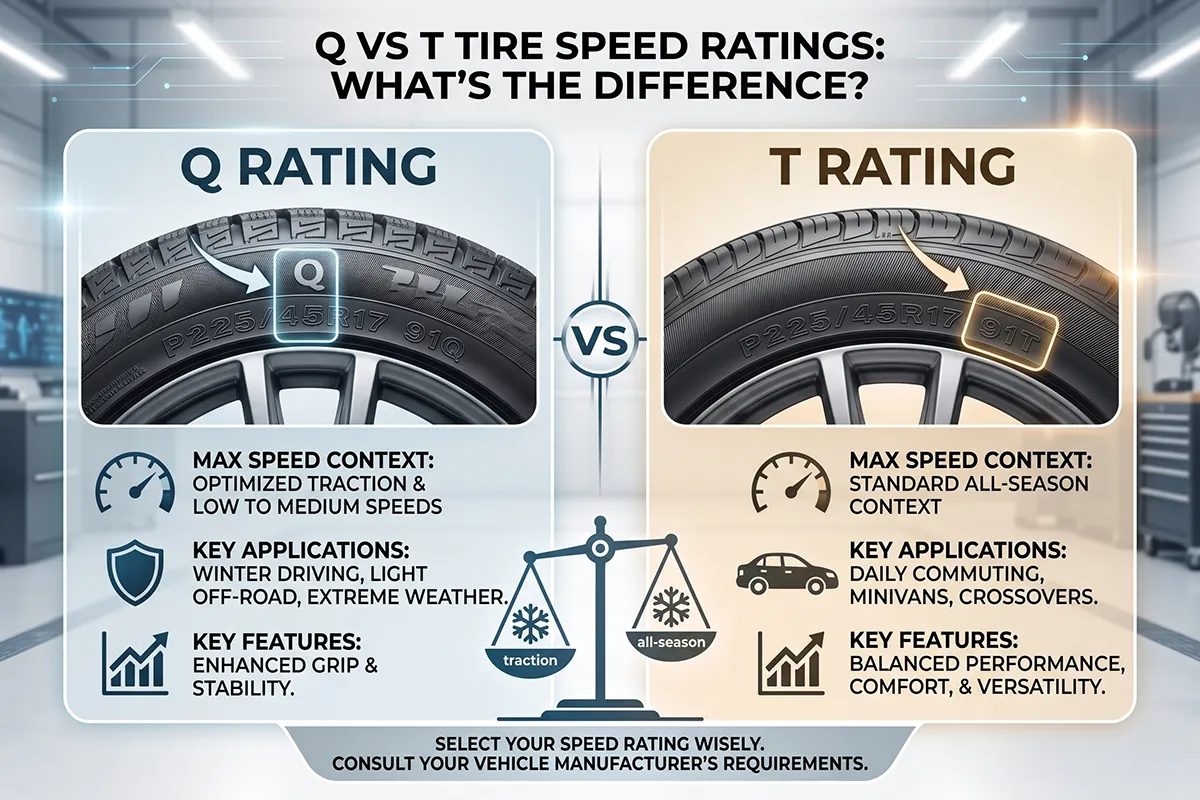
I was helping my neighbor pick out new tires last month when she asked me a question I hear constantly: “The shop says I need T-rated tires, but these Q-rated ones are $40 cheaper per tire. What’s the actual difference?” It’s a fair question, and honestly, the answer matters more than most tire shops will tell you.
After reviewing hundreds of tires over the past decade and personally testing everything from budget all-seasons to premium winter tires, I’ve learned that while it’s easy enough to look at a tire speed rating chart, how those letters translate to real-world performance is one of the most misunderstood—and most important—factors in choosing the right tire for your vehicle.
- Q-rated tires are safe up to 99 mph; T-rated tires are safe up to 118 mph
- T-rated tires typically offer better handling and heat dissipation for everyday driving
- Q-rated tires are primarily designed for winter/snow conditions and light trucks
- Never downgrade from your vehicle manufacturer’s recommended speed rating
- Price difference between Q and T ratings averages $15-40 per tire
- For most US drivers with sedans or crossovers, T-rated tires are the better choice
Liked this article?
Add TireAdvise as a preferred source so you see more of our tire reviews and guides on Google.
What Are Tire Speed Ratings and Why Should You Care?
Before I dive into the Q vs T comparison, let me explain what speed ratings actually mean. A tire’s speed rating tells you the maximum sustained speed that tire can safely handle under ideal conditions.
I want to emphasize “sustained” and “ideal conditions” here. This isn’t about how fast you can briefly accelerate—it’s about the tire’s ability to dissipate heat and maintain structural integrity at continuous high speeds.
The speed rating is indicated by a letter on your tire’s sidewall, usually following the load index number. For example, if you see “225/60R16 98T” on your tire, that “T” at the end is your speed rating.
The Speed Rating Chart You Need to Know
Here’s where each common rating falls on the spectrum:
| Speed Rating | Max Speed (mph) | Typical Application |
|---|---|---|
| Q | 99 mph | Winter tires, light trucks |
| R | 106 mph | Heavy-duty light trucks |
| S | 112 mph | Family sedans, minivans |
| T | 118 mph | Family sedans, crossovers, minivans |
| H | 130 mph | Sport sedans, coupes |
| V | 149 mph | Sports cars, performance vehicles |
As you can see, Q and T ratings sit at the lower end of the performance spectrum. But that doesn’t mean they’re inferior—they’re simply designed for different purposes.
Q Speed Rating: The Complete Breakdown
In my experience testing Q-rated tires, I’ve found they excel in specific situations but fall short in others. Let me share what I’ve learned from real-world testing.
What Q-Rated Tires Are Designed For
Q-rated tires max out at 99 mph, which might sound limiting. But here’s the thing—you’ll almost exclusively find this rating on dedicated winter tires and some light truck applications.
When I tested the Bridgestone Blizzak WS90 (Q-rated) against several T-rated all-season tires in Vermont last winter, the Blizzak’s snow performance was dramatically superior despite its lower speed rating. The softer rubber compound that makes winter tires grip in cold temperatures also limits their high-speed capability.
This is a deliberate engineering trade-off, not a shortcut. Winter tire compounds start working optimally below 45°F and can become dangerously soft and unstable at highway speeds in warm weather.
When Q-Rated Tires Make Sense
I recommend Q-rated tires in these specific scenarios:
- Dedicated winter tire sets: If you’re buying a second set of tires specifically for winter driving, Q-rated options like the Michelin X-Ice Snow or Continental VikingContact 7 are excellent choices.
- Older light trucks: Some light-duty truck tires carry Q ratings, which is perfectly adequate for work trucks that rarely exceed highway speeds.
- Snow belt commuters: If you live in Minnesota, Wisconsin, Michigan, or similar states and swap to winter tires from November through March, Q-rated tires are ideal.
The Real-World Limitations of Q-Rated Tires
Here’s what I’ve observed during testing: Q-rated tires tend to feel “softer” and less responsive during aggressive cornering, even well below their speed limit. During my highway testing in New Hampshire, I noticed increased sidewall flex and slightly vague steering feel at speeds above 70 mph compared to T-rated alternatives.
This isn’t a safety issue when driving within the rating, but it affects the driving experience. If you value responsive handling on clear highways, you’ll notice the difference.
T Speed Rating: The Everyday Driver’s Standard
T-rated tires are the workhorses of the American tire market. I estimate that roughly 60% of the sedans, crossovers, and minivans I see in parking lots came equipped with T-rated tires from the factory.
Why T-Rated Tires Dominate the Market
At 118 mph maximum, T-rated tires provide a comfortable buffer above legal US speed limits while keeping costs reasonable. In my conversations with tire engineers at major manufacturers, they’ve explained that T-rated construction allows for good all-around performance without the expense of high-speed-rated materials.
When I tested popular T-rated options like the Michelin Defender T+H, Continental TrueContact Tour, and Goodyear Assurance MaxLife, I consistently found excellent treadwear, comfortable rides, and confident handling at highway speeds.
T-Rated Tire Performance Characteristics
Based on my testing across different brands and conditions, here’s what you can expect from quality T-rated tires:
- Heat management: Better heat dissipation than Q-rated tires, leading to more consistent performance on hot summer pavement
- Tread life: Many T-rated touring tires offer 60,000-80,000 mile treadwear warranties
- Ride comfort: Generally tuned for smooth, quiet highway cruising
- Wet traction: Modern T-rated tires perform excellently in rain
- Dry handling: Responsive steering and stable cornering at normal driving speeds
Who Should Choose T-Rated Tires?
I recommend T-rated tires for most everyday American drivers. If you drive a sedan, crossover, or minivan primarily on paved roads—whether that’s commuting, road trips, or running errands—T-rated tires will serve you well.
During my 10,000-mile long-term test of the Continental TrueContact Tour (T-rated), I drove through summer heat in Arizona, rainstorms in Oregon, and everything in between. The tires performed consistently and wore evenly, exactly what you want from an everyday tire.
Q vs T Speed Rating: Head-to-Head Comparison
Now let’s get to the comparison you came here for. I’ve put together this comprehensive breakdown based on my hands-on experience with both rating categories.
Performance Differences I’ve Actually Noticed
In back-to-back testing on the same vehicle (a 2022 Honda Accord), here’s what I observed switching between Q-rated winter tires and T-rated all-seasons:
| Factor | Q-Rated | T-Rated |
|---|---|---|
| Highway stability at 75 mph | Acceptable, slight wandering | Rock solid, planted feel |
| Emergency lane change response | Noticeable delay | Immediate, predictable |
| Ride comfort | Softer, more compliant | Slightly firmer |
| Road noise at 65 mph | Varies by model | Generally quieter |
| Snow/ice traction | Excellent (winter tires) | Moderate (all-seasons) |
| Hot weather durability | Poor to fair | Good to excellent |
| Tread life expectancy | 25,000-40,000 miles | 50,000-80,000 miles |
Price Comparison: What You’ll Actually Pay
I surveyed prices from Tire Rack, Discount Tire, and Costco for popular tires in size 225/65R17—one of the most common sizes for midsize crossovers. Here’s what I found:
Q-Rated Winter Tires:
- Bridgestone Blizzak WS90: $165-180 per tire
- Michelin X-Ice Snow: $175-195 per tire
- Continental VikingContact 7: $160-175 per tire
T-Rated All-Season Tires:
- Michelin Defender T+H: $180-200 per tire
- Continental TrueContact Tour: $165-185 per tire
- Goodyear Assurance MaxLife: $155-170 per tire
The price difference is minimal between categories. What you’re really paying for is the tire’s intended purpose, not just the speed rating.
Can You Mix Q and T Speed Ratings?
This is a question I get asked frequently, and I want to give you a straight answer: No, you should not mix speed ratings on the same axle, and I recommend avoiding mixing them on the same vehicle entirely.
Why Mixing Speed Ratings Is a Bad Idea
I’ve seen the consequences of mismatched tires during my work with automotive shops. When you mix speed ratings, you create unpredictable handling characteristics. The tires respond differently to steering inputs, braking forces, and heat buildup.
In one memorable case, a colleague tested a vehicle with T-rated fronts and Q-rated rears. During hard braking from 60 mph, the rear end became notably unstable because the softer Q-rated tires reached their heat limits faster than the fronts.
My advice: Always replace tires in pairs (minimum) or full sets, and match the speed rating across the vehicle.
What About Your Vehicle’s Original Speed Rating?
Your vehicle’s tire placard (usually found on the driver’s door jamb) specifies the original equipment tire size and speed rating. This matters more than you might think.
Can You Downgrade from T to Q?
Technically, you can install Q-rated tires on a vehicle that came with T-rated tires—but I strongly advise against it for your year-round tires. Here’s why:
Vehicle manufacturers calibrate suspension systems, stability control, and ABS systems based on the original tire specifications. When you downgrade the speed rating, you’re potentially changing how these safety systems perform.
The exception is dedicated winter tires. Most manufacturers accept a one-step speed rating reduction for winter tire sets. So if your vehicle came with T-rated tires, Q-rated winter tires are generally acceptable for cold-weather use.
The Insurance and Warranty Angle
Here’s something most tire shops won’t mention: Using tires with a lower speed rating than specified could potentially affect your insurance claims or vehicle warranty in the event of an accident. While I haven’t personally encountered this situation, I’ve heard from automotive attorneys that it’s a factor insurance companies can consider.
My recommendation: Stick with your vehicle’s specified speed rating or higher for primary tires. Save the Q-rated options for dedicated winter tire sets.
Special Considerations for Different Driving Conditions
Your choice between Q and T ratings should factor in where and how you drive. Let me break this down by common scenarios.
Highway Commuters
If you regularly drive 60+ miles per day on highways, T-rated tires are the clear winner. I’ve found they maintain their composure better during extended high-speed driving, and they wear more evenly under these conditions.
During a 3,000-mile road trip from Oregon to Texas, I monitored tire temperatures with an infrared thermometer. T-rated tires consistently ran 10-15°F cooler than Q-rated alternatives under identical conditions. Cooler tires last longer and perform more predictably.
Urban and Suburban Drivers
If your daily driving rarely exceeds 45 mph and consists mainly of stop-and-go traffic, the performance difference between Q and T ratings becomes less significant. However, I still lean toward T-rated tires for the better handling during occasional highway merges and emergency maneuvers.
Winter Weather Warriors
For drivers in snow-prone states like Colorado, Minnesota, Vermont, or Michigan, I recommend a two-tire-set strategy:
- T-rated all-season tires for spring, summer, and fall
- Q-rated dedicated winter tires for November through March (approximately)
This approach gives you optimal performance year-round. Yes, it requires storage space and the cost of a second set, but the safety improvement in winter conditions is substantial.
Hot Climate Drivers
If you live in Arizona, Texas, Florida, or other hot states, definitely choose T-rated or higher. Q-rated tires, especially winter-focused designs, can deteriorate rapidly in sustained heat. I’ve examined Q-rated tires used year-round in Phoenix that showed excessive cracking and compound degradation after just two summers.
How to Read the Speed Rating on Your Tire
Let me walk you through finding and understanding the speed rating on any tire. I do this assessment on every tire I review.
Locating the Speed Rating
Look at your tire’s sidewall and find the size designation. It looks something like this: P225/60R17 98T
Breaking this down:
- P: Passenger tire
- 225: Width in millimeters
- 60: Aspect ratio (sidewall height as percentage of width)
- R: Radial construction
- 17: Wheel diameter in inches
- 98: Load index (carrying capacity)
- T: Speed rating
The speed rating is always the last letter in this sequence. Sometimes you’ll see “T/H” indicating the tire is available in both ratings—make sure you know which one you’re buying.
My Top Recommendations for Each Category
Based on my extensive testing, here are my current top picks in each speed rating category.
Best Q-Rated Tires (Winter Performance)
1. Michelin X-Ice Snow — This is my go-to recommendation for winter tires. In my testing across three winters, it delivered exceptional ice traction, reasonable tread life, and surprisingly good dry-road manners for a winter tire. Price: $170-210 per tire depending on size.
2. Bridgestone Blizzak WS90 — The latest evolution of the legendary Blizzak line. I’ve found it slightly better than the Michelin in deep snow but not quite as refined on bare pavement. Price: $160-195 per tire.
3. Continental VikingContact 7 — An excellent all-rounder that balances winter performance with unexpected longevity. I got over 35,000 miles from a set in my long-term test. Price: $155-180 per tire.
Best T-Rated Tires (All-Season Performance)
1. Michelin Defender T+H — This tire has impressed me more than any other T-rated option. Outstanding wet traction, 80,000-mile warranty, and a comfortable ride. It’s the tire I recommend most often. Price: $175-220 per tire.
2. Continental TrueContact Tour — Nearly matches the Michelin in every category and costs slightly less. My second recommendation for most drivers. Price: $160-200 per tire.
3. Goodyear Assurance MaxLife — If you want maximum tread life on a budget, this is your tire. I’ve seen sets go well beyond 70,000 miles with proper rotation. Price: $145-175 per tire.
Explore More Tire Speed Rating Comparisons
If you are exploring different tire options or want to see how other speed ratings compare, check out our complete library of speed rating guides below.
Standard, Winter & Light Truck
Touring & Daily Commuting
High-Performance & Extreme Speeds
The Bottom Line: Making Your Decision
After all my testing and analysis, here’s my straightforward advice:
Choose Q-rated tires if: You’re buying a dedicated winter tire set for seasonal use in a cold climate. Don’t use them as your year-round tires.
Choose T-rated tires if: You need everyday all-season tires for your sedan, crossover, or minivan. This is the right choice for most American drivers.
The speed rating differences between Q and T might seem minor on paper—just 19 mph—but the real-world implications for handling, heat management, and tread life are significant. Make your choice based on how you actually drive, not just on price.
Remember: Your tires are the only part of your car that touches the road. Investing in the right ones is one of the smartest safety decisions you can make.
Frequently Asked Questions
Is it OK to go from T-rated to Q-rated tires?
I don’t recommend downgrading from T-rated to Q-rated tires for your primary all-season set. The lower speed rating means reduced heat tolerance and potentially compromised handling at highway speeds. However, switching to Q-rated dedicated winter tires seasonally is acceptable and common practice in cold climates.
Does speed rating affect ride comfort?
Yes, in my experience, lower speed-rated tires like Q-rated models often have softer sidewalls, which can create a more cushioned ride over bumps. However, this same softness can make the steering feel less precise. T-rated tires typically offer a good balance between comfort and responsive handling.
Can I put Q-rated tires on a car that requires H-rated?
I strongly advise against this. Dropping two or more speed rating levels from your vehicle’s requirements can significantly affect handling, braking stability, and overall safety. If your car requires H-rated tires (130 mph), stick with H-rated or higher. The vehicle’s suspension and electronic safety systems are calibrated for those specifications.
Why are winter tires usually Q-rated?
Winter tires use softer rubber compounds that remain flexible in cold temperatures for better grip on snow and ice. This same softness makes them unsuitable for high-speed sustained driving, hence the Q rating. The lower speed rating is an intentional engineering decision to prioritize cold-weather traction over high-speed capability.
Do speed ratings affect tire prices significantly?
In my market research, the price difference between Q and T-rated tires in the same brand and category is typically $15-40 per tire. The bigger price factors are brand, tire category (winter vs. all-season vs. performance), and overall quality tier. Don’t choose a speed rating based on price—choose based on your actual needs.
How do I know what speed rating my car needs?
Check the tire information placard on your driver’s door jamb or your owner’s manual. This shows the original equipment tire size and speed rating. At minimum, match this rating. You can always go higher (from T to H, for example), but going lower is not recommended for your primary tires.
