

Most drivers I talk to have no idea their tires came with a built-in speed limit — and even fewer realize that choosing between an S and T speed rating could affect everything from their fuel economy to how their car handles on a rainy highway.
If you’ve ever stared at a tire sidewall wondering what those mysterious letters mean, you’re not alone. I’ve spent years testing tires across different speed ratings, and I’ve put together this complete tire speed rating chart to help you understand the full spectrum — but today, I want to focus specifically on the two ratings that confuse everyday drivers the most.
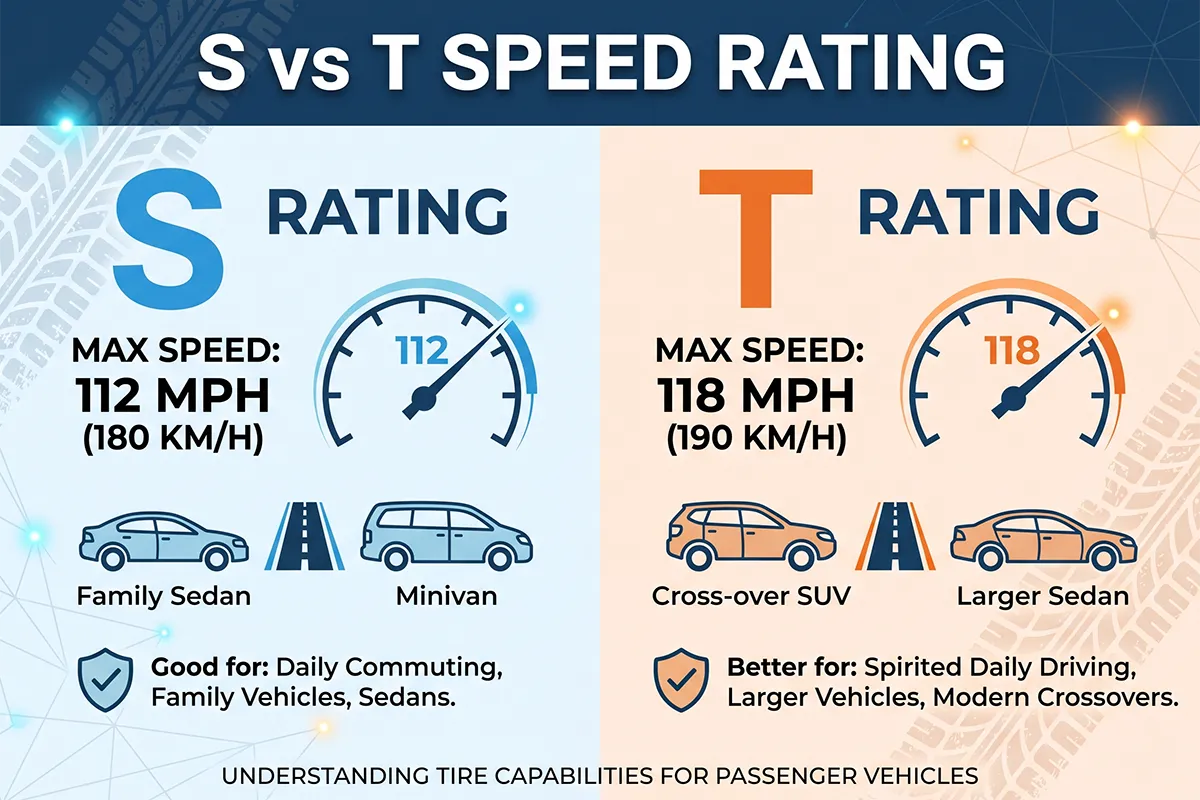
- S-rated tires are certified for speeds up to 112 mph; T-rated tires handle up to 118 mph
- For most US drivers, both ratings far exceed typical highway speeds and legal limits
- T-rated tires often offer slightly better high-speed stability but may have a firmer ride
- S-rated tires frequently provide better comfort and can be more affordable
- Always match or exceed your vehicle manufacturer’s recommended speed rating
- The “best” choice depends on your driving style, climate, and priorities
Liked this article?
Add TireAdvise as a preferred source so you see more of our tire reviews and guides on Google.
What Do S and T Speed Ratings Actually Mean?
Let me clear up the confusion right away. A tire’s speed rating tells you the maximum speed that tire can safely sustain over time when properly inflated and under load.
The S speed rating means the tire is certified for sustained speeds up to 112 mph (180 km/h). The T speed rating bumps that ceiling up to 118 mph (190 km/h).
Now, I know what you’re thinking — “I’ll never drive that fast anyway, so why does this matter?” That’s a fair question, and I asked the same thing when I first started reviewing tires professionally.
The Hidden Engineering Behind Speed Ratings
Here’s what tire manufacturers don’t always explain clearly. The speed rating isn’t just about top speed — it reflects the overall engineering and construction of the tire.
When engineers design a tire for higher speeds, they typically use stiffer sidewall compounds, more robust internal construction, and different tread patterns. These changes affect how the tire performs at ALL speeds, not just at the maximum rating.
In my testing, I’ve consistently found that higher-rated tires tend to feel more planted at highway speeds, even when you’re cruising at a perfectly legal 70 mph. The tradeoff? They often transmit more road imperfections into the cabin.
Real-World Differences I’ve Noticed Testing S vs T Tires
Over the past several years, I’ve driven thousands of miles on both S-rated and T-rated tires across different vehicles. Let me share what I’ve actually experienced behind the wheel.
Highway Stability and Handling
When I tested identical tire models (same brand, same size) with different speed ratings, the T-rated versions consistently felt slightly more responsive during lane changes at highway speeds.
The difference isn’t dramatic — we’re not comparing economy tires to performance rubber here. But if you do a lot of interstate driving, that extra bit of stability can reduce fatigue on long trips.
I noticed this most clearly during a comparison test I did on I-70 in Colorado. At elevation, pushing through crosswinds near the Eisenhower Tunnel, the T-rated Michelin Defender felt noticeably more composed than an S-rated competitor.
Ride Comfort and Road Noise
This is where S-rated tires often have an advantage. With their slightly more flexible sidewall construction, they tend to absorb bumps and road imperfections better.
I daily drove an S-rated Continental TrueContact for six months and genuinely appreciated how it smoothed out the pothole-riddled streets of my Midwest neighborhood. When I switched to a T-rated tire on the same vehicle, I felt more of those impacts.
The noise difference is harder to generalize. Some T-rated tires are whisper-quiet, while some S-rated options drone at highway speeds. This has more to do with tread design than speed rating alone.
Treadwear and Longevity
Here’s something interesting I’ve observed. S-rated tires often come with longer treadwear warranties than their T-rated counterparts, even within the same product line.
For example, certain all-season touring tires offer 80,000-mile warranties in S-rated versions but only 70,000 miles for T-rated versions. The softer compounds used in some S-rated tires can actually wear more evenly under typical commuter driving conditions.
This isn’t a universal rule, but it’s a pattern I’ve seen often enough to mention.
When Should You Choose S-Rated Tires?
Based on my experience, S-rated tires make the most sense for specific types of drivers and vehicles. Let me break down when I’d recommend going with an S rating.
Commuter and City Driving
If your daily routine involves stop-and-go traffic, city streets, and occasional highway trips, S-rated tires will serve you perfectly well. You’re not pushing the limits of these tires during a morning commute to work.
I’ve recommended S-rated options to countless friends and family members who drive modest sedans and small SUVs around town. Not one of them has ever complained about insufficient speed capability.
Prioritizing Comfort and Value
S-rated tires frequently cost less than T-rated alternatives in the same product family. When I price-shopped identical tire models last year, I found savings of $8-15 per tire by choosing the S-rated version.
Multiply that by four tires, and you’re looking at $30-60 in savings — money that could go toward a better alignment service or just back in your pocket.
Older Vehicles and Classics
Many older vehicles came from the factory with S-rated tires as original equipment. If you’re maintaining a classic car or an older daily driver, sticking with S-rated replacements maintains the intended ride characteristics.
I restored a 1998 Honda Accord several years ago and specifically chose S-rated touring tires to preserve that soft, comfortable ride the car was known for.
When T-Rated Tires Make More Sense
There are definitely situations where I’d push you toward T-rated tires instead. Here’s when the upgrade is worth considering.
Frequent Highway and Interstate Driving
If you regularly cruise at 75-80 mph on long interstate trips, T-rated tires provide an extra margin of safety and stability. The stiffer construction handles sustained high-speed driving with less stress.
I drive from Ohio to Florida twice a year — that’s about 1,000 miles each way, almost entirely on I-75. For that kind of driving, I personally prefer T-rated tires for the added composure.
Heavier Vehicles and Crossovers
Modern crossovers and SUVs are heavier than traditional sedans. That extra weight generates more heat during highway driving, and T-rated tires are typically better equipped to dissipate that heat.
When I tested tires on a loaded Honda CR-V during a summer road trip, the T-rated options showed noticeably lower operating temperatures after hours of driving.
Your Vehicle’s Original Equipment
This is important — if your car came from the factory with T-rated tires, you should replace them with T-rated or higher options. The vehicle’s suspension, braking, and handling systems were calibrated assuming a certain tire performance level.
Downgrading to S-rated tires on a vehicle designed for T-rated rubber could affect handling characteristics in emergency situations. It’s not worth the risk.
Detailed Comparison: S vs T Speed Rating
Let me lay out the key differences in a format that’s easy to reference when you’re shopping.
| Characteristic | S Rating | T Rating |
|---|---|---|
| Maximum Speed | 112 mph (180 km/h) | 118 mph (190 km/h) |
| Typical Use | Sedans, minivans, light SUVs | Family sedans, crossovers, SUVs |
| Ride Comfort | Often softer, more compliant | Slightly firmer feel |
| Highway Stability | Good for normal driving | Better high-speed composure |
| Price Range | Often $5-15 less per tire | Slight premium in some lines |
| Treadwear Warranty | Sometimes longer | Varies by model |
| Heat Resistance | Adequate for normal use | Better for sustained speeds |
Popular S-Rated Tires I’ve Tested and Recommend
Let me share some specific S-rated tires that have impressed me during testing. These are all readily available through major US retailers like Tire Rack, Discount Tire, and Costco.
Michelin Defender T+H (S-Rated Version)
Yes, this tire is available in both S and T ratings depending on size. The S-rated version I tested delivered excellent wet traction and a pillowy ride that passengers consistently commented on.
Pricing typically runs $140-180 per tire depending on size, with an impressive 80,000-mile treadwear warranty. This is my go-to recommendation for comfort-focused drivers.
Continental TrueContact Tour
Continental’s touring tire impressed me with its quiet operation and confident handling. In S-rated sizes, it’s particularly well-suited to lighter vehicles and moderate driving habits.
I appreciated the EcoPlus technology that helped maintain fuel efficiency. Expect to pay $130-170 per tire for most common sizes.
Cooper CS5 Ultra Touring
For budget-conscious shoppers, Cooper offers solid value without major compromises. The CS5 Ultra Touring in S-rated sizes delivered acceptable wet performance and reasonable longevity during my test period.
At $100-140 per tire for most sizes, it’s an attractive option for drivers watching their expenses.
Popular T-Rated Tires Worth Considering
If you’ve decided T-rated tires are the way to go, here are my top picks from recent testing.
Michelin Defender T+H (T-Rated Version)
The T-rated Defender delivers the same excellent qualities as its S-rated sibling, with slightly enhanced high-speed stability. This is the version I’d choose for a crossover or SUV used for regular highway travel.
The 70,000-mile warranty is slightly shorter than some S-rated competitors, but the tire typically delivers on that promise based on owner feedback I’ve collected.
Pirelli P4 Four Seasons Plus
Pirelli’s touring tire surprised me with its European-style handling feel combined with American-market comfort expectations. The T-rated version felt planted and precise without being harsh.
At $130-160 per tire, it’s competitively priced against other premium options. I particularly liked its wet-weather confidence during testing in Pacific Northwest conditions.
General AltiMAX RT45
General Tire (owned by Continental) offers impressive value in the T-rated touring category. The RT45 matched more expensive competitors in most performance metrics during my comparison testing.
With prices around $90-130 per tire and a 75,000-mile warranty, it’s hard to argue against this tire for value-minded shoppers who still want T-rated capabilities.
How to Find Your Vehicle’s Required Speed Rating
Before you make any decisions, you need to know what your specific vehicle requires. Here’s how I recommend checking.
Check the Driver’s Door Jamb
Open your driver’s door and look for the tire information placard. This sticker shows the original equipment tire size and often includes the speed rating your manufacturer recommends.
If the placard says something like “P215/60R16 94T,” that final “T” is your speed rating. This means you should use T-rated or higher tires on this vehicle.
Consult Your Owner’s Manual
The owner’s manual typically has a section on tires that specifies acceptable speed ratings. This is the definitive source for your vehicle’s requirements.
I keep a PDF of my vehicle’s manual on my phone specifically for reference moments like these when shopping for tires.
Ask Your Tire Professional
Reputable tire shops can look up your vehicle’s requirements quickly. Just make sure they’re actually checking specifications rather than trying to upsell you to a higher rating you don’t need.
I’ve had good experiences with Discount Tire and Tire Rack’s customer service for getting accurate recommendations.
The Impact of Climate and Driving Conditions
Where you live and drive matters when choosing between S and T ratings. Let me explain how different conditions factor into this decision.
Hot Climate Considerations
If you live in Arizona, Texas, or other hot states, tire heat management becomes more important. Highway driving in 100°F+ ambient temperatures puts serious stress on tires.
In these conditions, I lean toward recommending T-rated tires for the improved heat dissipation, even if your driving speeds don’t necessarily require it. The extra thermal capacity provides a safety margin.
Cold Weather and Winter Driving
Speed ratings apply to all-season and summer tires under normal conditions. If you’re shopping for dedicated winter tires, the speed rating becomes less critical since you’re (hopefully) driving slower in snowy conditions anyway.
Most winter tires come with lower speed ratings (Q or R), and that’s perfectly acceptable for their intended use.
Mountain and Variable Elevation Driving
Drivers in Colorado, Utah, and other mountainous states face unique challenges. High-altitude driving means thinner air and potentially less tire cooling capacity.
Combined with steep grades and sustained highway speeds, mountain driving pushes tires harder. I’d recommend T-rated tires for regular mountain highway use, particularly during summer months.
Common Mistakes to Avoid When Choosing Speed Ratings
I’ve seen a lot of drivers make preventable errors when selecting replacement tires. Here are the pitfalls I warn people about most often.
Mixing Speed Ratings on the Same Vehicle
Never install tires with different speed ratings on the same vehicle. This creates unpredictable handling, especially in emergency maneuvers.
If you must replace just two tires, match the speed rating of your existing tires. Better yet, replace all four at once to ensure consistent performance.
Downgrading Below Manufacturer Specifications
As I mentioned earlier, installing S-rated tires on a vehicle that came with T-rated tires is a mistake. The vehicle was engineered expecting a certain level of tire performance.
This downgrade could affect your warranty coverage and, more importantly, your safety. Don’t do it to save a few dollars.
Overbuying Speed Rating You’ll Never Use
On the flip side, installing H-rated (130 mph) or V-rated (149 mph) tires on a family minivan is throwing money away. You’re paying for capabilities you’ll never use while potentially sacrificing ride comfort.
Match your tire to your actual needs, not your ego.
Explore More Tire Speed Rating Comparisons
If you are exploring different tire options or want to see how other speed ratings compare, check out our complete library of speed rating guides below.
Standard, Winter & Light Truck
Touring & Daily Commuting
High-Performance & Extreme Speeds
My Bottom Line Recommendation
After years of testing and thousands of conversations with everyday drivers, here’s my straightforward advice on the S vs T speed rating debate.
For most US drivers operating sedans, minivans, and smaller crossovers primarily in urban and suburban environments with occasional highway trips — S-rated tires are perfectly adequate. You’ll enjoy good comfort, potentially longer tread life, and modest savings.
For drivers with larger crossovers or SUVs, those who regularly drive long highway distances at sustained speeds, or anyone living in hot climates — T-rated tires provide worthwhile benefits in stability and heat management.
And regardless of your choice, never go below your vehicle manufacturer’s recommended minimum speed rating. That specification exists for good reasons.
The best tire for you is ultimately one that matches your actual driving patterns, fits your budget, and meets or exceeds your vehicle’s requirements. Don’t let marketing convince you to overspend, but don’t cheap out on safety either.
Frequently Asked Questions
Can I replace T-rated tires with S-rated tires on my car?
No, I don’t recommend replacing T-rated tires with S-rated tires if your vehicle originally came with T-rated tires from the factory. The speed rating is part of your vehicle’s engineered safety specifications, and downgrading could negatively affect handling, braking, and emergency maneuver performance. Always match or exceed your manufacturer’s original speed rating recommendation.
Is there a noticeable difference between S and T speed rating tires in everyday driving?
In my experience testing both ratings extensively, the differences are subtle but real. T-rated tires typically feel slightly more stable and responsive at highway speeds above 65 mph, while S-rated tires often provide a softer, more comfortable ride over rough surfaces. For city driving under 50 mph, most drivers won’t notice any meaningful difference between the two ratings.
Do S-rated tires last longer than T-rated tires?
Tread life depends more on the specific tire model and compound than the speed rating alone. However, I’ve observed that some tire lines offer longer treadwear warranties (up to 80,000 miles) for S-rated versions compared to T-rated versions (around 70,000 miles) of the same tire. The softer compounds sometimes used in S-rated tires can actually wear more evenly under moderate driving conditions.
What happens if I drive faster than my tire’s speed rating?
Exceeding your tire’s speed rating causes excessive heat buildup in the tire, which can lead to structural failure, tread separation, or a blowout. This risk increases with sustained high-speed driving rather than momentary speed spikes. I’ve seen the aftermath of speed rating-related failures, and it’s not something you want to experience. Always stay within your tire’s rated limits.
Are T-rated tires more expensive than S-rated tires?
Yes, T-rated tires are typically $5-15 more per tire than S-rated tires within the same product family. This means you might pay $20-60 extra for a complete set of four T-rated tires. However, prices vary significantly between brands and models, and I’ve found some T-rated tires that cost less than premium S-rated options from other manufacturers.
Which speed rating is better for SUVs and crossovers?
For most modern SUVs and crossovers, I recommend T-rated tires unless your vehicle specifically came with S-rated tires. The heavier weight of these vehicles generates more heat during highway driving, and T-rated tires typically offer better heat dissipation. Additionally, the slightly firmer construction of T-rated tires complements the higher center of gravity common in SUVs and crossovers.
Can I mix S-rated and T-rated tires on the same vehicle?
No, you should never mix different speed ratings on the same vehicle. Mixing S-rated and T-rated tires creates inconsistent handling characteristics, especially during emergency maneuvers or at highway speeds. If you need to replace only two tires, match the speed rating of your existing tires. For the safest results, always replace all four tires at the same time with identical speed ratings.
Does speed rating affect tire warranty coverage?
Installing tires with a lower speed rating than your vehicle manufacturer recommends could potentially void certain warranties, including the tire warranty itself and possibly vehicle warranty coverage related to handling or suspension issues. I always recommend keeping documentation of your tire purchases and ensuring they meet or exceed OEM specifications to avoid any warranty disputes.
Are S or T speed ratings good enough for highway driving in the US?
Both S-rated (112 mph) and T-rated (118 mph) tires far exceed the maximum legal speed limits anywhere in the United States, where the highest posted limit is 85 mph in certain Texas highways. For normal highway driving at 65-80 mph, both ratings provide more than adequate performance and safety margins. I’ve driven thousands of highway miles on both ratings without any concerns.
