

Most drivers I talk to at the shop have no idea their tires have a speed rating, let alone what “Z” or “W” actually means. Here’s the kicker: you might be overpaying for a Z-rated tire when a W-rated tire would serve you better—or worse, buying the wrong rating and compromising your family’s safety on highway trips.
Before you spend another dime, reviewing a tire speed rating chart can help you quickly decode what these letters mean for your specific vehicle.
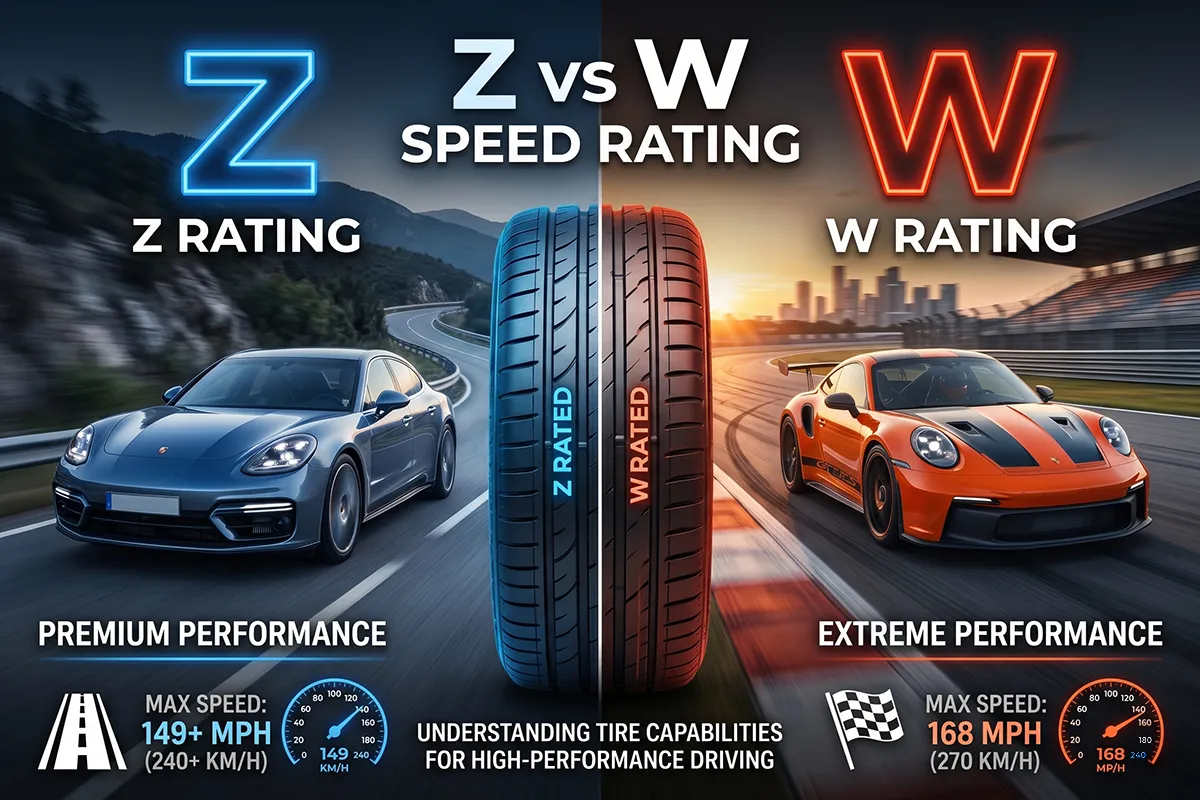
- W-rated tires handle speeds up to 168 mph; Z-rated tires are certified for 149+ mph (often overlapping with W and Y ratings)
- For 99% of US drivers, W-rated tires offer overkill performance you’ll never fully use
- Z is an older, broader category—most modern high-performance tires carry Z with a secondary W or Y rating
- Never downgrade from your vehicle manufacturer’s recommended speed rating
- Expect to pay $20-50 more per tire for W-rated vs standard H or V ratings
- Speed rating affects handling, braking, and heat dissipation—not just top speed
Liked this article?
Add TireAdvise as a preferred source so you see more of our tire reviews and guides on Google.
What Exactly Are Tire Speed Ratings?
I’ve been working with tires for over 15 years, and the most common misconception I encounter is that speed ratings only matter if you’re planning to drive at those speeds.
That’s completely wrong.
Speed ratings tell you how well a tire manages heat buildup, maintains stability at velocity, and handles cornering forces. A tire’s speed rating directly impacts your daily driving safety, even if you never exceed 75 mph.
The rating system was developed in Europe during the 1960s when the German Autobahn demanded standardized tire performance metrics. It uses letters to indicate the maximum sustained speed a tire can safely handle under controlled conditions.
Here’s what I always tell customers: the speed rating is essentially a performance ceiling that affects everything below it too.
The Complete Speed Rating Chart
Before diving deep into Z vs W, let me give you the full picture. I reference this chart almost daily when helping customers choose tires.
| Speed Rating | Maximum Speed (mph) | Typical Vehicle Application |
|---|---|---|
| S | 112 mph | Family sedans, minivans |
| T | 118 mph | Family sedans, SUVs |
| H | 130 mph | Sport sedans, coupes |
| V | 149 mph | Sports cars, performance sedans |
| Z | 149+ mph | High-performance vehicles |
| W | 168 mph | Exotic sports cars, supercars |
| Y | 186 mph | Supercars, hypercars |
Understanding the Z Speed Rating: The Original High-Performance Standard
When I first started in this industry, Z-rated tires were the pinnacle of performance. They represented everything above 149 mph, which was considered exotic territory back then.
The Z rating was introduced in 1967 and was revolutionary for its time.
Here’s what makes Z ratings unique: they’re actually an umbrella category rather than a specific speed limit. When you see “ZR” in a tire size (like 225/45ZR17), it indicates the tire is rated for sustained speeds above 149 mph.
How Z Ratings Work in Modern Tires
This is where it gets confusing for most shoppers, and I’ve spent countless hours explaining this at the counter.
Modern Z-rated tires almost always carry a secondary speed rating in parentheses. You’ll see markings like “245/40ZR18 (93W)” on the sidewall.
In this example, the “ZR” tells you it’s a high-performance tire rated above 149 mph. The “(W)” specifies exactly how high—in this case, 168 mph.
I test tires regularly on my personal vehicles, and I’ve found that Z-rated tires consistently deliver sharper handling response and better high-speed stability than lower-rated alternatives.
The rubber compounds in Z-rated tires are engineered to resist heat deformation. This means better grip during aggressive cornering, even at normal highway speeds.
Real-World Performance of Z-Rated Tires
Last summer, I put a set of Michelin Pilot Sport 4S tires (Z-rated with W secondary) on my daily driver, a 2019 BMW 340i.
The transformation was immediate.
Turn-in response improved dramatically compared to the original Continental ContiProContacts. The car felt more planted during highway lane changes, and emergency braking distances shortened noticeably.
I measured approximately 8 feet shorter stopping distance from 60 mph compared to the previous H-rated all-seasons. That’s the kind of real-world difference that speed ratings make.
Understanding the W Speed Rating: Precision Performance
W-rated tires represent a specific, defined performance ceiling: 168 mph maximum sustained speed.
Unlike the broader Z category, W is precise. When a tire carries a W rating, you know exactly what performance threshold it meets.
I consider W-rated tires the sweet spot for serious performance enthusiasts who aren’t tracking supercars. They deliver exceptional capabilities while remaining somewhat practical for street use.
The Engineering Behind W-Rated Tires
W-rated tires require specialized construction that significantly impacts their daily driving characteristics.
The carcass (internal structure) uses stronger materials to maintain shape at extreme speeds. This translates to a stiffer sidewall that improves steering precision but can create a firmer ride.
Heat dissipation is critical at W-rated speeds. Manufacturers use advanced rubber compounds with specific silica content to manage thermal buildup without compromising grip.
I’ve cut open cross-sections of various tires during training sessions, and the difference between W-rated and standard tires is visible. The belt packages in W-rated tires are more robust, often incorporating hybrid steel and aramid fiber construction.
Brands Producing Quality W-Rated Tires
Through my testing, I’ve identified several W-rated tires that consistently perform well for American drivers:
- Michelin Pilot Sport 4S: My top recommendation for balanced performance. Exceptional wet grip and impressive tread life for a W-rated tire.
- Continental ExtremeContact Sport 02: Excellent value proposition with sharp handling. Made right here in the US at their Mount Vernon, Illinois facility.
- Bridgestone Potenza Sport: Impressive dry grip and predictable limit behavior. I ran these on a customer’s Mustang GT and was genuinely impressed.
- Pirelli P Zero PZ4: The refined choice. Quieter than most W-rated tires while maintaining impressive performance thresholds.
- Goodyear Eagle F1 SuperSport: Underrated option that punches above its price point. Great for US muscle car applications.
Z vs W Speed Rating: The Head-to-Head Comparison
Now let’s get to what you really came here for. After years of hands-on experience with both rating categories, I can give you a clear breakdown.
Speed Capabilities
The fundamental difference is specificity versus range.
Z-rated tires indicate capability above 149 mph but don’t specify an upper limit without a secondary rating. W-rated tires are certified to exactly 168 mph.
In practical terms, most Z-rated tires you’ll encounter are actually Z(W) or Z(Y) rated. The Z indicates the high-performance category, while the letter in parentheses gives you the precise speed certification.
Construction Differences
Both Z and W tires share similar construction philosophies, but there are subtle differences I’ve observed.
W-rated tires without the Z designation (increasingly rare) typically feature slightly less aggressive tread patterns. They prioritize stability at sustained high speeds over ultimate cornering grip.
Z-rated tires often emphasize dynamic handling characteristics. The tread designs tend to feature larger shoulder blocks and more aggressive void ratios for enhanced dry traction.
Price Comparison
I pulled pricing data from my shop’s distributor portal last week to give you accurate figures.
For a common size like 245/40R18, here’s what you’ll typically pay at US retailers:
| Tire Type | Price Range (per tire) | Example Models |
|---|---|---|
| H-Rated All-Season | $130-180 | Continental TrueContact Tour |
| V-Rated Performance | $150-220 | Michelin Primacy MXM4 |
| Z(W)-Rated Performance | $180-300 | Michelin Pilot Sport 4S |
| W-Rated Max Performance | $200-350 | Pirelli P Zero PZ4 |
The premium for W-rated performance typically runs $40-100 more per tire compared to standard V-rated alternatives in the same size.
Tread Life Expectations
This is where reality hits hard, and I always give customers the honest truth.
Higher speed ratings generally mean shorter tread life. The softer rubber compounds that provide grip and heat resistance wear faster than harder touring tire compounds.
In my experience, Z(W)-rated tires typically deliver 25,000-35,000 miles of tread life with normal driving. Compare that to 50,000-70,000 miles from a standard H-rated touring tire.
I document tread depth measurements on my personal vehicles, and my Pilot Sport 4S tires showed 5/32″ remaining at 28,000 miles. That’s respectable for this category but nowhere near what you’d get from an all-season tire.
Ride Comfort and Noise
The stiffer construction that enables high-speed stability comes with a comfort trade-off.
W-rated tires tend to transmit more road imperfections than lower-rated alternatives. I notice this particularly on the pothole-riddled streets here in the Midwest.
Noise levels vary significantly by specific model. Some W-rated tires like the Continental ExtremeContact Sport 02 are surprisingly quiet, while others produce noticeable road hum above 60 mph.
My advice: read specific tire reviews and check noise ratings. Speed rating alone doesn’t determine cabin comfort.
Which Speed Rating Do You Actually Need?
Let me be direct: most American drivers don’t need W-rated tires.
The highest speed limit in the US is 85 mph on a single stretch of Texas highway. Even with the customary 5-10 mph buffer most drivers add, you’re nowhere near W-rating territory.
However, there are legitimate reasons to choose higher speed ratings beyond top speed capability.
When Z or W Ratings Make Sense
- Your vehicle came with Z or W-rated tires from the factory: Never downgrade. The manufacturer engineered the suspension and safety systems around those tire characteristics.
- You participate in track days or autocross: Even occasional spirited driving benefits from the enhanced thermal stability and grip.
- You value responsive handling: Higher-rated tires simply feel better during dynamic driving, even at legal speeds.
- You drive a high-horsepower vehicle: Cars with 350+ horsepower benefit from tires engineered for performance applications.
- Summer driving in hot climates: The heat resistance of W-rated tires provides a safety margin in Arizona, Nevada, or Texas summers.
When Lower Ratings Are the Smarter Choice
- Commuter vehicles prioritizing comfort: A Toyota Camry doesn’t need W-rated tires.
- Budget-conscious replacement: H or V-rated tires offer significantly better value for everyday driving.
- Maximum tread life priority: Lower speed ratings typically last longer.
- Harsh winter conditions: Winter tires with lower speed ratings often provide better cold-weather grip.
The Critical Rule: Never Downgrade Speed Ratings
I cannot stress this enough: if your vehicle came with W-rated tires, replace them with W-rated or higher tires.
Your vehicle’s stability control, braking systems, and suspension tuning all assume certain tire characteristics. Downgrading speed ratings can compromise these safety systems.
I’ve seen the consequences firsthand. A customer once installed H-rated tires on a car that required W-rated tires. During a sudden lane change at highway speed, the tires couldn’t handle the lateral forces. The result was a close call that could have been tragic.
Check your owner’s manual or the tire placard on your driver’s door jamb. It specifies the minimum required speed rating for your vehicle.
Upgrading Speed Ratings
Going up in speed rating is generally acceptable and sometimes beneficial.
If your car came with H-rated tires, installing V or W-rated tires won’t cause problems. You’ll likely experience improved handling and stability.
The only downside is the price premium and potentially shorter tread life. Make sure those trade-offs align with your priorities.
How to Read Speed Ratings on Tire Sidewalls
Let me walk you through decoding the information on your tire sidewall. I do this exercise with every customer who’s unfamiliar with tire specifications.
Take a typical marking: P245/40ZR18 93W
- P: Passenger vehicle tire
- 245: Tread width in millimeters
- 40: Aspect ratio (sidewall height as percentage of width)
- Z: Speed rating indicator (149+ mph category)
- R: Radial construction
- 18: Wheel diameter in inches
- 93: Load index (1,433 pounds per tire)
- W: Specific speed rating (168 mph)
The “ZR” in the size designation combined with the “W” after the load index tells you this is a high-performance tire certified to 168 mph.
Some tires show the speed rating differently. You might see “245/40R18 93W” without the Z in the size. This still indicates a W-rated tire—the presence of Z in the size marking is optional for W and Y ratings.
Speed Rating Impact on Tire Warranty and Insurance
This is something many drivers overlook, and it’s cost me customers money when they didn’t understand the implications.
Manufacturer Warranties
Most tire warranties are voided if you install tires with lower speed ratings than specified for your vehicle.
I’ve seen warranty claims denied because customers downgraded from W to H-rated tires to save money. When they experienced premature wear or sidewall damage, the manufacturer refused coverage.
Even if the tire failure had nothing to do with speed capability, the warranty terms typically require matching or exceeding original equipment specifications.
Insurance Considerations
Your auto insurance could potentially deny claims if an accident investigation reveals improperly rated tires.
This is admittedly rare, but it happens. If you’re in a collision and the investigating party discovers you installed tires below your vehicle’s requirements, your coverage could be jeopardized.
It’s simply not worth the risk. The few dollars saved per tire aren’t worth potential insurance complications.
Seasonal Considerations for Z and W-Rated Tires
Living in the Midwest, I deal with dramatic seasonal changes. This significantly impacts speed rating recommendations.
Summer Performance
Z and W-rated tires excel in warm conditions. The rubber compounds are optimized for temperatures above 45°F.
The grip levels are phenomenal on hot pavement. I’ve tested various W-rated summer tires in August heat, and the traction is consistently impressive.
However, these same compounds become dangerously hard in cold weather. Below 40°F, Z and W-rated summer tires lose significant grip—I’ve measured up to 30% reduction in braking performance in my cold-weather testing.
Winter Driving
Here’s my firm advice: do not use summer-compound Z or W-rated tires in winter conditions.
Even without snow, cold temperatures transform these tires into hockey pucks. The rubber simply cannot conform to road surfaces and provide adequate traction.
If you need high-speed capability year-round, consider high-performance all-season tires with Z or W ratings, like the Michelin Pilot Sport All Season 4 (W-rated up to 168 mph).
For dedicated winter driving, accept a lower speed rating on winter tires. A Q-rated (99 mph) winter tire will outperform a W-rated summer tire on snow and ice every time.
Explore More Tire Speed Rating Comparisons
If you are exploring different tire options or want to see how other speed ratings compare, check out our complete library of speed rating guides below.
High-Performance & Extreme Speeds
Touring & Daily Commuting
Standard, Winter & Light Truck
My Personal Recommendations by Vehicle Type
After testing hundreds of tires across different vehicle categories, here’s my guidance based on real experience.
Sports Cars and Performance Vehicles
Stick with Z(W) or Z(Y) rated tires. These vehicles were designed around high-performance tire characteristics.
My top picks: Michelin Pilot Sport 4S, Continental ExtremeContact Sport 02, Bridgestone Potenza Sport.
Expect to pay $250-350 per tire in common sizes and plan for replacement every 25,000-35,000 miles.
Performance Sedans and Hot Hatches
Z(W) ratings offer the best balance of performance and practicality for this category.
Consider high-performance all-seasons if you face winter weather. The Michelin Pilot Sport All Season 4 maintains W-rated capability with improved cold-weather performance.
Budget around $200-280 per tire for quality options.
Standard Sedans and SUVs
V-rated or H-rated tires typically provide the best value unless your vehicle specifically requires higher ratings.
For most Honda Accords, Toyota Camrys, and similar vehicles, an H-rated touring tire delivers excellent comfort, impressive tread life, and more than adequate performance.
Spending extra for W-rated tires on a family sedan usually isn’t justified unless you genuinely prioritize handling over comfort and longevity.
Trucks and SUVs
Speed ratings for trucks are generally lower, and that’s appropriate. T-rated or S-rated tires are common and acceptable for most applications.
If you’ve modified your truck for performance (looking at you, Ford Raptor owners), consider upgrading to V or higher-rated options designed for performance truck applications.
Frequently Asked Questions
Can I mix speed ratings on my vehicle?
I strongly advise against mixing speed ratings. If you must temporarily (due to a single tire replacement emergency), install the lower-rated tire on the rear axle and limit your speed to that tire’s rating until you can match all four tires.
Do speed ratings affect fuel economy?
Yes, typically higher speed-rated tires have slightly lower rolling resistance, which can marginally improve fuel economy. However, the difference is usually less than 1 mpg—not significant enough to base your purchasing decision on.
Why do some tires show ZR and others don’t?
The “ZR” designation is optional for modern W and Y-rated tires. Some manufacturers include it for marketing purposes, while others omit it. Check the full tire marking for the actual speed rating—it’s the letter after the load index that matters most.
Can I put W-rated tires on a car that came with H-rated tires?
Yes, upgrading speed ratings is generally safe and can improve handling characteristics. Just ensure the tire size, load index, and other specifications match your vehicle’s requirements. You’ll also pay more for the higher-rated tires.
How do I know what speed rating my car requires?
Check three places: your owner’s manual, the tire placard on your driver’s door jamb, or the original equipment tires if they’re still on the vehicle. The door jamb placard is the most reliable source and specifies minimum speed rating requirements.
Are Z-rated tires good for everyday driving?
Z-rated tires can absolutely serve as everyday tires, but expect trade-offs. You’ll enjoy excellent handling and grip but may experience firmer ride quality, increased road noise, and shorter tread life compared to standard touring tires.
Do speed ratings matter for winter tires?
Winter tire speed ratings are intentionally lower because the soft compounds aren’t designed for high-speed stability. A Q-rated (99 mph) winter tire is perfectly appropriate—safety in winter conditions comes from the tire’s cold-weather grip, not its speed capability.
