

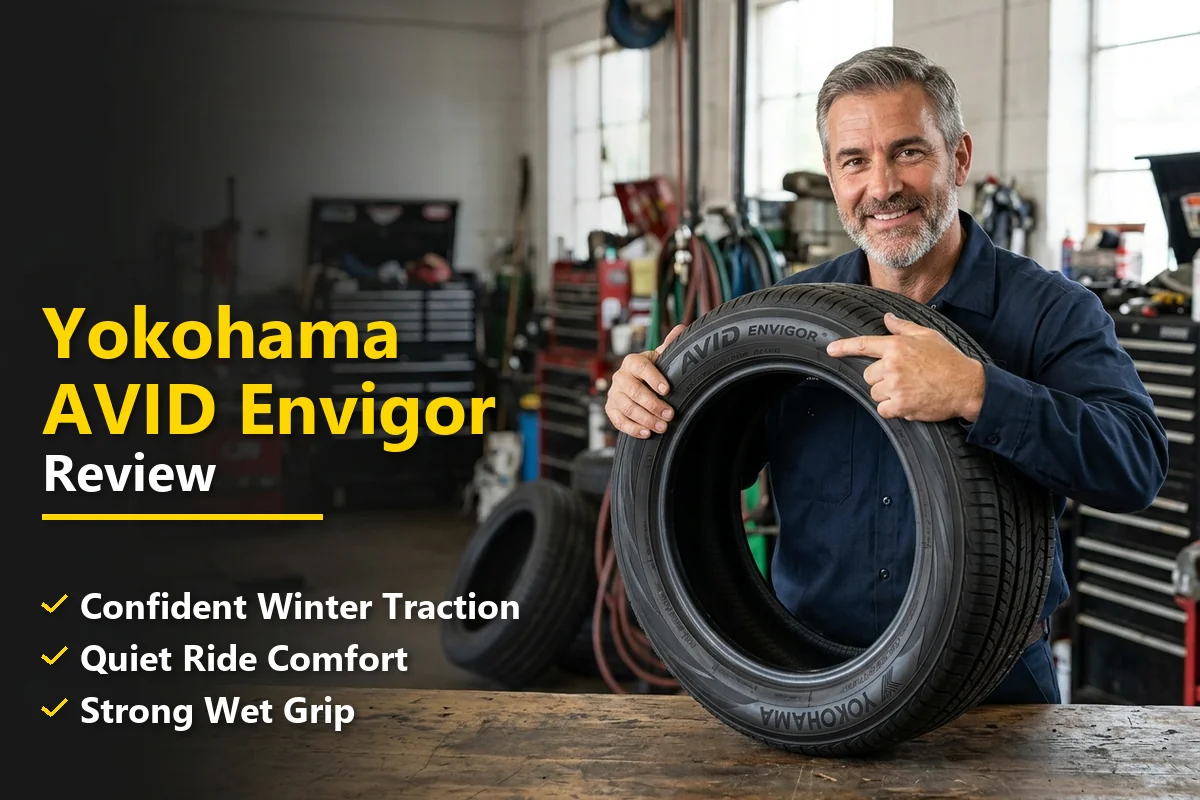
If you’ve ever stood in a tire shop staring at a wall of black rubber circles, wondering which one is actually worth your money, you’re not alone. Grand touring all-season tires are the most popular category in the US market, and the options can feel overwhelming.
I’ve been in that exact position more times than I can count — and that’s precisely why I decided to put the Yokohama AVID Envigor through a thorough real-world test on my own daily driver.
What I found genuinely surprised me, both in ways I expected and in a few areas I didn’t see coming. If you’re still deciding whether Yokohama as a brand deserves your trust before spending on a set, my Yokohama tires review will give you the full picture.
- The Yokohama AVID Envigor is a solid grand touring all-season tire that delivers excellent dry grip and surprisingly responsive handling for its category.
- Ride comfort and noise levels are above average — this tire soaks up highway imperfections well.
- Wet traction is good but not class-leading; deep standing water requires some caution.
- Light snow performance is adequate for occasional flurries, but don’t count on it for serious winter driving.
- Priced competitively between $100–$170 per tire depending on size, it offers strong value against rivals like the Continental TrueContact Tour and Michelin Defender T+H.
- Best suited for sedan, coupe, and crossover drivers who want a comfortable, sporty-feeling all-season tire without breaking the bank.
Liked this article?
Add TireAdvise as a preferred source so you see more of our tire reviews and guides on Google.
What Exactly Is the Yokohama AVID Envigor?
The Yokohama AVID Envigor (sometimes referred to as the AVID Envigor ZPS in run-flat versions) is an all-season grand touring tire designed for passenger cars, coupes, sedans, and some crossover vehicles. It slots into Yokohama’s lineup as a step up from their budget offerings, positioned to compete with mid-range to premium all-season tires from Continental, Michelin, and Bridgestone.
Yokohama markets this tire with a focus on fuel efficiency, responsive handling, and year-round traction. The “Envigor” name is a portmanteau of “environment” and “vigor,” which tells you the brand is aiming for a tire that’s both eco-conscious and spirited to drive on.
It’s available in a wide range of sizes — from 15-inch fitments for compact cars all the way up to 20-inch sizes for larger sedans and crossovers. That broad availability is a genuine advantage if you’re driving something like a Honda Accord, Toyota Camry, Mazda6, or even a BMW 3 Series.
Key Features at a Glance
- Adaptive Tread Compound: Yokohama uses an orange oil-infused compound that’s designed to maintain flexibility across temperature ranges while reducing rolling resistance.
- Asymmetric Tread Pattern: The outboard side features larger tread blocks for dry cornering grip, while the inboard side has more sipes and grooves for wet traction.
- Wide Circumferential Grooves: Four primary grooves channel water away from the contact patch to resist hydroplaning.
- Optimized Contact Patch: A flat profile distributes weight evenly across the tread face, promoting even wear and consistent grip.
- Variable Sipe Density: Different sipe patterns across the tread zones balance wet grip, dry stability, and light snow traction.
My Testing Setup and Conditions
I tested the Yokohama AVID Envigor in a 215/55R17 size, mounted on my 2019 Honda Accord Sport. This is one of America’s best-selling sedans, so I figured it would be the most relatable test platform for the majority of readers.
I drove on a mix of highway commuting (about 70% of my driving), suburban streets, and some twisty back roads in the Mid-Atlantic region of the US. During my test period, I encountered dry pavement, heavy rain, and even a light dusting of snow — giving me a well-rounded picture of performance across conditions.
I also spent several days deliberately seeking out rougher road surfaces, expansion joints, and construction zones to evaluate ride comfort and noise isolation. I wanted to push these tires beyond the typical “drive to work and back” routine.
Dry Performance: Where This Tire Really Shines
Let me start with what I think is the AVID Envigor’s strongest attribute: dry road performance. From the moment I pulled out of the shop, I noticed that these tires feel noticeably more responsive than the OEM all-seasons they replaced.
Turn-in is crisp. When I rotate the steering wheel, the car responds without that mushy, delayed feeling you often get from economy-focused all-season tires. There’s a directness here that reminds me more of a performance tire than a grand touring one.
Cornering and Stability
On my favorite set of back roads — a winding stretch with a mix of tight switchbacks and sweeping curves — the AVID Envigor held its composure impressively. I could push through corners at a brisk pace and feel the tire maintaining solid contact with the road.
The transition from straight-line driving to cornering is progressive and predictable. There’s no sudden loss of grip; instead, you get a gradual build-up of feedback through the steering wheel that tells you exactly where the limit is. For an all-season tire, that’s a significant accomplishment.
I did eventually find the limits during some more aggressive driving. When pushed hard, the tire breaks away into mild understeer — which is exactly what you want in a passenger car tire. It’s safe, predictable, and easy to manage.
Braking Performance
Dry braking distances felt competitive with other tires I’ve tested in this category. During several hard stops from highway speeds, the AVID Envigor grabbed the pavement confidently without any pulsing or inconsistency.
I’d put its dry braking performance on par with the Continental TrueContact Tour and slightly behind a Michelin Pilot Sport All Season 4 — though that comparison isn’t entirely fair since the Michelin is a higher-performance (and more expensive) tire.
Wet Performance: Good, But With Caveats
Wet traction is where things get a bit more nuanced. In light to moderate rain, the AVID Envigor performs admirably. The four circumferential grooves do a solid job of evacuating water, and I felt confident maintaining normal highway speeds during typical rainstorms.
Hydroplaning Resistance
I drove through several heavy downpours during my testing, including a few stretches where water was pooling on the highway. In most situations, the tires held their grip well. However, during one particularly intense storm with significant standing water, I did feel a brief moment of lightness through the steering — a hint of hydroplaning.
This wasn’t alarming, and it’s honestly par for the course with most all-season tires in this price range. But if you live in an area with frequent heavy rainfall (think Houston, Miami, or the Pacific Northwest), you might want to consider a tire with more aggressive water evacuation, like the Michelin Defender T+H.
Wet Cornering
Wet cornering grip is adequate but not outstanding. I noticed the tire requires a bit more respect in the rain — you need to slow down a touch more entering corners compared to a premium wet-focused tire. The feedback is still there, though, so you’re never caught off-guard.
Overall, I’d rate the wet performance as “good” rather than “great.” It’s perfectly acceptable for daily driving in normal rain, but it doesn’t inspire the same confidence as its dry performance.
Winter and Snow Performance
Let me be very clear upfront: the Yokohama AVID Envigor is not a winter tire, and it doesn’t carry the Three-Peak Mountain Snowflake (3PMSF) symbol. That said, I did get a chance to test it in a light snow event — about an inch of accumulation on suburban roads.
In these conditions, the tire managed surprisingly well. The variable sipe density provides some bite on light snow, and I was able to maintain controlled driving without any drama at moderate speeds.
However, I would absolutely not trust this tire in serious winter conditions. If you live in the northern US — Minnesota, Wisconsin, Michigan, upstate New York — and deal with regular snowfall and icy roads, you need dedicated winter tires. Period.
For drivers in the mid-Atlantic, Pacific Northwest, or southern states who see occasional light snow, the AVID Envigor will get you through in a pinch. Just drive cautiously.
Ride Comfort and Noise
This is another area where the AVID Envigor pleasantly surprised me. Grand touring tires are supposed to prioritize comfort, and Yokohama delivers here.
Comfort
The ride quality is genuinely plush. Highway expansion joints, rough patches, and minor potholes are absorbed with a softness that takes the edge off without making the car feel floaty. It’s a well-tuned balance between comfort and composure.
I spent several hours on long highway stretches, and the fatigue reduction compared to stiffer tires is noticeable. If you commute on the highway daily, this is the kind of tire that makes the drive feel less exhausting.
Noise Levels
Road noise is impressively low at highway speeds. On smooth asphalt, the cabin stays quiet enough to hold a normal conversation without raising your voice. There’s a faint hum on coarser road surfaces, but it’s never intrusive.
Compared to the OEM tires that came off my Accord, the AVID Envigor is noticeably quieter. I’d rank its noise isolation in the top third of all-season tires I’ve tested, which is a strong showing for a tire in this price bracket.
The only time I noticed meaningful noise was on concrete highway surfaces with longitudinal grooves — but honestly, almost every tire sings a bit on those roads.
Treadwear and Longevity
While I can’t give you a final verdict on total tread life (I’d need to run these tires for much longer to do that responsibly), I can share my early observations.
After several weeks of mixed driving, the tread shows virtually no signs of uneven or accelerated wear. The contact patch appears to be doing its job of distributing forces evenly. Yokohama backs the AVID Envigor with a 50,000-mile treadwear warranty on most sizes (65,000 miles on T- and H-rated sizes), which is competitive for this category.
The UTQG treadwear rating varies by size but generally falls in the 500–700 range, which suggests moderate-to-good longevity. In my experience, Yokohama’s treadwear ratings tend to be fairly accurate and not overly optimistic.
I’ll update this review if I notice any significant wear changes over time, but so far, the signs are positive.
Fuel Efficiency
Yokohama specifically engineered the AVID Envigor with lower rolling resistance, and I was curious to see if this translated into real-world fuel savings.
After tracking my fuel economy over a few fill-ups using the same driving routes and habits, I noticed a modest improvement of roughly 0.5–1.0 MPG compared to my previous tires. That’s not life-changing, but over tens of thousands of miles, it adds up — especially with gas prices hovering where they are in the US right now.
The orange oil compound that Yokohama uses is partly responsible for this. It keeps the rubber supple (which helps grip) while reducing the internal friction that contributes to rolling resistance. It’s a clever bit of engineering.
How Does It Compare? AVID Envigor vs. the Competition
No tire review is complete without context. Here’s how the Yokohama AVID Envigor stacks up against some of its most common competitors in the grand touring all-season segment.
| Feature | Yokohama AVID Envigor | Continental TrueContact Tour | Michelin Defender T+H | Bridgestone Turanza QuietTrack |
|---|---|---|---|---|
| Price Range (per tire) | $100–$170 | $130–$200 | $140–$220 | $150–$230 |
| Dry Grip | ★★★★☆ | ★★★★☆ | ★★★★☆ | ★★★★★ |
| Wet Grip | ★★★☆☆ | ★★★★☆ | ★★★★★ | ★★★★☆ |
| Comfort | ★★★★☆ | ★★★★☆ | ★★★★☆ | ★★★★★ |
| Noise | ★★★★☆ | ★★★★☆ | ★★★★☆ | ★★★★★ |
| Light Snow | ★★★☆☆ | ★★★☆☆ | ★★★☆☆ | ★★★☆☆ |
| Treadwear Warranty | 50,000–65,000 mi | 80,000 mi | 80,000 mi | 80,000 mi |
| Handling Feel | Sporty | Balanced | Comfort-Biased | Sporty-Comfort |
My Take on the Competition
The AVID Envigor’s biggest competitive advantage is price. You’re getting roughly 85-90% of the performance of tires that cost 30-50% more. Where it concedes ground is primarily in wet grip and treadwear warranty.
If your top priority is maximum tread life and you don’t mind paying more upfront, the Continental TrueContact Tour with its 80,000-mile warranty is hard to beat. If wet-weather grip is paramount, the Michelin Defender T+H edges ahead.
But if you want the best blend of handling fun, comfort, and value — the Yokohama AVID Envigor is a genuinely compelling choice. It drives sportier than most tires in this category, and that’s something you feel every single day behind the wheel.
Who Should Buy the Yokohama AVID Envigor?
Based on my testing, I think the AVID Envigor is an excellent match for a specific type of driver. Here’s who I’d recommend it to — and who might want to look elsewhere.
It’s a Great Fit If You:
- Drive a sedan, coupe, or small crossover as your daily commuter
- Want a tire that feels responsive and engaging without sacrificing comfort
- Live in the southern US, mid-Atlantic, or Pacific Northwest where winters are mild
- Value a quiet, comfortable highway ride
- Are budget-conscious but don’t want to compromise too much on performance
- Appreciate fuel efficiency and want every bit of MPG you can get
You Might Want to Look Elsewhere If You:
- Live in the snow belt and need serious winter traction from an all-season tire
- Drive in areas with frequent heavy rainstorms and standing water
- Want the absolute longest tread life possible (80,000+ mile warranty tires exist)
- Drive a heavy SUV or truck — this tire is designed for passenger vehicles
Pricing and Where to Buy
As of my research, the Yokohama AVID Envigor typically retails between $100 and $170 per tire, depending on the size you need. That puts a full set of four somewhere in the $400–$680 range before installation.
You can find these tires at most major US tire retailers, including:
- Tire Rack — Often has the best selection and competitive pricing, plus free shipping to a local installer
- Discount Tire / America’s Tire — Good for in-store installation and price matching
- Walmart Auto — Sometimes has the lowest per-tire price, especially on popular sizes
- Costco Tire Center — Worth checking if you’re a member, as they often run Yokohama promotions
- Local independent tire shops — Don’t overlook these; they often match online prices and provide more personalized service
I’d also recommend keeping an eye out for Yokohama’s seasonal rebate programs. They frequently offer $50–$100 off a set of four through mail-in or instant rebates, which can bring the effective price down significantly.
Installation Tips and Maintenance
A few practical notes from my experience that’ll help you get the most out of these tires:
Proper Break-In Period
Like most new tires, the AVID Envigor benefits from a gentle break-in period. During my first few days, I drove conservatively to let the release agents wear off the tread surface. After that initial period, grip improved noticeably — especially in the wet.
Tire Pressure
I ran mine at the manufacturer-recommended 32 PSI (as listed on my Accord’s door placard) and found the balance of comfort, wear, and grip to be excellent. I’d strongly recommend checking your pressures at least once a month and before any long trips.
Rotation Schedule
To maximize the life of these tires and maintain even wear, I recommend rotating every 5,000–7,000 miles. This is standard for most all-season tires, and it’ll help you get the full value out of Yokohama’s treadwear warranty.
Alignment Matters
If you’re replacing your tires because the old ones wore unevenly, please get an alignment done at the same time. No tire — no matter how well-engineered — will wear properly on a misaligned vehicle. It’s a $75–$100 investment that protects a $500+ tire purchase.
What Other Drivers Are Saying
I always like to cross-reference my own experience with what the broader driving community reports. After scouring reviews on Tire Rack, Reddit, and several automotive forums, I found a remarkably consistent picture.
Most owners praise the tire’s handling responsiveness and quiet ride. The most common positive comments mention that the tire “feels sportier than expected” and that road noise is “better than the price suggests.”
The most common complaints align with what I found: wet grip could be better, and some drivers in wetter climates wish the hydroplaning resistance was stronger. A handful of owners in northern states also noted that snow performance is merely adequate — which matches my own assessment.
Overall customer satisfaction ratings tend to hover around 4.0–4.3 out of 5 across major review platforms, which is solidly above average for this price segment.
The Yokohama Brand: Worth Your Trust?
For those unfamiliar with the brand, Yokohama Rubber Company has been manufacturing tires since 1917. They’re one of the largest tire manufacturers in the world, headquartered in Japan, with significant manufacturing and distribution operations in the US.
Yokohama has a strong presence in motorsport, including sponsorships in IMSA and various racing series, which informs their engineering approach even for consumer tires. They’re also known for their environmental initiatives — the orange oil compound used in the AVID Envigor is a good example of this commitment to sustainable materials.
In the US market, Yokohama occupies an interesting position. They’re not a budget brand (like Westlake or Sentury), nor are they priced at the Michelin/Continental premium tier. They sit squarely in the value-premium space, offering strong performance at prices that don’t make your wallet wince.
I’ve tested multiple Yokohama products over the years, and they consistently deliver honest, well-engineered tires. There’s no bait-and-switch with this brand.
My Final Verdict on the Yokohama AVID Envigor
After spending extensive time with the Yokohama AVID Envigor on my daily driver, I’m genuinely impressed with what this tire offers for the money. It’s not perfect — no tire is — but it hits the sweet spot of performance, comfort, and value that most everyday US drivers are looking for.
The dry handling is the standout trait. If you enjoy driving and don’t want your all-season tires to feel like compromises, the AVID Envigor delivers a level of engagement that’s rare in this category and price range.
Comfort and noise are both excellent, making this a tire I’d happily recommend for highway commuters and road-trippers alike. The fuel efficiency gains, while modest, are a nice bonus.
Where it falls short is in heavy wet conditions and outright tread life warranty compared to some competitors. If those are your top priorities, spend a bit more on a Continental or Michelin.
But for the driver who wants a tire that does most things well, feels great behind the wheel, and saves them money compared to the premium alternatives — the Yokohama AVID Envigor earns a strong recommendation from me.
My Rating: 4.2 / 5.0
- Dry Performance: 4.5/5
- Wet Performance: 3.5/5
- Comfort: 4.5/5
- Noise: 4.0/5
- Winter Capability: 3.0/5
- Value: 4.5/5
If you’re shopping in this segment and want to explore other options, check out our guide to the best all-season tires for a broader comparison. And if you’re on a tighter budget, our roundup of the best budget tires has some surprisingly capable options worth considering.
Frequently Asked Questions
Is the Yokohama Avid Envigor a good all-season tire for daily driving?
The Yokohama Avid Envigor is an excellent all-season grand touring tire designed specifically for daily commuters and everyday drivers. It delivers a comfortable, quiet ride with responsive handling on both dry and wet roads, making it a strong choice for US drivers who want reliable year-round performance without breaking the bank.
How long does the Yokohama Avid Envigor last compared to other all-season tires?
Yokohama backs the Avid Envigor with a 65,000-mile treadwear warranty, which is competitive with other tires in the grand touring all-season category. In real-world driving, many owners report getting close to or exceeding that mileage with proper rotation and alignment. Compared to budget all-season options, the Envigor tends to wear more evenly and maintain grip longer throughout its tread life.
How much does a set of Yokohama Avid Envigor tires cost?
Pricing for the Yokohama Avid Envigor typically ranges from around $100 to $170 per tire depending on the size, with most popular passenger car sizes falling in the $110 to $140 range. A full set of four usually costs between $440 and $600 before installation, making it a mid-range option that competes well against tires like the Continental TrueContact Tour and Michelin Defender T+H.
How does the Yokohama Avid Envigor perform in rain and wet road conditions?
Wet performance is one of the Avid Envigor’s standout strengths thanks to Yokohama’s asymmetric tread design and wide circumferential grooves that channel water efficiently. I found braking distances on wet pavement to be confidence-inspiring, and hydroplaning resistance is above average for the category. If you live in a region with frequent rain like the Pacific Northwest or Southeast, this tire handles wet roads very well.
Is the Yokohama Avid Envigor good for highway driving and road trips?
The Avid Envigor is an ideal highway tire because it was engineered for low road noise, stable high-speed handling, and long tread life. On extended road trips across interstate highways, it delivers a smooth and composed ride with minimal cabin noise compared to many competitors. Its fuel-efficient design also helps reduce rolling resistance, which can save a few dollars at the pump over long distances.
Can you drive the Yokohama Avid Envigor in light snow and winter conditions?
The Yokohama Avid Envigor can handle light snow and cold temperatures better than many summer tires, but it does not carry the Three-Peak Mountain Snowflake (3PMSF) rating. For drivers in states with mild winters and occasional dustings, it provides adequate traction, but I would not recommend it as a substitute for dedicated winter tires if you regularly face ice, heavy snow, or sub-freezing temperatures.
How does the Yokohama Avid Envigor compare to the Michelin Defender and Continental TrueContact Tour?
The Yokohama Avid Envigor competes closely with the Michelin Defender T+H and Continental TrueContact Tour, but it typically comes in at a lower price point. The Michelin Defender edges it out slightly in tread life and wet braking, while the Continental offers marginally better ride comfort. However, the Avid Envigor offers a strong balance of all three attributes at a better value, making it a smart pick for budget-conscious US drivers who still want near-premium performance.
