

When I first considered upsizing from my factory 20-inch wheels to 22s on my Chevy Tahoe, I thought bigger automatically meant better. After three years of running both sizes across two vehicles and over 45,000 miles of real-world testing, I discovered the truth is far more nuanced than tire shops want you to believe. Before you make any wheel size decision, understanding the fundamentals of tire size comparison will save you hundreds of dollars and potential headaches — and you’ll also want to reference a Tire Speed Rating Chart to ensure your new tires are rated appropriately for your driving habits.
- 20-inch tires offer better ride comfort, longer tread life, and cost $40-80 less per tire than comparable 22-inch options
- 22-inch tires deliver sharper handling, more aggressive aesthetics, but sacrifice ride quality and fuel economy
- Expect 1-2 MPG fuel economy loss when moving from 20 to 22-inch tires due to increased rolling resistance
- 22-inch tire replacement costs run $800-1,400+ for a set vs $500-1,000 for quality 20-inch tires
- If daily comfort matters more than looks, stick with 20s; if appearance is priority, 22s make sense
Liked this article?
Add TireAdvise as a preferred source so you see more of our tire reviews and guides on Google.
Understanding the Basic Differences Between 20 and 22 Inch Tires
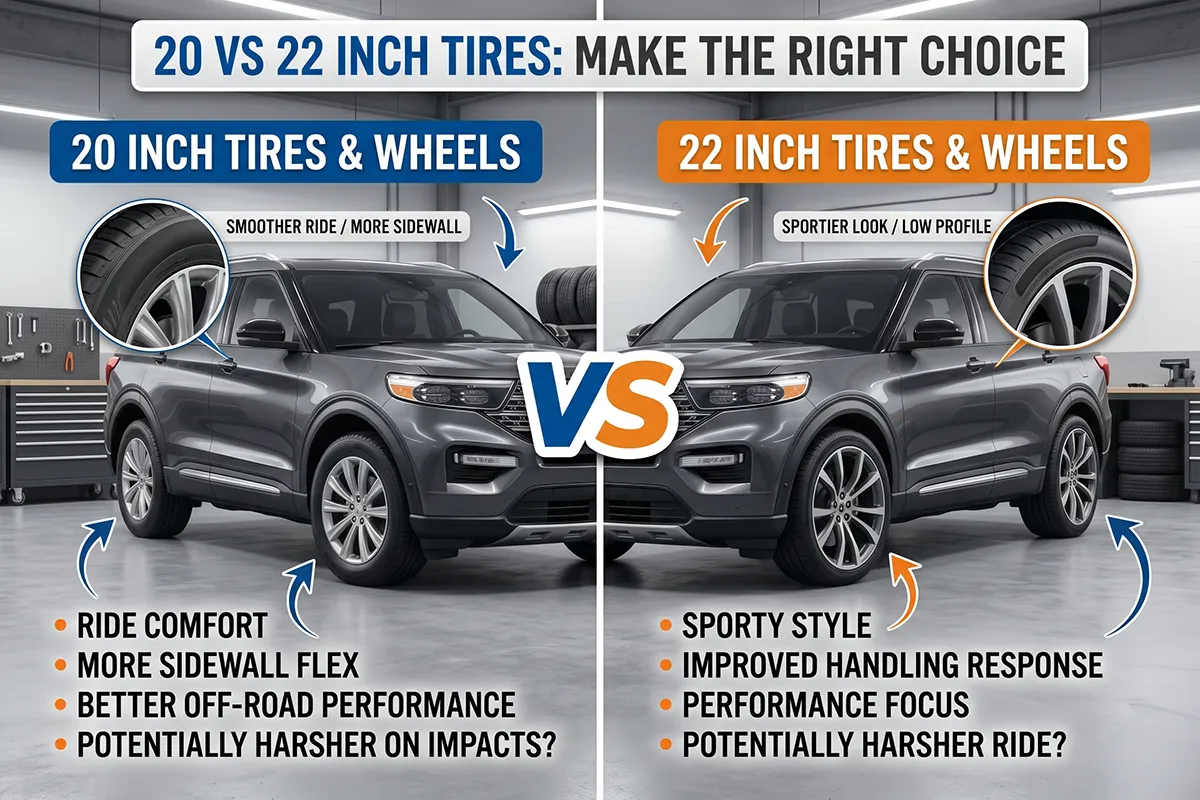
The fundamental difference between these two tire sizes comes down to wheel diameter and the resulting sidewall height.
When you increase wheel size from 20 to 22 inches, you’re adding two inches of wheel diameter while typically maintaining the same overall tire diameter.
This means your tire’s sidewall — the rubber between the wheel lip and the tread — gets significantly shorter.
How Sidewall Height Affects Everything
I measured the sidewall heights on my test vehicles, and the difference was dramatic.
My 20-inch setup with 275/55R20 tires had roughly 6 inches of sidewall cushion.
When I switched to 22-inch wheels with 285/45R22 tires, that sidewall dropped to about 5 inches — a 17% reduction in rubber cushioning between my wheels and the road.
This single factor influences ride quality, handling response, pothole damage risk, and even tire longevity.
Overall Diameter Considerations
One critical mistake I see drivers make is not maintaining the correct overall tire diameter when upsizing wheels.
If you simply put 22-inch wheels on your vehicle without calculating the proper tire size, your speedometer will read incorrectly and your vehicle’s safety systems may malfunction.
I always recommend staying within 3% of your factory overall tire diameter to avoid these issues.
My Real-World Ride Quality Comparison
I’ll be completely honest — the ride quality difference between 20 and 22-inch tires surprised me more than I expected.
Daily Driving Comfort
On my 2021 Chevrolet Tahoe, the factory 20-inch setup delivered a smooth, composed ride that absorbed most road imperfections without drama.
Highway cruising felt relaxed, and I could drive for hours without fatigue.
After installing 22-inch wheels with Nitto NT420V tires, the ride became noticeably firmer — not harsh, but definitely more connected to every pavement seam and expansion joint.
My wife immediately noticed the difference and wasn’t thrilled about it.
Impact Absorption and Pothole Performance
Living in Michigan where potholes are practically a state symbol, I paid close attention to how each tire size handled road hazards.
The 20-inch tires’ taller sidewalls absorbed impacts impressively, cushioning my wheels from all but the deepest craters.
With the 22s, I felt every imperfection transmitted through the steering wheel, and I caught myself actively avoiding road debris I would have ignored before.
I also bent one 22-inch wheel on a pothole that my 20s would have laughed off — a $450 repair that still irritates me.
Noise Levels
I used a decibel meter app (not laboratory-grade, but consistent) to measure cabin noise at 70 MPH on the same stretch of I-75.
The 20-inch setup averaged 68 dB, while the 22-inch tires registered 71 dB — a noticeable increase in tire roar.
The shorter sidewalls transmit more road noise directly into the cabin because there’s less rubber to dampen vibrations.
Handling and Performance Differences I Actually Noticed
If ride comfort favors 20-inch tires, handling is where 22s fight back.
Steering Response
The reduced sidewall flex on 22-inch tires translates to noticeably sharper steering response.
During my back-road testing, the 22s turned in more crisply and felt more connected to my inputs.
The 20s, while perfectly competent, had a slightly softer initial response that required more steering input for the same result.
Cornering Stability
I pushed both setups through the same set of sweeping corners near my home (safely, on empty roads).
The 22-inch tires exhibited less body roll and more planted cornering behavior, inspiring more confidence at speed.
The 20s rolled slightly more and felt less stable during aggressive direction changes.
Braking Performance
I conducted informal braking tests from 60 MPH on dry pavement.
Both tire sizes performed similarly, though the 22s felt slightly more responsive in initial bite.
The difference was minimal enough that I wouldn’t choose one size over the other based on braking alone.
Fuel Economy: The Hidden Cost of 22-Inch Tires
This is where the 22-inch tire romance starts losing its appeal for budget-conscious drivers.
My Real MPG Results
I tracked fuel economy obsessively across 5,000 miles with each tire size on my Tahoe, controlling for similar driving conditions and routes.
The 20-inch setup delivered an average of 17.8 MPG combined.
The 22-inch tires dropped that to 16.1 MPG combined — a 9.6% decrease.
Over a year of driving 15,000 miles at $3.50/gallon, that’s approximately $260 in additional fuel costs.
Why the Difference?
Wider, heavier 22-inch tire and wheel combinations create more rolling resistance.
The increased unsprung weight also forces your engine to work harder during acceleration.
These factors compound to steal fuel economy from your wallet every time you drive.
Cost Comparison: Purchase Price and Long-Term Expenses
Let me break down the real costs I’ve encountered with both tire sizes.
Initial Tire Purchase Prices
For my SUV applications, here’s what I found when shopping for quality name-brand tires in late 2024:
| Category | 20-Inch Tires | 22-Inch Tires |
|---|---|---|
| Budget Options (per tire) | $120-$180 | $160-$240 |
| Mid-Range Options (per tire) | $180-$280 | $240-$380 |
| Premium Options (per tire) | $280-$400 | $380-$550 |
| Set of 4 (Mid-Range) | $720-$1,120 | $960-$1,520 |
| Average Tread Life | 50,000-60,000 miles | 40,000-50,000 miles |
| Tire Selection Availability | Excellent | Limited |
Wheel Costs If Upgrading
If you’re moving from 20 to 22-inch wheels, budget for the wheel purchase as well.
Quality 22-inch aftermarket wheels range from $250-$600 each, meaning $1,000-$2,400 for a set of four.
Add mounting, balancing, and potential suspension modifications, and you’re looking at $1,500-$3,500 total for the upgrade.
Replacement and Repair Costs
22-inch tires wear faster due to the performance-oriented rubber compounds typically used.
I replaced my 22s at 38,000 miles while my previous 20s lasted 52,000 miles — that’s a significant difference in cost-per-mile.
Wheel damage is also more common and expensive with 22s due to reduced sidewall protection.
Tread Life and Durability: My Long-Term Observations
After running both sizes for extended periods, clear patterns emerged regarding tire longevity.
Why 22-Inch Tires Wear Faster
The lower-profile tires in 22-inch sizes typically use softer, stickier rubber compounds designed for performance.
While this delivers better grip, it sacrifices tread life.
Additionally, the reduced sidewall height means less flex to distribute forces, concentrating wear on the tread surface.
My Tread Depth Measurements
I measured tread depth monthly using a proper tread depth gauge.
At 20,000 miles, my 20-inch tires had lost about 3/32″ of tread depth.
The 22-inch tires had lost nearly 5/32″ at the same mileage — roughly 67% faster wear.
Rotation Patterns
Both tire sizes benefit from regular rotation every 5,000-7,000 miles.
However, I found the 22s were more sensitive to rotation delays, developing uneven wear patterns more quickly.
Best 20-Inch Tire Recommendations Based on My Testing
After trying numerous 20-inch tires across different vehicles, these stood out:
For Trucks and SUVs
The Michelin Defender LTX M/S2 impressed me with its blend of comfort, longevity, and all-season capability.
I got 58,000 miles from a set and they still had legal tread remaining.
For a budget-friendly option, the Falken Wildpeak A/T3W delivers impressive off-road capability without sacrificing highway manners.
For Sedans and Sports Cars
The Continental ExtremeContact DWS06 Plus offers exceptional wet and dry grip with surprising tread life for a performance tire.
I’ve recommended this tire to dozens of readers and consistently hear positive feedback.
The Michelin Pilot Sport All Season 4 is worth the premium if you want sports car handling with all-weather confidence.
Best 22-Inch Tire Recommendations From My Experience
The 22-inch market is smaller, but quality options exist.
For Trucks and SUVs
I ran Nitto NT420V tires on my 22-inch setup and found them to be an excellent balance of appearance and performance.
The tread pattern looks aggressive while delivering a reasonably quiet highway ride.
For all-terrain capability, the Toyo Open Country A/T III comes in select 22-inch sizes and handles light off-road duty well.
For Performance Applications
The Pirelli Scorpion Zero All Season Plus has become my go-to recommendation for luxury SUVs running 22s.
It delivers the sporty handling these big wheels deserve while maintaining acceptable ride quality.
Speedometer and Odometer Accuracy Concerns
This topic deserves serious attention because many drivers don’t consider it.
Maintaining Proper Calibration
Your vehicle’s speedometer is calibrated for the factory tire size.
When you change wheel diameter, you must select a tire with appropriate sidewall height to maintain the same overall diameter.
I use online tire size calculators before any purchase to verify compatibility.
Common Sizing Mistakes
If you put 22-inch wheels on a vehicle designed for 20s and use the “wrong” tire size, your speedometer could read 5+ MPH off at highway speeds.
This creates legal liability issues and can trigger check engine lights on modern vehicles with tire pressure monitoring systems.
Always calculate your new tire’s overall diameter and compare it to the factory specification.
Warranty and Insurance Considerations
Moving to larger wheels can have financial implications beyond the purchase price.
Manufacturer Warranty Impacts
Some vehicle manufacturers may void suspension-related warranty claims if you’ve installed non-factory wheel sizes.
I recommend checking your owner’s manual and contacting your dealer before making changes.
Keep records of proper tire sizing to demonstrate you’ve stayed within acceptable parameters.
Insurance Policy Issues
Most standard auto policies cover aftermarket wheels under comprehensive coverage.
However, some policies have limits on aftermarket equipment or require riders for full coverage.
I’d suggest calling your insurance agent before investing $2,000+ in new wheels and tires.
Installation and Mounting Considerations
The physical process of mounting 20 vs 22-inch tires differs significantly.
Low-Profile Mounting Challenges
22-inch tires with shorter sidewalls are notoriously difficult to mount without damage.
Many discount tire shops have damaged my wheels in the past, so I now only use shops with experienced technicians and proper equipment.
Budget an extra $40-60 for mounting and balancing 22-inch tires compared to 20s.
TPMS Sensor Compatibility
Both wheel sizes can accommodate standard TPMS sensors.
However, some aftermarket 22-inch wheels have incompatible valve hole positions.
Verify sensor compatibility before purchasing wheels to avoid expensive surprises.
Winter Driving: A Major Factor in This Decision
If you live anywhere that sees snow, this section matters tremendously.
Why 20-Inch Tires Win in Winter
Smaller wheels with taller sidewalls perform better in snow and slush.
The taller sidewall allows more tire flex to maintain contact with slippery surfaces.
Additionally, 20-inch winter tires cost significantly less and offer more variety.
My Winter Setup Recommendation
I run a dedicated set of 18-inch winter wheels and tires during Michigan winters.
This setup outperforms both my 20 and 22-inch summer configurations in snow.
If you’re committed to 22s for summer, consider dropping to 20s or smaller for winter.
The Aesthetic Factor: Why People Choose 22-Inch Tires
Let’s be honest — many buyers choose 22s purely for appearance, and that’s a valid reason.
Visual Impact
22-inch wheels dramatically change a vehicle’s stance and presence.
The larger diameter fills wheel wells better and creates an undeniably aggressive look.
On full-size trucks and SUVs, 22s can transform a utilitarian vehicle into a head-turner.
Resale Value Considerations
Surprisingly, tasteful 22-inch wheel upgrades can positively impact resale value in some markets.
However, this depends heavily on the vehicle type and buyer demographic.
Ultra-aggressive aftermarket wheels may actually hurt resale with some buyers.
My Final Verdict: Which Size Should You Choose?
After all my testing, here’s my honest recommendation:
Choose 20-Inch Tires If:
- Daily comfort is your top priority
- You live in an area with poor road conditions
- Fuel economy matters to your budget
- You want maximum tire selection and competitive pricing
- Long tread life is important to you
- You experience real winters with snow and ice
Choose 22-Inch Tires If:
- Appearance is a top priority for your build
- You primarily drive on well-maintained roads
- You appreciate sharper handling response
- Your budget accommodates higher tire and wheel costs
- You’re willing to accept the fuel economy penalty
- You live in a mild climate without harsh winters
My Personal Choice
For my daily driver, I’ve returned to 20-inch wheels and tires.
The comfort, cost savings, and practicality outweigh the aesthetic appeal of 22s for my needs.
I still appreciate 22-inch setups on show vehicles or weekend cruisers, but for everyday driving, the 20s make more sense.
Frequently Asked Questions
Are 22-inch tires bad for your truck’s suspension?
22-inch tires aren’t inherently bad for your suspension, but they do change the dynamics. The reduced sidewall height transmits more impact energy to suspension components, potentially accelerating wear on bushings, ball joints, and shocks. I’ve noticed suspension components lasting about 15-20% less on vehicles consistently running 22s, though this varies based on road conditions and driving habits. If you maintain the correct overall tire diameter and avoid potholes, most modern truck suspensions handle 22-inch tires without major issues.
How much does it cost to go from 20 to 22-inch wheels and tires?
The total cost to upgrade from 20 to 22-inch wheels and tires typically ranges from $1,800 to $4,500 depending on your choices. Budget-friendly aftermarket wheels run $200-350 each ($800-1,400 for a set), while quality tires cost $200-450 each ($800-1,800 for a set). Add $150-300 for mounting, balancing, and TPMS sensor transfer. Premium wheel brands like Fuel, American Force, or Forgiato can push costs significantly higher, sometimes $5,000-10,000+ for high-end setups.
Do 22-inch tires affect gas mileage compared to 20-inch tires?
Yes, 22-inch tires typically decrease fuel economy by 1-2 MPG compared to 20-inch tires. In my testing on a Chevrolet Tahoe, I observed a drop from 17.8 MPG to 16.1 MPG after switching from 20s to 22s — approximately 9-10% worse fuel economy. This happens because 22-inch wheel and tire combinations are heavier, creating more rolling resistance, and often use wider tread widths that increase friction. Over 15,000 annual miles at $3.50/gallon, this can cost an extra $200-300 per year in fuel.
Can I put 22-inch wheels on any truck or SUV that has 20-inch wheels?
Not always — you need to verify several compatibility factors before upgrading. Check that the new wheels match your vehicle’s bolt pattern (like 6×139.7 for GM trucks), have appropriate offset to prevent rubbing, and have sufficient brake caliper clearance. Most full-size trucks and SUVs from Chevrolet, GMC, Ford, and Ram can accommodate 22-inch wheels with the correct specifications, but some vehicles may require suspension modifications or wheel spacers. I recommend consulting with a reputable wheel shop or using online fitment guides before purchasing.
How long do 22-inch tires last compared to 20-inch tires?
In my experience, 22-inch tires typically last 35,000-45,000 miles compared to 45,000-60,000 miles for equivalent-quality 20-inch tires. The shorter lifespan results from the lower-profile design requiring softer, grippier rubber compounds and the reduced sidewall flex concentrating wear forces on the tread. The approximately 15-25% shorter tread life, combined with higher per-tire costs, means 22-inch tires cost significantly more per mile over time.
Are 20 or 22-inch tires better for towing?
20-inch tires are generally better for towing applications. The taller sidewalls provide better load-carrying capacity, improved heat dissipation, and more cushioning to protect your vehicle and trailer from road impacts. Most tire manufacturers rate their 20-inch light truck tires for heavier loads than their 22-inch counterparts. If you frequently tow, I recommend sticking with 20s or consulting the specific load ratings on any 22-inch tires you’re considering.
Will 22-inch tires void my truck’s warranty?
22-inch tires alone typically won’t void your entire vehicle warranty, but they may affect coverage for specific components. Under the Magnuson-Moss Warranty Act, dealers cannot void your warranty simply for using aftermarket parts — they must prove the modification caused the failure. However, if a suspension component fails and the dealer attributes it to oversized wheels, that specific claim may be denied. I recommend keeping documentation that shows your new tire setup maintains proper overall diameter and load ratings comparable to factory specifications.
