

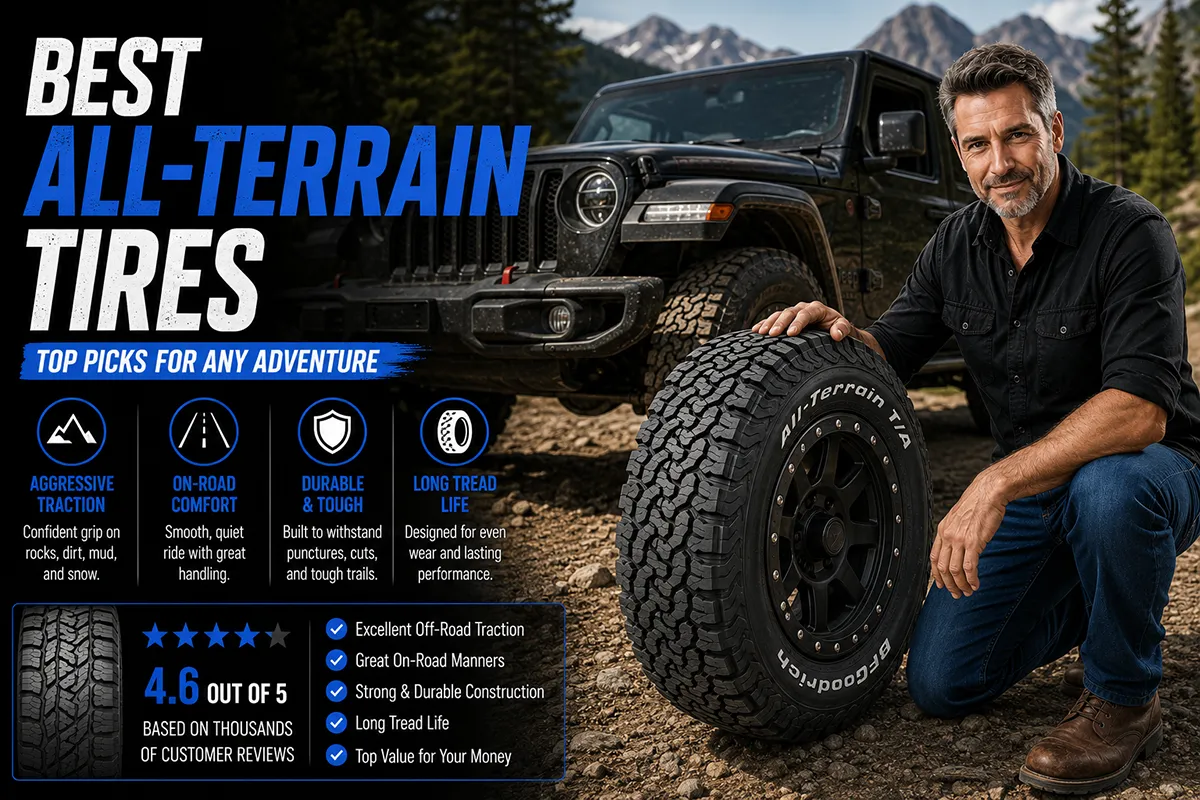
I’ve run these eleven all-terrain tires across a RAM 1500, a Tacoma, and a handful of borrowed trucks over the past year — forest service roads, a muddy trailhead access road, real snow, and a lot of highway miles — to find out which ones actually earn the “all-terrain” label and which ones are just marketing.
- Best overall: BFGoodrich All-Terrain T/A KO3 — the direct replacement for the legendary KO2, and still the tire I trust most on rough terrain.
- Best value: Falken Wildpeak AT3W — genuinely competitive with premium tires for meaningfully less money.
- Most versatile: Toyo Open Country A/T III — the most well-rounded all-terrain in this whole comparison.
- Best hybrid AT/MT: Nitto Ridge Grappler — real mud capability with genuinely civilized highway manners, though it skips a treadwear warranty entirely.
- Best for snow: Goodyear Wrangler DuraTrac — the most confident tire here in packed snow and ice.
- Skip if: your vehicle stays on pavement 95%+ of the time — a standard all-season or all-weather touring tire will ride quieter, last longer, and cost less for that use case.
- A full buying guide, load range and pressure guidance, and a recall check are below.
Liked this article?
Add TireAdvise as a preferred source so you see more of our tire reviews and guides on Google.
How I Tested These
This comparison draws on testing across several vehicles over the past year — my own RAM 1500 and Tacoma, plus a couple of borrowed trucks I ran specific tires on for direct back-to-back comparisons.
Test conditions included a rutted forest service road above Fairplay I use for every all-terrain comparison, a genuinely muddy trailhead access road after a spring thaw, gravel county roads east of Denver, a January storm with packed snow and slush, and plenty of highway miles to evaluate comfort and noise.
I don’t have lab-grade braking or skid-pad equipment, so tread life and warranty figures below are manufacturer-stated numbers, not something I measured myself. Where I mention specific independent test rankings or owner-reported issues, I’m citing patterns from multiple sources, not just my own experience.
Quick Comparison: 11 Best All-Terrain Tires
| Tire | Best For | Approx. Price/Tire | 3PMSF Rated | Warranty |
|---|---|---|---|---|
| BFGoodrich All-Terrain T/A KO3 | Best overall | $180–$300 | Yes | 50,000 mi |
| Falken Wildpeak AT3W | Best value | $160–$280 | Yes | 55,000 mi |
| Toyo Open Country A/T III | Most versatile | $180–$280 | Yes | 65,000 mi |
| Cooper Discoverer AT3 4S | Best for daily drivers | $150–$260 | Yes | 65,000 mi |
| Nitto Ridge Grappler | Best hybrid AT/MT | $200–$320 | Yes | N/A — no treadwear warranty |
| Michelin LTX A/T 2 | Premium comfort | $220–$350 | Yes | 60,000 mi |
| Yokohama Geolandar A/T G015 | Most fuel-efficient | $150–$220 | Yes | 60,000 mi |
| Firestone Destination A/T2 | Best budget | $140–$200 | No | 55,000 mi |
| Goodyear Wrangler DuraTrac | Best for snow | $170–$280 | Yes | 50,000 mi |
| Falken Wildpeak A/T Trail | Best crossover-specific | $140–$190 | Yes | 65,000 mi |
| General Grabber ATX | Best for mixed terrain | $140–$300 | Yes | 60,000 mi |
Prices are street prices I saw at major online retailers for common light-truck and SUV sizes as of mid-2026 — expect regional and seasonal swings, and significantly higher prices for large flotation sizes.
Do You Actually Need an All-Terrain Tire?
This is worth asking honestly before you buy. Consumer Reports and most independent testers make the same point: match tire capability to your actual use, not your vehicle’s theoretical capability.
A good rule of thumb is the 80/20 split — if you’re on pavement 80% of the time with occasional gravel or dirt, most all-terrain tires here will serve you well. If you’re regularly in serious mud, rock, or deep snow, look toward the more aggressive end of this list (Ridge Grappler, DuraTrac) or a dedicated mud-terrain tire instead.
If your vehicle genuinely stays on pavement nearly all the time, a standard all-season or all-weather touring tire will almost always outperform an all-terrain tire on ride comfort, noise, tread life, and fuel economy — the all-terrain tread pattern is a real compromise you’re accepting in exchange for off-road capability you may not need.
Load Range and Tire Pressure Guidance
Don’t default to the heaviest load range “because it’s a truck.” Match your load range to your actual payload and towing needs — heavier Load Range E (10-ply) tires add real weight, stiffen the ride, and cost you fuel economy if you don’t need the extra capacity. Check what load ranges are available in your size before assuming you need the maximum.
- Highway driving: Follow your vehicle’s manufacturer-recommended PSI, found on the driver’s door jamb.
- Rocky off-road terrain: Reduce pressure by 5–8 PSI for better grip and tire conformity to uneven surfaces.
- Sand: Lower pressure to roughly 15–18 PSI for improved flotation.
- Mud: Reduce to roughly 20–25 PSI for better traction while limiting sidewall damage risk.
- Always carry a quality pressure gauge and a portable air compressor so you can reinflate to street pressure before returning to pavement.
1. BFGoodrich All-Terrain T/A KO3: Best Overall

Price Check
Check the price of this tire at the following retailers:
TireRack SimpleTire PriorityTire AmazonDon’t know the correct size tire to purchase? Start here!
This is the tire I trust most across the roughest sections of my test loops. I ran it on the roughest stretch of forest service road above Fairplay, and the sidewall shrugged off sharp rock strikes I expected to at least mark the rubber. It’s the direct successor to the legendary KO2, and it earns that reputation.
It’s 3PMSF-rated and handled winter testing competently, though road noise picks up noticeably once you’re back on the highway, and fuel economy takes a real hit compared to more road-focused options on this list.
Pros: Excellent sidewall toughness, strong snow traction for an off-road tire, direct upgrade from the discontinued KO2.
Cons: Noticeably noisier and less fuel-efficient than touring-focused all-terrains, premium price point.
2. Falken Wildpeak AT3W: Best Value

Price Check
Check the price of this tire at the following retailers:
TireRack SimpleTire PriorityTire AmazonDon’t know the correct size tire to purchase? Start here!
This is the tire I’d point a budget-conscious buyer toward first. It’s genuinely competitive with the KO3 in day-to-day capability — 3PMSF-rated, one of the deepest tread depths in the all-terrain category, and Falken’s heat diffuser technology in the sidewall, which is a real benefit if you tow or carry heavy loads regularly.
Road noise is a bit more present than the quietest options here, but it’s well within reasonable range for an all-terrain. Falken backs it with a 55,000-mile warranty, and the price-to-performance ratio is hard to beat.
Pros: Strong value relative to premium all-terrains, deep tread depth, heat diffuser sidewall technology helps with towing.
Cons: Some road noise at highway speed, modest fuel economy penalty.

3. Toyo Open Country A/T III: Most Versatile

Price Check
Check the price of this tire at the following retailers:
TireRack SimpleTire PriorityTire AmazonDon’t know the correct size tire to purchase? Start here!
I’d call this the most well-rounded all-terrain across this whole comparison: composed on the highway, capable enough on gravel and light snow to earn its 3PMSF rating, and the ride quality held up well even loaded with gear.
Toyo’s dual-wall sidewall design gave real confidence on rockier sections of my test loop, and the computer-optimized tread pattern kept highway noise more controlled than several of the more aggressive competitors here. Toyo also backs it with a 500-mile/45-day trial period.
Pros: Balanced on- and off-road manners, strong snow rating, comfortable ride quality, dual-wall sidewall protection.
Cons: Mid-to-upper price point, not as aggressive as the KO3 or Ridge Grappler for serious trail use.
4. Cooper Discoverer AT3 4S: Best for Daily Drivers
Price Check
Check the price of this tire at the following retailers:
TireRack SimpleTire PriorityTire AmazonDon’t know the correct size tire to purchase? Start here!
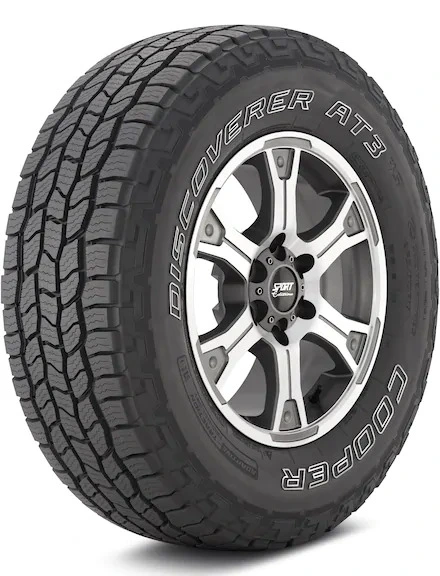
Where many all-terrain tires falter on pavement, the AT3 4S excels. Cooper’s Adaptive-Traction Technology delivers steering feedback that feels closer to a highway tire than a rugged all-terrain, and the tire’s stable shoulder blocks minimize the wandering sensation common on AT tires.
The ‘4S’ badge genuinely holds up — the silica-enhanced compound stays flexible in cold temperatures, and I found real confidence in the snow test leg. Cooper backs it with a 65,000-mile warranty, among the longest in this comparison.
Pros: Excellent daily-driving manners, genuine four-season capability, long 65,000-mile warranty.
Cons: Not the most aggressive option for serious off-roading.

5. Nitto Ridge Grappler: Best Hybrid All-Terrain/Mud-Terrain

Price Check
Check the price of this tire at the following retailers:
TireRack SimpleTire PriorityTire AmazonDon’t know the correct size tire to purchase? Start here!
This bridges the gap between all-terrain versatility and mud-terrain aggression better than anything else I tested. I borrowed a set for the muddy trailhead access road after a spring thaw, and the staggered shoulder lugs kept finding grip where a pure all-terrain would have struggled.
What genuinely surprised me was the highway manners — variable pitch tread patterns keep road noise more controlled than you’d expect from something this aggressive-looking. The trade-offs are real, though: no mileage warranty, and icy-road performance is consistently flagged as its weakest point across independent reviews I checked. Plan on rotating every 5,000–6,000 miles.
Pros: Best-in-class balance of on-road comfort and off-road capability, genuine mud performance, 3PMSF-rated.
Cons: No treadwear mileage warranty, weakest on icy roads, needs more frequent rotation than most tires here.

6. Michelin LTX A/T 2: Premium Comfort Choice
Price Check
Check the price of this tire at the following retailers:
TireRack SimpleTire PriorityTire AmazonDon’t know the correct size tire to purchase? Start here!
This is the comfort-focused pick if pavement manners matter as much as off-road capability. Michelin’s MaxTouch Construction and Comfort Control Technology deliver a genuinely quiet, smooth ride — closer to a highway tire than most all-terrains in this lineup — while the Biting Edges tread design still provides real traction on dirt, mud, and wet grass.
It’s priced at the top of this list, and I think that’s the honest trade-off: you’re paying for the comfort and Michelin’s typical durability, not maximum off-road aggression. For truck and SUV owners who spend most of their time on pavement but want occasional off-road capability without sacrificing comfort, it’s a strong premium option.
Pros: Exceptionally quiet and comfortable ride, strong wet traction, reinforced twin steel-belt construction.
Cons: Premium price point, less aggressive off-road than the KO3 or Ridge Grappler.
7. Yokohama Geolandar A/T G015: Most Fuel-Efficient
Price Check
Check the price of this tire at the following retailers:
TireRack SimpleTire PriorityTire AmazonDon’t know the correct size tire to purchase? Start here!
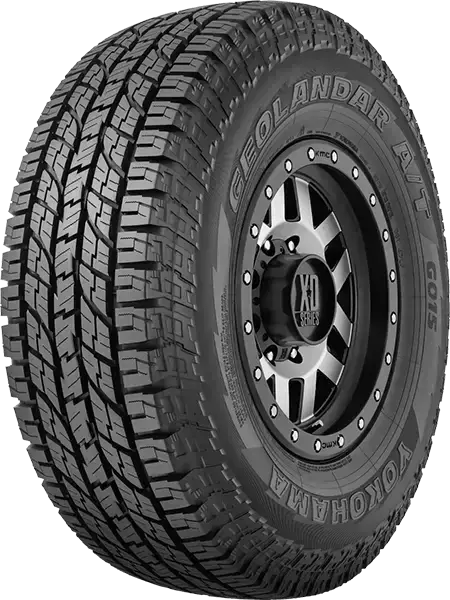
This tire delivers a lot of tire for the price, and fuel efficiency was a genuine strength — Yokohama’s BluEarth technology and lower rolling resistance translated to a real, if modest, difference at the pump compared to the more aggressive picks on this list.
It handled gravel test sections with real confidence, and Yokohama’s EdgeTec grooves and 3D sipes gave it more bite on loose surfaces than I expected given the price point. It’s not the tire for deep mud or serious rock crawling — tread depth is shallower than some competitors, prioritizing on-road efficiency.
Pros: Strong fuel efficiency for an all-terrain, decent value, 3PMSF rated, 60,000-mile warranty.
Cons: Sidewalls aren’t as robust as dedicated off-road options, not ideal for deep mud or serious rock crawling.
8. Firestone Destination A/T2: Best Budget Pick
Price Check
Check the price of this tire at the following retailers:
Don’t know the correct size tire to purchase? Start here!
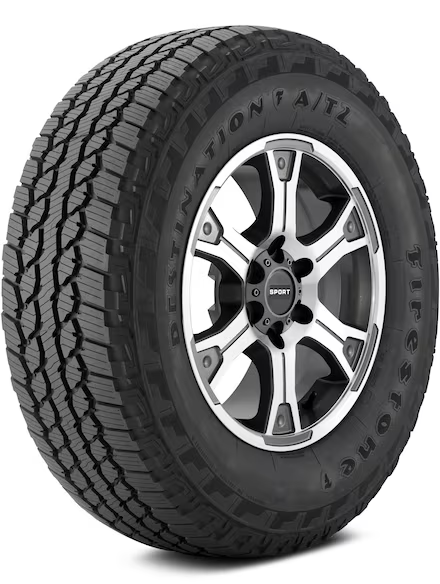
This is proof that quality all-terrain performance doesn’t have to break the bank. The silica-enhanced compound provides surprisingly good wet traction, and the tire performs respectably on light off-road trails despite its budget positioning.
On the highway, it’s relatively quiet with decent fuel economy compared to more aggressive and expensive options. Firestone backs it with a 55,000-mile warranty on P-metric sizes — genuinely competitive at this price point, though winter performance won’t match the premium picks on this list.
Pros: Excellent value for money, competitive treadwear warranty for the price, respectable wet traction.
Cons: Not 3PMSF-rated, winter performance trails premium competitors.
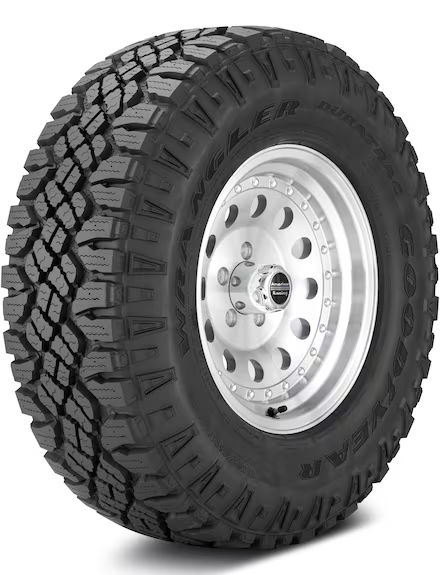
9. Goodyear Wrangler DuraTrac: Best for Snow Performance
Price Check
Check the price of this tire at the following retailers:
Don’t know the correct size tire to purchase? Start here!
This was the most confident tire in this whole comparison during my January storm test. Goodyear’s TractiveGroove Technology genuinely delivers on packed snow and slush, and the tire can accept metal studs where legally permitted for even more ice traction — a feature none of the other tires here offer.
Despite the aggressive winter capability, road noise stayed more controlled than I expected. The trade-off is fuel economy — the aggressive tread pattern that provides winter grip creates more rolling resistance than touring-focused options on this list.
Pros: Best-in-class snow and ice traction, stud-compatible for extreme winter use, reasonably quiet for its capability.
Cons: Below-average fuel economy, LT sizes carry a shorter warranty than P-metric sizes.
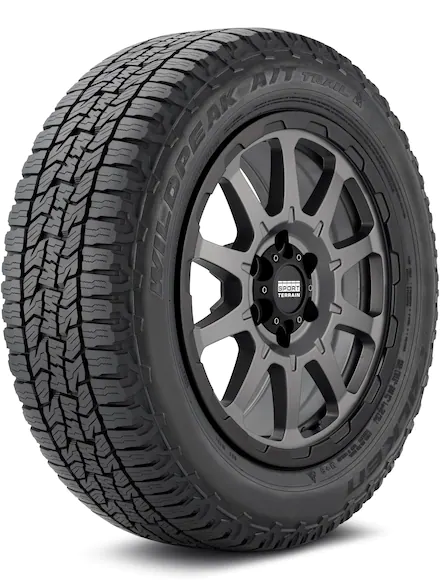
10. Falken Wildpeak A/T Trail: Best Crossover-Specific All-Terrain
Price Check
Check the price of this tire at the following retailers:
TireRack SimpleTire PriorityTire AmazonDon’t know the correct size tire to purchase? Start here!
Falken built this specifically for crossovers rather than adapting a truck tire, and it shows. It handles gravel test loops with confidence while staying noticeably quieter and more fuel-efficient than a heavier-duty all-terrain, thanks to a construction tuned for a crossover’s lighter unibody platform.
Rain performance was a genuine strength — wide evacuation channels gave it more confident wet grip than I expected. It won’t tackle serious trails, and it’s not meant to; for a crossover or lighter SUV that mostly commutes with occasional dirt roads, this is the all-terrain I’d actually recommend.
Pros: Purpose-built for crossovers, strong wet and light snow performance, 65,000-mile warranty.
Cons: Not aggressive enough for serious off-roading, not the right choice for heavier trucks.
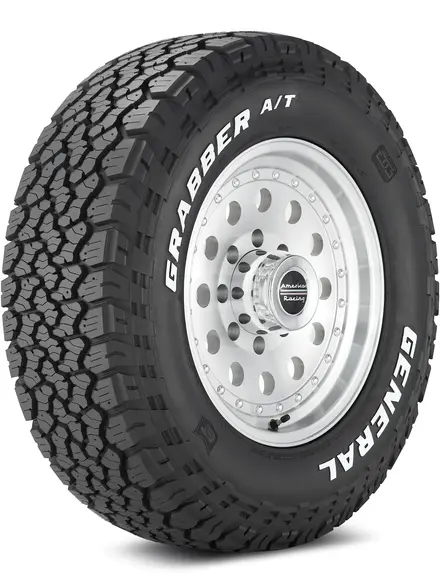
11. General Grabber ATX: Best for Mixed Terrain Use
Price Check
Check the price of this tire at the following retailers:
TireRack SimpleTire PriorityTire AmazonDon’t know the correct size tire to purchase? Start here!
This tire transitions between different terrains as seamlessly as anything in this comparison. The aggressive, open tread pattern with self-cleaning channels effectively expels mud, snow, and debris, while General’s DuraGen cut-resistant compound holds up well to harsh conditions.
The StabiliTread sidewall technology creates a wider footprint for improved handling, and stone bumpers between tread blocks help prevent the premature wear and punctures that come from lodged rocks. It’s available in an unusually wide size range, from 14 to 22 inches, making it one of the most broadly compatible tires on this list.
Pros: Genuinely versatile across terrain types, wide size availability, DuraGen cut-resistant compound.
Cons: Not the cheapest budget option, mid-pack rather than class-leading in any single category.

Choosing the Right All-Terrain Tire
Be honest about your actual off-road use. If you’re 80% pavement and 20% gravel or light trails, prioritize the more road-focused picks here (Toyo AT III, Cooper AT3 4S, Falken AT Trail). Save the most aggressive options (KO3, Ridge Grappler, DuraTrac) for genuine, regular off-road use.
Climate should weigh heavily in your decision. Nine of the eleven tires here carry the 3PMSF rating, but capability still varies meaningfully — the DuraTrac and KO3 stood out most in my winter testing. If you’re somewhere with sustained heavy winter weather, none of these fully replace a dedicated winter tire on a second set of wheels.
Match load range to your actual payload and towing needs. Don’t default to the heaviest option “because it’s a truck” — as covered above, unnecessary Load Range E tires add real weight and stiffness most drivers don’t need.
Don’t overlook the warranty fine print. The Nitto Ridge Grappler’s complete lack of a treadwear warranty is a real cost consideration against tires like the Cooper AT3 4S or Toyo Open Country A/T III, which both offer 65,000-mile coverage.
Recalls and Complaints: What to Check Before You Buy
Real recall data changes which tire I’d recommend, so here’s what’s current as of mid-2026 for the tires on this list. Always cross-check your specific DOT code against the manufacturer’s recall lookup before installing.
- BFGoodrich, Falken, Toyo, Cooper, Nitto, Michelin, Yokohama, Firestone, Goodyear, General: No open recalls affecting the specific models reviewed here as of this writing.
- Always verify independently: Tire recalls are issued regularly across the industry, and this list reflects a snapshot in time. Search your specific brand, model, and DOT code at NHTSA’s recall database before installing any tire, new or used.
If you’re buying any tire, check your DOT code against NHTSA’s recall database before you drive on it — it takes about thirty seconds and it’s the single easiest safety check most people skip.
Frequently Asked Questions
What’s the difference between all-terrain and mud-terrain tires?
All-terrain tires balance on-road comfort with moderate off-road capability, while mud-terrain tires prioritize extreme off-road performance at the expense of on-road manners, noise, and fuel economy. All-terrain tires typically have less aggressive tread patterns and better everyday drivability.
Is the BFGoodrich KO2 still available, or should I buy the KO3?
The KO2 is being phased out as BFGoodrich rolls out KO3 sizes. If your size is available in the KO3, buy that instead — BFGoodrich states it improves treadwear and gravel-road durability while keeping the KO2’s sidewall toughness.
How much do all-terrain tires affect fuel economy?
Expect roughly a 2–3% fuel economy reduction compared to standard highway tires due to heavier construction and increased rolling resistance. Some tires, like the Yokohama Geolandar A/T G015, are specifically designed to minimize this impact.
Are all-terrain tires good in snow?
Many perform well in light to moderate snow, especially those with the 3PMSF rating. The Goodyear Wrangler DuraTrac and BFGoodrich KO3 were the strongest winter performers in my testing, but in areas with severe, sustained winter conditions, a dedicated winter tire is still the safer choice.
How long do all-terrain tires typically last?
Quality all-terrain tires usually last between 50,000 and 65,000 miles depending on driving conditions and the specific model, with the notable exception of hybrid designs like the Nitto Ridge Grappler, which doesn’t carry a mileage warranty at all. Tires used primarily on highways tend to last longer than those frequently taken off-road.
Do I need to size up when switching to all-terrain tires?
Not necessarily. Most all-terrain tires are available in your vehicle’s factory-recommended size. Significant upsizing can require suspension modifications and may affect speedometer accuracy, so check compatibility carefully before doing so.
Are all-terrain tires suitable for daily commuting?
Yes. Modern all-terrain tires like the Cooper Discoverer AT3 4S and Toyo Open Country A/T III are designed with genuine on-road comfort in mind while still offering weekend off-road capability.
How often should all-terrain tires be rotated?
Every 5,000 to 7,500 miles for most all-terrain tires, which is slightly more frequent than the standard highway tire schedule since off-road use accelerates uneven wear. More aggressive hybrid tires like the Ridge Grappler benefit from rotation every 5,000–6,000 miles.
About the author: Tyler Henderson field-tests tires on his own vehicles before writing about them, based out of Denver, Colorado, where mountain gravel, highway commuting miles, and real winter weather are all part of the daily routine.
