

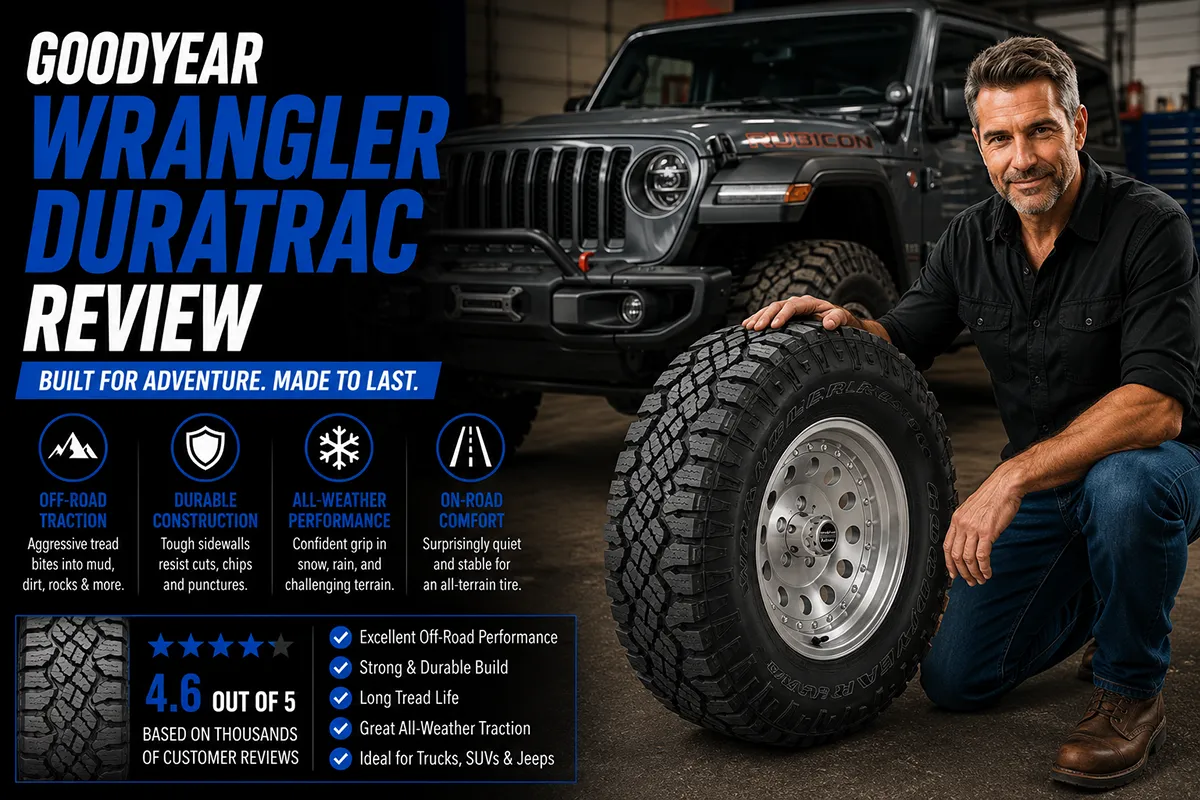
If you drive a truck or SUV and you’ve ever felt torn between a tire that handles your daily highway commute and one that won’t leave you stranded on a muddy trail, you’re not alone. That exact dilemma is why the Goodyear Wrangler DuraTrac exists — and why it’s become one of the most popular all-terrain tires in the US market.
I spent considerable time putting these tires through real-world conditions to see if they live up to the hype. If you’re comparing several options across the brand’s lineup, our full Goodyear Tires Review guide covers every model side by side. But right now, let’s dive deep into the DuraTrac specifically.
- The Goodyear Wrangler DuraTrac is an aggressive all-terrain tire that truly shines off-road — mud, gravel, light rock crawling, and especially snow.
- On-highway comfort is surprisingly good for such an aggressive tread, though road noise is noticeable at highway speeds.
- It carries the 3-Peak Mountain Snowflake (3PMSF) rating, making it a legitimate winter-capable tire.
- Treadwear is respectable for the category, but don’t expect touring-tire longevity.
- Pricing ranges from roughly $170 to $380+ per tire depending on size, making it mid-to-upper range for all-terrains.
- Best suited for truck and SUV owners who split time between pavement and unpaved terrain and need winter confidence.
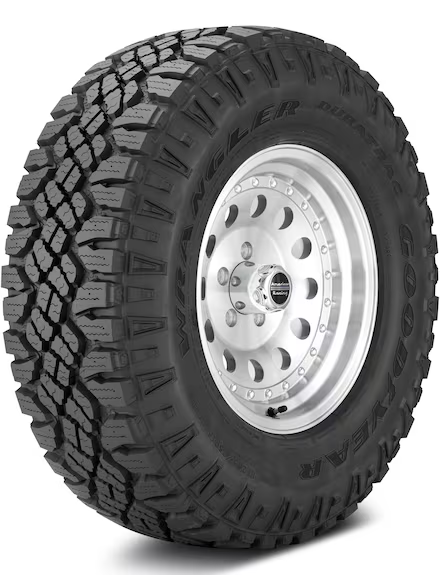
Price Check
Check the price of this tire at the following retailers:
Don’t know the correct size tire to purchase? Start here!
Liked this article?
Add TireAdvise as a preferred source so you see more of our tire reviews and guides on Google.
What Exactly Is the Goodyear Wrangler DuraTrac?
The Wrangler DuraTrac sits in an interesting spot within Goodyear’s truck tire lineup. It’s more aggressive than a standard all-terrain like the Wrangler All-Terrain Adventure, but it’s not a full-blown mud-terrain tire either. Goodyear positions it as a “versatile off-road tire” that can handle serious trail duty while still being your daily driver.
It features Goodyear’s TractiveGroove Technology, which places mini tread blocks within the grooves to maintain traction in deep mud, sand, and snow even as the tread wears down. The tire is also studdable for extreme ice conditions, which is a big plus for drivers in the northern US and mountain states.
Available in a huge range of sizes — from 15-inch wheels for classic Jeeps all the way up to 22-inch fitments for modern full-size trucks — the DuraTrac covers nearly every truck and SUV on American roads today.
My Testing Setup and Conditions
I tested the Goodyear Wrangler DuraTrac in the LT265/70R17 size, mounted on a 2020 Toyota Tacoma TRD Off-Road. This is one of the most popular size fitments for this tire, and it’s a common upgrade for Tacoma, Jeep Wrangler, and Ford Ranger owners.
During my test period, I drove through a mix of highway commuting, rural backroads, gravel forest service roads, muddy trails after rainstorms, and some light snow in the higher elevations. I wanted to replicate the kind of driving a typical truck owner in the western or midwestern US would encounter across different seasons.
I also paid close attention to ride comfort, road noise, fuel economy changes, and how the tire felt during spirited highway driving and emergency lane changes. Let me break down each area.
Tread Design and Build Quality
The first thing you notice about the DuraTrac is that tread pattern. It’s bold, aggressive, and looks like it means business. The alternating shoulder blocks are large and staggered, creating a rugged sidewall appearance that also provides extra bite when airing down on trails.
Key Tread Features
- TractiveGroove Technology: Small raised blocks sit inside the tire’s main grooves. These act like secondary tread elements that engage when you’re in deep mud or snow, essentially giving you traction even when the main lugs are overwhelmed.
- Self-cleaning shoulder blocks: The open, staggered shoulder design helps eject mud, clay, and packed snow so the tire doesn’t lose its grip after a few rotations in the muck.
- High-density siping: Each tread block is covered in thin sipes that create biting edges for wet and icy conditions. This is a big part of why the tire earns that 3PMSF snowflake rating.
- Rim protector: An aggressive rim flange helps guard your wheels against curb rash and rock damage on the trail.
- Studdable design: Pre-molded stud holes allow you to add metal studs for extreme ice traction in states where studded tires are legal.
In my hands, the build quality felt excellent. The sidewalls are thick and robust, and I never felt nervous driving over sharp rocks or rutted-out trail sections. The rubber compound feels durable without being overly stiff.
Off-Road Performance: Where the DuraTrac Truly Excels
Let’s start with the good stuff, because this is where the Wrangler DuraTrac really earns its reputation.
Mud and Soft Terrain
I took the DuraTrac through several sections of muddy forest road after a couple days of rain, and I was genuinely impressed. The tire dug in confidently, and the self-cleaning shoulder blocks did their job — I could hear mud flinging off with each rotation rather than packing into the grooves.
Is it as good as a dedicated mud-terrain tire in axle-deep slop? No. But for the kind of muddy conditions most weekend warriors actually encounter — rutted fire roads, wet meadow crossings, sloppy campsite approaches — the DuraTrac handles it without drama.
Gravel and Loose Surfaces
On gravel roads, the DuraTrac felt planted and predictable. I drove several stretches of washboard gravel at varying speeds, and the tire tracked straight without wandering. The large tread blocks grip the loose surface well, and I noticed excellent braking confidence on gravel — the tire doesn’t skate around the way a highway tire would.
Rock and Hard-Packed Surfaces
I did some light rock crawling on moderate trails, and the DuraTrac’s sidewall strength gave me confidence. I aired down to about 22 PSI and the tire conformed nicely to uneven surfaces, maximizing its contact patch. The aggressive shoulder lugs also proved useful when I needed to climb over a rocky ledge at an angle.
For serious rock crawling — Moab-level stuff — you’d probably want a dedicated mud-terrain or rock-crawling tire. But for most trail-rated adventures, the DuraTrac is more than capable.
Sand Performance
I had limited sand testing, but on a soft sandy access road leading to a desert trail, the DuraTrac performed well when aired down. The open tread design helps it float rather than dig, which is exactly what you want in sand.
On-Road and Highway Performance
Here’s where things get more nuanced. The DuraTrac is an aggressive tire, and that aggression comes with some trade-offs on pavement.
Dry Pavement Handling
On dry highways, the DuraTrac feels stable and confident. I drove extended stretches of interstate at 70-75 mph and the tire tracked straight with no pull or wander. Turn-in response is reasonable for a tire of this type — it’s not going to feel like a performance sedan tire, but it’s predictable and communicative.
During one emergency lane change I had to make to avoid debris on the highway, the DuraTrac held its composure. There was slight squirm from the large tread blocks, but it transitioned smoothly and didn’t feel like it was going to let go.
If you’re coming from a highway-oriented tire, though, you will notice the difference. The steering feels a touch less precise, and there’s a slight vagueness at center. This is normal for all-terrain tires in this aggression level, and the DuraTrac is honestly better than many competitors in this regard.
Wet Pavement Performance
Wet grip was a pleasant surprise. I drove through several heavy rainstorms during my test period, and the DuraTrac’s deep grooves channeled water effectively. Hydroplaning resistance felt strong, and braking distances on wet pavement were confidence-inspiring.
The dense siping across the tread blocks creates a lot of biting edges for wet surfaces. I’d rate the wet performance as above average for an aggressive all-terrain tire — not quite at the level of a dedicated all-season like the Goodyear Assurance Weatherready 2, but impressive for this category.
Road Noise — The Elephant in the Room
Let’s be honest: the DuraTrac is not a quiet tire. You will hear it on the highway. There’s a constant hum that becomes more pronounced above 55 mph, and it’s the kind of sound that becomes part of your driving experience.
That said, it’s not as loud as I expected based on how aggressive the tread looks. Goodyear has done a decent job with variable pitch sequencing in the tread blocks to break up the worst harmonics. After several days of driving, I found myself tuning it out — especially with the radio at a reasonable volume.
If road noise is a dealbreaker for you, this isn’t the right tire. Consider a less aggressive all-terrain option instead. But if you accept a moderate increase in cabin noise as the price of off-road capability, the DuraTrac’s noise level is totally livable.
Snow and Winter Performance
This is one of the DuraTrac’s strongest selling points, and I can confirm it lives up to the billing.
The tire carries the 3-Peak Mountain Snowflake (3PMSF) symbol, which means it has been tested and certified to meet snow traction performance requirements. This isn’t just marketing — it’s a measured standard, and the DuraTrac passes it convincingly.
Snow Traction
I tested the DuraTrac in several inches of fresh snow and on packed snow-covered roads, and the traction was outstanding. The deep sipes and aggressive tread blocks bite into snow with authority, and the TractiveGroove technology provides an extra layer of grip as snow packs into the main grooves.
Uphill starts on snowy grades were drama-free. The tire dug in and pulled without wheelspin, even on moderate inclines. I’ve driven dedicated winter tires that didn’t feel this confident in similar conditions.
Ice Performance
On ice, the DuraTrac is decent but not exceptional — which is expected for any non-studded, non-dedicated winter tire. The siping helps, but if you regularly face icy conditions, I’d recommend either studding these tires (where legal) or running a dedicated winter set.
For occasional ice encounters — the kind of thing you hit on a cold morning in Colorado or Montana — the DuraTrac handles itself fine with careful driving.
Ride Comfort and Fuel Economy
Comfort
For an aggressive all-terrain tire, the DuraTrac rides surprisingly well. It absorbs potholes and expansion joints without harsh jolts, and the sidewall flex provides a bit of cushion on rough roads. I wouldn’t call it “plush,” but it’s far from punishing.
On smooth highways, there’s a gentle vibration that comes from the aggressive tread pattern — it’s barely perceptible, but you’ll notice it if you’re paying attention. After a few days behind the wheel, I stopped noticing it entirely.
Fuel Economy
I noticed a small decrease in fuel economy compared to the highway tires the Tacoma had previously. This is completely normal for a tire with this level of rolling resistance — the aggressive tread and softer compound inherently require more energy to turn.
If fuel economy is your primary concern, the DuraTrac isn’t optimized for that. Tires like the Goodyear Efficient Grip are designed with fuel savings in mind, but they’re a completely different category. For an off-road-capable tire, the DuraTrac’s fuel economy impact is within the expected range.
Treadwear and Longevity
Goodyear rates the DuraTrac’s treadwear at 540 (UTQG rating), which is moderate for the all-terrain category. During my test period, wear appeared even across the tread face, and the tire showed no signs of irregular wear patterns with proper alignment and rotation.
Based on my observations and conversations with other DuraTrac owners, you can expect solid longevity if you maintain proper inflation and rotate regularly. The tire wears down predictably, and the TractiveGroove technology means you maintain decent off-road traction even as the tread depth decreases.
I’d recommend rotating every 5,000 to 7,500 miles and checking alignment after any significant off-road excursion. These simple steps will maximize the life of these tires.
Sizing, Pricing, and Value
The Wrangler DuraTrac comes in a wide range of sizes:
- Wheel diameters: 15″ to 22″
- Popular light truck sizes: LT245/75R16, LT265/70R17, LT275/65R18, LT285/75R16
- Popular P-metric sizes: P255/70R16, P265/65R17, P275/60R20
- Speed ratings: Q (99 mph) to S (112 mph) depending on size
- Load ratings: SL, XL, and LT (up to Load Range E)
Pricing (as of 2024)
Prices vary significantly by size, but here’s a general range I found at major US retailers:
| Size | Approx. Price Per Tire | Common Vehicle Fitments |
|---|---|---|
| LT245/75R16 | $185 – $220 | Jeep Wrangler, older Tacoma |
| LT265/70R17 | $220 – $270 | Tacoma, Ranger, Colorado |
| LT275/65R18 | $250 – $300 | F-150, Ram 1500, Tundra |
| LT285/75R16 | $230 – $280 | Jeep Wrangler (upsized) |
| LT275/65R20 | $280 – $340 | F-150, Sierra, Silverado |
| LT305/55R20 | $330 – $385 | Heavy-duty trucks, lifted rigs |
For a set of four in the most popular sizes, you’re looking at roughly $800 to $1,200 before mounting and balancing. That puts the DuraTrac in the mid-to-upper price range for all-terrain tires, which I think is fair given its capability and brand reputation.
How the DuraTrac Compares to Competitors
No tire review is complete without context. Here’s how the Wrangler DuraTrac stacks up against its main competitors in the aggressive all-terrain segment:
| Feature | Goodyear DuraTrac | BFGoodrich KO2 | Falken Wildpeak AT3W | Nitto Ridge Grappler |
|---|---|---|---|---|
| Tread Aggressiveness | High | Medium-High | Medium | High |
| Snow (3PMSF Rated) | Yes ✅ | Yes ✅ | Yes ✅ | No ❌ |
| Studdable | Yes ✅ | No ❌ | No ❌ | No ❌ |
| Mud Performance | Very Good | Good | Good | Very Good |
| Highway Comfort | Good | Good | Very Good | Good |
| Road Noise | Moderate-High | Moderate | Low-Moderate | Moderate |
| Approx. Price (265/70R17) | $220 – $270 | $230 – $280 | $180 – $220 | $240 – $290 |
The DuraTrac’s biggest competitive advantages are its studdable design and its strong mud performance for an all-terrain. If you live in a state that allows studded tires and you face serious ice, the DuraTrac is really your only option in this class.
Against the BFGoodrich KO2, the DuraTrac is more aggressive in mud but slightly noisier on the highway. The Falken Wildpeak AT3W is quieter and arguably a better daily driver, but it can’t match the DuraTrac in deep mud or provide the studding option. The Nitto Ridge Grappler is the closest competitor in terms of tread aggressiveness, but it lacks the 3PMSF winter rating.
Who Should Buy the Goodyear Wrangler DuraTrac?
Based on my extensive testing, here’s who I think this tire is ideal for:
- Weekend warriors: If you commute on highways during the week and hit trails on weekends, the DuraTrac bridges both worlds better than most.
- Northern and mountain-state drivers: The 3PMSF rating and studdable design make this a compelling year-round option if you face real winters.
- Overlanders and campers: The tire’s ability to handle mud, gravel, sand, and light rock makes it perfect for getting to remote campsites.
- Jeep, Tacoma, and mid-size truck owners: The DuraTrac looks fantastic on these vehicles and is available in all the popular fitments.
Who Should Look Elsewhere?
- Daily commuters who rarely go off-road: You’ll pay a noise and fuel economy penalty for capability you never use. A standard all-terrain or all-season would serve you better.
- Towing-focused drivers: While the DuraTrac is available in Load Range E for heavy-duty applications, there are tires specifically designed for towing that offer better highway stability under load.
- Noise-sensitive drivers: If cabin quiet is a top priority, this isn’t the right tire for you.
How Does It Fit Within Goodyear’s Lineup?
Goodyear offers a massive range of tires, and it’s worth understanding where the DuraTrac fits. It’s part of the Wrangler family, which is Goodyear’s truck and SUV line. Within that family, it’s the aggressive option — more trail-focused than the Wrangler All-Terrain Adventure but not as extreme as a dedicated mud tire.
If you own a car or crossover instead of a truck, Goodyear has plenty of excellent options in other categories. For performance driving, I’ve been impressed by the Goodyear Eagle F1 Asymmetric 3, which offers remarkable grip on sports cars and performance sedans. The newer Goodyear Eagle F1 Asymmetric 6 pushes that performance envelope even further.
For track-day enthusiasts, Goodyear’s Goodyear Eagle F1 Supercar 3R and Goodyear Eagle F1 Supersport are purpose-built for high-performance applications. And if you’re looking for a sporty all-season that handles wet weather, the Goodyear Eagle F1 Asymmetric All Season is worth checking out.
For luxury touring comfort, the Goodyear Eagle Touring is a completely different animal — whisper-quiet and smooth, basically the opposite philosophy of the DuraTrac. Meanwhile, the Goodyear Eagle Exhilarate slots in as a solid ultra-high-performance all-season.
The point is, Goodyear covers nearly every niche. Older models like the Goodyear Eagle F1 Asymmetric 2 and the Goodyear Excellence can still be found at discounted prices and represent good value for certain applications. And the Goodyear Eagle F1 Asymmetric 5 along with the original Goodyear Eagle F1 Supercar round out the performance lineup for enthusiasts.
Installation Tips and Recommendations
A few practical notes from my experience installing and running the DuraTrac:
- Balancing matters: Because of the aggressive tread, these tires can be slightly harder to balance. I recommend asking for road force balancing if your shop offers it — the ride quality improvement is noticeable.
- Break-in period: I noticed the DuraTrac felt a bit slippery on pavement for the first few days. This is normal — the mold release compound on new tires needs to wear off. Drive conservatively for the first couple hundred miles.
- TPMS recalibration: If you’re changing from a different tire size, make sure your TPMS is recalibrated. The DuraTrac in LT sizes often has different recommended pressures than P-metric tires.
- Inflation pressure: Check the door jamb sticker on your vehicle and cross-reference with the tire’s load rating. For the LT265/70R17 on my Tacoma, I ran 35 PSI front and 33 PSI rear for on-road driving, dropping to 20-22 PSI for trails.
Pros and Cons Summary
What I Loved
- Outstanding off-road traction in mud, snow, gravel, and sand
- 3PMSF rated for genuine winter capability
- Studdable for extreme ice conditions
- Aggressive, great-looking tread design
- Surprisingly decent highway manners for such an aggressive tire
- Wide range of sizes covering nearly all trucks and SUVs
- Strong sidewall construction for trail confidence
- TractiveGroove technology maintains traction as tread wears
What Could Be Better
- Road noise is significant — you’ll hear these on the highway
- Fuel economy takes a hit compared to highway-oriented tires
- Dry highway handling lacks the precision of less aggressive all-terrains
- Price is mid-to-upper range for the category
- Ice performance is only average without studs
Final Verdict: Is the Goodyear Wrangler DuraTrac Worth It?
After spending extensive time with the Goodyear Wrangler DuraTrac across a wide variety of
Frequently Asked Questions
Is the Goodyear Wrangler DuraTrac a good all-terrain tire for daily driving?
The Goodyear Wrangler DuraTrac is an excellent choice for daily driving if you also need serious off-road capability. I’ve found it handles highway commuting comfortably while still providing aggressive traction in mud, gravel, and snow. It’s technically classified as an all-terrain/mud-terrain hybrid, which makes it more versatile than a pure mud tire but slightly noisier than a standard all-terrain on pavement.
How long do Goodyear Wrangler DuraTrac tires last in real-world driving?
Most drivers report getting between 40,000 and 50,000 miles from a set of Goodyear Wrangler DuraTrac tires, though aggressive driving and frequent off-roading will reduce that figure. Goodyear does not offer a treadwear mileage warranty on the DuraTrac, which is common for tires with this level of off-road capability. Rotating them every 5,000 to 7,500 miles and keeping proper air pressure will help maximize their lifespan.
How much does a set of Goodyear Wrangler DuraTrac tires cost?
Prices for the Goodyear Wrangler DuraTrac typically range from $190 to $350 per tire depending on the size, with popular truck sizes like LT275/65R18 averaging around $270 to $300 each. A full set of four will generally cost between $760 and $1,400 before installation and balancing. I’d recommend checking Tire Rack, Discount Tire, and Walmart for competitive pricing, as sales and rebates from Goodyear can save you $50 to $100 on a set.
Are Goodyear Wrangler DuraTrac tires good in snow and ice?
The Goodyear Wrangler DuraTrac carries the Three-Peak Mountain Snowflake (3PMSF) rating, meaning it meets industry standards for severe snow traction. In my experience, it performs exceptionally well in deep snow and slushy winter conditions thanks to its aggressive tread pattern and TractiveGroove technology. However, on pure ice it won’t match a dedicated winter tire, so drivers in northern US states dealing with frequent black ice may want studs or a separate winter set.
Goodyear Wrangler DuraTrac vs BFGoodrich KO2: which is the better all-terrain tire?
The Goodyear Wrangler DuraTrac offers more aggressive off-road and mud performance than the BFGoodrich All-Terrain T/A KO2, making it the better pick if you frequently tackle muddy trails or deep snow. The KO2, on the other hand, tends to last longer with its 50,000-mile warranty and produces less road noise on highways. If your driving is 70% or more on-road, the KO2 is the safer bet, but if you need a tire that can handle serious off-road conditions without switching to a full mud-terrain, the DuraTrac wins.
How noisy are Goodyear Wrangler DuraTrac tires on the highway?
The Goodyear Wrangler DuraTrac is noticeably louder than a standard all-terrain tire on the highway, especially at speeds above 60 mph. The aggressive tread blocks that give it great off-road grip also produce a consistent hum on pavement that most drivers describe as a low drone rather than an annoying whine. I found the noise level manageable in newer trucks with good cabin insulation, but it’s something to consider if you drive a Jeep Wrangler or older vehicle with minimal sound deadening.
What truck and SUV sizes does the Goodyear Wrangler DuraTrac come in?
The Goodyear Wrangler DuraTrac is available in a wide range of sizes from 15-inch to 22-inch diameters, covering popular fitments for the Ford F-150, Chevy Silverado, Ram 1500, Toyota Tacoma, Jeep Wrangler, and full-size SUVs like the Chevy Tahoe. It comes in both P-metric and LT (light truck) load ratings, including heavy-duty Load Range E options for towing and hauling. I’d recommend checking Goodyear’s fitment tool with your exact year, make, and model to confirm the right size and load rating for your vehicle.
