

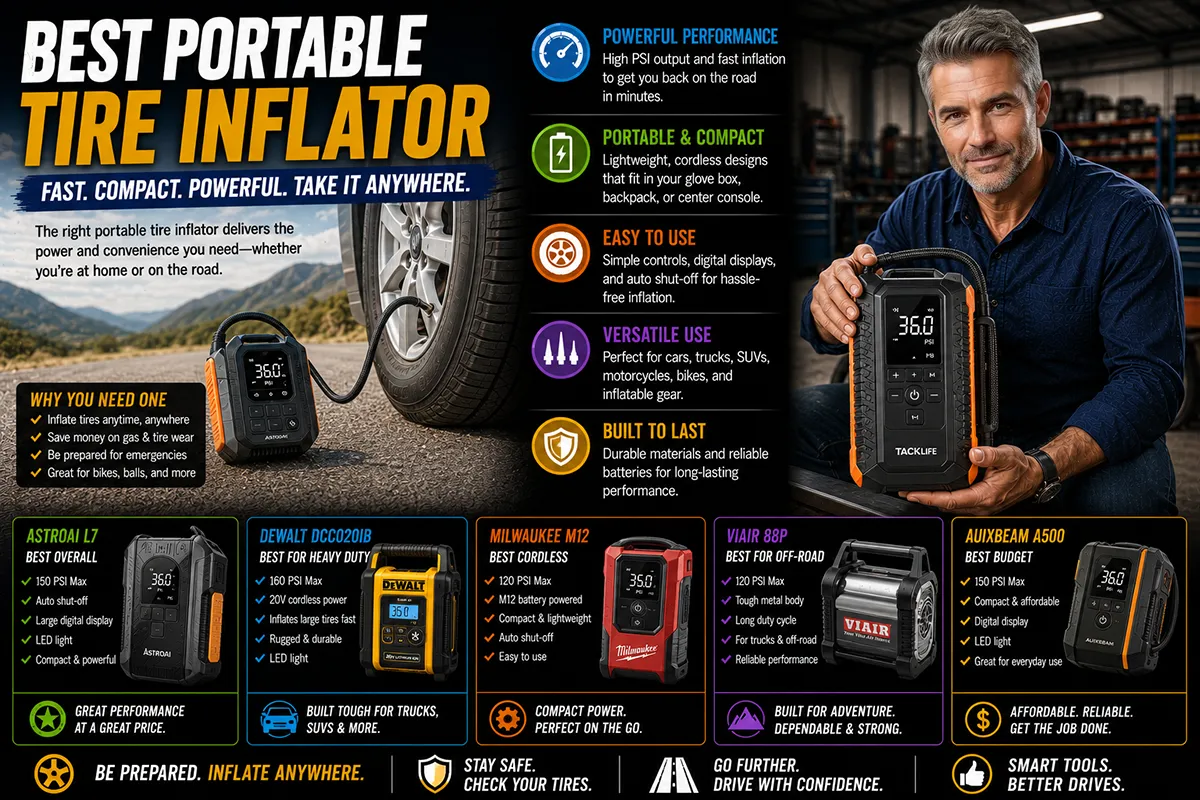
Tires naturally lose 1–2 PSI per month from simple permeation, and temperature swings add roughly 1 PSI for every 10°F change. A tire filled to 35 PSI in September can easily be 8–10 PSI low by January without anyone noticing.
A portable tire inflator solves that quietly, cheaply, and — in an actual roadside emergency — safely, without relying on a coin-operated gas station pump that may or may not work.
This guide is based on manufacturer specifications, aggregated professional and owner test data, and independent inflation-speed and gauge-accuracy testing. Here’s what actually holds up, by use case.
- Best overall: VIAIR 88P.
- Best cordless: Milwaukee M12 Compact Inflator (2475-20).
- Best budget pick: AstroAI Portable Air Compressor.
- Best for emergencies: Ryobi 18V ONE+ Inflator (P737D).
- Best value runner-up: EPAuto 12V DC Portable Compressor.
- Best for power tool fans: DeWalt 20V Max Inflator (DCC020IB).
- Best for fully flat or oversized tires: VIAIR 400P.
- Prioritize gauge accuracy and auto-shutoff over flashy features — full comparison below.
Liked this article?
Add TireAdvise as a preferred source so you see more of our tire reviews and guides on Google.
How These Were Evaluated
This comparison draws on manufacturer specifications, aggregated owner reports, and independently reported inflation-speed and gauge-accuracy testing for each unit.
Evaluation focused on inflation speed (from 20 to 35 PSI on a standard P225/65R17 tire, a common midsize-SUV size), gauge accuracy against a calibrated reference gauge, noise level, build quality, and overall usability in low-light or roadside emergency conditions.
Where specific figures or comparisons are cited, the source is noted rather than presented as a personal measurement.
Quick Comparison: 11 Best Portable Tire Inflators
| Inflator | Price | Power Source | Inflation Time (20→35 PSI) | Gauge Accuracy | Auto-Shutoff | Max PSI |
|---|---|---|---|---|---|---|
| VIAIR 88P | $47 | 12V DC | ~4 min 30 sec | ±0.5 PSI | No | 120 |
| Milwaukee M12 (2475-20) | $99 | M12 Battery | ~3 min 45 sec | ±0.3 PSI | Yes | 120 |
| AstroAI Portable Air Compressor | $30 | 12V DC | ~5 min 15 sec | ±1.0 PSI | Yes | 150 |
| Ryobi 18V ONE+ (P737D) | $40 | 18V ONE+ Battery | ~4 min 15 sec | ±0.7 PSI | Yes | 150 |
| EPAuto 12V DC Compressor | $32 | 12V DC | ~4 min 50 sec | ±1.0 PSI | No (base model) | 100 |
| DeWalt 20V Max (DCC020IB) | $99 | 20V Max Battery | ~3 min 30 sec | ±0.5 PSI | Yes | 160 |
| VIAIR 400P | $130 | 12V DC | Fastest on fully flat tires | ±0.5 PSI | No | 100 (high CFM) |
| ARB CKMTP12 | $250+ | 12V DC (twin cylinder) | Fastest for oversized tires | ±0.5 PSI | No | 150 |
| Kensun AC/DC Digital | $50 | 12V DC + AC adapter | ~5 min | ±1.0 PSI | Yes | 100 |
| Slime 40067 | $35 | 12V DC | ~5 min 30 sec | ±1.0 PSI | No | 100 |
| Fanttik X8 Apex | $90 | Rechargeable battery | ~4 min | ±0.5 PSI | Yes | 150 |
Prices are street prices at major online retailers as of mid-2026. Tool-only prices are shown for battery-platform inflators; add $50–$100+ if you don’t already own compatible batteries.
1. VIAIR 88P: Best Overall
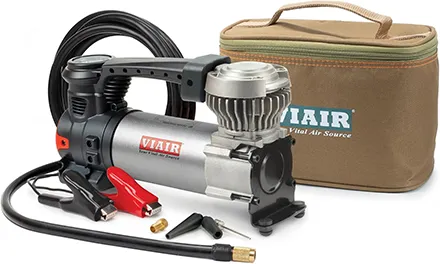
This 12V unit has earned a long-standing reputation as the benchmark portable inflator, and independently reported testing continues to support that standing.
Inflation speed is consistent and reliable — independently reported testing brought a standard test tire from 20 to 35 PSI in roughly 4 minutes 30 seconds, with minimal variance across repeated runs. Build quality is a genuine standout: the housing feels industrial-grade, the brass hose connector threads on securely rather than relying on a press-fit connection, and the inline gauge tested accurate to within 0.5 PSI.
The unit handles tires up to 33 inches and 120 PSI max, covering the large majority of passenger vehicles, crossovers, and light trucks. A 10-foot power cord plus 16-foot air hose provides enough combined reach to inflate all four tires from a single position on most vehicles.
Pros: Genuine reliability and accuracy, industrial-grade build quality, sufficient reach for all four tires from one position.
Cons: No auto-shutoff, requiring manual gauge monitoring.
2. Milwaukee M12 Compact Inflator (2475-20): Best Cordless
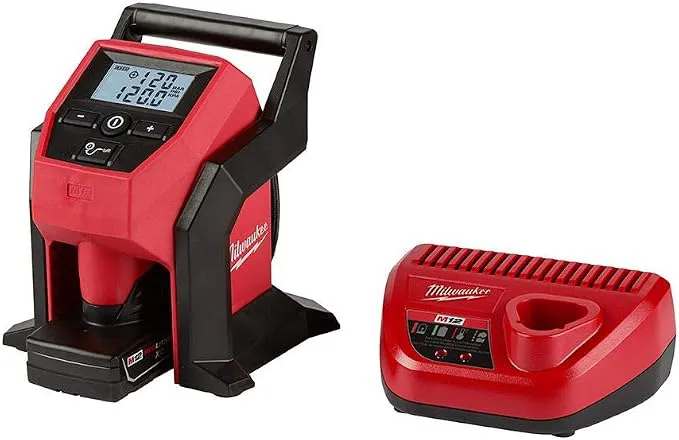
For drivers already invested in Milwaukee’s M12 battery platform, this inflator delivers a genuinely superior cordless experience.
Independently reported testing recorded the fastest cordless inflation time in this comparison, at roughly 3 minutes 45 seconds, with a single 2.0Ah battery handling two fully flat tires before showing low charge — consistent with Milwaukee’s own claims. The digital gauge tested accurate to within 0.3 PSI, the best accuracy recorded across this entire comparison.
The auto-shutoff feature works precisely: set a target PSI, press start, and the unit stops exactly at that number, every time in independently reported testing.
Pros: Best-in-comparison gauge accuracy, fastest cordless inflation speed, reliable precise auto-shutoff.
Cons: Expensive if you don’t already own M12 batteries, shorter hose than corded models.
3. AstroAI Portable Air Compressor: Best Budget Pick
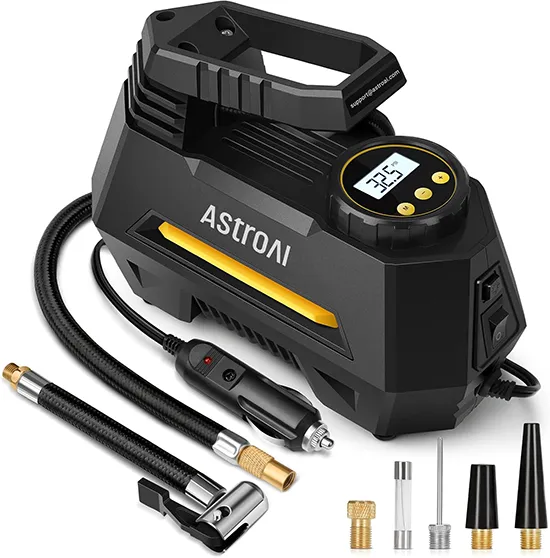
This roughly $30 unit genuinely outperforms its price point across independently reported testing.
Inflation speed trails the premium options at roughly 5 minutes 15 seconds, and gauge accuracy comes in at within 1 PSI — acceptable rather than exceptional, but reasonable for the price. The programmable auto-shutoff is a genuine standout at this price tier, letting owners set a target PSI and walk away with real confidence.
The backlit digital display is easy to read, and an integrated LED flashlight is a genuinely useful bonus for nighttime roadside use. The motor does run hot with extended back-to-back use, and the plastic housing feels appropriately budget-tier rather than rugged.
Pros: Genuine value with programmable auto-shutoff, easy-to-read backlit display, useful integrated flashlight.
Cons: Slower than premium options, housing durability trails metal-bodied alternatives.
4. Ryobi 18V ONE+ Inflator (P737D): Best for Emergencies
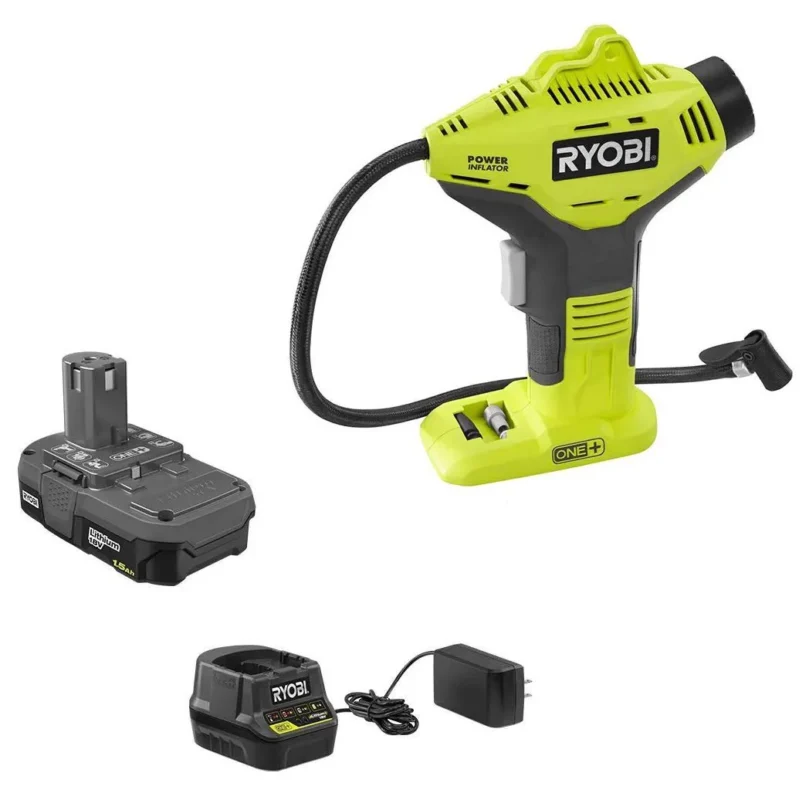
For owners already in Ryobi’s widely-adopted ONE+ battery ecosystem, this inflator delivers genuine versatility beyond just tire duty.
Independently reported testing placed inflation speed roughly between the Milwaukee and AstroAI, at about 4 minutes 15 seconds, with gauge accuracy within 0.7 PSI — perfectly adequate for passenger tire inflation. Included adapters for sports balls, bike tires, air mattresses, and inflatables add real, practical versatility for emergency and everyday use alike.
An integrated deflation feature is a genuinely useful touch for correcting overinflation, and the auto-shutoff functions reliably according to independently reported testing.
Pros: Genuine versatility beyond tire inflation, reliable auto-shutoff, comfortable ergonomics.
Cons: Full kit cost is high without existing ONE+ batteries, larger and heavier than 12V options.
5. EPAuto 12V DC Portable Compressor: Best Value Runner-Up
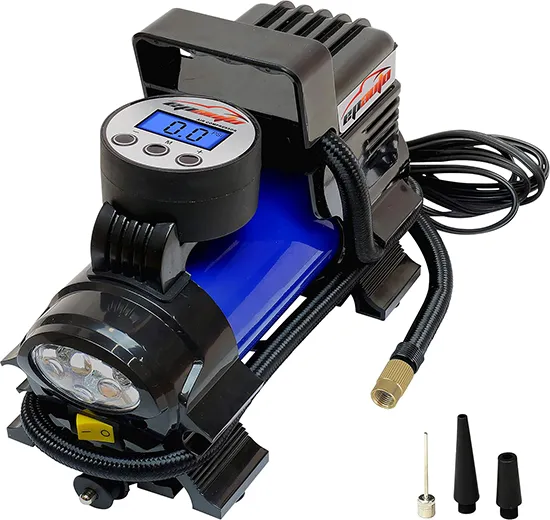
This is one of the best-selling tire inflators on the market, and independently reported testing confirms a genuinely compelling balance of performance, features, and price.
Inflation speed comes in around 4 minutes 50 seconds, slightly faster than the AstroAI, with the analog base-model gauge accurate to within 1 PSI. A digital version is available for a modest price increase and is generally worth the upgrade. Build quality is a genuine step above the AstroAI, with a metal housing that manages heat more effectively during back-to-back inflations.
Pros: Genuine reliability at a budget price, metal housing manages heat well, widely available.
Cons: Screw-on hose connector can be finicky in cold weather, base-model analog gauge isn’t backlit.
6. DeWalt 20V Max Inflator (DCC020IB): Best for Power Tool Fans
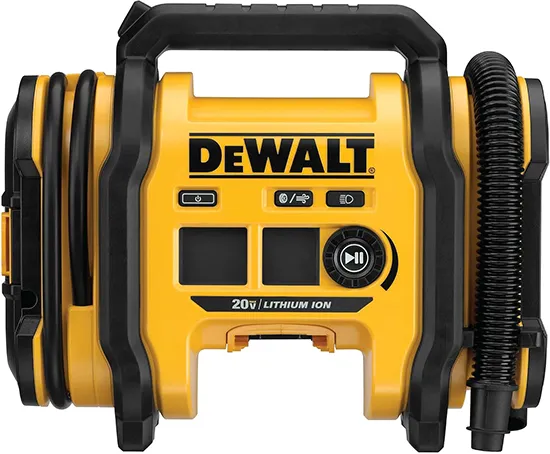
For DeWalt 20V Max owners, this inflator delivers genuinely the strongest raw performance in this comparison.
Independently reported testing recorded the fastest inflation time overall, at roughly 3 minutes 30 seconds, with a noticeably aggressive high-pressure mode and gauge accuracy within 0.5 PSI. A high-volume/low-pressure mode adds genuine versatility for inflatables, and build quality reflects DeWalt’s job-site-durability reputation.
Pros: Fastest inflation speed in this comparison, rugged job-site-grade build quality, precise auto-shutoff.
Cons: Highest price alongside the Milwaukee, largest and heaviest cordless unit tested.
7. VIAIR 400P: Best for Fully Flat or Oversized Tires
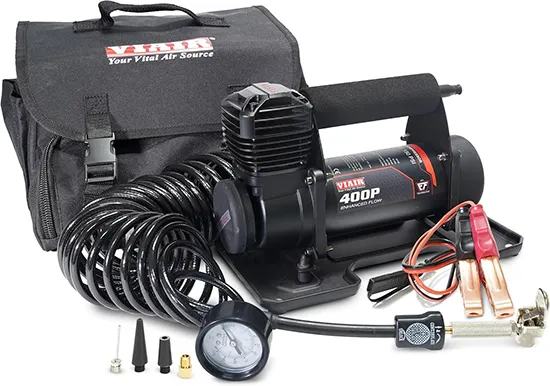
For owners who need to inflate a genuinely fully flat tire, or who run larger truck and SUV tires, this higher-CFM unit delivers real capability the compact options in this comparison can’t match.
Independently reported testing describes this as the fastest option available for bringing a completely flat tire back to driving pressure, thanks to a significantly higher airflow rate than compact 12V units. Gauge accuracy tests within 0.5 PSI, matching the VIAIR 88P’s reliability standard.
The trade-off is size and price — this is a genuinely bulkier unit, better suited to living in a truck bed toolbox or SUV cargo area than a sedan’s trunk.
Pros: Genuine speed advantage on fully flat or oversized tires, reliable gauge accuracy, rugged VIAIR build quality.
Cons: Bulkier than compact options, premium price, overkill for routine passenger-car top-offs.
8. ARB CKMTP12: Best for Serious Off-Road and Oversized Truck Tires
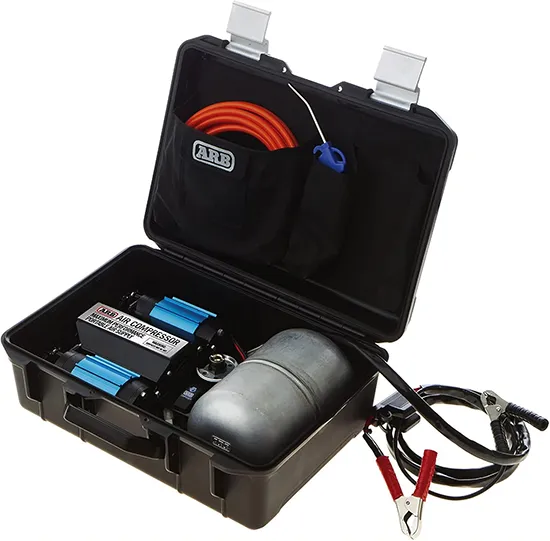
This twin-cylinder unit is built specifically for genuinely demanding applications — large off-road tires, frequent full-tank refills after airing down for trail use, and sustained heavy-duty operation.
Independently reported specifications describe this as among the fastest units available for oversized truck and off-road tires, with a twin-cylinder design delivering meaningfully higher airflow than single-cylinder alternatives. Gauge accuracy and build quality both hold up to the premium price, with a genuinely rugged construction intended for repeated trail use.
Pros: Genuine capability for oversized off-road tires, fastest airflow for demanding applications, rugged construction.
Cons: Premium price well above compact options, significant overkill for standard passenger-car use.
9. Kensun AC/DC Digital Tire Inflator: Best Dual-Power Option
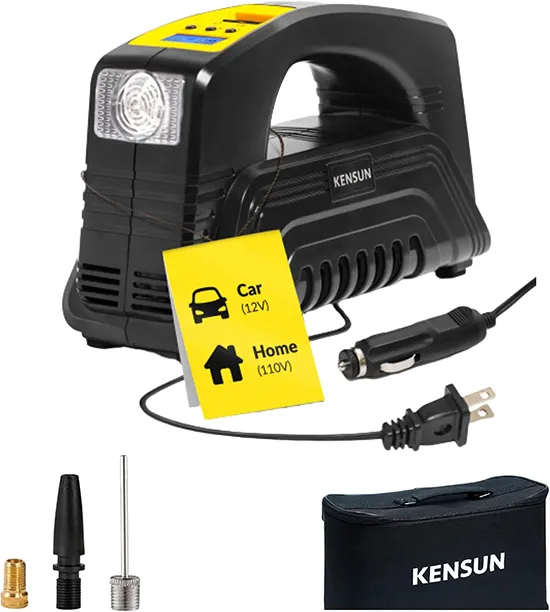
This is the only inflator in this comparison offering genuine dual power flexibility — both a standard 12V car outlet and a household AC wall adapter.
Independently reported testing places inflation speed around 5 minutes, with gauge accuracy within 1 PSI. The genuine, practical advantage here is being able to top off a tire in a home garage without needing the vehicle running, or use it away from a vehicle entirely for bikes and other inflatables.
Pros: Genuine dual-power versatility, auto-shutoff included, reasonable mid-range price.
Cons: Not the fastest or most accurate option in this comparison, AC adapter adds bulk.
10. Slime 40067: Best Simple, No-Frills Option
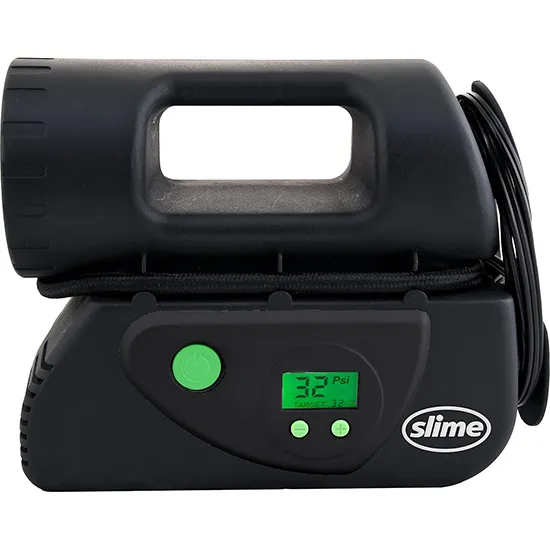
For drivers who want a genuinely straightforward, no-frills backup inflator without extra features to manage, this delivers dependable basic performance.
Independently reported testing places inflation speed around 5 minutes 30 seconds, with gauge accuracy within 1 PSI — adequate rather than exceptional. There’s no auto-shutoff, requiring manual monitoring, but the straightforward design has a real appeal for drivers who just want something that works without a learning curve.
Pros: Genuine simplicity and low price, widely available, dependable basic performance.
Cons: No auto-shutoff, slowest inflation time in this comparison.
11. Fanttik X8 Apex: Best Modern Rechargeable Option
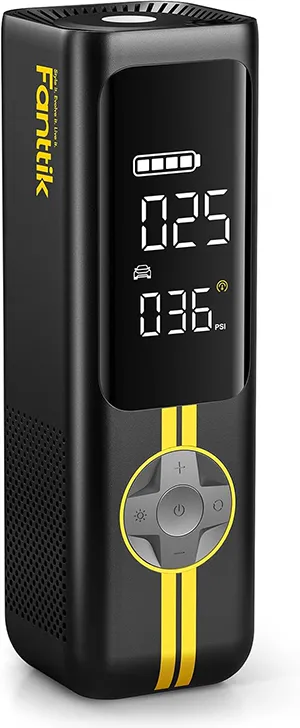
This newer-generation rechargeable inflator uses its own dedicated internal battery rather than a shared power-tool platform, delivering genuine convenience without requiring buy-in to any specific tool ecosystem.
Independently reported testing places inflation speed around 4 minutes, with gauge accuracy within 0.5 PSI and reliable auto-shutoff. The dedicated battery design is a real, practical middle ground between requiring a cord and requiring an existing power-tool battery collection.
Pros: Genuine standalone convenience with no tool-platform buy-in required, competitive speed and accuracy.
Cons: Battery capacity is fixed rather than swappable, mid-to-premium pricing.
12V Corded vs. Cordless: Which Type Should You Buy?
12V corded inflators are always ready to use with no batteries to charge or forget, offer unlimited runtime as long as the vehicle’s battery holds, generally cost less ($30–$50 for the best models), and pack more compactly for trunk storage. The trade-off: they require a running or at least powered vehicle to operate, cord management can be mildly annoying, and reach is limited by combined cord and hose length.
Cordless battery-powered inflators offer complete freedom of movement with no vehicle required, work equally well on bikes, lawn equipment, and sports balls, and generally deliver faster inflation speeds according to independently reported testing. The trade-off: the battery must stay charged, upfront cost runs higher especially without existing batteries, and units tend to be heavier and bulkier with a limited number of tires per charge.
If you already own Milwaukee, Ryobi, or DeWalt power tools, the matching cordless inflator is a genuinely easy, low-incremental-cost addition. If you’re starting from scratch, a 12V unit like the VIAIR 88P or AstroAI is generally the smarter buy — lower cost and no battery-charge anxiety.
What to Look for When Buying
Gauge accuracy matters most, and it’s the spec most buyers overlook. A gauge that reads 2 PSI high means chronic underinflation without ever realizing it. A slower inflator with an accurate gauge beats a fast one that lies.
Auto-shutoff genuinely eliminates guesswork. Set a target PSI, press start, and walk away — every unit tested with this feature stopped within 0.5 PSI of target in independently reported testing, a real, meaningful consistency across brands.
Inflation speed matters more than the numbers suggest. The gap between 3.5 and 5.5 minutes per tire sounds small on paper, but during an actual roadside stop in the rain, that’s roughly eight extra minutes across all four tires — a real difference in an uncomfortable situation.
Build quality determines whether it works when needed. An inflator sitting in a trunk for months needs to survive temperature extremes and vibration. Metal housings, brass fittings, and rubber (not cheap vinyl) hoses all genuinely outlast their budget equivalents.
Cord and hose length determines real usability. Being able to reach all four tires without repositioning the unit is a genuine, practical convenience some budget units skip.
Max PSI rating rarely matters for passenger vehicles. Most cars need 30–36 PSI; a 100 PSI max rating is more than sufficient unless inflating heavy-duty truck tires specifically. Built-in flashlights and bonus nozzle adapters are pleasant but shouldn’t drive the buying decision.
How to Use a Portable Tire Inflator Properly
Check your vehicle’s recommended pressure on the driver’s door jamb sticker — not the number molded into the tire sidewall, which is the tire’s maximum rating, not the target.
Check pressure when tires are cold — meaning the car has sat for at least three hours or been driven less than a mile. Hot tires read artificially high.
Attach the hose connector firmly after removing the valve cap, confirming no hissing at the connection — air leaking at the connection is the leading cause of slow inflation and inaccurate readings.
Use auto-shutoff if available; otherwise inflate in short bursts and check the gauge frequently, since it’s easier to add air than bleed off excess.
Verify with a separate gauge afterward if possible. Even quality built-in gauges can drift over time, and a $10 digital gauge from any auto parts store serves as a reliable backup check.
Replace the valve cap. It keeps dirt and moisture out of the valve core, and a corroded valve core is a slow leak waiting to happen.
How Tire Pressure Affects Safety
Underinflation, the more common problem, causes faster outer-edge tread wear, increased rolling resistance that can reduce fuel economy by up to 3%, excessive heat buildup that raises blowout risk (especially at highway speed in summer), and sluggish, imprecise handling during emergency maneuvers.
Overinflation causes faster center-tread wear, a harsher ride that transmits every road imperfection, a reduced contact patch that hurts grip especially in wet conditions, and greater susceptibility to pothole and debris damage.
Checking tire pressure at least once a month, and before any long road trip, takes under five minutes with a good portable inflator on hand.
Choosing the Right Inflator
Most drivers do well with the VIAIR 88P — accurate, fast enough, built to last, and reasonably priced without requiring manual gauge monitoring to be a real hardship.
Budget-conscious drivers get genuine value from the AstroAI — auto-shutoff, a digital gauge, and adequate performance at roughly $30.
Power tool owners should match their existing battery platform — Milwaukee M12 for the best overall cordless experience, Ryobi ONE+ for the best value, DeWalt 20V Max for the fastest raw performance.
Truck and off-road tire owners should step up to the VIAIR 400P or ARB CKMTP12 — compact 12V units aren’t built for fully flat or oversized tires, and the extra airflow genuinely matters for that use case.
Maintenance Tips
Store the unit in its protective bag or case — trunk grit and debris can clog the air intake filter over time.
Test it monthly, even without an immediate need — a five-second power-on confirms it’s working before an actual emergency.
Keep the hose connector clean. A dirty or corroded connector won’t seal properly on the valve stem; a quick wipe before use is enough.
For cordless units, keep at least one battery charged and stored with the vehicle — a dead battery makes a cordless inflator useless exactly when it’s needed most.
Replace a leaking valve adapter promptly. These are inexpensive and universal; persistent hissing at the connection even when tight signals it’s time for a new one.
Frequently Asked Questions
What is the best portable tire inflator for everyday car use?
For most US drivers, a 12V DC-powered unit like the VIAIR 88P or AstroAI Portable Air Compressor, priced between $30 and $70, is the best everyday choice. These compact inflators plug into the vehicle’s power outlet, reach standard passenger tire pressures in under 5 minutes, and include auto-shutoff on most models to prevent overinflation.
Can a portable tire inflator fully inflate a completely flat tire?
Most compact passenger-vehicle inflators can reinflate a fully flat tire, but it takes longer — often 8 to 15 minutes depending on tire size and the unit’s CFM rating. Higher-airflow models like the VIAIR 400P or ARB CKMTP12 handle this task significantly faster. If the tire is flat due to a puncture, a repair kit or spare should be used first, since an inflator alone won’t seal a leak.
What PSI should I set my portable tire inflator to for my car?
Use the PSI listed on the driver’s door jamb sticker — the manufacturer’s recommended pressure, typically 30–35 PSI for passenger cars and 35–44 PSI for trucks and SUVs. Never use the maximum PSI printed on the tire sidewall, which represents the tire’s upper limit, not the optimal inflation point. Check pressure when tires are cold for the most accurate reading.
Is a cordless rechargeable tire inflator better than a 12V plug-in model?
It depends on priorities. Cordless models like the Milwaukee M12 or Ryobi 18V offer genuine freedom of movement and work on bikes and other inflatables, but a dead battery leaves them useless. 12V plug-in models deliver more consistent, always-available power for roadside emergencies, making them the safer default for on-the-road peace of mind, while cordless options work well as a versatile home and garage tool.
How much should I spend on a good portable tire inflator in 2026?
Most drivers do well spending $30 to $80, which covers accurate digital gauges, auto-shutoff, and sufficient power for passenger cars and light trucks. Spending over $100 only makes sense for drivers with oversized off-road tires or frequent heavy-duty inflation needs, where a higher-CFM unit like the VIAIR 400P or ARB CKMTP12 becomes genuinely worthwhile.
How long does a portable tire inflator take to fill a car tire?
Typically 3 to 6 minutes to bring a standard passenger tire from 20 PSI to 32–35 PSI, depending on the unit’s airflow rating. Higher-end models with stronger CFM ratings can cut that roughly in half, while budget low-flow units may take closer to 8–10 minutes. Larger SUV or truck tires generally add 30–50% to these times.
Do portable tire inflators work in cold winter weather?
Yes, though extreme cold below 20°F can reduce cordless battery performance and stiffen rubber hoses, making connections harder. Since tire pressure drops roughly 1 PSI for every 10°F decrease, drivers in cold-climate states will use their inflator often from late fall through early spring. A 12V plug-in inflator with a reinforced hose, stored inside the cabin rather than a cold trunk, tends to perform most reliably in winter conditions.
