


The Bridgestone Potenza S007A carries genuine motorsport pedigree — developed using technology from Bridgestone’s 14 seasons as the official FIA Formula One tire supplier, and originally built as original equipment for the Ferrari F12 Berlinetta and Aston Martin DB11.
Here’s what most reviews of this tire gloss over: real, documented owner reports describe genuinely poor cold-weather and wet-traction performance in specific conditions, and a real endurance-racing account states the S007A doesn’t match the grip of Bridgestone’s own outgoing RE-71R/RE-71E, worsening further in light rain. This review covers what the S007A actually does well, where it falls short, and how it compares to Bridgestone’s newer Potenza Sport.
This is based on manufacturer specifications, aggregated professional and owner test data, and real long-term reports — not a single set of personal impressions.
- What it is: An Extreme Performance Summer tire built for sports cars, performance sedans, and modern muscle cars, succeeding the Potenza S001 as Bridgestone’s flagship track-capable street tire.
- Real strengths: Genuine dry grip and handling improvement over the S001, strong wear-life relative to its predecessor, excellent hydroplaning resistance, real OE motorsport heritage.
- Real weaknesses: Documented cold-weather traction complaints, inconsistent reports on wet-weather grip (some owners praise it, others report genuinely dangerous slip on acceleration), an exceptionally stiff ride even for its category, and comparisons unfavorable to Bridgestone’s own RE-71R in some track use cases.
- The catch: Bridgestone’s newer Potenza Sport is the current flagship, with independent aggregated testing showing it as a top-tier handling tire — though with its own real trade-offs in braking consistency.
- Bottom line: A genuinely capable extreme-performance tire with real dry-weather credentials, but the cold and wet-traction complaints are specific and serious enough to weigh carefully depending on your climate and how you actually drive.
Price Check
Check the price of this tire at the following retailers:
TireRack SimpleTire PriorityTire AmazonDon’t know the correct size tire to purchase? Start here!
Liked this article?
Add TireAdvise as a preferred source so you see more of our tire reviews and guides on Google.
The Complaints Most Reviews Don’t Mention
This is worth addressing directly, since it’s the part of this tire’s story that tends to get buried under generally positive marketing-adjacent coverage, and a shopper who only reads glowing summaries could end up genuinely surprised by real-world conditions this tire wasn’t built to handle gracefully.
One detailed independent owner review describes conditions that go well beyond a minor gripe: “Otherwise they are terrible in colder temperatures and the traction is poor in the wet… trying to gently accelerate out of an intersection or a corner is a recipe for sliding in all but the best conditions, starting in second gear is the only option in the wet.”
The same owner, running the tire on a rear-wheel-drive performance car, specifically states they wouldn’t buy the tire again and recommends against it for drivers in the USA, New Zealand, UK, or Europe — climates where consistently warm, dry conditions can’t be guaranteed.
A separate, genuinely notable account comes from a low-budget endurance racing team running the tire in wheel-to-wheel competition. Testing the S007A at 55-60°F in Alabama, the driver described the car as “very loose as driving on ice” even under dry conditions, and specifically noted performance “got much worse” in light rain.
The same account states plainly they don’t expect the S007A to ever match the grip of the RE-71E — Bridgestone’s own more track-focused tire — a genuinely direct, unfavorable comparison from real competitive use, not a casual impression.
This isn’t the whole story, though, and it’s worth presenting the counterpoint fairly. Other detailed owner accounts describe the opposite experience: one Subaru WRX STI owner running the tire specifically for track days found it “very impressive” compared to the previous-generation RE003 in dry conditions, and a Mustang forum comparison specifically credited the tire with “a nice step up in dry traction without much sacrifice to comfort,” while noting the tire “could use… an increase in wet grip” as its main honest limitation rather than a dealbreaker.
The practical takeaway: cold-weather and wet-traction performance on this tire appears to be a genuine, documented area of concern for at least some owners and use cases, particularly involving high-torque rear-wheel-drive applications and temperatures on the cooler side of the tire’s summer-only intended range. This is worth weighing seriously against your specific climate and driving style rather than assuming uniformly strong wet performance across the board.
What the S007A Actually Is
The Potenza S007A is Bridgestone’s Extreme Performance Summer tire, developed for drivers of sports cars, performance sedans, and modern muscle cars who want genuine motorsports-level capability in a street-legal package.
It succeeded the Potenza S001 eight years after that tire’s 2010 debut, with a Bridgestone executive specifically framing the naming jump — not just a minor refresh but “a serious jump in performance from level 1 to 7,” according to detailed press coverage from the tire’s original launch event.
The name traces back to the original Potenza S007, developed specifically as original equipment for the 2013 Ferrari F12 Berlinetta — not, contrary to a common assumption, a reference to the fictional MI-6 agent. Bridgestone later fitted the related S007A specifically to the Aston Martin DB11 in 2016, and the tire has since served as OE on additional performance models from Audi RS, BMW M, and Lexus F.
Like all tires in this category, the S007A is strictly a summer-only tire, not intended for use, storage, or even servicing at or below freezing temperatures, and never suitable for snow or ice.
Key Technology and Construction
“Ultimat Eye” contact patch visualization. This is Bridgestone’s genuinely distinctive development technology, allowing engineers to map exactly which parts of the tire’s contact patch are in play during high-speed cornering, braking, and acceleration — through drum-based sensor testing, computer simulation, and instrumented proving-ground surfaces. Bridgestone specifically credits this technology with enabling the S007A’s claimed 2.5-second-per-lap improvement over the outgoing S001.
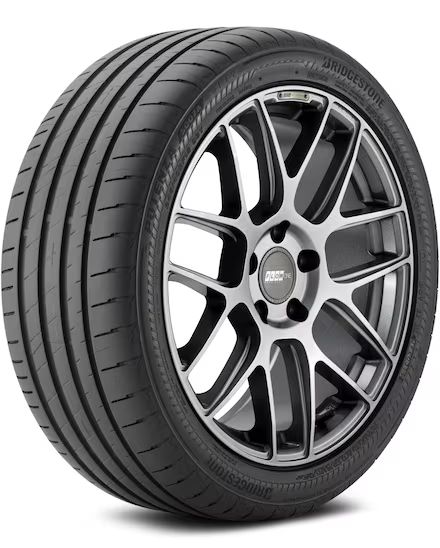
Straight-rib, asymmetric tread pattern. A low-void design specifically optimizes rubber-to-road contact within the footprint, while wide, stiff ribs are aimed at immediate steering response and maximum ultimate traction.
Notched outboard shoulder. This delivers confident lateral grip specifically for high-speed cornering, working alongside low-angle sipes designed to reduce tread squirm — the flexing that can rob precision from a tire under hard cornering loads.
Carbon black, silica, and rubber compound. This combination is aimed at reducing rolling resistance, contributing to both traction and a degree of efficiency uncommon in this performance category.
Lightweight belt package. Steel belts combined with polyester and Aramid plies allow for genuinely better cornering capability, even at higher speeds, without the weight penalty a less refined construction might carry.
Dry Performance
This is the S007A’s clearest, most consistently praised strength, and it holds up well across multiple independent sources.
A detailed track-time account from a launch event at Phillip Island Grand Prix Circuit — conducted with a former Formula One driver behind the wheel of an F80 BMW M3 — describes high-speed lane changes between 170-190 km/h executed “with absolute ease,” with the tires holding the car composed through banked corners at speed.
Real owner track-day accounts back this up. The Subaru WRX STI owner cited above described the S007A as “very impressive” compared to the previous-generation RE003 specifically on dry surfaces, and independent aggregated review data notes owners consistently praising “wet traction and hydroplaning resistance” alongside strong dry credentials, describing the tire as exceeding expectations relative to the outgoing S001.
Wet Performance: A Genuinely Mixed Picture
This deserves honest, direct treatment given how sharply independent sources diverge here.
On one hand, aggregated review data specifically credits the tire with strong hydroplaning resistance, and one Australia-based Motor magazine test of eight 19-inch tires found the S007A delivered “excellent lateral stability in the wet” alongside a short dry braking distance — genuinely strong marks in a competitive field test.
On the other hand, that same test noted “relatively long braking distance on wet pavement” as a specific weak point, and the direct owner complaint cited earlier describes traction poor enough to require starting in second gear during wet acceleration on a torque-heavy rear-wheel-drive car.
A separate detailed owner review specifically flagged aquaplaning as “poor” despite otherwise being satisfied with the tire overall.
The honest synthesis: wet lateral grip and hydroplaning resistance appear to be genuine strengths, but wet braking distance and low-speed wet traction under power — particularly relevant for high-torque, rear-wheel-drive applications — show real, documented weakness across multiple independent sources.
Ride Comfort
This is a straightforward, well-documented trade-off rather than a surprise. Independent aggregated analysis states plainly that the S007A “delivers an exceptionally stiff ride, even compared with other tires in this category, which are generally stiff” — a real, honest acknowledgment that this tire prioritizes performance over comfort more than most competitors in an already firm-riding category.
That said, comfort is genuinely relative to what it replaces. One detailed Alfa Romeo 4C owner account, comparing directly against previous Pirelli tires, described the “floaty feeling completely gone” with the ride feeling “way more comfortable” and the car feeling “way more planted” after switching — a reminder that “stiff for the category” doesn’t necessarily mean uncomfortable relative to every possible alternative.
Tread Life
This is a genuine area of improvement over the outgoing S001, according to multiple independent sources. Aggregated review data specifically notes: “People who had already used Bridgestone mentioned that the S007A was much better than the S001, especially the wear life.”
The tire carries a UTQG treadwear rating of 240 — a figure debated among enthusiasts on forums as neither particularly high nor low for the Extreme Performance category, with some owners questioning how meaningfully it differs from tires rated in the low 200s.
Real-world reports vary: one owner running a matched pair purchased new discovered date codes over four years old with visible oil contamination and hardened rubber, a genuine buyer-caution issue worth knowing about (detailed further below) rather than a reflection of the tire’s inherent durability when properly stored and sold fresh.
Buying Tip: Check the Date Code Before You Buy
This is a genuinely practical, underreported issue worth flagging directly. One detailed SimpleTire owner review describes purchasing a pair in September 2023 and receiving tires with a date code of 2719 — meaning the tires were already more than four years old at the time of purchase, with visible oil contamination and noticeably hardened rubber suggesting improper, non-climate-controlled storage.
For a tire carrying a 240 treadwear rating specifically purchased for genuine performance capability, receiving old, degraded stock is a real, meaningful problem — rubber compounds harden and lose grip characteristics with age regardless of remaining tread depth.
Checking the four-digit DOT date code on any Potenza S007A before installation, and requesting a specific manufacture-date range from the retailer if buying online, is a genuinely sensible precaution given this documented issue.
S007A vs. Potenza Sport: What’s Changed
Since the Potenza Sport is Bridgestone’s current flagship and the more relevant comparison for many shoppers today, it’s worth covering directly.
Independent aggregated testing across more than 22 professional tests shows the Potenza Sport performing exceptionally in pure handling terms — potentially the top handling UHP tire in its class by cornering-grip measurement, with 6 outright test wins and an average finishing position of 3.3rd across the aggregated dataset.
But that same aggregated analysis includes a genuinely important caution: the Potenza Sport “behaves more like a race slick than a road tire, with a volatile nature and shockingly inconsistent braking” — a real, documented trade-off that the analysis specifically frames as “a cautionary tale for anyone considering it for their daily driver.”
The practical comparison: the S007A’s documented weak points are cold-weather and specific wet-traction scenarios, while the Potenza Sport’s documented weak point is braking consistency despite class-leading cornering grip. Neither tire is without real trade-offs, and the right choice depends on which specific limitation matters less for your driving.
S007A vs. Michelin Pilot Sport 4S
This is one of the most common real-world cross-shopping comparisons, and there’s genuine, detailed owner data worth citing directly.
One Ford Mustang forum thread compiled Tire Rack’s own comparative data, noting significant pricing differences favoring the S007A (roughly $1,092 for a set of four in the poster’s specific sizes, versus $1,630 for the Michelin Pilot Sport 4S).
Tire Rack’s own brief assessment described the S007A as offering “a nice step up in dry traction without much sacrifice to comfort” while suggesting room for “additional steering feel and an increase in wet grip” — again pointing to wet performance as this tire’s most consistently identified relative weakness.
Who the S007A Still Makes Sense For
Owners who primarily drive in consistently warm, dry climates. Given the documented cold and wet-weather complaints, this tire’s strengths are most fully realized where those specific limitations rarely get tested.
Drivers prioritizing outright dry-weather value. The genuine price advantage over flagship alternatives like the Pilot Sport 4S, combined with real dry-grip credentials, makes this a compelling budget-conscious choice for the right use case.
Owners upgrading from the S001 specifically, given the well-documented, real improvement in both grip and tread life over that predecessor.
Who Should Consider Alternatives
Owners in regions with real seasonal temperature swings or frequent rain, given the specific, documented complaints about cold-weather and wet-traction performance from multiple independent sources.
High-torque, rear-wheel-drive vehicle owners specifically, given the pattern of complaints about wet acceleration traction in exactly that configuration.
Track-focused drivers chasing maximum grip above all else, who may want to weigh the Potenza Sport’s stronger aggregated cornering-grip data against its own documented braking-consistency trade-off, or consider Bridgestone’s more track-focused RE-71R line.
Getting the Most Out of This Tire
Given the documented cold-weather and wet-traction concerns, a few practical habits genuinely matter more with this tire than with a more forgiving all-season option.
Respect the temperature threshold strictly. Given real owner complaints about performance degrading noticeably even above freezing, treating 50-55°F as a practical lower bound for confident driving — rather than waiting until the tire’s absolute minimum-temperature warning — is a genuinely sensible habit for anyone who’s read the documented cold-weather complaints seriously.
Allow a proper heat-cycle before pushing hard. The endurance-racing account cited earlier specifically noted improved results after “more thought into” tire pressure and warm-up on a second track outing, suggesting at least part of the initial “loose, like driving on ice” impression may have been addressable through proper setup rather than being purely an inherent tire limitation.
Moderate throttle application on wet or cold roads, especially in rear-wheel-drive applications. Given the specific, repeated pattern of complaints about wet acceleration traction, treating this tire with real caution during the shoulder seasons — not just genuine winter — is a reasonable, safety-conscious approach rather than an overreaction.
Verify date codes at purchase, every time. As detailed above, this is a genuinely documented issue with this specific tire, and it’s a thirty-second check that protects against a real, known risk.
Pricing and Value
Current retail pricing for the S007A varies by size but generally sits in a genuinely competitive position relative to flagship alternatives — the direct Tire Rack comparison cited earlier showed a full set running roughly $1,092 versus $1,630 for the Michelin Pilot Sport 4S in matched sizes, a meaningful real-world price gap for comparable dry-weather capability.
That value proposition is real, but it should be weighed honestly against the documented trade-offs covered throughout this review.
A tire priced lower than its most direct flagship competitor, with genuine strengths in dry grip and tread life but real, repeated documentation of wet and cold-weather weaknesses, represents a legitimate value choice for the right driver and climate — not a straightforward “better tire for less money” claim across every use case.
Frequently Asked Questions
Is the Bridgestone Potenza S007A good in the rain?
It’s genuinely mixed. Independent testing credits it with strong hydroplaning resistance and wet lateral stability, but multiple sources — including a direct owner complaint and an independent Motor magazine test — document real weaknesses in wet braking distance and low-speed wet traction under acceleration, particularly on high-torque rear-wheel-drive vehicles.
Is the Bridgestone Potenza S007A good in cold weather?
No — and this applies to any Extreme Performance Summer tire, but the S007A specifically has documented owner complaints describing traction as “terrible in colder temperatures.” It’s not intended to be serviced, stored, or driven at or below freezing temperatures, and performance degrades noticeably as temperatures drop even above freezing.
What replaced the Bridgestone Potenza S007A?
The Bridgestone Potenza Sport is the current flagship, with independent aggregated testing across 22-plus tests showing it as a top handling performer by cornering grip, though with a documented trade-off in braking consistency that the same analysis specifically flags as a caution for daily-driver use.
How does the Bridgestone Potenza S007A compare to the Michelin Pilot Sport 4S?
Real owner-compiled Tire Rack data shows the S007A priced meaningfully lower (roughly 33% less in one direct comparison), with genuine dry-traction competitiveness and comparable comfort, but Tire Rack’s own assessment specifically noted the S007A could use “additional steering feel and an increase in wet grip” relative to the Michelin.
What vehicles does the Bridgestone Potenza S007A fit?
It’s built for sports cars, performance sedans, and modern muscle cars, available in 18, 19, and 20-inch sizes, with a documented history serving as original equipment on the Ferrari F12 Berlinetta, Aston Martin DB11, and select Audi RS, BMW M, and Lexus F performance models.
How long does the Bridgestone Potenza S007A last?
It carries a UTQG treadwear rating of 240, and independent aggregated review data notes genuine improvement over the outgoing S001 in wear life. Buyers should specifically check the DOT date code before purchase, given at least one documented case of a customer receiving tires over four years old with degraded rubber.
Should I buy the Bridgestone Potenza S007A or wait for a track day-focused tire like the RE-71R?
If maximum track grip is the priority and comfort or daily usability matter less, a real endurance-racing account specifically states the S007A doesn’t match the RE-71R/RE-71E’s grip level, particularly in damp conditions. The S007A is better suited to drivers wanting strong street performance with occasional track use rather than dedicated competitive use.
