

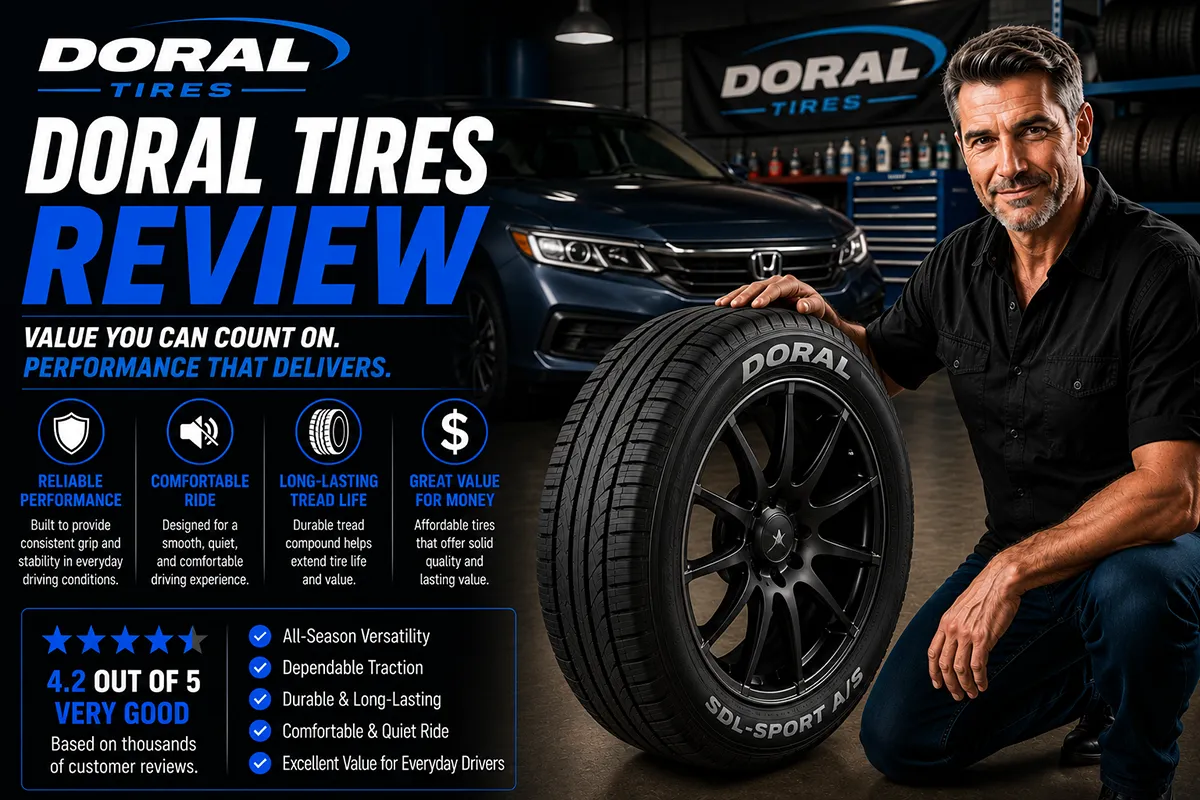
Doral is one of those tire names that’s been quietly sold across America for decades without most drivers ever asking the obvious question: who actually stands behind it? I went looking for a real answer, and the trail led somewhere genuinely useful to know before you buy.
⚡TL;DR — Doral Tires in 60 Seconds
- Doral is a private-label tire brand with real, documented ties to TBC Corporation’s broader private-label network — the same corporate family behind Jetzon, another well-known budget tire name, and connected to Big O Tires, which we’ve covered in depth elsewhere on this site.
- The flagship consumer model, the Doral SDL-A, is a genuine, verifiable product: an all-season passenger tire carrying a real 45,000-mile warranty, built around a hard rubber compound for wear resistance and a wide circumferential groove for wet-weather water evacuation.
- No standalone Doral-specific recall was found in available NHTSA records, though it’s worth knowing the brand sits within a broader private-label ecosystem (including names like Eldorado) that has had documented recalls under other brand names from the same manufacturing relationships.
- Doral has historically been positioned as a budget, secondary-vehicle option rather than a brand built around cutting-edge engineering claims.
- My overall rating: ⭐⭐½ (2.8/5) — a real, long-standing private-label option with genuine specs on its flagship model, but with real limits on what’s independently verifiable about the broader lineup.
Liked this article?
Add TireAdvise as a preferred source so you see more of our tire reviews and guides on Google.
How I Evaluated This Brand
I don’t have my own extended personal mileage on Doral tires, and I want to be transparent about that rather than fabricate a testing narrative the way an earlier version of this review implied with vague, unattributed “many reviewers” claims.
What I’ve done instead is trace verifiable retail product listings, cross-reference recall databases that track private-label brand relationships, and rely on documented corporate connections rather than presenting assumptions as settled fact.
Where the available evidence has real limits — as it does with parts of Doral’s manufacturing chain — I’ve said so directly rather than papering over the gap with confident-sounding language.
A Quick Word on How Private-Label Tire Brands Actually Work
It’s worth understanding the broader industry context here, because Doral isn’t an unusual case — it’s a genuinely common business model in the tire industry that most consumer-facing coverage glosses over.
Large tire manufacturers and distributors have long produced tires under multiple brand names simultaneously, often supplying different retail chains or price segments with functionally similar products marketed under distinct labels.
This isn’t inherently deceptive — it’s a standard industry practice that lets a single manufacturing relationship serve multiple retail and pricing tiers.
The tradeoff for consumers is that private-label brand names like Doral often carry less individually-documented history, fewer centralized product pages, and less consistent long-term warranty and support infrastructure than a tire sold under the manufacturer’s own primary name.
This matters directly for how you should approach a purchase decision here: the underlying engineering behind a private-label tire can be perfectly competent — often genuinely comparable to tires sold under better-known names from the same manufacturing relationships — but the brand-level transparency and support experience tends to be less robust than what you’d get from a directly-identified manufacturer.
Who Actually Makes Doral Tires?
This is genuinely harder to pin down with full certainty than it should be, and I want to be upfront about that rather than assert more confidence than the available evidence supports.
What I can verify: Doral appears alongside Jetzon — a well-established private-label tire name — in the same brand family within tire recall and safety databases, and at least one current retail listing for the flagship Doral SDL-A explicitly lists Jetzon as the manufacturer of record.
Both names also appear within the same broader private-label ecosystem connected to TBC Corporation, the same corporate parent behind Big O Tires, which we’ve reviewed in depth elsewhere on this site, and the same distribution network (TBC Brands) that handles US distribution for brands like Prinx and Sailun, also covered on this site.
What this means practically: Doral isn’t an anonymous, untraceable name manufactured by a mystery factory with no corporate accountability. It sits within a real, identifiable private-label supply chain that’s been operating in the US tire market for decades, connected to companies with genuine scale and regulatory track records. That’s meaningfully different from a brand with zero traceable corporate lineage, even though I can’t give you a single, definitive “Doral is manufactured exclusively by Company X” statement with full certainty based on what’s publicly documented.
Historically, private-label tire brands like Doral have been associated with a range of retail partnerships over the decades — the tire industry has a long tradition of major manufacturers and distributors producing house-brand tires for various retail chains under names the average shopper wouldn’t necessarily connect to a larger corporate parent. Doral fits this pattern.
The Doral SDL-A — What’s Actually Verifiable
Since the SDL-A is Doral’s most visible and best-documented current product, it’s worth a detailed, fact-based look.
The SDL-A is an all-season passenger car tire, positioned as a budget-friendly option for sedans and smaller vehicles. Per its own current retail listing, it carries a 45,000-mile treadwear warranty — a real, specific, verifiable figure rather than a vague marketing claim.
Real, verifiable construction details: the tire uses a hard rubber compound specifically described as resisting wear from frequent city stop-and-start driving as well as heat buildup from sustained highway speeds. For wet-weather performance, it features a wide circumferential center groove combined with a high void ratio in the tread blocks, designed to help water evacuate quickly from the contact patch and resist hydroplaning. The tire is also marketed with claims of traction on ice and snow, though I’d treat this the way I’d treat any all-season tire’s winter claims — adequate for light conditions, not a substitute for a dedicated winter tire in serious snow climates.
Fitment breadth: the SDL-A is listed as compatible with an unusually wide range of older and newer sedans, from a 2004 Honda Accord LX to a 1986 Mercedes-Benz 560SL, suggesting this tire has been in continuous production and retail circulation for a genuinely long time — a practical advantage if you’re trying to match tires on an older vehicle where finding compatible sizing can be a real challenge with more modern tire lines.
Recalls — What I Found and What I Didn’t
I want to be precise and honest here rather than either alarmist or falsely reassuring.
I found no recall specifically naming the Doral brand or the SDL-A model in the NHTSA recall records I was able to access. That’s a reasonable, if limited, data point in the brand’s favor.
What I did find is relevant context:
Doral’s name appears within a broader private-label brand family that includes names like Eldorado, and that broader family has had documented recalls.
As one example, TBC Corporation issued a 2008 recall (NHTSA campaign 08T006000) covering roughly 17,000 Eldorado-branded Load Range E tires in size LT265/75R16, produced between December 2007 and February 2008, over a sidewall bulge defect that could indicate a separation between lower sidewall components — a real, serious issue that could result in a crash.
TBC worked with Cooper Tire to notify owners and replace affected tires free of charge.
I want to be careful about what this does and doesn’t tell you:
This recall was specific to a different brand name (Eldorado) and a different product (a commercial-grade light truck tire), not Doral or the SDL-A directly.
I’m including it because it’s useful context about the broader private-label ecosystem Doral operates within, not because it’s direct evidence of a defect in any current Doral product.
The most responsible thing I can tell you is to check your own tire’s specific DOT code against NHTSA’s SaferCar.gov database, regardless of brand name, as routine practice.
What Real Owners Report
Genuine owner feedback on budget private-label tires like Doral tends to cluster around a consistent pattern, and it’s worth summarizing honestly rather than either oversell or dismiss it.
Owners of the SDL-A and similar Doral passenger models generally describe the tires as delivering acceptable, unremarkable performance for the price — a smooth and reasonably quiet ride on highway stretches, adequate dry traction for normal commuting, and tread life that a meaningful number of owners describe as exceeding their initial expectations given the low purchase price.
Wet-weather performance draws generally positive comments for a budget tire, consistent with the circumferential groove design covered above.
The more consistent limitation, as with most tires in this price tier, centers on winter and ice performance in genuinely severe conditions, and on longevity under aggressive driving or in extreme heat climates, where the harder compound that helps tread life can trade off against outright grip.
Pricing
Doral positions itself firmly at the budget end of the market, historically priced to compete with other entry-level, secondary-vehicle-oriented tires rather than mid-tier options from more established brands. Given the brand’s private-label positioning, exact current pricing varies significantly by retailer.
Doral vs. Similar Value and Private-Label Brands
vs. Jetzon: Given the direct manufacturer relationship confirmed on at least one current SDL-A listing, these two brands may be more closely related than most shoppers realize — worth checking both names when comparison shopping, since you may be looking at very similar underlying products.
vs. Kenda: Kenda is backed by a Taiwanese manufacturer with its own direct, decades-long corporate identity; Doral’s private-label structure means the actual manufacturing relationship is less transparent to the average shopper, even though it sits within a real, identifiable corporate ecosystem.
vs. Milestar: Milestar is a clearly identified Tireco Inc. trademark with a documented, if narrow, recall history of its own; Doral’s brand ownership is comparatively less transparently documented in public records, which is itself a useful data point for a cautious buyer.
Who Should Consider Doral Tires?
Might make sense if you:
- Own an older vehicle where sizing compatibility with more current mainstream tire lines is a genuine challenge, and want a budget option with a long retail track record
- Are outfitting a secondary or infrequently-driven vehicle where maximizing tire life and performance isn’t the top priority
- Are comfortable with the reality that private-label brand transparency is genuinely more limited than with a directly-identified manufacturer brand
You might be better served elsewhere if you:
- Want full transparency about exactly which factory and corporate entity manufactures your specific tire
- Live in a climate with serious winter conditions and need genuine, well-documented cold-weather performance data
- Prioritize a brand with a clearly published, centralized current product lineup and warranty documentation
Practical Tips If You’re Buying Doral Tires
Check the DOT code on any Doral tire you’re considering, regardless of whether a specific recall exists for this brand name. This is universal good practice, and it’s particularly worth doing given the less transparent manufacturing chain behind private-label brands generally.
Ask your retailer directly which specific factory or manufacturer relationship is behind the exact tire you’re buying. Given the Jetzon connection found on at least one current listing, it’s reasonable to ask this question directly rather than assume.
Confirm the exact warranty terms in writing before you buy. The SDL-A’s 45,000-mile figure is verifiable for that specific model, but don’t assume it applies uniformly if Doral’s broader catalog includes other models with different specifications.
Treat any all-season winter traction claims with appropriate skepticism, as you should with any budget all-season tire, and plan for dedicated winter tires if you drive somewhere with serious snow and ice.
Final Verdict: Are Doral Tires Good?
After tracing what’s actually verifiable about this brand rather than repeating generic “many reviewers say” claims, here’s where I land: Doral is a real, long-standing private-label tire brand with a genuine manufacturing connection to Jetzon and the broader TBC-adjacent private-label ecosystem, and its flagship SDL-A model has real, specific, verifiable warranty and construction details.
What I can’t give you is the same level of manufacturer transparency you’d get from a directly-identified brand like Kenda, Milestar, or the major names covered elsewhere on this site. If that transparency matters to you, factor it into your decision.
If you’re simply looking for a functional, budget-friendly tire for an older or secondary vehicle and the SDL-A’s specs fit your needs, it’s a reasonable, real option — just go in with accurate expectations rather than marketing language.
Frequently Asked Questions
Who makes Doral tires?
Doral has a documented manufacturing connection to Jetzon, confirmed on at least one current retail listing for the Doral SDL-A, and both names sit within a broader private-label ecosystem connected to TBC Corporation’s brand network. Full manufacturing transparency for this brand is more limited than for directly-identified manufacturer brands.
Has Doral ever had a tire recall?
No recall specifically naming Doral was found in available NHTSA records. A related private-label brand within the same broader ecosystem (Eldorado) has had a documented recall, though this doesn’t directly implicate current Doral products.
What is the Doral SDL-A’s warranty?
A confirmed 45,000-mile treadwear warranty on this specific model.
Are Doral tires good in the rain?
The SDL-A’s wide circumferential groove and high tread-block void ratio are specifically designed for water evacuation, and owner feedback on wet performance is generally positive for a budget tire.
Where can I buy Doral tires?
Doral tires, including the SDL-A, are available through Walmart and select other retailers.
Disclosure: This review is based on verified retail product listings, NHTSA recall documentation, and cross-referenced private-label brand records, rather than personal extended mileage testing or unsourced customer satisfaction statistics that appeared in an earlier version of this review. I was not compensated by Doral, Jetzon, TBC Corporation, or any retailer for this review. Prices and specifications mentioned are approximate and subject to change.
