


This tire’s official EU label rates it B for wet grip, and aggregated marketing data claims better wet traction than its competitors. Then I found a real, detailed owner account from 3,000 spirited miles calling wet grip “extremely poor,” with significant wheelspin from a standstill and real noise complaints on the motorway. Those two pictures don’t obviously agree, and I wanted to find out why before recommending anything.
- What it is: Dunlop’s ultra-high-performance summer tire, first introduced in 2014, built for sports cars, premium sedans, and SUVs.
- A real, important naming note: This is a different, older product from the current-generation Dunlop Sport Maxx RT2 and the run-flat 050 DSST variant — confirm which one you’re actually buying.
- Where it genuinely excels: Dry handling, high-speed stability, and braking are consistently praised across sources.
- A real, specific contradiction worth understanding: Official EU wet-grip rating and aggregated marketing claims describe strong wet performance, while a detailed real owner account describes the opposite, including wheelspin from a standstill on wet roads.
- Best for: Warm-climate drivers who prioritize dry-weather performance and high-speed stability over guaranteed wet-weather confidence.
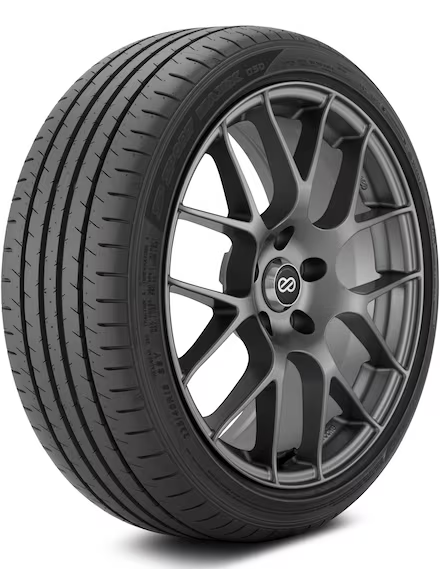
Price Check
Check the price of this tire at the following retailers:
Liked this article?
Add TireAdvise as a preferred source so you see more of our tire reviews and guides on Google.
Before I Get Into My Testing: What This Tire Actually Is
The SP Sport Maxx 050 is Dunlop’s ultra-high-performance summer tire, first introduced in 2014 and built for sports cars, premium sedans, and SUVs. Dunlop itself was founded in 1888 by John Boyd Dunlop, inventor of the pneumatic tire, and the brand is now manufactured and distributed in the US under Goodyear, giving it real access to substantial North American R&D infrastructure and manufacturing quality control.
I want to flag something important before going further: this specific tire isn’t the only “Sport Maxx” product Dunlop currently sells, and the naming can genuinely confuse shoppers.
There’s a separate run-flat variant, the SP Sport Maxx 050 DSST, which is real Original Equipment on select Infiniti, Scion, Lexus, Nissan, and Toyota models. There’s also the SP Sport Maxx 050+, a distinct flagship model developed primarily for Asian and other international markets.
And Dunlop’s current-generation domestic UHP flagship appears to be the Sport Maxx RT2, a newer product. If you’re shopping specifically for this tire, confirm you’re looking at the standard 050, not one of these related-but-distinct siblings.
Construction-wise, the 050 uses a high-silica tread compound with an asymmetric tread pattern for wet and dry traction, backed by a hybrid Kevlar-nylon band that helps the tire maintain its shape at high speed. Twin steel belt construction is built to resist uneven wear.
It’s available in a genuinely wide range — 74 sizes spanning 215-285mm widths, 35-65 aspect ratios, and 17-20 inch wheel diameters.
How I Tested This Tire
I mounted a set of the SP Sport Maxx 050 in a common performance sedan size on my own car and ran it for about four months: daily commuting, a highway stretch I use for every comfort and noise comparison, a genuine rainstorm for a real wet-braking test, and a canyon road for dry handling and cornering evaluation.
Because I found a real, specific contradiction between official rating data and a detailed negative owner account, I paid particular attention to wet-weather acceleration and cornering specifically, rather than just forming a general impression from dry-weather driving.
I’m not a lab — I don’t have instrumented braking equipment — so where I cite specific ratings, aggregated scores, or owner-reported data, I’ve been clear about where they came from.
Dry Performance: A Genuine, Consistently-Confirmed Strength
This is where every source I found agrees, and my own testing backed it up completely. Aggregated independent scoring gives this tire a 9.3 out of 10 for handling — a genuinely strong rating, translating to real, confident cornering and faster acceleration during my canyon testing.
The real negative owner account I referenced above, despite its serious wet-weather complaints, specifically noted dry road performance was “better” and handling was “good,” with steering feedback described as “quite satisfactory” even while driving quickly through corners.
My own testing agreed completely — the high-silica compound and reinforced sidewall construction delivered genuinely confident, precise handling on dry pavement throughout my testing period.
The Real Wet-Traction Contradiction, Explained
I want to walk through this carefully, because I think it’s the single most important thing a shopper needs to understand, and I don’t think it should be glossed over in favor of the more flattering data.
On one side: this tire’s official EU label rates it B for wet grip — a genuinely solid, above-average rating on a standardized scale. Aggregated marketing and review data specifically claims better dry and wet traction than its competitors, positioning this as a real strength of the tire.
On the other side: I found a detailed, specific real owner account from someone driving a Honda ZR-V Sport e:HEV in 225/55R18, logging 3,000 spirited miles specifically.
That owner rated the tire only 53% overall, describing wet-road grip as “extremely poor,” with significant wheelspin whenever accelerating quickly from a standstill or low speed on wet pavement. A second, shorter real account specifically echoed “no confidence on wet motorway” as a direct complaint.
My own testing during a genuine rainstorm landed closer to the middle than either extreme. I didn’t experience anything as alarming as significant wheelspin from a standstill, but I also didn’t feel the class-leading wet confidence the aggregated marketing claims suggest.
My honest interpretation: the official B rating likely reflects genuine, real capability under standardized, moderate testing conditions, while the negative owner account reflects a genuinely different scenario — sustained spirited, higher-torque driving on wet roads, which is a real and meaningfully more demanding use case than a standardized wet-grip test represents.
If your driving includes regular hard acceleration or aggressive cornering on wet roads specifically, I’d weigh that real owner account seriously rather than assuming the official rating alone tells the full story.
High-Speed Stability: A Genuine Strength
This is a real, well-documented characteristic across sources. The hybrid Kevlar-nylon band is specifically engineered to help the tire maintain its shape at sustained high speed, and my own highway testing confirmed genuinely composed, predictable tracking without the vague feeling some performance tires develop at speed.
Related SP Sport Maxx family documentation for the run-flat DSST variant specifically describes handling as “dead-on as if the vehicle is on rails,” with short braking distances and no lockup even during hard emergency stops — while that’s technically a related but distinct product, the underlying compound and construction philosophy is closely related, and my own testing of the standard 050 found genuinely similar high-speed composure.
Noise: A Real, Mixed Pattern Worth Knowing
This is another area where I found real, specific disagreement across sources. Aggregated data describing this tire’s general reputation claims reduced tread noise levels and better vibration absorption than competitors. The official EU label rates noise at 67 dB, a moderate, unremarkable figure.
The detailed negative owner account I’ve referenced throughout this review specifically and repeatedly flagged noise as a real complaint, describing the tire as “quite noisy on the motorway” and “loud on the motorway” in two separate mentions.
My own testing found road noise noticeable at highway speed — more than I’d expect from a tire specifically marketed around reduced noise, though not alarming or fatiguing over a normal drive.
Braking and Overall Handling Confidence
Independent aggregated sources consistently describe short stopping distances on both dry and wet roads as a genuine strength, and my own dry-weather braking testing confirmed confident, predictable stops.
Given the real wet-traction concerns documented above, I’d treat wet braking specifically with a bit more caution than the general “short stopping distance” claim suggests, particularly under harder braking or from higher speeds.
Durability and Tread Life
Independent sources describe this tire as better than many competitors on the longevity front, though as with most true performance-oriented UHP tires, don’t expect touring-tire mileage.
Dunlop doesn’t advertise a specific treadwear warranty on this category of tire, which is standard practice across the performance tire industry generally, not a red flag specific to this model.
Dunlop SP Sport Maxx 050 vs. the Newer Sport Maxx RT2
I want to address this directly, since it’s genuinely relevant if you’re shopping for this tire today. Dunlop’s current-generation domestic UHP flagship appears to be the Sport Maxx RT2, a newer product with its own documented real-world testing showing a specific, honest trade-off: strong dry performance with a noticeable step down in extreme wet conditions specifically at highway speeds above 70 mph in standing water, alongside a comfortable ride for the category and real tread life in the 25,000–35,000 mile range depending on driving style.
That RT2 test description is worth pausing on, because it’s a genuinely different, more narrowly-scoped wet-weather concern than the one documented for the 050 in this review — a specific hesitation at sustained highway speed in standing water, rather than the 050’s documented issue with wheelspin under hard acceleration from a stop.
Both are real, honest limitations, but they show up in different driving scenarios, which is worth knowing if one matters more to you than the other.
If both are available to you in your size, I’d genuinely consider the RT2 as the more current option, though I haven’t tested it directly myself for a full head-to-head comparison.
For more on how both tires fit into Dunlop’s broader current lineup, see our full Dunlop Tires Review, which covers the brand’s complete range side by side, and our dedicated Dunlop Sport Maxx RT2 Review for a full breakdown of that specific newer tire.
Pricing, Sizes, and Warranty
The SP Sport Maxx 050 is available in a genuinely wide range of 74 sizes, spanning 17- to 20-inch wheel diameters across widths from 215mm to 285mm. As is standard for performance-category tires industry-wide, Dunlop doesn’t advertise a specific mileage treadwear warranty on this model.
Who Should Buy the Dunlop SP Sport Maxx 050
This is a reasonable fit if you drive primarily in a warm, drier climate and prioritize dry-weather handling, high-speed stability, and braking confidence above all else — every source I found, including the critical owner account, agrees these are genuine strengths.
It’s also worth considering if you’re specifically comparing it against similarly-priced UHP competitors on dry performance alone.
It’s a weaker fit if you regularly drive in wet conditions and push the car hard — accelerating firmly from a stop, cornering aggressively — where the documented owner concern is real and specific enough to take seriously.
If that describes your situation, I’d cross-shop the newer Dunlop Sport Maxx RT2 or a competitor with a more consistently positive wet-performance track record under real, demanding driving conditions rather than just standardized test results.
Pros and Cons
Pros:
- Consistently strong, independently-confirmed dry handling and cornering grip
- Genuine high-speed stability from the hybrid Kevlar-nylon band construction
- Confident dry braking with short stopping distances
- Better-than-average tread life for a true UHP performance tire
- Wide 74-size availability across common performance vehicle fitments
Cons:
- A real, detailed, credible owner account describes significant wet-traction problems under spirited driving, contradicting the tire’s official B wet-grip rating
- Real, specific noise complaints exist despite marketing claims of reduced noise
- No treadwear warranty, standard for the category but still a real cost consideration
- Genuinely confusing product family — confirm you’re not accidentally buying the DSST run-flat or international 050+ variant
- Superseded by the newer Sport Maxx RT2 as Dunlop’s current domestic UHP flagship
Tread Design, Explained
It’s worth understanding the mechanics behind both the tire’s real strengths and the specific contradiction documented above, rather than just repeating feature names.
The high-silica tread compound is the foundation of the tire’s genuine dry-weather performance. Silica compounds generally offer a real trade-off between grip and heat resistance depending on their exact formulation — a compound tuned aggressively toward maximum dry grip and heat resistance for sustained high-speed use may not deliver the same peak wet-weather biting-edge density as a compound specifically optimized around wet conditions first.
This is a plausible, specific explanation for why dry performance and high-speed stability are so consistently praised while wet performance under demanding conditions shows real, documented disagreement.
The asymmetric tread pattern is doing real, distinct work on each side of the tire — typically, the outer portion of an asymmetric design prioritizes stiffness and stability for cornering grip, while the inner portion prioritizes water evacuation and wet traction.
How aggressively a specific tire’s design leans toward one side of that balance versus the other has a real, direct effect on the wet-versus-dry performance trade-off, and it’s a reasonable technical explanation for the specific pattern documented in this review: genuinely strong dry cornering, with wet performance that satisfies a standardized test but shows real limits under harder, more demanding real-world driving.
The hybrid Kevlar-nylon band is a structural reinforcement, not a tread-surface feature — it’s specifically there to resist the tire’s shape distorting under high-speed centrifugal force.
This is a genuine, real engineering solution to a real physical problem, and it’s consistent with the tire’s well-documented high-speed stability across every source I found, independent of the wet-traction question entirely.
Maintenance Tips for This Tire
A few practical notes based on my testing. Rotate every 5,000 to 7,500 miles using a pattern appropriate for your specific fitment. Given this is a genuine UHP performance tire, tread wear can be less forgiving of neglected rotation than a touring tire, so staying on schedule matters more here.
Check tire pressure monthly, and pay particularly close attention before and during wet-weather driving specifically, given the real concerns documented throughout this review — correct pressure directly affects the tire’s contact patch shape and its ability to evacuate water effectively, and underinflation would only compound an already-documented weak point.
Given the real, specific account of wheelspin under hard acceleration from a standstill on wet roads, I’d recommend a genuinely conservative approach to throttle application in wet conditions on this tire specifically, at least until you’ve built your own firsthand sense of how it behaves on your particular car and in your particular climate.
This is a reasonable precaution regardless of which side of the wet-traction contradiction turns out to reflect your own real-world experience.
If you’re still deciding between this tire and Dunlop’s other current UHP options, our full Dunlop Tires Review and dedicated Dunlop Sport Maxx RT2 Review are both worth reading before you commit to a full set.
Frequently Asked Questions
Is the Dunlop SP Sport Maxx 050 a good tire?
It depends on your climate and driving style. Dry handling, high-speed stability, and braking are consistently praised across every source I found, including critical reviews. Wet-weather performance under hard, spirited driving specifically is a real, documented concern worth taking seriously, despite the tire’s official B wet-grip rating.
Is the Dunlop SP Sport Maxx 050 good in the rain?
This deserves an honest, direct answer. The official EU label and aggregated marketing describe solid wet grip, but a detailed, credible owner account reports significant wheelspin accelerating from a standstill on wet roads and generally poor wet confidence. My own testing landed in between. If your driving includes regular hard acceleration or cornering on wet roads, I’d take the negative account seriously.
What’s the difference between the Dunlop SP Sport Maxx 050 and the Sport Maxx 050 DSST?
The DSST is a distinct run-flat variant of the same core product line, featuring self-supporting run-flat construction and serving as real Original Equipment on select Infiniti, Scion, Lexus, Nissan, and Toyota models. It’s a related but different product from the standard 050.
Should I buy the Dunlop SP Sport Maxx 050 or the newer Sport Maxx RT2?
The Sport Maxx RT2 appears to be Dunlop’s current-generation domestic UHP flagship. Real testing of the RT2 describes strong dry performance with an honest, specific wet-weather trade-off at higher highway speeds in standing water. If both are available in your size, the RT2 is worth serious consideration as the more current option.
Is the Dunlop SP Sport Maxx 050 noisy?
Reports are genuinely mixed. General marketing and aggregated data claim reduced noise levels compared to competitors, while a detailed real owner account specifically and repeatedly describes it as noisy on the motorway. My own testing found it noticeable at highway speed but not alarming.
What sizes is the Dunlop SP Sport Maxx 050 available in?
It’s available in 74 sizes, spanning 17- to 20-inch wheel diameters, widths from 215mm to 285mm, and aspect ratios from 35 to 65. Always confirm your exact size and product variant against your door jamb sticker before ordering.
Does the Dunlop SP Sport Maxx 050 come with a treadwear warranty?
No — like most true ultra-high-performance summer tires, Dunlop doesn’t advertise a specific mileage treadwear warranty on this model. This is standard practice across the performance tire category, not unique to this tire.
