

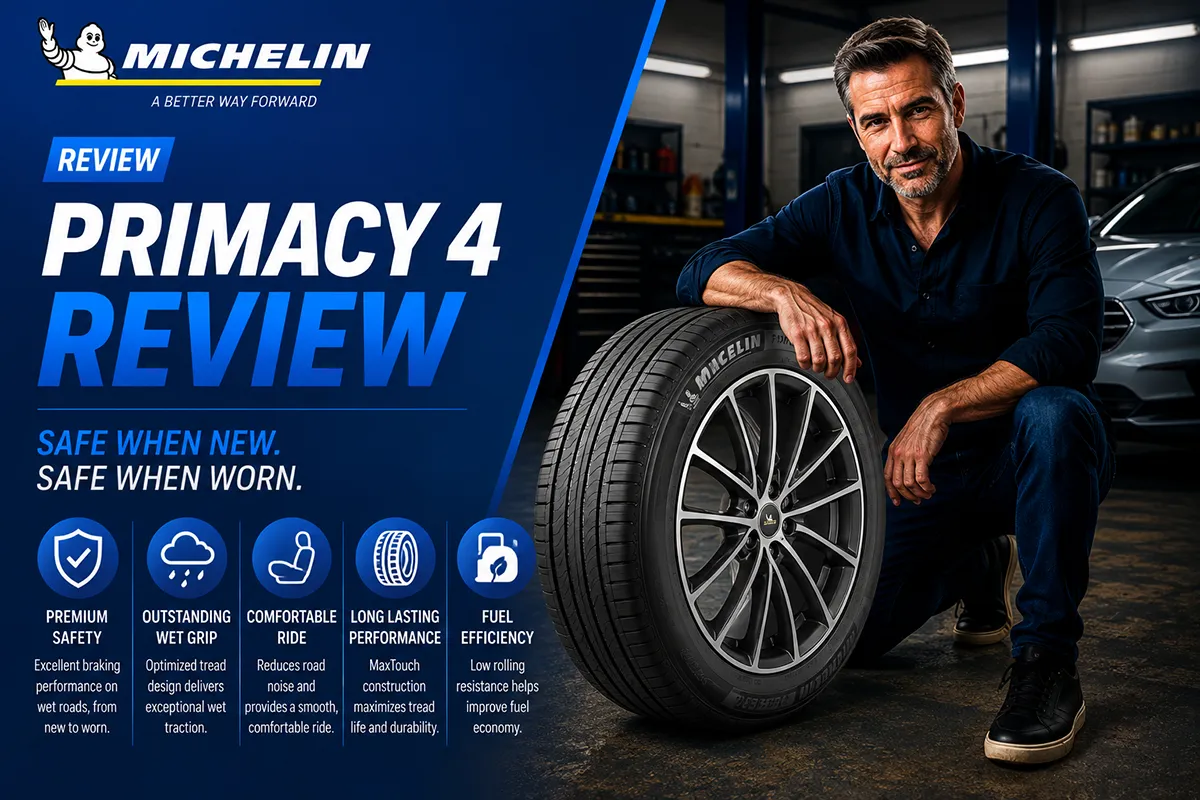
The Michelin Primacy 4 launched in 2018 as the successor to the widely popular Primacy 3, and it quickly became one of the most-recommended premium touring tires on the market — an ADAC 2020 Summer Test Winner, tested more than 30 times by independent publications, with 8 outright test wins.
Here’s what most reviews of this tire don’t make clear, though: Michelin has since released two newer generations. The Primacy 4+ arrived in 2023, and the Primacy 5 followed in 2025. If you’re shopping for a “Primacy 4” today, there’s a real chance a newer option is a better fit — or that the plain Primacy 4 remains genuinely available and still the smarter buy for your specific situation.
This review is based on manufacturer specifications, aggregated professional test data, and real owner reports — not a single set of personal impressions.
- What it is: A premium summer touring tire built around comfort, safety, and long-term wet braking consistency — not outright sportiness.
- Real strengths: Excellent dry handling and braking, dependable wet braking that holds up as the tire wears, low rolling resistance, quiet and comfortable ride, strong tread life.
- Real weaknesses: Steering feel is relaxed rather than sharp, wet performance in deep standing water trails newer rivals, and it’s priced at a premium.
- The catch: Two direct successors now exist — the Primacy 4+ (2023) and Primacy 5 (2025) — each targeting different aspects of the original’s trade-offs.
- Bottom line: Still a genuinely strong, safety-focused touring tire, but check current-generation availability and pricing before assuming the plain Primacy 4 is Michelin’s best option in this category today.
Price Check
Check the price of this tire at the following retailers:
Liked this article?
Add TireAdvise as a preferred source so you see more of our tire reviews and guides on Google.
Two Newer Generations Already Exist — Here’s Why That Matters
This is the most important thing to know before buying, and it deserves to be addressed directly rather than mentioned in passing.
Michelin’s own naming makes the lineage clear: Primacy 3 (2016–2018), Primacy 4 (2019–2022), Primacy 4+ (2023–2025), and Primacy 5 (2025–present). The plain Primacy 4 sits two full generations behind Michelin’s current flagship touring tire.
Independent aggregated scoring from The Tire Lab illustrates an interesting, non-obvious pattern across these generations: the Primacy 3 and Primacy 4 both scored 8.5 in their system, the Primacy 4+ actually scored lower at 7.1, and the Primacy 5 scored highest at 8.6. That’s a genuinely useful, counterintuitive data point — the direct “+” refresh wasn’t a straightforward upgrade across every measured category, even though Michelin’s own marketing describes it as a comfort-and-longevity refinement.
The Primacy 4+ specifically targets comfort and mileage — Michelin’s own positioning emphasizes “outstanding mileage, low noise, and a smooth ride,” with independent testing confirming genuinely short braking distances and high durability, while flagging “aquaplaning reserves and wet grip” as merely “modest” relative to newer competitors.
The Primacy 5, as the newest entrant, currently holds the strongest aggregated score of the four generations, suggesting Michelin addressed more of the wet-performance trade-offs that both the Primacy 4 and 4+ carried.
The practical takeaway: the plain Primacy 4 hasn’t disappeared from the market, and it remains a genuinely capable tire — but anyone comparison-shopping should check whether the 4+ or 5 is available in their size and at a comparable price before defaulting to the older tire, since Michelin’s own newer engineering may deliver a better result for a similar cost.
What the Primacy 4 Actually Is
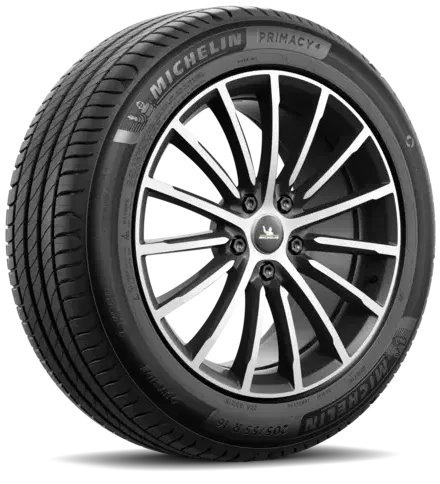
The Primacy 4 is a premium grand touring summer tire, positioned by Michelin around safety and longevity rather than outright performance. It debuted at the 2017 IAA International Motor Show as the successor to the Primacy 3, developed over roughly three years with a specific focus on wet-braking consistency across the tire’s entire usable life, not just when new.
It’s available across a genuinely wide size range — 123 sizes from 14-inch to 23-inch wheel diameters according to independent size-tracking data — covering everything from compact sedans to larger luxury vehicles and crossovers.
Michelin’s central engineering claim is that braking and grip performance shouldn’t degrade sharply as the tire wears, since most tire testing (and most marketing) focuses on new-tire performance while ignoring how a tire behaves after 20,000 or 30,000 miles.
Key Technology and Construction
EverGrip Technologies. This is the Primacy 4’s core engineering story. Michelin combined a new high-performance rubber compound with a safety-oriented tread sculpture that provides 22% more space to evacuate water even as the tire wears — directly targeting the common failure mode where a tire’s wet grip drops off sharply once tread depth decreases.
Less tapered, squarer grooves. Michelin states this design choice increases water-evacuation capacity by roughly 50% compared to more traditional groove shapes, contributing directly to the tire’s wet-braking consistency claims.
MaxTouch Construction. This distributes acceleration, braking, and cornering forces evenly across the contact patch, aimed at both longevity and consistent handling — a Michelin technology shared across much of its touring lineup, not unique to the Primacy 4 specifically.
2nd-generation Silent Rib Technology. A bridge structure between tread blocks reduces vibration transfer, aimed specifically at cabin noise reduction — a genuinely noticeable factor for owners upgrading from an older or lower-tier tire.
Independently verified worn-tire braking claims. In a notable Michelin-conducted test, a Honda Accord fitted with new Primacy 4 tires (8mm tread depth) and a second set worn to 2mm was compared directly against equally-sized new and worn tires from two competing brands during 80 km/h hard-braking tests. The Primacy 4 stopped 2.5mm shorter than competitors when new, and the gap widened to 5.1mm shorter when worn — with even the worn Primacy 4 braking 1.8mm shorter than the competitors’ factory-fresh tires. That’s a genuinely meaningful claim if it holds up broadly, since it directly addresses the “how does this tire perform after years of wear” question most tire marketing ignores.
Dry Performance
Independent aggregated testing consistently rates the Primacy 4 highly here. Tyre Reviews’ Bayesian-aggregated analysis — drawing on 30 independent professional tests — lists dry handling among the tire’s clear strong points, alongside wet braking, describing the tire’s overall approach as “balanced grip in the dry and wet, focusing on safety qualities rather than dynamic driving.”
ADAC’s 2022 16-inch SUV summer tire test specifically noted the Primacy 4 “achieved the second best result on dry roads,” a genuinely strong showing in a competitive field.
Real owner reports consistently describe smooth, predictable steering and confident straight-line stability, though several specifically note the tire feels “less responsive” than sportier alternatives — an expected, honest trade-off given the Primacy 4’s comfort-first positioning rather than a genuine flaw.
Wet Performance
This is where the Primacy 4’s story gets more nuanced than a simple “it’s great” or “it’s weak” verdict.
Wet braking is a genuine, well-documented strength. Tyre Reviews lists it explicitly among the tire’s strong points across the aggregated 30-test dataset, and Michelin’s own worn-tire comparison data (detailed above) directly supports this specific claim with real, independently reproducible test methodology rather than vague marketing language.
Deeper wet performance and aquaplaning resistance is more of a mixed picture. Owner-aggregated data notes “the main compromises are steering feel and wet performance in deeper water” — meaning the tire’s straight-line wet braking is genuinely strong, but its handling and grip margin specifically in standing water or heavy aquaplaning conditions is less class-leading. This is consistent with the pattern seen in the later Primacy 4+, which independent testing flagged for “limited aquaplaning resistance, especially in curved conditions” — suggesting this is a persistent characteristic of the Primacy architecture that Michelin has continued refining across generations rather than a one-off issue.
Ride Comfort and Noise
This is a consistently praised strength across every source reviewed. Real owner reports describe road noise as “significantly reduced” compared to previous tires, with several specifically noting rides feel like driving “a new car” after replacing worn or budget tires.
Tyre Reviews’ aggregated analysis lists “high levels of comfort and low noise” among the tire’s clear strengths, and this isn’t a marginal or subjective claim — it shows up consistently across dozens of independent tests and hundreds of owner reviews.
The 2nd-generation Silent Rib Technology appears to be doing real, measurable work here rather than functioning as marketing language without substance.
Longevity and Tread Life
This is arguably the Primacy 4’s single strongest, most consistently documented category. Owners rate the tire 8.2 out of 10 for wear across a sample of 159 aggregated reviews, with 66 of those reviews coming from owners past 10,000 miles.
Michelin’s own claim of roughly 20% more mileage and greater fuel efficiency than the previous generation is broadly supported by independent longevity data, and the tire is specifically marketed as delivering approximately 11,000 more miles than direct competitors according to retailer-sourced spec data.
Real-world experience is mixed at the edges, as it is for any high-mileage tire. Some owner reports describe reaching the full expected tread life without issue; others — including a small number of more serious complaints on Michelin’s own consumer feedback channel — describe sidewall cracking or uneven wear surfacing well before the expected mileage, in one case cited around 28,000–29,000 miles. These appear to be a minority pattern rather than the norm across the broader aggregated dataset, but they’re worth knowing about, particularly for owners who don’t maintain regular rotation schedules or who drive in climates with significant UV exposure.
Fuel Efficiency and Rolling Resistance
Independent testing consistently confirms genuinely low rolling resistance for the Primacy 4, and Tyre Reviews’ aggregated data specifically lists this among the tire’s strong points.
Real owner reports back this up with concrete numbers — one detailed review specifically cited a 1 liter per 100km reduction in fuel consumption after switching to this tire, a meaningful, tangible benefit for high-mileage drivers.
Pricing and Value
This is the Primacy 4’s most consistently cited weakness across every independent source reviewed. Tyre Reviews’ aggregated analysis explicitly lists “Price” as the tire’s singular clear weak point relative to the broader competitive field, and multiple other aggregators echo this, describing it as “relatively high” or noting it “cost a little more than some alternatives.”
That premium isn’t hidden or unexplained — it’s a direct trade-off for the tire’s longevity, comfort, and consistent wet-braking performance, and most owner reviews describe it as worthwhile given the total cost of ownership over the tire’s extended lifespan. But it’s a real factor for budget-conscious shoppers to weigh, especially now that Michelin’s own newer Primacy generations may offer a more current value proposition at a similar price point.
Michelin Primacy 4 vs. Primacy 4+ vs. Primacy 5: What Actually Changed
Since these are the more relevant current comparisons for most shoppers, it’s worth laying out what’s genuinely different.
Primacy 4 (2019–2022). The original EverGrip-era touring tire, built around consistent wet braking across the tire’s life, strong dry handling, and genuine longevity. Still widely available and still a capable, well-tested option.
Primacy 4+ (2023–2025). Michelin’s direct refinement, emphasizing “outstanding mileage, low noise, and a smooth ride” with short braking distances. Independent testing confirms strong comfort, rolling resistance, and wear scores, but specifically flags “limited aquaplaning resistance, especially in curved conditions” and rates lower on overall value — interestingly, in The Tire Lab’s aggregated scoring, it actually finished behind the plain Primacy 4 (7.1 vs. 8.5), suggesting the refinement prioritized comfort and mileage at some cost to broader all-around performance.
Primacy 5 (2025–present). The current flagship, holding the highest aggregated score of the four generations at 8.6. As the newest entrant with the most current engineering, it represents Michelin’s latest attempt to balance the comfort-and-longevity strengths of the Primacy line with the wet-performance refinement that both the 4 and 4+ have shown room to improve.
The practical reality for most shoppers: if the Primacy 5 is available in your size at a comparable price to the Primacy 4, it’s likely the stronger overall choice based on current aggregated data. If it’s not available in your specific fitment, or if you find the plain Primacy 4 at a meaningfully lower price, it remains a genuinely well-tested, capable tire rather than an outdated one to avoid.
Who the Primacy 4 Still Makes Sense For
Owners who prioritize consistent wet braking above all else. The tire’s core engineering claim — that braking performance holds up as the tire wears rather than degrading — is genuinely well-supported by independent testing and Michelin’s own reproducible worn-tire comparison data.
High-mileage commuters and family-car owners. Strong tread life, low rolling resistance, and a comfortable, quiet ride make this a sensible default for daily driving and long highway trips.
Shoppers who find it at a meaningfully lower price than the 4+ or 5. As an older generation, the plain Primacy 4 sometimes clears at a genuine discount, and given its strong aggregated scoring, that can represent real value.
Who Should Look at the Primacy 4+ or Primacy 5 Instead
Owners in regions with frequent heavy rain or standing water. Given the documented, honest weak point around deep-water aquaplaning resistance, drivers facing genuine heavy-rain risk have a real reason to check whether the Primacy 5’s refined wet performance is available in their size.
Shoppers prioritizing the absolute latest engineering at a similar price. With the Primacy 5 now holding the strongest aggregated independent score across the whole lineage, there’s less reason to default to an older generation when the current one is priced comparably.
Owners who specifically want maximum comfort and the longest realistic tread life, and are willing to accept the Primacy 4+’s documented wet-weather trade-offs in exchange — a reasonable choice for drivers in consistently dry or moderate climates.
What Real Owners Say vs. What Test Labs Measure
There’s a genuinely useful pattern worth understanding before buying this tire, since owner sentiment and instrumented lab testing tell slightly different stories.
Aggregated owner data shows 66% of Primacy 4 owners say they would buy it again — a solid, though not overwhelming, repurchase rate for a premium-priced tire. Real owner reviews consistently praise the quiet ride, the smooth and predictable steering, and the confidence-inspiring wet-braking performance, with several specifically describing it as noticeably better than the tires it replaced.
Professional instrumented testing largely confirms this positive picture rather than contradicting it, which is itself worth noting — this isn’t a tire where casual owner enthusiasm outpaces what the lab data actually shows. Tyre Reviews’ aggregation across 30 independent tests puts the Primacy 4 at an average finish of 4th place with 8 outright test wins, a genuinely strong, consistent result rather than an occasional standout in an otherwise average field.
Where the two sources diverge slightly is on value. Owners tend to frame the price as justified once they’ve experienced the tire’s longevity and comfort firsthand, while professional test panels comparing it head-to-head against a full competitive field at a single point in time are more likely to flag the sticker price as a standalone weakness, since a test panel doesn’t get to experience 30,000 miles of accumulated value the way an actual owner does.
How the Primacy 4 Stacks Up Against Non-Michelin Rivals
Positioned honestly, the Primacy 4 competes directly against tires like the Bridgestone Turanza T005, Continental PureContact LS, and Goodyear Assurance MaxLife in the premium touring category — and it holds up well in that company.
In the ADAC 2020 Summer Test that the Primacy 4 won outright, it beat a genuinely competitive field rather than an easy one, which is part of why the win carries real weight in the tire’s reputation. In at least one other independent comparison referenced in aggregated testing, the Bridgestone Turanza T005 edged out the Primacy 4 for the top spot, a reminder that no touring tire wins every single test and that the competitive gap at the top of this category is often narrow.
The honest summary: the Primacy 4 isn’t uniquely dominant in every category, but it’s remarkably consistent — an 8-time test winner across 30 independent tests is a genuinely strong track record that few competitors in this price bracket can match, even accounting for the newer generations that have since arrived to build on that foundation.
Frequently Asked Questions
Is the Michelin Primacy 4 still a good tire in 2026?
Yes, with an important caveat. It remains a genuinely well-tested, capable premium touring tire with real strengths in dry handling, wet braking consistency, comfort, and longevity. But Michelin has released two newer generations since — the Primacy 4+ (2023) and Primacy 5 (2025) — so it’s worth checking whether either is available in your size at a similar price before defaulting to the original.
What’s the difference between the Michelin Primacy 4 and Primacy 4+?
The Primacy 4+ emphasizes comfort, low noise, and mileage, with independent testing confirming strong wear and rolling-resistance scores. However, it specifically shows more limited aquaplaning resistance in curved conditions, and interestingly scored lower than the original Primacy 4 in at least one independent aggregated scoring system, suggesting the refinement traded some all-around performance for its comfort-and-longevity focus.
Is the Michelin Primacy 4 good in the rain?
It’s genuinely strong for straight-line wet braking, a specific, well-documented strength backed by independent testing and Michelin’s own reproducible worn-tire comparison data. Its weaker point is deeper aquaplaning resistance and wet handling in standing water, which trails some newer competitors and later Primacy generations.
How long does the Michelin Primacy 4 last?
Owners rate it 8.2 out of 10 for wear across aggregated reviews, and it’s marketed as delivering roughly 11,000 more miles than direct competitors. Most owners report reaching full expected tread life, though a minority report earlier issues like sidewall cracking, making regular rotation and proper inflation genuinely important for maximizing lifespan.
Is the Michelin Primacy 4 worth the price?
For most owners, yes — the price is the tire’s most consistently cited weakness in independent aggregated data, but it’s a direct trade-off for genuine strengths in comfort, longevity, and consistent wet braking. Budget-conscious shoppers should compare current pricing against the Primacy 4+ and Primacy 5, since Michelin’s newer engineering may offer better value at a similar cost.
What vehicles is the Michelin Primacy 4 designed for?
It’s built for mid-size sedans, luxury cars, and compact-to-midsize crossovers seeking a comfort-focused daily-driving tire rather than a performance tire. It’s available across roughly 123 sizes spanning 14- to 23-inch wheel diameters, covering a wide range of mainstream and premium vehicles.
Does the Michelin Primacy 4 replace the Primacy 3?
Yes. The Primacy 4 launched in 2019 as the direct successor to the Primacy 3, which remains a separate, older tire. Independent aggregated scoring shows both generations scoring similarly overall, though the Primacy 4 incorporated Michelin’s newer EverGrip technology specifically targeting consistent wet-braking performance as the tire wears.
