

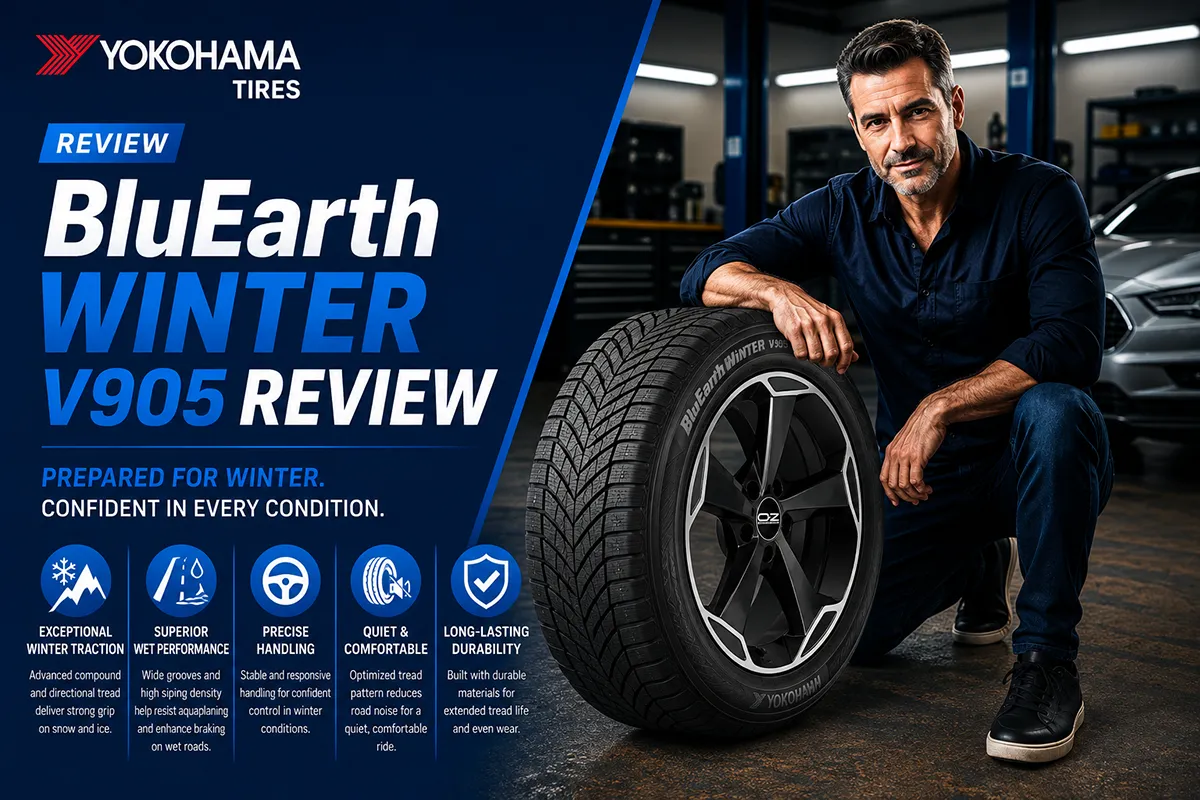
The Yokohama BluEarth Winter V905 has been a fixture in budget-to-mid-range winter tire shopping since it launched for the 2017–2018 season. It’s still sold today, still 3PMSF-certified, and still shows up as one of the cheapest winter options at major retailers.
But here’s what most reviews of this tire don’t tell you clearly: Yokohama replaced it with the BluEarth Winter V906 back in 2020, specifically to fix the V905’s two documented weak points. This review covers what the V905 actually does well, where independent testing shows it falls short, and whether it’s still the right buy in 2026.
This is based on manufacturer specifications, aggregated professional test data, and real owner reports — not a single set of personal impressions.
- What it is: A budget-to-mid-range winter touring tire, 3PMSF-certified, available in a huge size range (195–325mm width, 15–22 inches).
- Real strengths: Strong snow traction, confident subjective wet handling in owner reports, competitive pricing, quiet for a winter tire.
- Real weaknesses: Below-average ice braking and ice traction in independent testing, subpar wet-grip scores relative to newer rivals, no treadwear warranty.
- The catch: Yokohama’s own V906, launched in 2020, was built specifically to fix the V905’s wet-grip and winter-grip weaknesses.
- Bottom line: A reasonable value pick for moderate winter climates on a budget — but check whether the V906 is available in your size before buying, since it directly addresses this tire’s known gaps.
Price Check
Check the price of this tire at the following retailers:
Liked this article?
Add TireAdvise as a preferred source so you see more of our tire reviews and guides on Google.
A Genuine Successor Already Exists — Here’s Why That Matters
This is the single most important thing to know before buying a V905, and it’s worth addressing up front rather than burying it in a footnote.
Yokohama itself announced the BluEarth Winter V906 in 2020, explicitly describing it as an improvement over the V905 in “two key areas considered important for winter tires by European and American drivers — performance on snow and ice and wet-grip performance.” That’s not marketing spin pulled from a random retailer page; it’s the language from Yokohama’s own official product launch.
This matters because those two areas — ice performance and wet grip — are exactly where independent, aggregated testing shows the V905 struggling relative to its era’s competitors. Yokohama built a direct answer to its own tire’s documented weaknesses.
The V906 uses a newly developed “super-rich silica compound” for wet grip, plus a Harmony Tread Design with what Yokohama calls Uniform Pressure Blocks for more consistent winter grip, while aiming to maintain the V905’s wear resistance and pricing position.
The practical takeaway: the V905 hasn’t vanished from the market — it’s still sold in a wide size range and remains a genuinely reasonable budget option — but anyone cross-shopping should at minimum check whether the V906 is available in their size before committing, since it was built to directly fix this tire’s known gaps.
What the V905 Actually Is
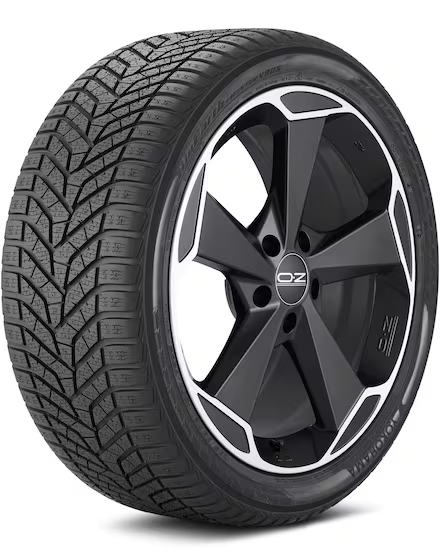
The BluEarth Winter V905 is a directional, silica-compound winter touring tire, originally developed for the European market and built on the tread architecture of the well-regarded Yokohama W.drive V905, which scored well in German ADAC testing years before the BluEarth version launched.
It carries the 3-Peak Mountain Snowflake (3PMSF) certification, meaning it’s passed the industry’s severe snow traction standard rather than merely claiming winter capability. It’s marketed toward performance cars, sedans, and crossovers rather than heavy-duty trucks — Yokohama offers separate SUV-focused winter lines for that use case.
Construction-wise, it uses a two-ply polyester casing for a balance of ride comfort and durability, with two wide steel belts reinforced by a nylon cap ply for handling responsiveness and higher-speed capability than many winter tires attempt.
Key Technology and Construction
End-Locked silica compound. Yokohama’s compound is infused with orange oil, a formulation intended to improve high-temperature stability while retaining low-temperature flexibility — the core challenge every winter tire compound has to solve, since rubber that’s soft enough to grip ice can turn to mush the first warm day of March.
Triple 3D sipes. Every tread block is cut with three-dimensional sipes that interlock during flex, creating additional biting edges for ice and snow traction while helping maintain block rigidity during hard cornering or braking.
Directional tread with wide slanting grooves. The tread pattern is engineered to evacuate water and slush quickly from the contact patch, aimed at reducing hydroplaning risk — a real consideration for a winter tire, since slush-covered roads combine both traction demands at once.
High rigid bead filler. This is aimed at steering response and handling precision, an area where softer winter compounds often feel vague compared to summer or all-season rubber.
Snow wear bars. A useful, practical touch — these visual indicators show not just how much tread remains, but at what point the tire has worn past the depth needed for genuine winter effectiveness, distinct from the legal minimum tread depth.
Dry Performance
Real owner reports, including a detailed long-term account from a BMW X5/X6 owner running a staggered 20-inch setup, consistently describe the V905’s dry handling as “very good” for a winter tire — composed cornering, adequate stability at speed, with steering response described as “a little lacking” compared to a genuine all-season performance tire like the Continental ExtremeContact DWS06 Plus, which the same owner had used previously.
That’s a reasonable, expected trade-off. Winter tire compounds are fundamentally softer than all-season or summer rubber to stay flexible in the cold, and that softness costs some steering precision on dry pavement. The V905 isn’t uniquely weak here — it’s simply behaving like a winter tire.
Wet Performance: The Documented Weak Point
This is where independent, aggregated testing tells a more cautious story than casual owner impressions might suggest.
TireScouter’s expert scoring rates the V905’s wet grip at 5.5 out of 10, describing it directly as “subpar” and flagging it as “a concern for those facing frequent winter rain or slush.”
Tyre Reviews’ Bayesian-aggregated analysis, drawing on seven independent professional tests, similarly lists wet performance among the tire’s relative weaknesses compared to category leaders, even while noting that subjective owner-reported wet handling tends to run more positive.
That gap between owner sentiment and lab-measured performance is worth taking seriously. Individual drivers rarely have a direct back-to-back comparison to reference, while professional test tracks measure wet braking distances and lateral grip against a controlled field of competitors.
The instrumented data consistently shows this as a real area where the V905 trails newer winter tires — which lines up exactly with why Yokohama specifically targeted wet-grip improvement when it developed the V906.
Snow and Ice Performance: Strong in Snow, Weaker on Ice
Snow traction is a genuine strength. TireScouter scores the V905 at 8 out of 10 for snow traction, and Tyre Reviews’ aggregated data lists snow traction among the tire’s clear strong points across multiple independent tests.
Real owner reports back this up. The same long-term BMW owner, who had prior experience with Bridgestone Blizzaks and the Pirelli Scorpion Ice & Snow, described the V905 as “as good as the others” in direct snow-driving comparison across roughly 5,500 miles of mixed winter conditions.
Ice is a different story. Tyre Reviews’ aggregated scoring specifically flags ice braking and ice traction as weak points relative to the competitive field, and TireScouter’s separate ice score of 46 out of 100 — with an owner-rated 8.5 out of 10 from a smaller sample — highlights a real gap between professional instrumented testing and casual owner perception on pure ice.
The practical takeaway: this tire handles snow-covered roads with real confidence, but drivers in regions with frequent black ice or sustained sub-freezing glaze conditions should weigh this limitation seriously, and it’s specifically one of the two areas Yokohama targeted for improvement in the V906.
Ride Comfort and Noise
Owner reports consistently describe the V905 as comfortable and reasonably quiet for a winter tire — not silent, but not noticeably worse than typical winter rubber on asphalt or concrete. The same detailed BMW owner review specifically noted it wasn’t “any noisier than other tires on concrete,” a fair benchmark given how much road-surface texture affects perceived winter tire noise.
The tire’s compound runs noticeably softer than summer or all-season options, which owners consistently describe as a comfort benefit — a more compliant, absorbent ride over rough or frost-heaved pavement, a real seasonal advantage in regions where winter roads take a beating.
Fuel Efficiency and Rolling Resistance
Yokohama designed the V905 with two slim, rigid steel belts specifically to reduce weight and lower rolling resistance, aiming for a genuine fuel-economy benefit relative to older or heavier winter tire constructions.
Independent aggregated testing complicates that claim somewhat. Tyre Reviews’ data lists rolling resistance among the tire’s weaker relative scores across the tested field, suggesting the real-world efficiency benefit may be more modest than the marketing copy implies — a fair, honest caveat rather than a dismissal of the underlying engineering intent.
Tread Life and Warranty
This is a straightforward, important gap: the V905 doesn’t carry a manufacturer treadwear warranty. TireScouter flags this directly, noting that buyers need to budget for eventual replacement without a mileage-based safety net most all-season tires include.
That’s not unusual for winter-specific tires generally — treadwear warranties are less common in this category since winter tires are meant for seasonal use rather than year-round mileage accumulation. But it’s worth knowing going in, especially for owners comparing this tire against options that do offer warranty coverage.
Real owner reports don’t describe unusually fast wear, and Tyre Reviews notes a real “data discrepancy” between professional test-measured mileage projections and owner-reported experience — a roughly 41% difference — which the site attributes to the genuinely wide range of driving conditions and climates V905 owners report from.
That gap is worth keeping in mind as a reminder that any single number quoted for expected tread life should be treated as a rough estimate rather than a guarantee, since winter driving conditions vary so widely between a mild coastal climate and a harsh inland one.
Pricing and Value
The V905 consistently prices as one of the more affordable options in the winter tire category. One detailed BMW owner account specifically noted choosing the V905 partly because it was “the cheapest choice” available at the time on Tire Rack for a staggered 20-inch setup, coming in just over $1,000 for a full set with free shipping — a genuinely competitive price point for that wheel size.
Current retail pricing varies meaningfully by size — smaller, common passenger sizes run considerably less than the larger, performance-oriented fitments like 265/35R18 or 325/30R21, which can run $300-plus per tire given their extra-load ratings and lower profile.
Yokohama BluEarth Winter V905 vs. V906: What Actually Changed
Since the V906 is the more relevant current comparison for most shoppers, it’s worth laying out concretely what changed.
Wet grip. The V906 uses a newly formulated super-rich silica compound specifically engineered to improve wet-surface performance — directly targeting the V905’s documented weak point. EU tire label data shows this reflected in practice: the majority of V905 sizes carry a “C” wet-grip rating, while the majority of V906 sizes carry the meaningfully better “B” rating.
Snow and ice grip. The V906’s Harmony Tread Design and Uniform Pressure Blocks aim to deliver more consistent grip specifically on winter surfaces, again targeting the V905’s second identified weak point.
Tread life. Yokohama states the V906 maintains a high level of wear resistance while improving those two performance areas, rather than trading longevity away for the gains.
Size availability. The V905 remains available in a notably wider range — 152 sizes spanning 195–325mm width and 15–22-inch wheels, compared to a narrower initial V906 lineup. This is a real, practical reason some shoppers still end up with a V905: it may simply be the only one of the two available in their specific fitment.
Independent test standing. AllTyreTests’ aggregated data on the V906 shows an overall rating around 90.5% across 41 measurements from four independent tests, a genuinely strong showing that supports Yokohama’s claimed improvements rather than treating them as unverified marketing.
Who the V905 Still Makes Sense For
Budget-conscious buyers in moderate winter climates. If winters bring regular snow but not sustained, severe ice, the V905’s real snow-traction strength and competitive pricing make it a reasonable, defensible choice.
Owners needing an uncommon size. With the V905 still covering a wider size range than the V906, some owners — particularly those running larger performance wheels — may not have a V906 option available at all.
Owners prioritizing ride comfort and quiet. Real owner reports consistently praise this tire’s comfortable, reasonably quiet character, a genuine benefit for daily winter driving.
Who Should Look at the V906 Instead
Owners in regions with frequent freezing rain or black ice. Given the V905’s documented ice-traction weakness — and that this is specifically what the V906 was built to fix — drivers facing genuine ice risk have a clear, direct reason to check V906 availability first.
Owners who drive frequently in winter rain or slush. The V905’s below-average wet-grip scoring is a real, measured gap the V906 specifically closes.
Anyone whose size is available in both. Given the V906 is a direct, purpose-built successor at a comparable position in Yokohama’s lineup, and independent testing shows it performing strongly, there’s little reason to default to the older tire when the newer one is available in the same fitment.
What Real Owners Say vs. What Test Labs Measure
There’s a genuinely interesting pattern worth understanding before buying this tire: owner sentiment and instrumented lab testing don’t always agree, and knowing why helps make sense of the mixed signals around this tire.
Aggregated owner feedback collected by Tyre Reviews describes drivers reporting “outstanding snow and ice traction, confident wet grip, and strong dry performance for a winter tire,” with many noting stable handling and braking, and several specifically praising durability and mileage. That’s a genuinely positive overall picture from the people actually driving on these tires day to day.
Professional instrumented testing tells a more measured story. The same aggregation notes that “professional tests are more reserved, showing weaker snow and ice results versus leading rivals,” summarizing the tire as “a capable mid-range winter option, though not the most consistent performer in severe winter conditions.”
This isn’t a contradiction so much as two different measurement standards. Individual owners are comparing this tire against their own past experience — often an older all-season tire, or a tire from years earlier — and against that baseline, the V905 genuinely feels like a major improvement in winter capability.
Professional test tracks compare it directly against the current competitive field using controlled, repeatable conditions, which is a much higher bar and a fairer way to answer “is this the best tire I could buy right now.”
The most-cited drawbacks in real owner feedback are higher road noise than expected, some softness or reduced precision in warmer or high-speed dry conditions, and a handful of reports of faster front-tire wear compared to premium rivals — all consistent with what a mid-tier, softer-compound winter tire would be expected to show.
How the V905 Stacks Up Against the Broader Winter Tire Field
Positioned honestly, the V905 sits in the mid-range of the winter tire category — not a budget-tier tire cutting corners on safety, but not a flagship performer chasing the top of every test chart either.
In Auto Bild’s 2019 winter tire test, the V905 finished in the “Satisfactory” tier, a reasonable but unremarkable result against category winners like the Continental WinterContact TS 860 and Dunlop Winter Sport 5, which finished in the top “Exemplary” bracket. That’s a fair, honest way to frame where this tire sits: solidly usable, but not table stakes for drivers who specifically want the best-tested option regardless of price.
Where it earns real credit is value relative to that mid-pack finish. Owners consistently report the V905 delivering genuine winter safety at a price meaningfully below flagship options from Michelin, Bridgestone, or Continental — a legitimate trade-off for budget-conscious buyers rather than a compromise that leaves them unsafe.
Frequently Asked Questions
Is the Yokohama BluEarth Winter V905 still a good tire in 2026?
It remains a reasonable budget-to-mid-range winter tire with genuine strengths in snow traction and comfort, but independent testing shows real weaknesses in ice traction and wet grip. Yokohama’s own V906, launched in 2020, was specifically built to address those two gaps, so it’s worth checking V906 availability in your size before buying a V905.
What’s the difference between the Yokohama BluEarth Winter V905 and V906?
The V906 uses a newly formulated super-rich silica compound for improved wet grip and a Harmony Tread Design intended to improve snow and ice performance — the two areas independent testing shows the V905 trailing in. EU label data confirms the improvement, with most V906 sizes rated B for wet grip versus C for most V905 sizes.
Is the Yokohama BluEarth Winter V905 good on ice?
It’s a genuine relative weakness. Independent aggregated testing consistently flags ice braking and ice traction as below-average compared to the broader winter tire field, even though snow traction scores well. Drivers in regions with frequent black ice or sustained icy conditions should weigh this carefully.
Does the Yokohama BluEarth Winter V905 have a treadwear warranty?
No. The V905 doesn’t carry a manufacturer treadwear warranty, which is common for winter-specific tires but still worth budgeting for, since replacement costs aren’t offset by mileage-based coverage.
What sizes does the Yokohama BluEarth Winter V905 come in?
It’s available in 152 sizes, spanning roughly 195–325mm in width and 15–22-inch wheel diameters, a notably wide range that still exceeds the V906’s initial size lineup in some fitments.
Is the Yokohama BluEarth Winter V905 good for performance cars and SUVs with staggered setups?
Yes, with real owner experience to support it — one detailed long-term review comes from a BMW X5/X6 owner running a staggered 20-inch setup with strong results in snow, adequate dry handling, and a comfortable, reasonably quiet ride, though with the same wet-grip caveats noted throughout independent testing.
How does the Yokohama BluEarth Winter V905 compare to Bridgestone Blizzak tires?
Real owner comparisons, including a direct account from a driver with prior Blizzak experience, describe the V905’s snow performance as comparable — “as good as the others” — while independent testing suggests dedicated Blizzak options may hold an edge specifically in ice-braking performance, an area where the V905 scores below average.
